Global | EN
Let’s talk
Preview mode: every page is below, so you can scroll through all of it. Tap a link to jump. For the planner and hiring advisor, tap Share and open this file in Safari or Chrome.

01Customer experience

Move off C4C V1 without losing a quarter

Sales Cloud V2, Service Cloud V2, Commerce Cloud, CPQ and Engagement Cloud, running on the same data as S/4HANA.

Proof One SAP Commerce template rolled out to 21 countries for a global manufacturer.

C4C V1 → Sales Cloud V2✓ Accounts reconciled · 0 variance✓ Open cases moved with history◷ Cutover wave 2 · EMEA

02Finance and core

Close faster. Collect sooner.

S/4HANA finance, FSCM credit and collections, and a payment factory connected to your banks.

Proof Touchless invoice processing: cost per invoice down from $12 to $3.

Invoice INV-4711✓ Captured by AI · 0 errors✓ Matched to PO and goods receipt✓ Posted in S/4HANA · 1m 48s

03Data & AI readiness

Good AI starts with clean data

Assess, cleanse, match and harmonise your business data before go-live, then let AI use it.

Proof Illustrative: 15 supplier records become 5 governed SKUs, with nothing deleted.

Duplicate checkHead Lamp · Front Lamp · HL Assy→ OEM-EL-100045 · 97% match◷ Steward approval

04AI Value-to-Autonomy

From assist to autonomous, one level at a time

Assist, recommend, execute, orchestrate, then act inside guardrails your business sets.

Proof Six levels of autonomy, each with its own KPI and the person’s role written down.

Autonomy levelL3 · Execute · 88% straight-through

05Security and GRC

Prove who can do what in SAP

Access requests, segregation-of-duties checks and firefighter access, embedded in S/4HANA on the standard SAP ruleset.

Proof A standard Phase 1 runs about nine weeks with a small remote pod.

Access request · AP invoice role1 conflict · create and pay supplier✓ Role owner saw the risk◷ Firefighter log review due

06Multi-country rollout

Build once. Go live everywhere.

One global template, regional layers and country localisation, delivered in waves by local teams.

Proof Live in 9 and 21 countries for global manufacturers.

Rollout wavesINSGAEUKDEUSCAJP◷ Wave 3 · Americas

07Specialist talent

The right SAP and AI people, on compliant local contracts

W-2, 1099 and C2C in the USA, IR35-aware in the UK, AÜG-aware in Germany, and Deel wherever we have no entity.

Proof Only about 7 in 100 applicants reach a client after ten vetting stages.

Senior SAP EWM consultant✓ Technical interview passed✓ Architect approved◷ Contract via Deel · Germany

08Managed services

Keep SAP running, and better every release

L1 to L4 application support, monitoring and a standing improvement team, under SLAs.

Proof Root causes fixed in the next release instead of closing the same ticket every week.

Ticket INC-20931Repeat issue · 6th this month✓ Root cause fixed✓ Shipped in release 24.3

09Business services & GCC

Run the back office at outcome-level SLAs

Finance, procurement, HR and logistics operations, or a capability centre we build, run and transfer to you.

Proof From time-and-materials to outcome-based managed services in five steps.

Operating model✓ Build · Operate◷ Transfer · Q3Scale to 2 more functions

Certified and trusted

Quality, security and delivery maturity, independently certified.

Trusted by global customers

  • Bosch
  • Nestlé
  • Samsung
  • Tredence
  • Goodyear
  • EmbitelA Volkswagen Group company

Meet the people behind PGC Digital

Sappy introduces our leadership team

Sappy says

Meet Vinod, our Chairman and Managing Director. Strategy, technology, SAP and global growth.

Full board and leadership →
  • Vinod Kumar BeliChairman and Managing Director
  • Geeta AriWhole-time Director
  • Arun KohliNon-Executive Director · Regional Sales, Asia, Middle East & UAE
  • Sanjay VaidyaFinancial Advisor
  • Sunil KumarChief Financial Officer
  • Ravikumar BeliChief Technology Officer
  • Puneeth Kumar T RSenior Director · Delivery
  • Divya MarigowdaSenior Director · Delivery
  • Anupam MajumdarSenior Director · APJ & EMEA

Data & AI services · the SAP + Data + AI company

Your SAP data, turned into decisions people trust.

We bring SAP and non-SAP data into one governed platform, build AI that reaches production, and run it for you. Three services, used together or on their own.

Your data: SAP, CRM, MES, filesData FactoryAI FactoryDigital OpsBetter decisions

01 · PGC Data Factory

Get the data right

One trusted version of customers, products, suppliers and orders, from SAP and every other system.

What we deliver · click to explore

Built onSnowflake · Databricks · Microsoft Fabric · SAP Datasphere · SAP MDG

02 · PGC AI Factory

Turn data into decisions

Forecasts, plain-language answers and AI agents that your teams use every day, with a person approving.

What we deliver · click to explore

Built onSnowflake Cortex · Databricks Mosaic AI · Azure ML · SAP Joule

03 · PGC Digital Ops

Run it every day

Dashboards, copilots and a team that keeps pipelines, models and costs healthy after go-live.

What we deliver · click to explore

Built onPower BI · SAP Analytics Cloud · managed services on AWS, Azure, Google Cloud

Not sure where to start? Tell us one decision you want to make better.Talk to a Data & AI leadFind your path by roleSee a real case: supply chain control tower

Insights and case studies

Browse by business topic, read what applies to you

65 field guides, playbooks and customer stories on SAP CX, migration, AI, data and operations. Each one links to the service behind it.

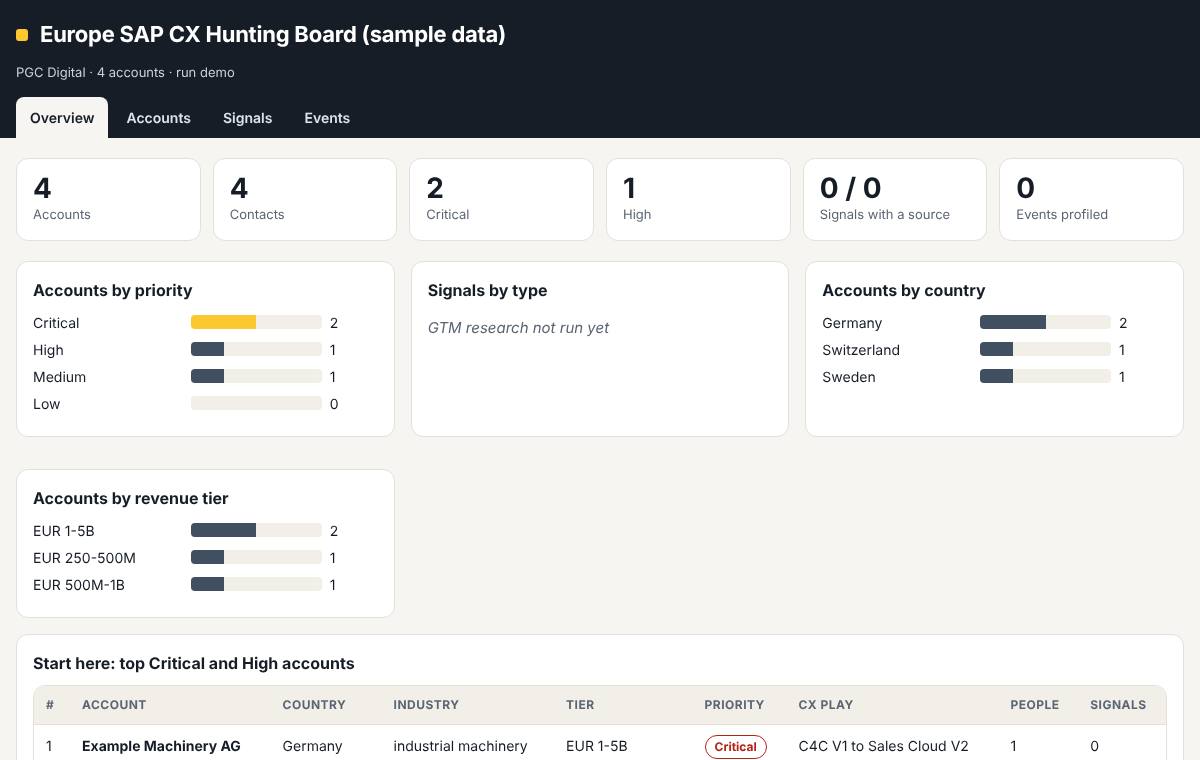
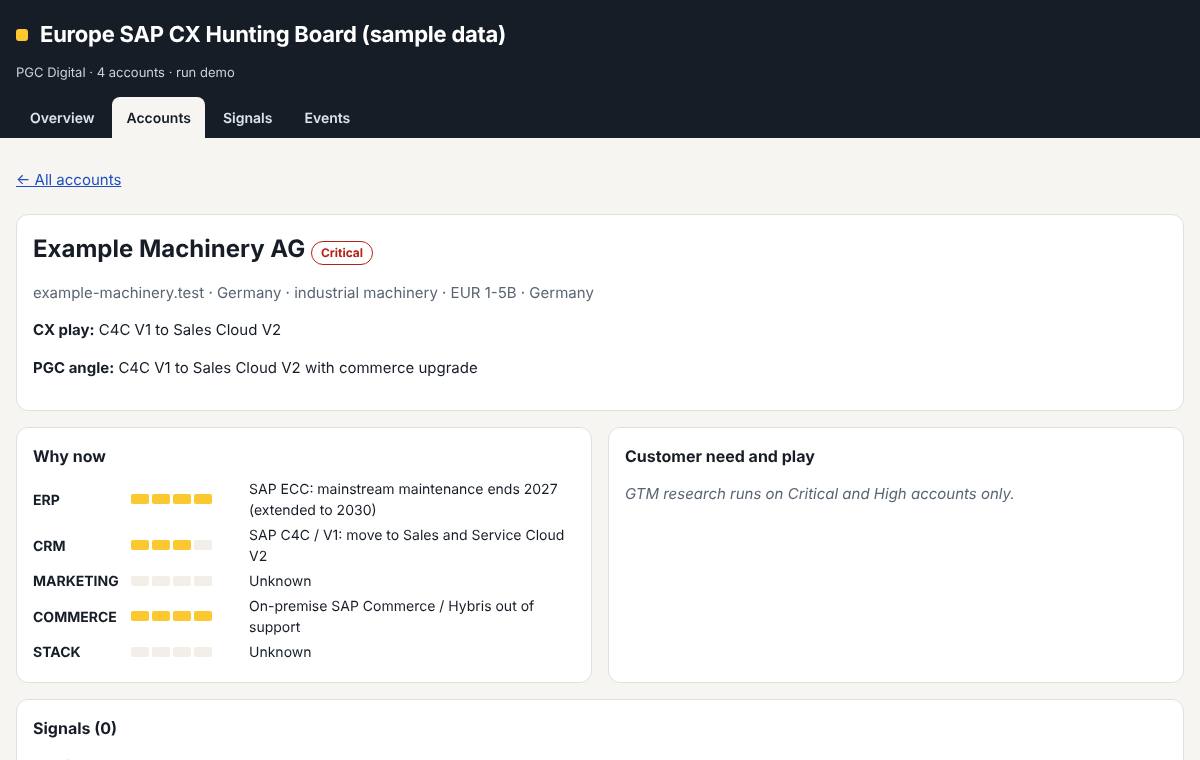
TrendingFrom 200 names to a ranked SAP CX hunting board: how four Claude skills and 11 research agents run our GTMA spreadsheet of target companies becomes a board that says who to call, why now and what to offer, with every fact sourced and every credit approved. The story, the…SAP CX4 min read →Setup guide · downloadsInstall the GTM skills in 15 minutes: downloads, prompts and the first hunting boardDownload the four skills, upload them to Claude, test the connectors, then run a 10-account pilot and the full Europe or USA & Canada board, session by session.SAP CX9 min read →Under the hoodInside the GTM skills: briefs, waves, the retry loop and urgency scoringWhat each of the 11 briefs asks, how batches run in parallel waves, how merge and retry make the run reliable, and the rules that turn findings into Critical, High,…SAP CX4 min read →Pillar guideHow we changed global hiring: a $17 Claude seat, the right connectors and one funnelWhat changed in PGC Digital’s recruitment when every recruiter got Claude with out-of-the-box connectors for sourcing, enrichment, calendars, CRM and WhatsApp, on top…4 min read →Pillar guideUnlock the power of manufacturing data: from data silos to an AI-powered value chainWhere your plants are on the journey from fragmented data to automated decisions, what each stage costs and takes, and the team that moves you to the next one. With…Data & AI6 min read →InfographicInside one SAP sales order: every deduction from list price to pocket priceOne product, €499 list, sold to a dealer at €340. A mock S/4HANA sales order with its pricing conditions, every on- and off-invoice deduction, and how the pricing…SAP CX10 min read →

See all 65 insights and case studies →

SAP CX & Commerce · Sales, service, commerce and engagement on one customer record

See all 11 in SAP CX & Commerce →

Pricing & revenue · B2B, B2C and D2C pricing, rebates, price rules, AI pricing engines and SAP integration

InfographicInside one SAP sales order: every deduction from list price to pocket priceOne product, €499 list, sold to a dealer at €340. A mock S/4HANA sales order with its pricing conditions, every on- and off-invoice deduction, and how the pricing…SAP CX10 min read →Pillar guidePricing is a CX pillar: one price truth for B2B, B2C and D2C on SAPCustomers judge you on the price they see, the price they pay and the rebate they were promised. Here is how to make all three agree, across every channel, on SAP.SAP CX4 min read →InfographicFrom web shop to pocket price: how SAP Commerce, S/4HANA, SAP CPQ and a pricing engine form one value chainOne price, followed step by step: decided in Conga (PROS B2B) or Pricefx, executed in S/4HANA, quoted in SAP CPQ, sold in SAP Commerce Cloud, and learned from. With…SAP CX11 min read →InfographicOne product, seven channel prices: follow ₹4,999 from web shop and store to modern trade and general tradeWeb, BOPIS, brand store, store-assisted orders, modern trade, general trade and mall stores each take a different cut. Bar charts of where the money goes, the system…SAP CX9 min read →Decision guideSAP ERP pricing, SAP CPQ, a CAP service or a third-party engine: what each does, where it stops, and when you need all of themS/4HANA executes prices well. Quotes, optimisation and special rules are where it stops. A plain-words guide to the four options and the architecture that uses them…SAP CX6 min read →Field guideAI-driven pricing by industry: which third-party engine fits, and how it connects to SAPConsumer appliances, CPG, chemicals, industrial, distribution, life sciences and retail buy pricing software for different reasons. A vendor map with the SAP…SAP CX4 min read →

See all 11 in Pricing & revenue →

Migration & upgrades · C4C V1 → V2, Marketing Cloud → Engagement Cloud, ECC → S/4HANA

See all 11 in Migration & upgrades →

AI & Joule · What SAP Business AI costs, where it pays, and how far it can run on its own

GTM with Claude skills · Hunting boards, research agents and downloadable Claude skills for SAP CX go-to-market

Talent acquisition & AI · How we hire globally with Claude, connectors, LinkedIn, Zoho and WhatsApp: funnel, KPIs and playbooks

Pillar guideHow we changed global hiring: a $17 Claude seat, the right connectors and one funnelWhat changed in PGC Digital’s recruitment when every recruiter got Claude with out-of-the-box connectors for sourcing, enrichment, calendars, CRM and WhatsApp, on top…4 min read →Setup guideSet up Claude for recruiting in one day: the complete playbook with promptsPlans, connectors, a hiring project, a prompt library for every funnel stage, a recruiter’s daily routine, guardrails and a 30-60-90 rollout.5 min read →Field guideOut-of-the-box Claude connectors for hiring: the list, what each one does and when to add itSourcing, enrichment, email and calendar, documents, CRM, job boards, scheduling, signatures and WhatsApp: the connectors a global recruiting team actually uses, and…5 min read →ScorecardThe global hiring funnel: KPIs and KRAs that make a recruiting team predictableEight funnel stages, twelve KPIs with formulas and targets, and the key result areas for sourcers, recruiters, campaign managers and talent leads.3 min read →PlaybookCandidate campaigns that people answer: LinkedIn, Zoho Campaigns and WhatsApp, run with ClaudeA multi-channel cadence with consent built in: who gets which message, on which channel, when, and how Claude prepares, personalises and measures it while recruiters…3 min read →ComparisonApollo.io, Lusha or ZoomInfo: which contact database for which hiring marketPublished database sizes, country and regional coverage, and a simple test that shows which tool really finds your candidates in India, South-East Asia, the Gulf and…3 min read →

Manufacturing data & AI · From data silos to an intelligent factory and an AI-powered, automated value chain

Data & AI · Governed SAP data on Snowflake and Databricks, master data and control towers

Guided journey · with Sappy

Find your path in three steps

Tell Sappy what you want to improve and where you are today. You get the offering that fits, a case study, something to read and the next step.

Talk to us

Tell us what you want to fix. We reply with a plan.

One short form for any service, offering or case study. A named person from the right team replies.

Discovery callAssessmentPilot or proof of conceptStatement of work

↑ Back to all pages

Home · Journeys

Every way in

All journeys, by who you are

Nine starting points. Each one takes you through the pages that answer your first questions, in order.

Not sure where to start?

Ask Sappy from the button in the corner, or send us one line about what you need.

↑ Back to all pages

Home · Multi-country rollout

Global template · regional layers · country localisation

Roll out once, go live everywhere

Most of the solution is built once in the global template. Regional templates and country localisation add only what differs, so each new country goes live faster than the last.

How the template works

Three layers, one design authority

Global templateData model · catalogue structure · pricing framework · checkout · S/4HANA integration · security · design system
Regional templatesLanguages · currencies · tax engines · payment providers · regional fulfilment
Country localisationLegal content · local payments · logistics partners · country catalogue and prices

Each country's change requests go through template governance, so the core stays upgradeable.

The rollout factory

Wave plan by region and readinessReusable test packs and cutover runbooksCountry onboarding kitHypercare, then handover to run

Rollout planner

Pick your countries

The planner needs JavaScript. Open this page in a browser to group your countries into waves.

A planning aid, not a quote. Wave order, dates and team sizes are agreed with you in discovery.

Multi-country rollout

Send me your list of countries. I will show you the waves, the team that governs each one and how we contract locally.

Vinod Kumar BeliChairman and Managing Director · SAP CX · PGC Digital

+1 (732) 784-4063+44 07861 958510+91 81054 78242Vinod.b@us.pgcdigital.aiVinod.b@in.pgcdigital.aiLinkedIn ↗

Turn the waves into a plan

Send us the countries and scope. We come back with a wave plan, the governing team per region and the contracting route for each country.

↑ Back to all pages

Home · Countries

Local teams · local contracts

Where we work, and who you meet

Each country page names the team, the services offered there, the ways we can engage people locally, and the payroll and compliance route.

↑ Back to all pages

Home · Countries · United States

Americas · Incorporated entity

United States

Sales and customer governance for North America.

Entity · PradeepIT Global Consulting (America) Inc.Base · St. Petersburg, Florida
St. Petersburg, FloridaUTC−5--

Your team in USA

People you will work with

Yuvraj ThombreSenior Vice President, USABusiness development for SAP CX, SAP HXM and SAP ERPLinkedIn ↗
Ram KrishnamaniAdvisor · PGC Digital USASAP ERP and finance transformation for CFO-led programmesLinkedIn ↗
Raj JagaliLife Sciences · PGC Digital AmericaRegulated lab and quality systems: LIMS, TrackWise, QC labsLinkedIn ↗
Karthik IyerT&M and Managed ServicesSAP and technology talent and long-term managed servicesLinkedIn ↗
Nayana GawdeConsultant · US accountsS/4HANA, BI and CXO dashboarding

Services offered here

Common services, local focus

Life sciences work starts where our leaders are based: Greater Boston (Cambridge, Seaport, Longwood, Lexington, Waltham) and the I-270 corridor in Maryland (Rockville, Gaithersburg, Germantown).

SAP CXSales, service and commerce, including C4C V1 to Sales & Service Cloud V2
SAP HXMSuccessFactors, from core HR and payroll to talent and recruiting
SAP ERPS/4HANA with finance depth: Central Finance, readiness and CFO-led transformation
Life SciencesPharma and biotech: LIMS, TrackWise and QC lab systems alongside SAP
T&M and Managed ServicesSAP and technology talent, and managed services run from India and Vietnam

All services →

Hiring and engagement models in USA

How people can work on your programme

ModelWhat it meansWho employs or contractsBest for
W-2 employeeOn our US payroll. We withhold federal and state income tax and FICA, pay employer taxes and offer benefits under our plans.PGC Digital AmericaLong engagements, client wants one accountable employer
1099 independent contractorSelf-employed consultant who handles their own taxes and is paid on Form 1099-NEC. Classification is checked against IRS common-law rules and state tests such as California’s ABC test.The consultantShort, defined work where the consultant controls how it is done
C2C (corp-to-corp)The consultant’s own LLC or corporation invoices us; we invoice you under one MSA.The consultant’s companyIncorporated specialists and niche skills
C2H (contract-to-hire)Starts on contract, converts to your payroll on agreed terms.Us, then youYou want to test fit before a permanent hire
Managed services / ODCAn outcome or SLA-based team run from India and Vietnam with US governance.PGC DigitalRun, support and continuous improvement

Local rules we plan around

  • Form I-9 employment eligibility checks for every employee, and E-Verify where a state or contract requires it.
  • Worker classification (W-2 vs 1099) is decided on the facts of control and independence, never on preference.
  • Visa-sponsored consultants are handled case by case with immigration counsel.
  • State payroll tax and paid-leave rules follow the state where the person works.

Payroll and compliance route

Our own entity

Where we have no entity, or a person sits in another country, onboarding, localised contracts, payroll and offboarding run through Deel, our global payroll and compliance partner. You still get one MSA and one consolidated invoice from PGC Digital.

How Deel fits →

General information to help you plan, not legal or tax advice. The right model is confirmed for each engagement with local advisers.

Talk to the USA team

Tell us the roles, the start date and how you want to engage. We reply with a proposal or matched candidates.

↑ Back to all pages

Home · Countries · Canada

Americas · Incorporated entity

Canada

Contracting and onshore support for Canadian clients.

Entity · PGC Digital Canada entityBase · Canada
CanadaUTC−5--

Your team in Canada

People you will work with

Yuvraj ThombreSenior Vice President, USABusiness development for SAP CX, SAP HXM and SAP ERPLinkedIn ↗
Karthik IyerT&M and Managed ServicesSAP and technology talent and long-term managed servicesLinkedIn ↗

Canadian engagements are run with our North America leadership. A named country lead will be listed here once confirmed.

Services offered here

Common services, local focus

Delivery runs from Bengaluru and Vietnam with an Eastern-time overlap for governance calls.

SAP CXSales, service and commerce on SAP
SAP ERPS/4HANA finance and logistics
Data & AISnowflake, Databricks and Power BI on SAP data
TalentSpecialists on compliant Canadian contracts

All services →

Hiring and engagement models in Canada

How people can work on your programme

ModelWhat it meansWho employs or contractsBest for
Employee (T4)On a Canadian payroll with CPP or QPP, EI and income tax withheld at source.Our Canada entity or DeelLong engagements
Independent contractorSelf-employed; status follows the CRA employee-versus-self-employed tests.The consultantDefined, independent work
Incorporated contractorThe consultant’s corporation invoices us. We check the arrangement does not look like employment.The consultant’s companyExperienced specialists
Contract-to-hireContract first, then conversion to your payroll.Us, then youTesting fit before a permanent role

Local rules we plan around

  • Quebec has its own pension plan (QPP) and language rules for workplace documents.
  • Employment standards (hours, holidays, termination) are set by each province.
  • Incorporated contractors who would otherwise be employees can fall under the personal services business rules.

Payroll and compliance route

Our own entity

Where we have no entity, or a person sits in another country, onboarding, localised contracts, payroll and offboarding run through Deel, our global payroll and compliance partner. You still get one MSA and one consolidated invoice from PGC Digital.

How Deel fits →

General information to help you plan, not legal or tax advice. The right model is confirmed for each engagement with local advisers.

Talk to the Canada team

Tell us the roles, the start date and how you want to engage. We reply with a proposal or matched candidates.

↑ Back to all pages

Home · Countries · United Kingdom

Europe · Incorporated entity

United Kingdom

Contracting and T&M and managed services for UK clients.

Entity · PGC Digital UK entityBase · United Kingdom
United KingdomUTC+0--

Your team in UK

People you will work with

Karthik IyerT&M and Managed ServicesSAP and technology talent and long-term managed servicesLinkedIn ↗
Anupam MajumdarSenior Director · APJ & EMEAEnterprise sales across Asia and the Middle EastLinkedIn ↗

Our international T&M and managed services line covers the UK, and EMEA sales is led by our Senior Director for APJ & EMEA.

Services offered here

Common services, local focus

UK hours overlap with Bengaluru for most of the working day, so delivery and governance run in near real time.

SAP Customer ExperienceMigrations, commerce and CPQ
SAP coreS/4HANA, FSCM and BTP integration
Data & AIData readiness, analytics and agents
T&M and Managed ServicesSpecialists and run teams from India and Vietnam

All services →

Hiring and engagement models in UK

How people can work on your programme

ModelWhat it meansWho employs or contractsBest for
PAYE employeeOn a UK payroll with income tax and National Insurance through PAYE.Our UK entity or DeelLong engagements
Limited-company contractorContractor works through their own company. Medium and large private-sector clients decide IR35 status and issue a Status Determination Statement.The contractor’s companyOutside-IR35 project work
Umbrella companyContractor is employed by an umbrella company that runs PAYE on their pay.Umbrella companyInside-IR35 roles
Fixed-term contractEmployment for a set period with the same core rights as permanent staff.Our UK entityProgramme-length roles

Local rules we plan around

  • The off-payroll (IR35) small-company thresholds changed from 6 April 2026; we confirm which party decides status on each engagement.
  • Right-to-work checks for everyone before they start.
  • Agency workers gain equal treatment on pay and conditions after 12 weeks in the same role.

Payroll and compliance route

Our own entity

Where we have no entity, or a person sits in another country, onboarding, localised contracts, payroll and offboarding run through Deel, our global payroll and compliance partner. You still get one MSA and one consolidated invoice from PGC Digital.

How Deel fits →

General information to help you plan, not legal or tax advice. The right model is confirmed for each engagement with local advisers.

Talk to the UK team

Tell us the roles, the start date and how you want to engage. We reply with a proposal or matched candidates.

↑ Back to all pages

Home · Countries · Germany

Europe · Entity from January 2028

Germany

European sales and customer governance from Frankfurt.

Entity · PGC Digital GmbH (to be established January 2028)Base · Frankfurt am Main
Frankfurt am MainUTC+1--

Your team in Germany

People you will work with

Kiran BalasubramanyamDirector · GermanyGermany business and the Frankfurt set-upLinkedIn ↗
Anand RahulLeadership · GermanyEuropean sales and customer governanceLinkedIn ↗
Business Development ExecutivePlanned local hire · FrankfurtEuropean sales, hired locally in Germany

Until PGC Digital GmbH is established in January 2028, contracts run through our group entities and people are engaged through Deel or licensed partners.

Services offered here

Common services, local focus

GDPR and EU data residency come first in every data engagement, with European data tools where clients prefer them.

SAP Customer ExperienceC4C V1 to V2, commerce and marketing cloud migration
SAP coreS/4HANA, EWM and TM, FSCM
Data readinessGDPR-first data governance and migration
TalentSpecialists on compliant German arrangements

All services →

Hiring and engagement models in Germany

How people can work on your programme

ModelWhat it meansWho employs or contractsBest for
Permanent employee (Festanstellung)Employment with statutory social insurance and the protections of German labour law.PGC Digital GmbH from January 2028, or DeelLong engagements and local roles
Freelancer (Freiberufler)Self-employed specialist. Each engagement is checked for false self-employment (Scheinselbstständigkeit); a status check with Deutsche Rentenversicherung is possible.The freelancerDefined expert work
Contract for work (Werkvertrag)We owe a defined result and direct our own team, so control stays with PGC Digital.PGC DigitalFixed-scope deliverables
Temporary agency work (AÜG)Workers placed under the client’s direction need a licensed agency. Assignments are generally capped at 18 months, with equal pay generally after nine months.Licensed agency or EORStaff working inside your team

Local rules we plan around

  • Who directs the work decides the contract type: a Werkvertrag cannot be used to hide agency work.
  • Works councils (Betriebsrat) may have co-determination rights where they exist.
  • Employer-of-record arrangements in Germany run under the AÜG, so long assignments are planned from the start.

Payroll and compliance route

Delivery entity, with Deel where needed

Where we have no entity, or a person sits in another country, onboarding, localised contracts, payroll and offboarding run through Deel, our global payroll and compliance partner. You still get one MSA and one consolidated invoice from PGC Digital.

How Deel fits →

General information to help you plan, not legal or tax advice. The right model is confirmed for each engagement with local advisers.

Talk to the Germany team

Tell us the roles, the start date and how you want to engage. We reply with a proposal or matched candidates.

↑ Back to all pages

Home · Countries · United Arab Emirates

APJ & Middle East · Incorporated entity

United Arab Emirates

Sales coverage for the UAE and wider Middle East.

Entity · PGC Digital UAE entityBase · Dubai
DubaiUTC+4--

Your team in UAE

People you will work with

Arun KohliNon-Executive Director · Regional Sales, Asia, Middle East & UAEChartered Accountant; sales governance, finance and complianceArun.K@pgcdigital.aiLinkedIn ↗
Anupam MajumdarSenior Director · APJ & EMEAEnterprise sales across Asia and the Middle EastLinkedIn ↗
PraveenRegional salesAPJ, Middle East and UAE
MadhuriRegional salesAPJ, Middle East and UAE
MayuriRegional salesAPJ, Middle East and UAE

Services offered here

Common services, local focus

The FSCM Payment Factory offer was scoped for a Middle East bank and runs with a seven-person hybrid team, onsite and in Bengaluru.

SAP Customer ExperienceBilingual commerce, including Arabic right-to-left storefronts
SAP FSCM Payment FactoryBCM, APM, MBC and EBS with ISO 20022 for banks and corporates in the GCC
Data & AIData readiness and analytics
Business services & GCCBack-office operations and capability centres

All services →

Hiring and engagement models in UAE

How people can work on your programme

ModelWhat it meansWho employs or contractsBest for
Mainland employeeWork permit and residence visa through MOHRE; salaries paid through the Wage Protection System (WPS).Our UAE entity or DeelLong engagements on the mainland
Free-zone employeePermits and visas through the relevant free-zone authority.A free-zone entity or DeelClients based in a free zone
Fixed-term contractUAE employment contracts are fixed-term under Federal Decree-Law No. 33 of 2021.The employer of recordProgramme roles
Offshore podTeam in Bengaluru or Vietnam with onsite leads for workshops and cutover.PGC DigitalCost-efficient delivery

Local rules we plan around

  • End-of-service gratuity is due to employees under UAE labour law.
  • Emiratisation targets apply to some mainland employers.
  • Visa and permit processing time is planned into every start date.

Payroll and compliance route

Our own entity

Where we have no entity, or a person sits in another country, onboarding, localised contracts, payroll and offboarding run through Deel, our global payroll and compliance partner. You still get one MSA and one consolidated invoice from PGC Digital.

How Deel fits →

General information to help you plan, not legal or tax advice. The right model is confirmed for each engagement with local advisers.

Talk to the UAE team

Tell us the roles, the start date and how you want to engage. We reply with a proposal or matched candidates.

↑ Back to all pages

Home · Countries · Singapore

APJ & Middle East · Incorporated entity

Singapore

Regional hub and APAC operations.

Entity · PradeepIT Global Consulting (SEA) Pte. Ltd.Base · Singapore
SingaporeUTC+8--

Your team in Singapore

People you will work with

Arun KohliNon-Executive Director · Regional Sales, Asia, Middle East & UAEChartered Accountant; sales governance, finance and complianceArun.K@pgcdigital.aiLinkedIn ↗
Anupam MajumdarSenior Director · APJ & EMEAEnterprise sales across Asia and the Middle EastLinkedIn ↗
PraveenRegional salesAPJ, Middle East and UAE
MadhuriRegional salesAPJ, Middle East and UAE
MayuriRegional salesAPJ, Middle East and UAE

Services offered here

Common services, local focus

Singapore also covers our wider APJ markets, including Japan, from the regional hub.

SAP Customer ExperienceMulti-country template rollouts across Asia
SAP coreS/4HANA and BTP integration
Data & AIData readiness, analytics and agents
Talent & GCCAPAC hub for specialists and capability centres

All services →

Hiring and engagement models in Singapore

How people can work on your programme

ModelWhat it meansWho employs or contractsBest for
Employment PassFor professionals; most new applications are assessed under the COMPASS framework.Our SEA entitySenior specialists relocating to Singapore
S PassFor mid-level skilled staff, subject to quotas and levies.Our SEA entityMid-level technical roles
Local employeeSingapore citizens and permanent residents, with CPF contributions.Our SEA entity or DeelLocal, long-term roles
Contract for serviceAn independent contractor engaged for defined work.The contractorShort specialist work

Local rules we plan around

  • The Employment Act sets core terms for most employees.
  • CPF contributions apply to citizens and permanent residents.
  • Pass eligibility and quotas are checked before any offer.

Payroll and compliance route

Our own entity

Where we have no entity, or a person sits in another country, onboarding, localised contracts, payroll and offboarding run through Deel, our global payroll and compliance partner. You still get one MSA and one consolidated invoice from PGC Digital.

How Deel fits →

General information to help you plan, not legal or tax advice. The right model is confirmed for each engagement with local advisers.

Talk to the Singapore team

Tell us the roles, the start date and how you want to engage. We reply with a proposal or matched candidates.

↑ Back to all pages

Home · Countries · India

India & Vietnam delivery · Holding company

India

Headquarters, holding company and principal delivery centre.

Entity · PradeepIT Global Consulting LimitedBase · Bengaluru
BengaluruUTC+5:30--

Your team in India

People you will work with

Services offered here

Common services, local focus

Head office: 208, 2nd Floor, Brigade Gardens, 19 Church Street, Bengaluru 560001.

Delivery for every regionBengaluru, Indore and Mumbai delivery centres
SAP practiceA 111-person SAP practice for parallel workstreams
Business services120+ ITeS professionals across five back-office towers
GCCBuild, operate, transfer and scale capability centres in India

All services →

Hiring and engagement models in India

How people can work on your programme

ModelWhat it meansWho employs or contractsBest for
Full-time employeeOn our payroll under the four Labour Codes in force since 21 November 2025, with PF, ESI where applicable, gratuity and TDS.PradeepIT Global Consulting LimitedDelivery teams and ODCs
Fixed-term employeeEmployment for a set term with parity of benefits under the Labour Codes.PradeepIT Global Consulting LimitedProgramme-length roles
Independent consultantProfessional fees with tax deducted at source and GST invoices where registered.The consultantNiche expert work
GCC on build-operate-transferWe build and run a centre, then transfer people, process and IP to your entity when you choose.PGC Digital, then youYour own captive centre

Local rules we plan around

  • Wage definitions under the Labour Codes affect PF and gratuity, so pay structures are reviewed per role.
  • State-level rules (shops and establishments, professional tax) follow the work location.
  • Background checks and data protection follow the Digital Personal Data Protection Act.

Payroll and compliance route

Our own entity

Where we have no entity, or a person sits in another country, onboarding, localised contracts, payroll and offboarding run through Deel, our global payroll and compliance partner. You still get one MSA and one consolidated invoice from PGC Digital.

How Deel fits →

General information to help you plan, not legal or tax advice. The right model is confirmed for each engagement with local advisers.

Talk to the India team

Tell us the roles, the start date and how you want to engage. We reply with a proposal or matched candidates.

↑ Back to all pages

Home · Countries · Vietnam

India & Vietnam delivery · Delivery centre

Vietnam

Offshore delivery centre for all regions.

Entity · Offshore delivery centreBase · Vietnam
VietnamUTC+7--

Your team in Vietnam

People you will work with

Delivery in Vietnam is led by our delivery directors, who run delivery for all regions from India and Vietnam.

Services offered here

Common services, local focus

Vietnam adds a second Asian delivery site, close to APJ clients and overlapping with Singapore hours.

SAP deliveryDevelopment, testing and support
AMSApplication management and managed services
Data engineeringPipelines and analytics
ODC & podsDedicated offshore teams

All services →

Hiring and engagement models in Vietnam

How people can work on your programme

ModelWhat it meansWho employs or contractsBest for
EmployeeUnder Vietnam’s Labour Code, with social, health and unemployment insurance.Delivery entity or DeelOffshore delivery teams
Offshore pod / ODCA dedicated team under PGC Digital governance.PGC DigitalLong-running delivery
Work permit for foreign staffForeign specialists working in Vietnam need a work permit.EmployerOnsite leads

Local rules we plan around

  • Employment contracts and insurance contributions follow the Labour Code.
  • Foreign staff need a work permit before starting.

Payroll and compliance route

Delivery entity, with Deel where needed

Where we have no entity, or a person sits in another country, onboarding, localised contracts, payroll and offboarding run through Deel, our global payroll and compliance partner. You still get one MSA and one consolidated invoice from PGC Digital.

How Deel fits →

General information to help you plan, not legal or tax advice. The right model is confirmed for each engagement with local advisers.

Talk to the Vietnam team

Tell us the roles, the start date and how you want to engage. We reply with a proposal or matched candidates.

↑ Back to all pages

Home · Services

Common services across every country

One accountable partner for the whole estate

SAP CX and commerce, SAP core and finance, data and AI, nine industry practices, business services and GCCs, and specialist talent, under one MSA and one governance forum.

Ways to engage

Start small, scale on the same contract

Start

Assessment

Fixed-scope review with a plan and estimate.

Deliver

Fixed-scope programme

Agreed scope, milestones and acceptance criteria.

Scale

Rollout factory

Country waves on your global template.

Run

Managed services

L1 to L3 AMS and an improvement pod under SLAs.

Augment

Specialists

Named consultants added to your team.

Every service, offering, team and skill → Engagement and commercial models →

↑ Back to all pages

Home · Services · Catalogue

Services, offerings and skills

Everything we do, and the teams that do it.

Ten service lines, the offerings in each, the team we usually start with, the skills and niche skills behind it, and the industries we serve. Pick a line, or start from your industry.

10service lines60+offerings650+professionals across the group111SAP practitioners64+AI specialists9industry verticals

Ways to work with us

Nine ways to buy, from a fixed-price assessment to a whole centre

Start small and grow: most clients begin with an assessment or a few specialists, then move to a pod, a managed service or outcome-based operations.

01 · Assess

Fixed-price assessments

Two to four weeks to a plan you can act on: readiness, architecture, business case and roadmap.

Fixed price

02 · Build

Implementation and migration projects

S/4HANA, CX, data platforms and AI, delivered in phases with a scorecard at each gate.

Fixed scope or milestones

03 · Extend

Specialists and specialist teams

Named SAP, data and AI consultants added to your team, from one person to thirty.

Time and materials

04 · Scale

Pods and offshore delivery centres

A forward-deployed engineer with a 3–9 person pod, or a 25+ person ODC under PGC governance.

Monthly pod fee

05 · Run

Managed services and AMS

SAP, data platforms, models and integrations run to agreed SLAs, and improved every month.

Monthly, SLA-based

06 · Operate

Business process services

Finance, procurement, HR and supply chain operations, moving from effort to transaction or outcome pricing.

Per transaction or outcome

07 · Staff

ITeS resources on PGC payroll

Trained accounting, logistics, HR, PMO and design professionals, often the same or next business day.

Monthly per resource

08 · Build-operate-transfer

Global capability centres

We set up, run and hand over a capability centre in India or Vietnam.

Set-up, run and transfer fees

09 · Hire anywhere

Global hiring and payroll

Hire in 16 payroll countries through our entities or with Deel as employer of record.

Per person per month

Service catalogue

Offerings, team, skills and industries, line by line

Service line 01

SAP Customer Experience

Sales, service, marketing, commerce and pricing on SAP, connected to S/4HANA.

Offerings

  • C4C V1 to Sales & Service Cloud V2Fit-to-standard redesign, BTP rebuild of custom code, data reconciled by region
  • SAP Commerce CloudB2B, B2C, B2G and D2C storefronts; replatforming from Salesforce Commerce
  • SAP Engagement Cloud and EmarsysMarketing cloud migration with consent and segments kept
  • SAP CPQConfigurable products and rule-based pricing in the sales flow
  • Pricing on SAPS/4HANA conditions, condition contracts, CPQ and Conga (PROS B2B) or Pricefx integration
  • Customer Data CloudOne login, consent record and profile across channels
  • CX support and continuous improvementSLA-based support and a standing improvement pod

Typical team · about 11 people

  • 1Solution architect
  • 2Sales & Service Cloud V2 consultants
  • 3Commerce Cloud developers
  • 1BTP / CAP developer
  • 1Integration Suite developer
  • 1Data migration consultant
  • 1QA and test lead
  • 1Project manager

A starting point; we size the team to your scope.

Core skills

Sales & Service Cloud V2C4C V1SAP Commerce CloudComposable StorefrontSAP CPQEmarsysCustomer Data CloudSAP BTP CAPIntegration Suite

Niche skills

C4C PDI code rebuilt as BTP extensionsV1 to V2 data reconciliationCondition-record replication to CommerceEU 30-day reference priceVariant Configuration and Pricing service

Industry verticals

AutomotiveManufacturingRetail / eCommerceFMCG / CPG

Service line 02

SAP Core, Finance & Engineering

A clean S/4HANA core and the money flows behind it.

Offerings

  • S/4HANA deployment modelWhat runs inside S/4HANA and what runs beside it
  • Finance and logistics coreFI/CO, SD, MM, FI-CA and FSCM
  • FSCM Payment FactoryBCM, APM, MBC and EBS with ISO 20022 bank formats
  • Warehouse and transportSAP WM, EWM and TM
  • SAP BTP and Integration SuiteOne integration hub for SAP and non-SAP
  • Enterprise AI platformPrivate, governed, multi-LLM stack on SAP BTP

Typical team · about 11 people

  • 1Solution architect
  • 2FI/CO consultants
  • 2SD / MM consultants
  • 1FSCM consultant
  • 2ABAP / RAP developers
  • 1Integration developer
  • 1Basis consultant
  • 1Project manager

A starting point; we size the team to your scope.

Core skills

S/4HANA FI/COSDMMFI-CAFSCMEWMTMABAP RAPIntegration SuiteSAP BTP

Niche skills

Payment Factory: BCM, APM, MBC, EBSISO 20022 bank formatsIn-house cashEWM with automationClean-core extensions

Industry verticals

ManufacturingAutomotiveBFSILogistics / 3PLEnergy / Utilities

Service line 03

ECC → S/4HANA transformation

Move ERP before the 2027 deadline, with a clean core.

Offerings

  • Readiness assessmentCustom code, data volume, simplification items and business case
  • Brownfield, greenfield or selectiveThe transition path chosen on evidence
  • Custom code remediationFit, retire or rebuild beside the core
  • Data migration and reconciliationMigration Cockpit, cleansing and sign-off
  • Test and cutoverRegression, dress rehearsals and hypercare

Typical team · about 13 people

  • 1Migration architect
  • 4Functional leads FI/CO, SD, MM, PP
  • 3ABAP remediation developers
  • 2Data migration consultants
  • 1Basis (SUM / DMO)
  • 1Test lead
  • 1Programme manager

A starting point; we size the team to your scope.

Core skills

S/4HANASUM / DMOMigration CockpitATC custom code checksFioriSolution Manager / Cloud ALM

Niche skills

Selective data transitionCustom code remediation at scaleNear-zero downtime cutoverClean core with RAP and BTP

Industry verticals

ManufacturingAutomotiveFMCG / CPGHealthcare / Pharma

Service line 04

Data & AI

Governed SAP and non-SAP data, turned into decisions.

Offerings

  • Data readiness and MDM for SAPAssess, cleanse, match, harmonise, migrate and reconcile masters
  • SAP data modernisationBW and HANA analytics to Snowflake, Databricks or Fabric with SAP meaning kept
  • Pipelines and data productsCDC, APIs, streaming and IoT into curated data products
  • Analytics and BIPower BI and SAP Analytics Cloud
  • Control towersOne screen for service level, risk and the next decision
  • Manufacturing data and AIData foundation, intelligent factory, predictive AI and automated value chain
  • Data & AI managed servicesDataOps, model monitoring and cost control

Typical team · about 9 people

  • 1Data architect
  • 1SAP data consultant
  • 3Data engineers
  • 1Analytics engineer
  • 1Data quality and MDM specialist
  • 1BI developer
  • 1Project manager

A starting point; we size the team to your scope.

Core skills

SnowflakeDatabricksMicrosoft FabricInformaticaSAP DatasphereSAP MDGdbtPower BISAP Analytics Cloud

Niche skills

SAP BW to lakehouse with semantics keptSAP Business Data Cloud ConnectExtraction compliant with SAP Note 3255746OPC UA and IoT for plant dataGolden-record matching

Industry verticals

ManufacturingFMCG / CPGRetail / eCommerceLogistics / 3PLBFSITelecom

Service line 05

AI, Agents & SAP Joule

AI that reaches production, at the autonomy level each process is ready for.

Offerings

  • Predictive modelsForecasts, ETA, churn, quality and failure prediction
  • GenAI answers on governed dataPlain-language questions with sources
  • Agentic AIAgents that diagnose, simulate and propose; people approve
  • SAP Joule and Business AIUse cases, AI Units and adoption
  • MLOpsModels monitored and retrained in production

Typical team · about 7 people

  • 1AI architect
  • 2Agent engineers
  • 1Data scientist
  • 1ML engineer (MLOps)
  • 1SAP BTP AI / Joule consultant
  • 1Evaluation and guardrails engineer

A starting point; we size the team to your scope.

Core skills

PythonAzure MLDatabricks Mosaic AISnowflake CortexRAGLLM agentsSAP JouleSAP AI CoreMLflow

Niche skills

Maker–checker agents with audit trailAgentic revenue growth for FMCGCortex Analyst semantic modelsAgent evaluation and guardrails

Industry verticals

FMCG / CPGManufacturingRetail / eCommerceBFSILogistics / 3PL

Service line 06

SAP Security & GRC

Prove who can do what in SAP, before the auditor asks.

Offerings

  • Access control and SoDRulesets, risk analysis and remediation
  • Firefighter / emergency accessControlled, logged privileged access
  • Role design and redesignClean roles for S/4HANA and Fiori
  • Audit readinessEvidence packs and continuous control monitoring
  • Data and AI guardrailsWho and what can see and act on data

Typical team · about 5 people

  • 1GRC architect
  • 2Access control consultants
  • 1SoD analyst
  • 1Security / Basis consultant

A starting point; we size the team to your scope.

Core skills

SAP GRC Access ControlSAP IAGFiori securityS/4HANA rolesSoD rulesets

Niche skills

Firefighter (EAM) at scaleSoD for S/4HANA migrationsContinuous control monitoring

Industry verticals

BFSIHealthcare / PharmaManufacturingEnergy / Utilities

Service line 07

Multi-country SAP rollout

One template, many countries, local rules respected.

Offerings

  • Global template designWhat is global and what is local
  • Pilot country and wavesWave plan by risk and value
  • Localisation and complianceE-invoicing, tax and statutory reporting per country
  • Local delivery and hiringEntities in India, USA, UK, UAE, Singapore and Canada; Deel elsewhere

Typical team · about 8 people

  • 1Template architect
  • 2Localisation leads per country
  • 3Functional consultants
  • 1Change and training lead
  • 1Cutover manager

A starting point; we size the team to your scope.

Core skills

SAP global templatesLocalisationActivate methodologyChange management

Niche skills

E-invoicing across countriesTemplate rolled out across 21 countriesFollow-the-sun cutover

Industry verticals

AutomotiveManufacturingFMCG / CPG

Service line 08

Enterprise Operations & GCC

Finance, procurement, HR and supply chain run by one partner.

Offerings

  • Finance & accountingP2P, O2C, R2R, AP/AR, reconciliation and reporting
  • Procurement operationsPO processing, vendor management, SAP Ariba support
  • HR servicesHR operations, payroll support, onboarding
  • Logistics & supply chainOrder management, freight coordination, exceptions
  • Enterprise servicesPMO, compliance support, service desk, MIS
  • GCC build-operate-transferLocation, entity, hiring, operation and handover

Typical team · about 16 people

  • 1Delivery head
  • 3Process leads (F&A, procurement, HR)
  • 10Process analysts
  • 1Automation developer
  • 1Transition manager

A starting point; we size the team to your scope.

Core skills

SAP FI and MM transactionsSAP AribaReconciliationPower AutomateOCR and workflow

Niche skills

Transaction-priced work packagesForeign trade operationsOutcome-based managed services

Industry verticals

ManufacturingAutomotiveLogistics / 3PLRetail / eCommerce

Service line 09

ITeS staffing & resources

Skilled people on PGC Digital payroll, often the same or next business day.

Offerings

  • Accounting & FinanceAP, AR, general accounting, vendor master, audit support
  • Purchasing & LogisticsPO creation (SAP MM), assets, proof of transport, foreign trade
  • HR Shared ServicesHR operations, talent acquisition, training support
  • Information & Process ComplianceAIMS executives, information management, process documentation
  • PMO & Project SupportPMO, operations and data analysis, Power BI, testing
  • DesignGraphic design, brand collateral, e-learning
  • Technical Writing & ContentManuals, content strategy, French language

Typical team · about 10 people

  • 1Head of ITeS
  • 1General Manager
  • 2Client relationship managers
  • 2Senior recruiters
  • 2Recruiters
  • 1Customer relationship executive
  • 1Document process executive

A starting point; we size the team to your scope.

Core skills

SAP FISAP MMTallyAdvanced ExcelPower BITableauAdobe SuiteSQL basics

Niche skills

Foreign trade operationsSupplier qualityAIMS complianceFrench-language contentE-learning development

Industry verticals

AutomotiveManufacturingLogistics / 3PL

Service line 10

SAP, data & AI talent and pods

Scarce specialists and pods, hired compliantly in 16 countries.

Offerings

  • SpecialistsNamed SAP CX, BTP, data and AI consultants
  • Specialist teams10–30 people as a dedicated team
  • Engineering podsAbout nine people: architect, data, AI, cloud, DevOps, QA
  • FDE plus offshore podA forward-deployed engineer backed by a Bengaluru pod
  • Offshore delivery centre25+ people under PGC governance
  • Global hiring and payrollOur entities or Deel as employer of record

Typical team · about 8 people

  • 1Forward-deployed engineer
  • 1Architect
  • 2Data engineers
  • 1AI engineer
  • 1Cloud / DevOps engineer
  • 1QA engineer
  • 1Delivery manager

A starting point; we size the team to your scope.

Core skills

SAP CXSAP BTPS/4HANASnowflakeDatabricksGenAIAWSAzureGoogle Cloud

Niche skills

Forward-deployed engineersTen-stage AI-assisted vettingClaude-assisted global recruiting

Industry verticals

BFSITelecomRetail / eCommerceManufacturing

Niche skills

The skills that are hard to find, and that we have in-house

The specialisms that usually decide a programme date. Each one is linked to its service line.

C4C PDI code rebuilt as BTP extensionsSAP Customer ExperienceV1 to V2 data reconciliationSAP Customer ExperienceCondition-record replication to CommerceSAP Customer ExperienceEU 30-day reference priceSAP Customer ExperienceVariant Configuration and Pricing serviceSAP Customer ExperiencePayment Factory: BCM, APM, MBC, EBSSAP Core, Finance & EngineeringISO 20022 bank formatsSAP Core, Finance & EngineeringIn-house cashSAP Core, Finance & EngineeringEWM with automationSAP Core, Finance & EngineeringClean-core extensionsSAP Core, Finance & EngineeringSelective data transitionECC → S/4HANA transformationCustom code remediation at scaleECC → S/4HANA transformationNear-zero downtime cutoverECC → S/4HANA transformationClean core with RAP and BTPECC → S/4HANA transformationSAP BW to lakehouse with semantics keptData & AISAP Business Data Cloud ConnectData & AIExtraction compliant with SAP Note 3255746Data & AIOPC UA and IoT for plant dataData & AIGolden-record matchingData & AIMaker–checker agents with audit trailAI, Agents & SAP JouleAgentic revenue growth for FMCGAI, Agents & SAP JouleCortex Analyst semantic modelsAI, Agents & SAP JouleAgent evaluation and guardrailsAI, Agents & SAP JouleFirefighter (EAM) at scaleSAP Security & GRCSoD for S/4HANA migrationsSAP Security & GRCContinuous control monitoringSAP Security & GRCE-invoicing across countriesMulti-country SAP rolloutTemplate rolled out across 21 countriesMulti-country SAP rolloutFollow-the-sun cutoverMulti-country SAP rolloutTransaction-priced work packagesEnterprise Operations & GCCForeign trade operationsEnterprise Operations & GCCOutcome-based managed servicesEnterprise Operations & GCCForeign trade operationsITeS staffing & resourcesSupplier qualityITeS staffing & resourcesAIMS complianceITeS staffing & resourcesFrench-language contentITeS staffing & resourcesE-learning developmentITeS staffing & resourcesForward-deployed engineersSAP, data & AI talent and podsTen-stage AI-assisted vettingSAP, data & AI talent and podsClaude-assisted global recruitingSAP, data & AI talent and pods

Industry verticals

Nine industries, the service lines that serve each

Each vertical has a designated team, a lead and its first use cases. Ticks show where a service line has a vertical playbook.

Industry, first use cases and leadCXCoreS/4DataAIGRCRolloutOpsITeSTalent
AutomotiveDealer-to-cash commerce · Multi-country rollout · Part master and warranty recoveryPod of 8, led by SAP CX Solution Architect (indicative)✓✓✓✓✓✓
FMCG / CPGSecondary-sales visibility · Trade promotion analytics and optimisation · Agentic RGM orchestratorPod of 7, led by SAP Integration / Data Architect (indicative)✓✓✓✓✓
ManufacturingSAP data for the S/4HANA move · Plant data integration · Predictive maintenance lakehousePod of 9, led by SAP Integration / Data Architect (indicative)✓✓✓✓✓✓✓✓✓✓
Retail / eCommerceStock and order sync · Customer 360 · Demand forecast per SKUPod of 8, led by Lead Data Engineer / Data Architect (indicative)✓✓✓✓✓
BFSICore-banking data modernization · Risk-finance warehouse · Real-time fraud and credit scoringPod of 8, led by Lead Data Engineer / Data Architect (indicative)✓✓✓✓✓
Healthcare / PharmaEHR, lab and ERP integration · SAP quality and batch data · Deviation modelsPod of 7, led by SAP Integration / Data Architect (indicative)✓✓
Logistics / 3PLTMS, WMS and ERP integration · Supply-chain analytics · Live ETA predictionPod of 8, led by Lead Data Engineer / Data Architect (indicative)✓✓✓✓✓
TelecomOSS / BSS data modernization · Revenue assurance · Subscriber 360 and churnPod of 8, led by Lead Data Engineer / Data Architect (indicative)✓✓
Energy / UtilitiesSAP IS-U and asset data · IoT and asset integration · Grid failure predictionPod of 7, led by SAP Integration / Data Architect (indicative)✓✓
Where we have vertical playbooks today. Every service line also works outside these industries.
Not sure which line fits?

Tell us the outcome you need. We reply with the offering, the team and the first step.

Get a planFind my path in three steps

↑ Back to all pages

Campaign · SAP CX by PGC Digital

Autonomous CX. Sell, serve and market on one AI-ready customer record.

Replatform from C4C V1, migrate from SAP CRM 7.0, or modernise sales and service on SAP’s next-generation CX, connected to S/4HANA and ready for AI agents. One partner for the strategy, the build and the people.

6SAP CX offerings3project types16specialist CX roles4regions supported111SAP practitioners

Why now

Your CRM is either ageing, or about to hold back your AI.

SAP CRM 7.0 runs out of road

Like ECC, SAP Business Suite 7 leaves mainstream maintenance at the end of 2027. Planning a move takes most of a year.

C4C V1 has a successor

Sales Cloud V2 and Service Cloud V2 are SAP’s next-generation CX, built for extensions on BTP and for AI.

AI needs clean customer data

Agents can only act on one trusted customer record, with consent, orders and service history connected.

Customers compare you to the best

Prices, stock and service promises must match on every channel, every time.

Built for your role

Pick your seat at the table, see what changes for you.

CIO / IT head

“Our CRM is old, customised and expensive to keep alive.”
  • A replatforming or migration path with a clean core
  • Custom code rebuilt as BTP side-by-side extensions
  • One integration layer to S/4HANA

Sales Cloud V2Service Cloud V2Integration Suite

MeasureCustom objects retired, interfaces reduced, upgrade effort

Plan this with us

Sales leader

“Forecasts are guesses and quotes take days.”
  • Pipeline and forecasting sellers trust
  • CPQ quotes priced like the invoice
  • AI next-best actions inside the opportunity

Sales Cloud V2SAP CPQ

MeasureForecast accuracy, quote turnaround, win rate

Plan this with us

Service leader

“Cases bounce between teams and SLAs slip.”
  • Case routing and SLAs that hold
  • Agent desktop with order and asset history
  • Automated approvals and escalations

Service Cloud V2

MeasureFirst-contact resolution, SLA attainment, cost per case

Plan this with us

Marketing leader

“We send campaigns, but sales says the leads are cold.”
  • Journeys triggered by real behaviour
  • Consent and profile in one place
  • MQL to SQL hand-off measured end to end

SAP Engagement CloudSAP Customer Data Cloud

MeasureMQL to SQL conversion, campaign ROI

Plan this with us

Digital and commerce head

“The web shop, the dealer portal and ERP disagree on price and stock.”
  • One storefront for B2B, B2C and D2C
  • Prices and stock from S/4HANA
  • Composable storefront for speed

SAP Commerce CloudSAP Customer Data Cloud

MeasureConversion, price accuracy, online revenue share

Plan this with us

CFO and pricing

“Margin leaks between quote, discount and rebate.”
  • One price truth across channels
  • Approval thresholds on discounts
  • Rebates as S/4HANA condition contracts

SAP CPQSAP Commerce Cloud

MeasurePrice realisation, discount leakage

Plan this with us

SAP partner or procurement

“We need certified SAP CX people now, not in three months.”
  • Matched profiles from our CX inventory
  • Specialists, pods or a full team
  • Delivery from India and Vietnam, onsite where needed

All six offerings

MeasureTime to first profile, interview-to-select ratio

Plan this with us

What we offer

Six SAP CX offerings, one connected customer record.

01

Sales Cloud V2

Sellers spend time with customers, not with the CRM.

Accounts, leads, opportunities, pipeline and forecasting, with AI-assisted selling and guided next steps.

Sales Cloud V2BTP CAP extensionsS/4HANA order handoff

Plan Sales Cloud V2 →

02

Service Cloud V2

Every case answered on time, by the right person.

Case lifecycle, SLAs, routing, agent desktop and field service, connected to orders and installed base.

Service Cloud V2Build Process AutomationIntegration Suite

Plan Service Cloud V2 →

03

SAP Engagement Cloud

Campaigns that know what each customer just did.

Journeys, segmentation and lead nurturing on Emarsys, with consent kept and MQLs handed to sales.

EmarsysCustomer Data CloudSales Cloud V2

Plan SAP Engagement Cloud →

04

SAP Commerce Cloud

One storefront for B2B, B2C, D2C and dealers.

Catalogue, pricing, promotions and checkout on SAP, with the same prices and stock as S/4HANA.

Commerce CloudComposable StorefrontS/4HANA and CPQ

Plan SAP Commerce Cloud →

05

SAP Customer Data Cloud

One login, one consent, one customer.

Identity, consent and profile across web, app, commerce and marketing, ready for GDPR and India’s DPDP Act.

Customer Data CloudEmarsysCommerce Cloud

Plan SAP Customer Data Cloud →

06

SAP CPQ

Complex quotes out the door in hours, priced like the invoice.

Configurable products, pricebooks, approvals and guided selling, with S/4HANA pricing through the pricing service.

SAP CPQVariant Configuration and PricingSales Cloud V2

Plan SAP CPQ →

Three ways to move

Replatform, migrate or modernise: pick the path, not just the product.

Project type 1

Replatforming

Moving the existing CRM solution to a new technology platform

ExampleSAP C4C V1 → SAP Sales Cloud V2

Focus

New architectureCloud platformIntegrationDataExtensions

Typical duration
16–24 weeks (indicative)
Typical team
Architect, V2 consultants, BTP CAP developers, Integration Suite developer, data migration, test lead
Scope my replatforming

Project type 2

Migration

Moving business data, configurations and relevant processes from one system to another

ExampleSAP CRM 7.0 → SAP Sales Cloud V2

Focus

Data migrationProcess mappingTestingCutover

Typical duration
20–30 weeks (indicative)
Typical team
Architect, V2 consultants, data migration consultants, test lead and testers, release support
Scope my migration

Project type 3

Modernization

Improving the business processes, technology and customer experience

ExampleSAP CRM Sales & Service → Sales Cloud V2 and Service Cloud V2, integrated with S/4HANA

Focus

Process redesignAutomationUXAPIsAI

Typical duration
24–40 weeks (indicative)
Typical team
Architect, V2 consultants, BTP and workflow developers, Engagement Cloud, CPQ, analytics
Scope my modernization

Durations are indicative for one region and depend on scope, custom code and data volume.

Technology that serves the business

The Autonomous CX architecture, layer by layer.

Channels

Web shop and appDealer and partner portalContact centreField serviceEmail and WhatsApp

Experience

SAP Commerce CloudSAP Customer Data CloudSAP Engagement Cloud

Engagement core

Sales Cloud V2Service Cloud V2SAP CPQ

Extend and connect

BTP CAP extensionsBuild Process AutomationIntegration SuiteEvent Mesh

Run the business

S/4HANA orders, pricing, invoicesDatasphere and SAC analyticsJoule and AI agents

Clean core: standard SAP CX, extensions on BTP, one integration layer to S/4HANA, and AI acting on governed data.

Why “Autonomous”

From recording customers to acting for them, with guardrails.

  1. L0 · Record

    People enter and look up data

  2. L1 · Assist

    AI summarises, suggests, drafts

  3. L2 · Recommend

    Next-best action with reasons; people choose

  4. L3 · Act with approval

    Lead routing, case triage, quote approvals run after one click

  5. L4 · Act within guardrails

    Low-risk updates run alone and are reported

Each CX process climbs one level at a time, only after the previous level is proven in the data.

The people behind it

16 SAP CX roles, four skill groups, one inventory.

Every consultant in our Autonomous CX inventory is mapped from project down to sub-skill, by offering, project type, grade, region and industry, so the profile you receive matches the job.

Technical

Configuration, BTP development, platforms and tools

Functional

Sales, service, marketing and commerce processes

Integration

APIs, iFlows, events, data flows to S/4HANA

Other

Leadership, governance, operations, runbooks

SAP CX Solution ArchitectDesign authority, BTP and integration architectureSales Cloud V2 ConsultantAccounts, leads, opportunities, forecastingService Cloud V2 ConsultantCase lifecycle, SLAs, routingEmarsys / Engagement Cloud ConsultantJourneys, segmentation, consentSAP Commerce Cloud DeveloperExtensions, composable storefront, OCC APIsCustomer Data Cloud ConsultantIdentity, consent, profile syncSAP CPQ ConsultantProduct models, pricebooks, approvalsBTP Architect / Senior DeveloperCAP, RAP, Fiori, eventsBTP CAP DeveloperCDS, handlers, OData servicesBTP Workflow DeveloperBuild Process Automation, approvalsIntegration Suite DeveloperiFlows, Groovy, mapping, IDocSAC / Datasphere ConsultantFunnel, forecast and KPI analyticsData Migration ConsultantMapping, deduplication, reconciliationTest Lead and TestersSIT, UAT, regression, API testingRelease and Deployment SupportCutover, hypercare, runbooksProject ManagerSAP Activate, RAID, steering

APJ

Singapore, Vietnam, IndiaSGT · ICT · IST

EMEA

Germany, UK, IndiaCET · GMT · IST overlap

Americas

USA, Canada, IndiaEST · CST · follow-the-sun

India & MEA

India, UAEIST · GST
G1AssociateG2ConsultantG3Senior ConsultantG4LeadG5Architect / ManagerG6Principal Architect

Industries

CX playbooks for nine industries.

Automotive

Dealer-to-cash, warranty, multi-country rollout

Manufacturing

Installed base service, spare parts commerce, CPQ

Retail / eCommerce

D2C storefront, customer 360, loyalty

FMCG / CPG

Distributor portal, trade promotions, retail execution

BFSI

Customer onboarding, service cases, consent

Healthcare / Pharma

Field force, complaints, compliant consent

Logistics / 3PL

Customer portal, case management, ETA updates

Telecom

Subscriber 360, service cases, churn

Energy / Utilities

Customer service, field service, self-service

Need people?

Matched SAP CX profiles, from requirement to interview.

  1. 1Share the requirement

    Offering, project type, region, industry, grade and budget.

  2. 2We match the inventory

    Every consultant scored on offering, project type, region, industry and budget.

  3. 3You get profile cards

    Role, grade, experience, offerings, industries, availability and engagement model.

  4. 4Interview and start

    Interviews in your week; specialists, a pod or a full team.

AssessmentFixed priceFixed-scope projectMilestonesSpecialistsT&M monthlyPodMonthly feeCX supportSLA-based

From the founder

“Your customers should never feel your CRM change. Let’s plan your SAP CX move together.”

Vinod Kumar Beli · Chairman and Managing Director, PGC Digital · SAP CX

+1 (732) 784-4063+44 07861 958510+91 81054 78242Vinod.b@us.pgcdigital.aiVinod.b@in.pgcdigital.aiLinkedIn ↗

↑ Back to all pages

Home · Services · SAP Customer Experience

Autonomous CX

Harmonise your CRM and CX with a single autonomous system, where AI acts on the full truth of your business to power every customer experience.

Sales Cloud V2 · Service Cloud V2 · Engagement Cloud · Commerce Cloud · Customer Data Cloud · SAP CPQ · S/4HANA

One connected system

Every CX product on the same data as S/4HANA

Sales Cloud V2, Service Cloud V2, Engagement Cloud, Commerce Cloud, Customer Data Cloud and SAP CPQ run on the same customer, product, price and order data as SAP S/4HANA. We migrate, implement and run them, and get the data ready for SAP’s AI assistants. Tap a circle to jump to a product.

The SAP CX portfolio

Seven building blocks, one customer view

Tap Sappy’s ring above or the chips to jump to a product. Each card says what it does for the business, how we help and what flows to and from S/4HANA.

Sales Cloud V2

Win more deals with one view of every account, lead, opportunity and quote.

What it does

  • Accounts, contacts, leads and opportunities
  • Pipeline, forecasting and activities
  • Mobile selling and AI deal insights

How PGC Digital helps

  • C4C V1 to Sales Cloud V2 migration
  • Fit-to-standard implementation
  • Extensions on SAP BTP

S/4HANA link Customers, products, prices and order status come in from S/4HANA; won quotes go back as sales orders.

Service Cloud V2

Resolve cases faster with the full customer and equipment history in one place.

What it does

  • Cases, tickets and service-level tracking
  • Field service and service orders
  • Knowledge for agents and self-service

How PGC Digital helps

  • C4C V1 to Service Cloud V2 migration
  • Case routing and SLA design
  • SLA-based support after go-live

S/4HANA link Installed base and warranty come in from S/4HANA; service orders and billing go back.

SAP Engagement Cloud

Formerly SAP Emarsys

Run personalised journeys across email, SMS, web and mobile, with loyalty and feedback.

What it does

  • Omnichannel journeys and personalisation
  • Loyalty and customer feedback
  • Campaign analytics

How PGC Digital helps

  • Hybris Marketing to Engagement Cloud migration
  • Consent and segments carried over
  • Journey design and content set-up

S/4HANA link Uses consented profiles from Customer Data Cloud and purchases from commerce and sales.

SAP Commerce Cloud

Sell online in B2B, B2C, B2G and D2C models on one global template.

What it does

  • Catalogue, search and merchandising
  • Pricing, promotions and checkout
  • Multi-country, multi-language storefronts

How PGC Digital helps

  • Salesforce Commerce to SAP Commerce Cloud
  • Global template and country rollout
  • Continuous-improvement pod

S/4HANA link Products, prices and stock come from S/4HANA; web orders go back; order and invoice status return to the shopper.

SAP Customer Data Cloud

Give every customer one login, one consent record and one profile across channels.

What it does

  • Customer identity and login
  • Consent and preference management
  • Unified customer profile

How PGC Digital helps

  • Identity and consent design per country
  • Integration with commerce and marketing
  • Privacy rules mapped to each market

S/4HANA link Shares consented profiles with Engagement Cloud and Commerce Cloud.

SAP CPQ

Formerly CallidusCloud

Configure complex products and price them by rule, inside the sales flow.

What it does

  • Product configuration with rules
  • Rule-based pricing and approvals
  • Customer-ready quote documents

How PGC Digital helps

  • CPQ connected to Sales Cloud V2 and Commerce
  • Pricing rules from S/4HANA conditions
  • Approval workflows

S/4HANA link Materials and pricing conditions come from S/4HANA; accepted quotes become sales orders.

SAP S/4HANA data flows

Through SAP Integration Suite

Keep the front office and the back office on the same customer, product, price and order.

What it does

  • Master data replication
  • Orders, deliveries and invoices
  • Events in real time and in batches

How PGC Digital helps

  • Integration design on SAP Integration Suite
  • Data readiness before go-live
  • Monitoring after go-live

S/4HANA link One integration hub instead of point-to-point links between every system.

SAP S/4HANA data flows

What moves between the front office and the core

Every flow runs through SAP Integration Suite, so there is one hub to monitor instead of a web of point-to-point links.

FromToWhat flowsWhy the business cares
S/4HANASales Cloud V2 · CPQ · Commerce CloudCustomers (business partners), products, prices and conditionsSales and the web shop quote the same customer and price as finance
S/4HANACommerce Cloud · Sales Cloud V2Stock availabilityPromise dates the warehouse can keep
Sales Cloud V2 · CPQ · Commerce CloudS/4HANASales orders from won quotes and web ordersNobody re-keys an order
S/4HANASales · Service · CommerceOrder status, deliveries, invoices and creditAnyone can answer “where is my order?”
S/4HANAService Cloud V2Installed base, equipment and warrantyThe agent sees what the customer owns
Service Cloud V2S/4HANAService orders and billingService work is invoiced without manual steps
Customer Data CloudEngagement Cloud · Commerce CloudConsented profiles and preferencesMarketing only reaches people who agreed
Commerce · SalesEngagement CloudPurchases and behaviourJourneys react to what customers actually do

Typical flows. The exact scope is designed for each programme in discovery.

Autonomous CX

Customer experience assistants that work for your teams

SAP’s Joule assistants coordinate AI agents to orchestrate work, so teams move faster, think more strategically and deliver better customer experiences. Sappy shows four of them.

Campaign Assistant

Plans, launches and tunes campaigns across channels. SAP says campaigns that took weeks to build can launch in a day, with AI handling targeting, content and optimisation so your team can focus on strategy.

Agents it coordinates

  • Campaign Insights Agent
  • Audience Identification Agent
  • Campaign Activation Agent

Works with SAP Engagement Cloud · SAP Customer Data Platform

View Campaign Assistant details ↗

Sales Assistant

Flags deals at risk, sharpens the forecast and generates quotes, so sellers spend their time with customers rather than on admin.

Works with SAP Sales Cloud

See SAP’s CX assistants ↗

Merchandising Assistant

Tunes product content, pricing, assortment and promotions using live commerce data, so the shop keeps up with demand.

Works with SAP Commerce Cloud

See SAP’s CX assistants ↗

Case Management Assistant

Streamlines how cases are handled and turns resolved inquiries into reusable best practices for every service rep.

Works with SAP Service Cloud

See SAP’s CX assistants ↗

What PGC Digital sets up so they work

Clean, connected customer and product dataS/4HANA flows on Integration SuiteGovernance in SAP AI Agent HubUsage measured before AI Units are bought

Assistant availability, packaging and AI Unit consumption are set by SAP and change over time. Is Joule free? Sappy explains →

How we deliver

From V1 or legacy to V2, step by step

1. AssessInventory objects, custom code, integrations, reports and users
2. DesignFit-to-standard; decide what to retire, reconfigure or rebuild
3. BuildExtensions on SAP BTP and V2 APIs
4. Migrate dataAccounts, contacts, opportunities, tickets and history, reconciled
5. Cut overDress rehearsals, phased by region
6. HypercareAdoption support, then handover to run

Sources

Product and assistant details

  1. SAP — CRM and customer experience ↗
  2. SAP — Campaign Assistant ↗
  3. SAP — CX packages and pricing: assistants ↗
  4. SAP — Joule assistants for CX ↗
  5. TechTarget — SAP renames Emarsys SAP Engagement Cloud (Mar 2026) ↗
  6. CX Foundation — SAP AI assistants for CX (Oct 2026) ↗

Checked 16 October 2026. Assistant descriptions are summarised from SAP’s pages. SAP, S/4HANA, Joule and the product names are trademarks of SAP SE.

SAP Customer Experience

Moving off C4C V1 or bringing commerce onto S/4HANA? Call me and I will walk you through the path, the risks and the first step.

Vinod Kumar BeliChairman and Managing Director · SAP CX · PGC Digital

+1 (732) 784-4063+44 07861 958510+91 81054 78242Vinod.b@us.pgcdigital.aiVinod.b@in.pgcdigital.aiLinkedIn ↗

Moving off C4C V1, or connecting CX to S/4HANA?

Start with an assessment of your tenant, integrations and data. You get a migration plan and an estimate.

Pricing on SAP · the connected value chain

One price, five systems. Decided once, the same everywhere.

How a pricing engine, SAP S/4HANA, SAP CPQ and SAP Commerce Cloud connect, so the web price, the dealer quote and the invoice agree.

  1. 01

    Decide

    Pricing engineConga (PROS B2B) or Pricefx
    → Approved price change
  2. 02

    Execute

    SAP S/4HANASD pricing and Settlement Management
    → Condition records
  3. 03

    Quote

    SAP CPQB2B dealers, projects, key accounts
    → Approved quote → sales order
  4. 04

    Sell

    SAP Commerce CloudB2C, D2C web shop and B2B portal
    → Web order
  5. 05

    Learn

    Data platformInvoices, rebates, win-loss, web behaviour
    → Better next decision

The loop closes. Invoiced prices, paid rebates, won and lost quotes and web conversion flow back to the engine, so every next price decision is based on the pocket price, not the list price.

The pricing value chain: one price decided once, executed in SAP, quoted and sold everywhere, then learned from.

Insights and case studies for this service

Read before you decide, 35 guides and stories

TrendingFrom 200 names to a ranked SAP CX hunting board: how four Claude skills and 11 research agents run our GTMA spreadsheet of target companies becomes a board that says who to call, why now and what to offer, with every fact sourced and every credit approved. The story, the…SAP CX4 min read →Setup guide · downloadsInstall the GTM skills in 15 minutes: downloads, prompts and the first hunting boardDownload the four skills, upload them to Claude, test the connectors, then run a 10-account pilot and the full Europe or USA & Canada board, session by session.SAP CX9 min read →Under the hoodInside the GTM skills: briefs, waves, the retry loop and urgency scoringWhat each of the 11 briefs asks, how batches run in parallel waves, how merge and retry make the run reliable, and the rules that turn findings into Critical, High,…SAP CX4 min read →InfographicInside one SAP sales order: every deduction from list price to pocket priceOne product, €499 list, sold to a dealer at €340. A mock S/4HANA sales order with its pricing conditions, every on- and off-invoice deduction, and how the pricing…SAP CX10 min read →Pillar guidePricing is a CX pillar: one price truth for B2B, B2C and D2C on SAPCustomers judge you on the price they see, the price they pay and the rebate they were promised. Here is how to make all three agree, across every channel, on SAP.SAP CX4 min read →InfographicFrom web shop to pocket price: how SAP Commerce, S/4HANA, SAP CPQ and a pricing engine form one value chainOne price, followed step by step: decided in Conga (PROS B2B) or Pricefx, executed in S/4HANA, quoted in SAP CPQ, sold in SAP Commerce Cloud, and learned from. With…SAP CX11 min read →InfographicOne product, seven channel prices: follow ₹4,999 from web shop and store to modern trade and general tradeWeb, BOPIS, brand store, store-assisted orders, modern trade, general trade and mall stores each take a different cut. Bar charts of where the money goes, the system…SAP CX9 min read →Decision guideSAP ERP pricing, SAP CPQ, a CAP service or a third-party engine: what each does, where it stops, and when you need all of themS/4HANA executes prices well. Quotes, optimisation and special rules are where it stops. A plain-words guide to the four options and the architecture that uses them…SAP CX6 min read →InsightSystem consolidationConsolidate, don’t accumulate: one customer platform instead of fiveMost CX estates grew one tool at a time. Consolidation is the cheapest transformation: fewer licences, one customer record, one team to run it.SAP CX4 min read →

See all 35 on the Insights page →

↑ Back to all pages

Home · Services · SAP Core, Finance & Engineering

02 · Core

SAP Core, Finance & Engineering

Modernise the core and the money flows behind it. Finance, logistics and payments run across too many hand-offs. The core has to be clean before anything on top of it can scale.

Offerings

What we deliver

S/4HANA deployment modelDecide early what runs inside S/4HANA and what runs beside it.
Finance and logistics coreFI/CO, SD, MM, FI-CA and FSCM.
FSCM Payment FactoryBCM, APM, MBC and EBS with ISO 20022 bank formats.
Warehouse and transportSAP WM, EWM and TM.
SAP BTP and Integration SuiteOne integration hub for SAP and non-SAP systems.
Enterprise AI platformA private, governed, multi-LLM stack on SAP BTP.

One example

What it looks like

An FSCM Payment Factory programme follows Prepare (3 weeks), Explore (5), Realize (10), Test (6), Cutover and Hypercare (4): about 30 weeks for one region with a seven-person hybrid team.

How it runs

Method

PrepareExploreRealizeTestCutoverHypercare

Available in every country we serve, governed by the local team and delivered from India and Vietnam.

SAP core and finance

If month-end, collections or payments still run on spreadsheets, let’s find the one change that moves cash first.

Vinod Kumar BeliChairman and Managing Director · SAP CX · PGC Digital

+1 (732) 784-4063+44 07861 958510+91 81054 78242Vinod.b@us.pgcdigital.aiVinod.b@in.pgcdigital.aiLinkedIn ↗

Start with one step

An assessment, a single pod or one specialist. The contract and governance stay the same as you grow.

↑ Back to all pages

Home · Services · Data & AI

03 · Intelligence · SAP + Data + AI

PGC Digital, the SAP + Data + AI company.

We connect SAP, supply chain, finance and customer data into a governed foundation, then turn it into decision intelligence and agents your people trust. For enterprises, and as the capacity partner behind data and AI firms.

650+professionals across the group111SAP practitioners64+AI specialists120+ITeS professionals16payroll countries

Group-level figures as of 2026, from the PGC Digital company profile.

Guided navigation · who are you?

Pick your seat at the table, Sappy shows the way

Six buyers, six first questions. Each path shows what we would do, what to read next and the one step to take.

Data & AI services firm

“We win SAP-heavy data and AI deals, but SAP specialists are hard to find.”

What we would do

  1. SAP specialists in the same pod as your data and AI engineers
  2. A Forward Deployed Engineer with your client, a 3–9 person pod in Bengaluru
  3. Your brand and solution lead; our people build

CIO or CDO

“Our SAP data is not ready for AI, and BW is getting old.”

What we would do

  1. A one-hour workshop on your SAP and data landscape
  2. SAP BW and HANA analytics moved to Snowflake or Databricks with semantics kept
  3. Data products with owners, then the first AI use case on top

Supply chain or operations leader

“We can track trucks, but we find out about problems too late.”

What we would do

  1. One governed foundation across SAP, TMS, WMS, carriers and external data
  2. ETA and delivery-risk models that learn from outcomes
  3. A control tower and copilot that propose reroute, expedite or reallocate

CFO or finance leader

“Finance numbers live in SAP, spreadsheets and banks, and nobody trusts one version.”

What we would do

  1. Finance and banking data modelled once, with FSCM and FI/CO meaning kept
  2. Reconciliation and anomaly models on a governed platform
  3. Executive views and AI answers your auditors can trace

FMCG or CPG commercial head

“Promotions and prices are decided on gut feel and checked months later.”

What we would do

  1. Price, promotion and assortment agents that simulate the P&L
  2. People approve before anything is written back to TPM, CRM or ERP
  3. One customer and product master so claims are not paid twice

CISO or GRC lead

“We cannot let AI near data until access and audit are under control.”

What we would do

  1. Roles, SoD and access designed for data platforms and AI
  2. Guardrails: data stays in your tenant, every answer shows sources
  3. Audit trail and kill switch for every agent

Why PGC Digital

Five reasons, in one view

SAP + Data + AI in one team

S/4HANA, BW, BTP, Integration Suite, CX and SuccessFactors specialists next to Snowflake, Databricks, Informatica, GenAI and agent engineers.

Talent to execute

AI-vetted screening, offshore, onsite and nearshore, with SAP-certified consultants, architects and data engineers.

Delivery you can audit

CMMI Level 3 and ISO 9001:2015, with an eight-stage method from Discover to Optimise.

Proven at global scale

Global and regional SAP templates rolled out across 21 countries for one manufacturer and 9 for another.

People who stay

Great Place to Work® Certified 2025–26 and one of India’s Best Workplaces for Women 2024.

You bring

Platform depth, AI IP and enterprise clients
+

We bring

SAP specialists in the same team as data and AI engineers
=

Together

SAP data keeps its business meaning all the way into the lakehouse and AI

Offerings · three factories

From raw data to decisions that run every day

Nine offerings in three factories. Start with one; each one ends in something live, not a slide.

→→

Skills inventory

Five Centres of Excellence, one team

SAP CoE

S/4HANA FI/CO, SD, MM · BW/4HANA · BTP · CX and Commerce · SuccessFactors · EWM

Niche Datasphere, FSCM, Commerce global templates

Santosh · Krishna · Yuvraj
Data Engineering CoE

Snowflake · Databricks · Informatica · CDC and streaming · data products

Niche SAP-to-lakehouse with SAP semantics kept

Data & AI practice
AI & Agents CoE

ML and forecasting · GenAI and RAG · Snowflake Cortex · Databricks Mosaic AI

Niche Cortex Analyst and Agents, maker–checker agents

Data & AI practice
Security & GRC CoE

SAP GRC · roles and access · SoD · data and AI guardrails

Niche SAP GRC, SoD and role design

Balaji
Cloud & Managed Services CoE

AWS · Azure · Google Cloud · SAP AMS · application support

Niche Run SAP and data platforms to SLAs

Puneeth · Santosh
Designations in every CoEConsultant›Senior Consultant›Lead / Solution Architect›Principal Consultant›Director

Pods by customer need

The right pod for Snowflake, Databricks and SAP

SAP data to a control towerSnowflake + Cortex

SAP data consultant, 2–3 Snowflake engineers, analytics engineer, data scientist, Cortex engineer

Ask for this pod →
SAP to lakehouse and MLDatabricks

SAP extraction (Datasphere / BW), Databricks engineers, ML engineer, DataOps

Ask for this pod →
Finance and banking data for AISnowflake or Databricks

FSCM / banking consultant, data engineers, BI developer

Ask for this pod →
Governed, secure data and AIEither

GRC consultant, access and SoD design, AI guardrails

Ask for this pod →
Customer 360 and CX analyticsEither + SAP CX

CX / Commerce consultant, BTP integration, data engineers

Ask for this pod →
Fast pod ramp for a data firmEither

FDE + 3–9 engineers from capability pools

Ask for this pod →

Skills: S/4HANA, BW, Datasphere, BTP · Snowpark, Cortex · Delta Lake, Unity Catalog, MLflow · GenAI, RAG, agents. Pod sizes are typical.

How to start

Start with one decision, or one pod

Data & AI firms

Send us your three hardest open roles

We propose a pod with names, skills and a start date.

Send the roles

Enterprises

Take a one-hour SAP and data landscape workshop

We map your SAP and data estate and name the first use case worth doing.

Book the workshop

Either way

Agree a 90-day pod or pilot with a scorecard you sign off
  1. Intake
  2. Build
  3. Operate
  4. Enable

Seven ways to engage

Consulting & implementationFixed-price projectsTime and materialResource augmentationManaged servicesApplication supportTech-enabled business services

Talk to a Data & AI lead

Tell us the one decision you want to make better

Or the roles you cannot fill. We reply by email with a first view, and agree a 90-day pod or pilot with a scorecard you sign off.

This preview cannot send forms. Email Vinod.b@us.pgcdigital.ai (USA) or Vinod.b@in.pgcdigital.ai (India), or open the page in a browser.

What happens next

  1. 1
    We read it and replyA Data & AI lead replies by email with questions or a first view.
  2. 2
    Workshop or pod proposalA one-hour landscape workshop, or a pod proposal for your open roles.
  3. 3
    90-day pod or pilotIntake, build, operate, enable, with a scorecard you sign off.

Prefer to talk? Vinod Kumar Beli, Chairman and Managing Director · USA +1 (732) 784-4063 · UK +44 07861 958510 · India +91 81054 78242 · USA Vinod.b@us.pgcdigital.ai · India Vinod.b@in.pgcdigital.ai

Data & AI readiness

Good AI starts with boring, clean data. Send me one data problem and I will show you how we would fix it.

Vinod Kumar BeliChairman and Managing Director · SAP CX · PGC Digital

+1 (732) 784-4063+44 07861 958510+91 81054 78242Vinod.b@us.pgcdigital.aiVinod.b@in.pgcdigital.aiLinkedIn ↗

Manufacturing data, AI and automation

From data silos to an AI-powered value chain

Four stages, each with sample data, the SAP and non-SAP data it moves, the team, the days and an indicative budget.

  1. 01Data consolidationOne trusted foundation for SAP and non-SAP dataRead blog 1 →
  2. 02Real-time visibilityMachines, MES and ERP visible as it happensRead blog 2 →
  3. 03Intelligent, predictive factoryAI forecasts, predicts failures and recommendsRead blog 3 →
  4. 04AI-powered value chainApproved decisions executed automaticallyRead blog 4 →
The journey: each stage builds on the last. Most manufacturers sit between stages 1 and 2 today.

Insights and case studies for this service

Read before you decide, 14 guides and stories

Pillar guideUnlock the power of manufacturing data: from data silos to an AI-powered value chainWhere your plants are on the journey from fragmented data to automated decisions, what each stage costs and takes, and the team that moves you to the next one. With…Data & AI6 min read →Blog 1 · Data foundationFrom data silos to a single source of truth: the manufacturing data foundationHow manufacturers consolidate SAP and non-SAP ERP, MES, CRM, quality and supply chain data into one trusted, business-ready foundation.Data & AI8 min read →Blog 2 · Intelligent factoryFrom data visibility to an intelligent factory: real-time manufacturing analyticsHow IoT, MES, cloud analytics and live dashboards let plants see performance, downtime, quality and energy as it happens, not three days later.Data & AI7 min read →Blog 3 · AIBeyond dashboards: how AI turns manufacturing into a predictive enterpriseHow machine learning improves forecasts, right-sizes inventory, predicts machine failures and recommends the next best action.Data & AI7 min read →Blog 4 · Value chainThe autonomous manufacturing value chain: connecting data, AI and automationHow manufacturers move from insight to automated, approved decisions across procurement, production, inventory, logistics and customer fulfilment.Data & AI8 min read →InsightThe data and AI layer for pricing: what the engine needs to be trustedAI pricing is only as good as the transactions, costs and competitor signals behind it. The data products, models and guardrails to build first.Data & AI3 min read →Case studyPGC Digital engagementControl towerSnowflake + Cortex AI on SAP S/4HANA, TMS and WMS dataFrom “where is my truck?” to decision intelligence.Data & AIRead the case · 5 min →Case studyIllustrative caseOne part masterfrom duplicate SKUs to warranty recoveryFrom SKU chaos to warranty recoveryData & AIRead the case · 5 min →eBookBlueprint for master data governance that lastsFive chapters for business and IT leaders: why master data matters, the challenges that stall programmes, and the practices that keep governance alive long after go-live.Data & AI3 min read →

See all 14 on the Insights page →

↑ Back to all pages

Home · Services · Vertical Practices

04 · Industry

Vertical Practices

Nine industries on one platform, each with designated teams. Each industry has its own data estate and its own first question. Automotive and FMCG lead the practice.

Pod of 8 · led by SAP CX Solution Architect

Automotive

Dealer-to-cash commerce · Multi-country rollout · Part master and warranty recovery · Predictive quality · Warranty claims agent

Pod of 7 · led by SAP Integration / Data Architect

FMCG / CPG

Secondary-sales visibility · Trade promotion analytics and optimisation · Agentic RGM orchestrator · Trade-to-Cash

Pod of 9 · led by SAP Integration / Data Architect

Manufacturing

SAP data for the S/4HANA move · Plant data integration · Predictive maintenance lakehouse · Maintenance agent

Pod of 8 · led by Lead Data Engineer / Data Architect

Retail / eCommerce

Stock and order sync · Customer 360 · Demand forecast per SKU · Product assistant · Autonomous merchandising

Pod of 8 · led by Lead Data Engineer / Data Architect

BFSI

Core-banking data modernization · Risk-finance warehouse · Real-time fraud and credit scoring · Policy assistant with audit trail

Pod of 7 · led by SAP Integration / Data Architect

Healthcare / Pharma

EHR, lab and ERP integration · SAP quality and batch data · Deviation models · Validated SOP assistant

Pod of 8 · led by Lead Data Engineer / Data Architect

Logistics / 3PL

TMS, WMS and ERP integration · Supply-chain analytics · Live ETA prediction · Exception agent

Pod of 8 · led by Lead Data Engineer / Data Architect

Telecom

OSS / BSS data modernization · Revenue assurance · Subscriber 360 and churn · Network service agent

Pod of 7 · led by SAP Integration / Data Architect

Energy / Utilities

SAP IS-U and asset data · IoT and asset integration · Grid failure prediction · Dispatch agent

Pods are indicative and scale with scope. Also aerospace and defence and the public sector, across B2B, B2C, B2B2C, B2G and D2C models.

Industry practices

Every industry has its own first question. Tell me yours and I will bring the playbook and the team for it.

Vinod Kumar BeliChairman and Managing Director · SAP CX · PGC Digital

+1 (732) 784-4063+44 07861 958510+91 81054 78242Vinod.b@us.pgcdigital.aiVinod.b@in.pgcdigital.aiLinkedIn ↗

Start with one step

An assessment, a single pod or one specialist. The contract and governance stay the same as you grow.

↑ Back to all pages

Home · Services · Enterprise Operations & GCC

05 · Operations · ITeS, managed services and GCC

Enterprise operations, AI-enabled and built on SAP.

Finance, procurement, HR, supply chain and enterprise services run by one accountable partner, on governed SAP data, with AI agents for the routine work. Delivered as managed services, outcome-based contracts or your own capability centre.

9service lines8"as a service" offers5engagement modelsSame dayITeS resources1contract and governance

Start here · three clicks

Pick a service, pick a model, get a scope back

Nine service lines run on SAP, with AI agents for the routine work. Click a service and a model; the enquiry form below fills itself in.

1Choose a service line

2Choose how you want to work

  1. One specialistStaff augmentation
  2. A teamDedicated delivery team
  3. A serviceManaged service with SLAs
  4. An outcomeTransaction or outcome pricing
  5. Your centreGCC build-operate-transfer

3Tell us the scale and send

Lead capture · talk to our operations lead

Tell us the process, we come back with a scope

Pick the service, the model and the scale. Your enquiry goes straight to Bhavani, who leads our ITeS and business operations, with a qualification summary attached.

Enquiry strength
0

This preview cannot send forms. Email Vinod.b@us.pgcdigital.ai (USA) or Vinod.b@in.pgcdigital.ai (India), or open the page in a browser.

What happens next

  1. 1
    Bhavani reviews itBhavani, General Manager – ITeS & Technology Services owns every operations enquiry.
  2. 2
    Discovery callWe confirm process, volumes, systems, hours and the model that fits.
  3. 3
    Scope and commercialsScope, SLAs to validate, staffing assumptions and pricing basis.
  4. 4
    Transition planKnowledge transfer, parallel run, stabilisation and reporting.

The strength meter shows how complete your enquiry is. It helps us reply with the right scope; it is not a decision about you.

Promoter directors

Every operations contract has a director behind it

Write to us directly. USA enquiries go to the US desk, India and all other regions to the India desk.

$76.5BFinance & accounting outsourcing, 2026 estimate9.3% CAGR projected to 2033
$8.1BProcurement as a service, 2026 estimate10.8% CAGR projected to 2033
2,117GCCs in India, FY2026≈ 2.36 million professionals
$98.4BIndia GCC ecosystem revenue, FY2026reported

Sources: Grand View Research, finance & accounting BPO market ↗ · Grand View Research, procurement as a service market ↗ · Nasscom & Zinnov, India GCC Landscape 2026 ↗. Market figures use different definitions and are not additive.

Guided navigation · who are you?

Seven buyers, seven first questions

Pick your seat. See what we would run for you, the numbers we would be measured on, and the one step to take.

CFO or Finance Controller

“Our close takes too long and every invoice costs too much to process.”

What we would run

  1. Finance Operations as a Service: P2P, O2C, R2R, reconciliations
  2. AI-assisted matching and collections prioritisation on SAP
  3. Priced on cost per invoice and close days, not headcount

Measured on Cost per invoice · DSO · close days

CPO or Procurement Head

“Requisitions crawl, supplier data is messy and Ariba needs constant care.”

What we would run

  1. Procurement Operations as a Service with SAP Ariba support
  2. Supplier onboarding and vendor master clean-up
  3. Invoice exceptions resolved with AI assistance

Measured on First-pass match · PO cycle time · spend compliance

CHRO or HR Operations Head

“We run HR across countries, and every onboarding is a manual project.”

What we would run

  1. People Operations as a Service on SAP SuccessFactors
  2. Payroll coordination with local partners such as Deel
  3. Employee self-service with an assistant that answers first

Measured on Time to onboard · payroll accuracy · ticket resolution

COO or Supply Chain Head

“We see exceptions too late and fix them by email.”

What we would run

  1. Supply Chain Operations as a Service: orders, exceptions, control tower
  2. SAP and logistics data in one view
  3. Exception agent proposes; your team decides

Measured on On-time delivery · exception time · freight cost per case

CIO or Shared Services Head

“We have five vendors for SAP support, service desk and MIS, and nobody owns the outcome.”

What we would run

  1. SAP application support and enterprise services in one contract
  2. One governance, one portal, shared KPIs
  3. Automation of repeatable tickets and reports

Measured on SLA attainment · MTTR · backlog age

CMO or Brand & Localisation Head

“We launch in six languages and every market waits weeks for design and translation.”

What we would run

  1. A dedicated design studio team on a monthly plan
  2. Translation and localisation with AI assistance and human review
  3. One brand and terminology system across markets

Measured on Turnaround · first-time-right · cost per word

Head of GCC or Country MD

“We want our own capability centre in India, but not to build every piece ourselves.”

What we would run

  1. GCC Build-Operate-Transfer with SAP, data and AI capability
  2. Talent, operating model, launch and stabilisation
  3. A documented transfer plan from day one

Measured on Time to first team · attrition · transfer readiness

Nine service lines, four groups

What we run for you

Each line can be bought on its own. Most clients start with one and extend, because the contract and governance stay the same.

Business process servicesRun the processes behind every rupee, purchase and person
Finance & Accounting

P2P, O2C, R2R, AP/AR, reconciliations, close management, reporting and finance transformation.

Why it matters Faster close, better cash conversion, stronger controls, lower cost per transaction.

Cost per invoiceDays sales outstandingClose-cycle days
Ask about Finance & Accounting →
Procurement Operations

PO processing, supplier onboarding, vendor master data, sourcing support, invoice exceptions and SAP Ariba operations.

Why it matters Savings visibility, supplier resilience, spend compliance and touchless purchasing.

First-pass match ratePO cycle timeSpend under management
Ask about Procurement Operations →
HR Operations

HR administration, payroll coordination, employee lifecycle, onboarding, HR data and SAP SuccessFactors support.

Why it matters Global workforces, HR platform modernisation and employee self-service.

Time to onboardPayroll accuracyTicket resolution time
Ask about HR Operations →
Operations & managed servicesKeep orders moving and systems running to SLAs
Logistics & Supply Chain

Order management, shipment coordination, freight exceptions, logistics visibility, inventory support and control towers.

Why it matters Disruption, margin pressure and demand swings make real-time operational intelligence pay.

On-time deliveryException resolution timeFreight cost per case
Ask about Logistics & Supply Chain →
Enterprise Services

PMO, compliance operations, service desk, MIS reporting, master data and cross-functional shared services.

Why it matters Consolidate fragmented operations, standardise and automate repeatable work.

SLA attainmentBacklog ageReport on-time rate
Ask about Enterprise Services →
SAP Application Support

Incident resolution, service requests, functional and technical support, monitoring and SLA-led delivery.

Why it matters One accountable partner for SAP and the processes running on it.

Incidents within SLAMean time to resolveRepeat incidents
Ask about SAP Application Support →
Design & language servicesMake every message clear, in every market and language
Design Services

UX and UI design, presentation and document design, brand and marketing creative, e-learning and technical illustration, delivered by a dedicated studio team.

Why it matters Brands need a steady flow of on-brand material across markets without growing an in-house studio.

Turnaround timeFirst-time-right rateBrand compliance
Ask about Design Services →
Translation & Localisation

Document, website and software translation, multilingual content, AI-assisted translation with human review, and multilingual AI data and evaluation.

Why it matters Global companies sell, support and comply in many languages, and AI models need multilingual data.

Words per dayQuality score (review)Time to market per language
Ask about Translation & Localisation →
Capability centresBuild your own delivery operation, without starting from scratch
GCC Build-Operate-Transfer

Location strategy, business case, entity setup coordination, talent, operating model, launch, stabilisation and handover.

Why it matters Strategic capability in India and other hubs, faster and with less risk.

Time to first teamAttritionTransfer readiness
Ask about GCC Build-Operate-Transfer →

ITeS staffing and managed resources

Skilled ITeS people on PGC Digital payroll, same day or next business day

Seven skill groups, staffed and managed by one team. Start with one specialist, grow to a managed team, or build it into your own capability centre.

  • 130+ITeS specialists deployed today
  • 7skill groups, 50+ skills
  • Same dayor next business day for a resource
  • 2 modelsTime & Material · Work Package

Our seven ITeS teams

Team 01 · ITeS · on PGC Digital payroll

Accounting & Finance

Invoices pile up and the month-end close slips.

Same day or next business dayTime & Material · Work PackagePuneeth Kumar, Head of ITeS · Bhavani, General Manager

  • Accounts payable
  • Accounts receivable
  • General accounting
  • Vendor master data
  • Internal audit support
  • SAP FI
  • Tally
  • Advanced Excel

Team 02 · ITeS · on PGC Digital payroll

Purchasing & Logistics

POs, assets and proof-of-delivery need trained hands every day.

Same day or next business dayTime & Material · Work PackagePuneeth Kumar, Head of ITeS · Bhavani, General Manager

  • Procurement & PO creation (SAP MM)
  • Purchase engineering
  • Asset management
  • Proof of transport
  • Foreign trade operations
  • Supplier quality
  • Supply chain support
  • Target reporting

Team 03 · ITeS · on PGC Digital payroll

HR Shared Services

Hiring, onboarding and HR admin take your managers’ time.

Same day or next business dayTime & Material · Work PackagePuneeth Kumar, Head of ITeS · Bhavani, General Manager

  • HR operations & administration
  • Talent acquisition
  • HR generalist
  • HR coordination
  • Training support
  • Candidate pipeline management

Team 04 · ITeS · on PGC Digital payroll

Information & Process Compliance

Audits and process checks need trained executives, not stretched teams.

Same day or next business dayTime & Material · Work PackagePuneeth Kumar, Head of ITeS · Bhavani, General Manager

  • AIMS executives
  • Information management
  • Compliance & CTG support
  • Process documentation

Team 05 · ITeS · on PGC Digital payroll

PMO & Project Support

Project leads spend their week on trackers and reports.

Same day or next business dayTime & Material · Work PackagePuneeth Kumar, Head of ITeS · Bhavani, General Manager

  • PMO back office
  • Operations analysis
  • Data analysis
  • Power BI & Tableau
  • Advanced Excel
  • SQL & Python basics
  • Manual testing

Team 06 · ITeS · on PGC Digital payroll

Design

Campaigns, decks and training wait on design.

Same day or next business dayTime & Material · Work PackagePuneeth Kumar, Head of ITeS · Bhavani, General Manager

  • Graphic design
  • Logo & brand collateral
  • Adobe Suite
  • Illustrator & CorelDRAW
  • PowerPoint specialist
  • E-learning development

Team 07 · ITeS · on PGC Digital payroll

Technical Writing & Content

Manuals and content lag behind releases.

Same day or next business dayTime & Material · Work PackagePuneeth Kumar, Head of ITeS · Bhavani, General Manager

  • Technical writing
  • Creative content writing
  • Content strategy
  • Google Analytics
  • French language

How we staff

  1. Tell us the roleSkills, location, start date, model
  2. ShortlistScreened profiles from our ready pipeline
  3. InterviewYou meet the candidates
  4. Resource in placeSame day or next business day

On PGC Digital payroll

  • Payroll, statutory compliance and joining kit
  • Onboarding documents and background verification
  • Timesheets, leave tracking and invoicing
  • Replacements and extensions handled by us

Engagement models

  • Time & MaterialMonthly, timesheet-based
  • Work PackageDelivery- or count-based

Resources working today in Bangalore, Coimbatore, Hyderabad and Pune.

The team behind every resource

  • 1×
    Puneeth Kumar · Head of ITeSStrategy, P&L, customer relationships and delivery governance
  • 1×
    Bhavani · General ManagerYour single point of contact: open roles, reviews, escalations, renewals
  • 2×
    CRM – Bangalore & CoimbatoreProposals, records, offers and joining status
  • 2×
    Senior RecruitersMid-to-senior and niche roles, pipelines, offer negotiation
  • 2×
    RecruitersSourcing, screening and interview scheduling
  • 1×
    Customer Relationship ExecutiveLeaves, timesheets, service entries and invoice checks
  • 1×
    Document Process ExecutiveOnboarding documents, background verification, joining kit

Commercial packaging

Buy an outcome, not a headcount

Eight offers you can buy as a service, each measured on business results such as cost per invoice, first-pass match rate, days sales outstanding, close-cycle duration and exception resolution.

Where we start first

1SAP Finance & Procurement Managed Services

SAP application support with AP/AR, Ariba, reconciliation, master data and workflow automation, for SAP customers who want one accountable operations partner.

2GCC Launch and Operations

Operating model, recruitment, SAP, data and AI capability setup, transition and managed operations, with specialist advisors for entity, tax and real estate.

3AI-enabled Supply Chain Operations

Order management, logistics exceptions, supply chain reporting and control-tower integration on SAP and connected data.

How it fits together

Not another BPO. SAP + Data + AI + operations.

Data foundationSAP, integration, master data and governance
AI operationsAI agents, automation and exception handling
Business servicesFinance, procurement, HR and supply chain
Delivery modelsManaged services, outsourcing and GCC BOT
Commercial outcomeLower process cost · Faster cycle times · Better controls · Higher productivity

How we got here, and what comes next

From labour arbitrage to accountable outcomes

Customers want more than inexpensive labour: providers that redesign processes, integrate systems, automate routine work and own service-level outcomes.

  1. 1990sLabour arbitrage

    Data entry, transaction processing, bookkeeping, call centres and basic IT support move to lower-cost locations.

  2. 2000–10Shared services

    Finance, HR, procurement and IT are standardised through offshore outsourcing and shared-service centres.

  3. 2010–20Cloud ERP and managed services

    SAP, Ariba and cloud platforms enable end-to-end process delivery and workflow automation.

  4. 2020–24Digital operations and GCCs

    Resilient delivery, real-time reporting, data governance and specialised capability centres.

  5. 2025–26AI-enabled, outcome-based

    AI-assisted execution, agentic workflows, exception resolution and accountable business outcomes.

  6. 2027–2030Our view of the next 3–5 years

    Six shifts below.

Agents do the routine, people own the exceptions

Agents retrieve, match, post and chase within approved rules; people decide what needs judgement.

Contracts priced on outcomes

Cost per invoice, first-pass match rate, DSO and close days replace headcount as the unit of value.

Clean SAP core and governed data first

Agents can only act safely on dependable master data and integrated workflows.

Hybrid capability centres

Captive GCCs and partner-run teams in one operating model, with AI CoEs inside.

Assurance built in

Audit trails, segregation of duties and AI execution monitoring become part of the service.

Service you can see

A live portal for volumes, SLAs, backlog, exceptions and improvement, not a monthly slide.

The 2027–2030 view is PGC Digital’s perspective, not a forecast from a cited source.

What we bring to the table

Five things you get from PGC Digital

SAP + business operations in one contract

SAP application support and P2P, O2C, R2R, procurement and master data under one catalogue, one governance and shared KPIs.

AI-assisted exception handling

Automation and governed AI agents for the routine steps, without a large consulting programme first.

Outcome transparency

Tickets, volumes, SLA attainment, backlog, exceptions and improvements visible to you, not buried in a resource report.

GCC-in-a-box for SAP, data and AI

Workforce, delivery governance, SAP and data capability, operational setup, stabilisation and transfer, as one modular offer.

Talent that scales

From one specialist to a managed team to your own centre, with the same contract and governance.

Business services & GCC

Want a capability centre without the start-up risk? Let’s talk about build, operate and transfer on your timeline.

Vinod Kumar BeliChairman and Managing Director · SAP CX · PGC Digital

+1 (732) 784-4063+44 07861 958510+91 81054 78242Vinod.b@us.pgcdigital.aiVinod.b@in.pgcdigital.aiLinkedIn ↗

↑ Back to all pages

Home · Services · AI Capabilities & Talent

06 · Capacity

AI Capabilities & Talent

Supply and govern scarce specialist skill. Scarce SAP, data and AI skills decide programme dates. Vetting and compliant contracts decide whether the people stay.

Offerings

What we deliver

SpecialistsNamed SAP CX, BTP, data and AI consultants added to your team.
Specialist teams10 to 30 people as a dedicated team or project pod.
Engineering podsAbout nine people: architect, data, AI, cloud, DevOps and QA.
FDE plus offshore podA forward-deployed engineer in your team, backed offshore.
ODC25+ people in an offshore centre under PGC governance.
Managed servicePGC runs the platforms, models and integrations to SLAs.

One example

What it looks like

A request goes through a ten-stage method in our ATS: of every 100 applicants, about 7 reach a client and about 4 are selected.

How it runs

Method

Demand intakeTalent matchingSubmissionOnboardingDeliveryKPI monitoring

Available in every country we serve, governed by the local team and delivered from India and Vietnam.

AI capabilities & talent

Need scarce SAP or AI people this quarter? Tell me the roles and the country; we come back with vetted profiles.

Vinod Kumar BeliChairman and Managing Director · SAP CX · PGC Digital

+1 (732) 784-4063+44 07861 958510+91 81054 78242Vinod.b@us.pgcdigital.aiVinod.b@in.pgcdigital.aiLinkedIn ↗

Start with one step

An assessment, a single pod or one specialist. The contract and governance stay the same as you grow.

↑ Back to all pages

Home · Services · SAP Security & GRC

SAP Security & GRC · Access Control

Govern every SAP access. Stay audit-ready.

We implement SAP GRC Access Control inside your S/4HANA landscape, so every access request is risk-checked and approved, risky combinations are visible and owned, and every privileged action is logged and reviewed.

≈ 9 weekstypical Phase 1 to go-live2.2 FTEpod, delivered remotelyStandardSAP ruleset, no custom code

Sappy explains · in plain English

What is SAP GRC Access Control?

It answers three questions auditors ask every year. Who can do what in SAP? Did anyone hold access that lets one person both create and pay a supplier? When someone used powerful admin access, what did they change, and did anyone check?

Without GRC, the answers live in emails, spreadsheets and shared passwords. With it, the system checks the risk before access is granted, routes the decision to the business owner, and keeps the evidence for you.

From pain to outcome

Five problems we find in most SAP landscapes

Each one maps to a standard SAP GRC capability and to a measure you can hold us to.

Pain todayAccess requested by email or phoneNo proof of who approved what
ARMAccess Request Management
OutcomeEvery access change risk-checked, approved and logged
Pain todayToxic segregation-of-duties combinations invisibleFraud exposure: firms lose about 5% of revenue to fraud (ACFE)
ARAAccess Risk Analysis
OutcomeCompany-wide SoD baseline, every risk with a named owner
Pain todayShared administrator passwordsPrivileged changes unlogged, the top audit-trail exception
EAMEmergency (firefighter) access
OutcomeNo shared-ID logins; every privileged session reviewed
Pain todayLeavers and dormant IDsOpen doors for fraud and data breaches
ARAUser clean-up and risk analysis
OutcomeClean user base confirmed at go-live
Pain todayAudit-season firefightingWeeks of IT effort and repeat findings
BRMRole ownership and evidence
OutcomeEvidence on demand, not in audit season

Why now

Access control is now a board-level question

In India, three rules make access governance a statutory matter, with named officers liable. Globally, weak internal controls remain where most losses start.

59%of India’s top-100 NSE companies received modified audit-trail reports in FY25KPMG India, Sep 2025
₹250 Crmaximum DPDP penalty for failing to keep reasonable security safeguardsDPDP Act and Rules, Nov 2025
₹22 Craverage cost of a data breach in India in 2025IBM Cost of a Data Breach 2025
2.7×non-compliance costs about 2.7 times more than compliancePonemon / Globalscape, 2017
5%of annual revenue lost to occupational fraud; median 12 months to detectACFE Report to the Nations 2024
14.2%annual growth of enterprise GRC spending, 2025–2030MarketsandMarkets, 2025
RegulationWhat it demandsHow GRC helps
Companies Act audit trail
Rule 3(1), mandatory from 1 April 2023; auditors report under Rule 11(g)
An edit log on every change to the books, never disabled, kept for eight yearsFirefighter access logs every privileged action; access requests record every change
Internal financial controls
Sections 134(5)(e) and 143(3)(i)
Directors affirm controls are adequate and working; auditors give an opinionA segregation-of-duties and critical-access baseline, each risk with a named owner
DPDP Act and Rules
Rules notified 13 November 2025; full force within 18 months
Reasonable security safeguards, including access control, over personal dataLeast-privilege requests, dormant-ID clean-up and reviewed firefighter use

Summary for orientation, not legal advice. Confirm how each rule applies to your company with your statutory auditor.

What we implement

Three capabilities, plain English first

ARM

Access Request Management

People request access through a short form. It routes to the owner of that access, a risk check runs before anyone approves, and approved access is provisioned automatically.

  1. Request
  2. Risk check
  3. Provisioned

Replaces Email requests and manual user admin

ARA

Access Risk Analysis

Finds users holding combinations of access that should not sit with one person, and produces a dated, owned report of those conflicts.

  1. All users
  2. SoD rules
  3. Owned conflicts

Replaces Nothing: this visibility does not exist today

EAM

Emergency Access Management

Privileged work is done by checking out a temporary firefighter ID for a set window. Every action is logged and a named controller reviews the log.

  1. Check out
  2. Every action logged
  3. Reviewed

Replaces Shared administrator passwords

Business Role Management holds role ownership. Process Control and Risk Management can follow as a later phase.

After go-live

How access works: five steps, two approvals

  1. 1RequestUser or team lead raises a short form
  2. 2ManagerLine manager approves
  3. 3Risk checkAny conflict shown in plain English
  4. 4Role ownerBusiness owner of that access approves
  5. 5ProvisionedGranted automatically and logged

Emergency and privileged work

Firefighter access

  1. Firefighter ID checked out for a set window, with a reason code
  2. Every action logged automatically
  3. ID returned at the end of the window
  4. A named, independent controller reviews the log within the agreed time

Through a business user’s eyes

What changes for each person

  • Requester: one form instead of emailing IT, with status visible
  • Approver: one screen, with the risk shown before the decision
  • Risk owner: named, dated accountability for the risks in their area
  • Firefighter controller: proof that someone reviewed every privileged session

The plan

Live in about nine weeks

Five stages, each closing on a signed deliverable. Phase 1 goes live first so that the clean-up in Phase 2 is based on real risk data rather than guesses.

PrepareW1–3
Workshops, blueprint, ruleset scope, ownership matrix

Prepare · W1–3 Workshops, blueprint, ruleset scope, ownership matrix. Deliverable: Design document signed

RealiseW2–5
Configuration in Development with a weekly playback

Realise · W2–5 Configuration in Development with a weekly playback. Deliverable: Configuration document

VerifyW6–8
Unit test, transport to Quality, user acceptance testing

Verify · W6–8 Unit test, transport to Quality, user acceptance testing. Deliverable: UAT sign-off

DeployW8
Production cutover and the first baseline risk report

Deploy · W8 Production cutover and the first baseline risk report. Deliverable: Baseline SoD report

StabiliseW9
Hypercare and knowledge transfer

Stabilise · W9 Hypercare and knowledge transfer. Deliverable: Handover and closure report

Phase 1 · now

  • GRC embedded in your existing S/4HANA landscape
  • Standard SAP ruleset, scoped to the processes you run
  • Access requests with role-owner approval and a risk check
  • Firefighter access replacing shared admin IDs
  • Baseline SoD and critical-access report at go-live

Phase 2 · next

  • Remediation of the conflicts Phase 1 reveals
  • Role redesign: personal roles replaced with job roles
  • Mitigating controls where a conflict cannot be removed
  • Periodic access review and recertification

About 22 weeks end to end with Phase 2, scoped and contracted separately.

Typical plan for an embedded deployment. Go-live depends on SAP add-on availability on every tier, and on your team naming a coordinator, owners and testers on time.

Our GRC Centre of Excellence

What we offer

Start with a readiness check or a Phase 1 implementation, then keep the controls running with managed services.

Advisory and audit readiness

  • SoD ruleset design and risk ownership
  • Audit-trail (Rule 11(g)) and IFC readiness
  • Access governance health checks

Implementation

  • Access Control: ARA, ARM, EAM, BRM
  • Embedded or standalone; Cloud IAG
  • Process Control and Risk Management

Managed GRC services

  • Firefighter log-review support
  • User admin and access requests
  • Periodic access recertification

Platform modernisation

  • Access Control 12.0 to GRC for SAP HANA readiness
  • S/4HANA conversion security
  • Cloud IAG for SaaS applications
Requirement workshop kitRuleset scoping templateOwnership matrixUAT script libraryCutover checklistBaseline report packFirefighter review procedureAudit evidence packBusiness-user quick guidesGRC for HANA readiness checklist

Accelerators we bring on day one.

Plan for the next platform

Build close to standard, migrate later without a rebuild

  1. 6 Mar 2026SAP GRC for SAP HANA released to customers
  2. 31 Dec 2027Access Control 12.0 mainstream maintenance ends
  3. 2030Extended maintenance for 12.0 ends
  4. 2040Planned mainstream maintenance for GRC for HANA

A standard ruleset and standard workflow mean no custom code to carry forward, and clean ownership data moves to any successor: GRC for SAP HANA, Access Control embedded in S/4HANA, or SAP Cloud Identity Access Governance.

Dates from SAP and SAPinsider publications. Confirm them in SAP’s Product Availability Matrix.

Free first step

Ask for a GRC readiness check

Tell us your SAP release, roughly how many users you have, and your last audit findings. We reply with the gaps we see, a Phase 1 scope and a plan.

Sources
  • KPMG India, Trends in audit trail reporting (Sep 2025)
  • EY India, DPDP Act and Rules (Nov 2025)
  • IBM, Cost of a Data Breach Report 2025: India
  • ACFE, Occupational Fraud 2024: A Report to the Nations
  • Ponemon Institute and Globalscape, The True Cost of Compliance (2017)
  • MarketsandMarkets, eGRC Market Report (2025)
  • Companies (Accounts) Rules 2014, r.3(1); Companies (Audit and Auditors) Rules, r.11(g)
  • SAPinsider, SAP Access Control 12.0 mainstream maintenance ends in 2027

SAP Security & GRC

If your auditor still asks for access evidence by email, call me. I will show you how we make it a report you run on demand.

Vinod Kumar BeliChairman and Managing Director · SAP CX · PGC Digital

+1 (732) 784-4063+44 07861 958510+91 81054 78242Vinod.b@us.pgcdigital.aiVinod.b@in.pgcdigital.aiLinkedIn ↗

↑ Back to all pages

Home · Services · ECC → S/4HANA

ECC → S/4HANA · from RFQ to ROI

Not a migration. A governed ERP transformation.

How PGC Digital takes an SAP ECC estate to S/4HANA: we decide what data, risk and custom code you carry for the next 20 years before anyone prices a migration, then deliver it as a controlled lifecycle with the business, finance and audit signed in.

31 Dec 2027ECC mainstream maintenance ends7 phaseseach with a sign-off4 podsone accountable lead

Why move, and why now

Three business benefits, with the proof behind them

31 Dec 2027SAP mainstream maintenance for ECC 6.0 ends. Extended maintenance to 2030 costs more and only covers EHP 6–8.Read: should we wait? →
01

Leaner data, lower run cost

Carry only the data and code that earn their keep.

30–40%less data volume25–35%lower AMS effort
02

Faster, cleaner finance

One Universal Journal and governed master data speed up the close.

2–3 daysfaster month-end close
03

Audit-ready and AI-ready

Compliance engineered in, and a clean core that BTP and AI can build on.

SOX · GDPR · DPDPtraceable by designClean coreready for Joule and agents

Benefit ranges come from PGC Digital’s ECC → S/4HANA business-case model for a large manufacturer; your discovery replaces them with your own baseline. The maintenance date is published by SAP.

Part 1 · when the RFQ arrives

What you ask, and what we hear

What the request usually says

“We want to move from ECC to S/4HANA. Please share commercials.”

What we hear

  • Fragmented ECC landscapeshidden data risk across regions
  • Compliance pressurea board-level worry, not an IT one
  • Cost focusthe CFO needs a business case
  • “Migration”really means simplifying the business

Our rule: we never answer an ECC → S/4HANA request with a pure migration quote.

Pick the road

Three ways to S/4HANA, chosen on evidence

We recommend a path only after discovery. Each has a place; none is right for everyone.

Brownfield

System conversion

Convert the existing ECC system, keeping data, configuration and custom code.

Best whenProcesses are sound and history matters.

Selective

Selective data transition

Choose which configuration, master data and history to carry; leave the rest behind.

Best whenYou want to split, merge or go live in phases.

Greenfield

New implementation

Start clean on S/4HANA with standard processes and migrate only what you need.

Best whenProcesses need redesign and old customising holds you back.

New to these terms? Read the S/4HANA jargon guide →

Part 2 and 3 · how we win trust before pricing

Your journey with us, in four moves

  1. 1

    Reframe the problem

    Before cost, we ask what data, risk and governance you will carry forward for 20 years.

    • ECC landscape decomposition by region
    • Data-domain heat map
    • Regulatory exposure scan: DPDP, GDPR, SOX
    • Path options: selective or full landscape

    You getAn executive framing, not a solution deck

  2. 2

    Discover what matters

    Smart discovery that answers four questions about your data.

    • Which data must move
    • Which data must not move
    • Which data creates audit risk
    • Which data drives return

    You getA data and governance baseline the board understands

  3. 3

    Propose with governance built in

    A strategy-grade proposal, not just effort estimates.

    • A migration playbook for your estate
    • Compliance controls designed in
    • Phase-by-phase accountability
    • A clear value logic

    You getA board-ready, audit-safe plan

  4. 4

    Deliver as a controlled lifecycle

    Seven phases, each closing on a signed deliverable.

    • Risk priced out before go-live
    • Business-owned mappings
    • Finance-led reconciliation
    • A clean handover to run

    You getA predictable go-live and an exit without dependency

What discovery typically finds

It is a data and governance problem, not an IT one

18–22%duplicate vendor recordsRisk: payments and compliance
120M+finance documents of historyRisk: performance and cost
Z-logiccustom pricing everywhereRisk: upgrade complexity

Illustrative findings for a large multi-region manufacturer. Your discovery measures your own estate.

Step by step · what we actually do

Seven phases, each with an owner and a sign-off

Tap a phase to see its intent, our role and the work inside it.

Phase 1 of 7

Plan and discover

Business intent
Remove uncertainty
Our role
Lead strategy and risk framing
Inside the phase
Readiness Check, custom-code and data-volume analysis, path decision

Phase 2 of 7

Design

Business intent
Lock accountability
Our role
Business-owned mappings
Inside the phase
Fit-to-standard, target data model, Business Partner design

Phase 3 of 7

Build

Business intent
Industrialise
Our role
Automation and accelerators
Inside the phase
Rule-based transformations, custom code remediation, interfaces

Phase 4 of 7

Test

Business intent
Remove risk
Our role
Dress rehearsals
Inside the phase
Mock conversions, integration and user acceptance testing

Phase 5 of 7

Validate

Business intent
Prove trust
Our role
Finance-led reconciliation
Inside the phase
Automated reconciliation, audit logs, sign-off by finance

Phase 6 of 7

Deploy

Business intent
Protect the business
Our role
Scripted cutover
Inside the phase
Cutover runbook, downtime plan, go/no-go

Phase 7 of 7

Operate

Business intent
Exit clean
Our role
Ready for managed services
Inside the phase
Hypercare, knowledge transfer, AMS handover

“We price risk out of the programme before go-live.”

Visual guide · the holistic view

Eighteen pictures that explain the whole move

Pick a picture. Each shows one part of an ECC → S/4HANA programme, in the order you will meet it.

01 / 18

System conversion sequence

The technical route for a brownfield conversion, in two phases.

Prepare

  1. Planning & system requirements
  2. Maintenance Plannerupgrade path
  3. Simplification Item checkrelevance + consistency
  4. Custom code migrationanalyse + adapt
SAP Readiness Check & Simplification Item catalogue feed every step
Cross-application preparation activities

Realise

  1. Software Update Manager (SUM)one controlled run
  2. Follow-on activitiescross-app and app-specific
Database migrationSoftware updateData conversion
Sappy explains

Think of it as renovating a house while you still live in it. First we survey every room and decide what must change; then one well-rehearsed weekend swaps the wiring.

What it means for your business

You keep your history and processes, and downtime is planned to the hour.

What PGC Digital does

  • Run the SAP Readiness Check and size the work
  • Fix custom code and data before the weekend, not during it
  • Rehearse the conversion until it is boring, then run it for real
02 / 18

Readiness Check and simplification items

What SAP’s own check tells you before any work starts.

Simplification itemsrelevant to you
Consistency errorsblock the conversion
Custom objectsaffected
Fiori appsrecommended from usage
Simplification itemAreaA · RelevanceB · ConsistencyWhat it means
Business Partner approachMaster dataRelevantErrorMandatory: customers and vendors become business partners
Material Ledger obligatorySupply chainRelevantConsistentActivated during conversion; check valuation set-up
Asset AccountingFinanceRelevantErrorNew asset accounting must be ready before conversion
General LedgerFinanceRelevantWarningMoves to the Universal Journal
Credit managementFinanceProbably relevantConsistentFI-AR credit management replaced by FSCM
Output managementCross-applicationProbably relevantNot relevantNew output control available; plan the switch
Foreign trade fields in material masterSupply chainNot relevantNot relevantNot relevant for this system
  1. ARelevance: does this change affect us?
  2. BLast consistency check: is our data ready?
  3. CCheck log: exactly what failed
  4. DExemptions: approved, documented skips
  5. ESAP note: the official fix

Counts appear when the check runs on your system; items shown are common examples.

Sappy explains

Before any work starts, SAP checks your system and lists every change that affects you, and whether your data is ready.

What it means for your business

A fact-based scope and cost, instead of guesses, before you sign anything.

What PGC Digital does

  • Run the Readiness Check on a copy of production
  • Turn each relevant item into an owned task
  • Clear every consistency error before the first rehearsal
03 / 18

S/4HANA conversion, end to end

Who does what, from the request to a converted system.

Request for S/4HANA conversion↓Assessment

Team gathering

BasisFinanceSales & distributionQuality managementProduction planningMaterials managementPlant maintenanceABAP
Run Readiness Check report↓Remediate simplification-item checklist↓Identify custom code
ConvertECC → S/4HANA↓Finance conversion
Validate and reconcileRemediate custom codeFiori experienceBI objects
🏁 Converted S/4HANA system delivered
Sappy explains

A conversion is a relay race: the right teams gather, the checks run, issues are fixed, then the system converts and is proven, step by step.

What it means for your business

Every business area has a seat at the table, so nothing breaks quietly.

What PGC Digital does

  • Bring finance, supply chain and ABAP teams in from day one
  • Fix simplification items and custom code before converting
  • Validate, reconcile and hand over with Fiori ready
04 / 18

From brownfield to greenfield

Four ways to S/4HANA, from reusing everything to redesigning everything.

Process reuseProcess redesign
System conversionReuse existing customising in fullSystem conversion
Shell conversionReuse customising as a baseline, build new on topSelective data transition
Mix & matchReuse part of the customising, add newSelective data transition
Model company + best practiceFull redesign on standardNew implementation
Sappy explains

There is no single right road. The more you reuse, the faster you move; the more you redesign, the more you can simplify.

What it means for your business

You choose speed or simplification with your eyes open, per business area.

What PGC Digital does

  • Map each process to reuse or redesign
  • Recommend a path from evidence, not preference
  • Show the cost and risk of each road side by side
05 / 18

Selective data transition, step by step

Pick what moves by company code or controlling area, then move only that.

  1. Source systemyour ECC
  2. System copyshell without data
  3. Data identificationcompany codes, plants, years
  4. Data uploadonly data in scope
  5. System verificationreconcile and sign off
Systemone source client
Company codepick the legal entities
Valuation areapick inventory valuation
Plantpick sites and history
1 · Define selection criteria→2 · Extract only data in scope
Sappy explains

Like moving house and only packing what you still use. You pick the companies, plants and years that come along; the rest stays archived.

What it means for your business

Smaller, cleaner S/4HANA, phased go-lives and room to merge or split businesses.

What PGC Digital does

  • Agree selection rules with finance and the business
  • Build a clean shell system and load only the scope
  • Reconcile every number before sign-off
06 / 18

Company structure: what moves

Client, controlling area, company code, valuation area and plant: choose the scope level by level.

Source system · client 100 · tap an area to put it in scope

1Define selection criteria›››2Extract only data in scope

In scope: 1 controlling area · 2 company codes · 3 plants

Each level, phase by phase

Swipe the grid to see all five phases →

LevelSource systemSystem copyData identificationData uploadSystem verification
SystemClient 100New client, structure onlyClient 100Target S/4HANATarget S/4HANA ✓
Company code1000 · 2000 · 3000 …—2000 · 20102000 · 20102000 · 2010 ✓
Valuation areaOne per plant—Plants of 2000 · 2010LoadedStock values ✓
Plant9 plants—2100 · 2200 · 23002100 · 2200 · 2300Reconciled ✓

Scoping view · select company codes

Company codeCountryControlling areaLast activityRecordsScope
1000Germany1000Jan 202628,300Out of scope
1010Belgium1000Jan 202663,400Out of scope
2000USA2000Feb 2026170,300In scope
2010Canada2000Aug 202514,200In scope
3000India3000Mar 202644,100Out of scope
3010Singapore3000Dec 20190Archive

Illustrative structure. A company code with no activity since 2019 is a candidate to archive, not migrate.

Sappy explains

Your SAP system is like a family tree: one client, then controlling areas, company codes, valuation areas and plants. Pick the branches that move, and only those come along.

What it means for your business

Move one region or business at a time, leave dormant entities behind, and go live in waves without disturbing the rest.

What PGC Digital does

  • Map your org structure and data volume per company code
  • Agree scope rules with finance: which codes, plants and years
  • Prove each level reconciles before sign-off
07 / 18

Data migration in eight steps

How data actually moves, with orchestration, workflow and reporting around every step.

Project orchestration · accelerators · data cleansing · knowledge capture

  1. Extractstage and catalogue
  2. Assessstructure and quality
  3. Designsource-to-target mapping
  4. Enrichfill and cleanse
  5. Transformreshape structures
  6. Simulatetest load
  7. Loadinto S/4HANA
  8. Reconcileprove it matches

Workflow · reporting · audit trail

A quiet, predictable go-live
Sappy explains

Data does not just move; it is checked, cleaned, reshaped, rehearsed and proven. Eight steps, each with an owner.

What it means for your business

Go-live without surprises: the numbers in S/4HANA match the numbers you trust today.

What PGC Digital does

  • Profile and catalogue source data
  • Let business owners sign off mappings and fixes
  • Simulate loads and reconcile automatically, with an audit trail
08 / 18

SAP S/4HANA migration cockpit

SAP’s own tool for loading master and open data into S/4HANA.

SAP Business SuiteLegacy systems
→
  1. Select migration objects
  2. Get data
  3. Map and transformmodel your custom needs
  4. Simulate
  5. Migrate
→
S/4HANA Cloud, publicS/4HANA Cloud, privateS/4HANA

Migration programs are generated automatically, with no programming.

Sappy explains

SAP gives you a built-in loading tool. Pick what to move, map it, test it, load it. No custom programs to write.

What it means for your business

Lower build effort and a standard, supportable way to load data.

What PGC Digital does

  • Choose the right migration objects for your scope
  • Model custom fields and rules in the mappings
  • Run test loads until error-free
09 / 18

Real-time replication with SLT

SAP Landscape Transformation keeps a target in sync while the source keeps running.

SAP sourceApplication tableDB triggersLogging table
→
SLT replication serverRead engineMapping & transformationWrite engine
→
SAP HANA targetApplication table
Sappy explains

A live mirror: every change in ECC is copied to the target within moments, while the business keeps working.

What it means for your business

Near-zero downtime cutovers and real-time reporting during the move.

What PGC Digital does

  • Set up replication for the tables that matter
  • Transform data on the way across
  • Monitor and switch over when you are ready
10 / 18

Central Finance to the Universal Journal

Bring SAP and non-SAP finance into one journal before, or instead of, a full conversion.

SAP ERP · FI/CO documentsNon-SAP ERP · FI documents
→
SLT replicationDatabase triggers
→
  1. Central Finance interface
  2. Business mappinggoverned by SAP MDG
  3. Error handling (AIF)
→
Universal JournalSAP HANA
Sappy explains

Bring every ledger, SAP or not, into one finance view first. Finance gets the S/4HANA benefits before the whole estate moves.

What it means for your business

One version of financial truth across entities, and a faster close, early.

What PGC Digital does

  • Replicate finance postings from each source
  • Map accounts and cost centres under governed master data
  • Handle errors in one place before they reach the ledger
11 / 18

SAP Activate journey and milestones

The six phases every S/4HANA programme follows, with continuous innovation after go-live.

  1. Discoverdiscovery assessment
  2. Prepareset-up, onboard team
  3. Explorefit-to-standard
  4. Realizeconfigure, migrate, test
  5. Deployonboard users, go-live
  6. Runoperate, innovate
QualificationBuyScope and backlog finalisedChange managementGo-live readinessGo-liveUpdate and upgrade
Sappy explains

SAP’s standard route map: six phases from first conversation to running and improving.

What it means for your business

Everyone, inside and outside your company, works to the same plan and milestones.

What PGC Digital does

  • Run fit-to-standard workshops early
  • Hold a go-live readiness check before cutover
  • Plan the first update after go-live from day one
12 / 18

Process mining before you move

Collect real order-to-cash and procure-to-pay data from ECC to find what to fix first.

OrdersDeliveriesGoods movementsInvoicesPayments
→
Collector runsat intervals over time
→
Process insightsThroughput, rework, automation rate

Uses SAP Signavio process insights; findings shape scope and the business case.

Sappy explains

Before moving, look at how orders, deliveries and invoices actually flow today, not how the slides say they flow.

What it means for your business

You fix the costly bottlenecks first and prove the value with real data.

What PGC Digital does

  • Collect process data from ECC over time
  • Find rework, delays and manual steps
  • Turn findings into scope and a business case
13 / 18

Carve-outs and divestitures

When the move coincides with selling or buying a business.

  1. Pre-signingIT preparation
  2. Pre-closingDay One readiness
  3. TransitionTSA period
  4. Post separationDay Two
Owned by seller ITJointly ownedOwned by buyer IT
Sappy explains

Selling or buying a business while you move? Systems must be separated or joined on exact dates, under a service agreement in between.

What it means for your business

Day One continuity for the business being sold or bought, and a clean Day Two.

What PGC Digital does

  • Plan IT separation alongside the legal deal
  • Run services under a transition agreement
  • Move the carved-out data and users safely
14 / 18

Database migration factory, 360°

Six moves that take a database migration from business case to a fixed-price plan.

01Business caseTCO and return, with SAP value engineering
02Scoping and sizingdatabase, application and infrastructure; SAP HANA sizing
03To-be architecturesimplify end to end on SAP HANA
04AutomationSAP and partner tools and accelerators
05Proof of conceptprove feasibility and performance
06Fixed-price plana predictable end-to-end migration
360°one migration team
Sappy explains

Moving the database is a project on its own. Run it like a factory: prove the business case, size it, prove it works, then fix the price.

What it means for your business

A database move with a known cost, a known downtime window and no surprises.

What PGC Digital does

  • Build the TCO case and size SAP HANA
  • Run a proof of concept on your own data
  • Turn the plan into a fixed-price, fixed-window migration
15 / 18

Data governance that outlives the project

Who owns data decisions, from the board to each business unit.

Executive sponsor
Steering committee↔Data governance lead
Data architectureData managementBusiness analysisTechnical analysis
Business-unit data governance offices
BU analysis groupBU analysis groupBU analysis groupBU analysis group
Sappy explains

Data needs owners, not just tools. A small structure from the board down keeps data decisions fast and accountable.

What it means for your business

Data quality that lasts after the project team leaves.

What PGC Digital does

  • Set up a data steering committee and lead
  • Name data owners in each business unit
  • Hand over rules, routines and dashboards
16 / 18

Centre of Excellence team

The team that keeps S/4HANA healthy after go-live.

ERP director
Solution architectSAP CoE lead

Platform

Release managerSecurity analystInfrastructure analystBasis analyst

Quality

Test coordinator

Applications

Functional analyst · financeFunctional analyst · supply chainBasis analystRelease manager

Business units (dotted line)

Business analyst / SMEBusiness analyst / SMEBusiness analyst / SME

CoE: Centre of Excellence · SME: subject-matter expert. Roles scale with your estate; one person can hold several.

Sappy explains

After go-live, a small Centre of Excellence keeps S/4HANA healthy, secure and improving, with business analysts in every unit.

What it means for your business

Clear owners for releases, security, testing and change, and lower long-term support cost.

What PGC Digital does

  • Design the CoE roles for your size
  • Staff gaps with PGC Digital specialists
  • Coach your people to run it themselves
17 / 18

Run model after go-live

Who handles what once you are live.

SAP usersSAP key usersTier 1 · user support and service deskTier 2 · solution support and maintenanceTier 3 · application support and maintenanceSAP global support
BusinessCentre of ExcellenceSAP
Sappy explains

After go-live, every question has a clear home, from your key users up to SAP itself.

What it means for your business

Faster answers for users and predictable support cost.

What PGC Digital does

  • Train key users as the first line
  • Run service desk and application support to SLAs
  • Escalate to SAP only when it is SAP’s to fix
18 / 18

Learning paths for your people

What each group needs to learn, and how.

StakeholdersWhy we move, what changes, how we decide
Business usersRole tutorials, new screens, data ownership
Developers and analystsTools, methods and certification

Platform & methodology

Programme essentialsData migration essentialsClean core essentials

Business user tutorials

Fiori and new processesData owner duties

Product & methodology

Tool foundationsMigration foundationsDeveloper certification 🎓
💻 eLearning👩‍🏫 Instructor-led🎓 Certification
Sappy explains

Different people need different lessons. Leaders need the why, users need the how, builders need the tools.

What it means for your business

People adopt the new system faster, and fewer tickets reach the help desk.

What PGC Digital does

  • Map learning to each persona
  • Mix eLearning with instructor-led sessions
  • Certify the people who will own it

Diagrams redrawn by PGC Digital from standard SAP concepts. SAP product names belong to SAP SE.

Tools · free, open source or paid

Which tool, and when it pays back

Tools do not replace the method; they remove the manual, repeatable work. We stay tool-neutral and pick per programme.

Decision anchor · 30 seconds

Which tool set fits you?

Answer five questions. Sappy shows the tool set we would start from, and why.

SAP-includedStart here, alwaysAlready in your licence. Enough for one clean system with master data and open items.
Open sourceAdd when you need repeatabilityFree pipelines and checks around the SAP tools: profiling, reconciliation, code checks in a pipeline.
How many ECC systems are you moving?
How much custom code do you have?
What data must move?
Do auditors or regulators need evidence?
How often will SAP change after go-live?

Your starting tool set

A starting point, not a quote. Discovery confirms it on your own system.

Validate my tool set →

Use the quick decision guide below to find your starting tool set.

Sappy says

Think of tools as power tools for a renovation. A small room you can do by hand. A whole building, with inspectors watching, you cannot. The bigger and riskier the move, the more the tools pay for themselves.

Data migration

Moving master, open and historical data, and proving it matches.

SAP-includedSAP S/4HANA Migration CockpitStandard migration objects and generated programs, no coding. Best for master data and open items.
SAP-includedSAP Landscape Transformation (SLT)Real-time replication when downtime must be near zero.
Open sourcePython, dbt and Airflow pipelinesProfiling, staging and automated reconciliation around the SAP tools.

Effort index, manual = 100

Manual or custom scripts100
SAP-included + open source75
With a specialist paid tool55

Which one whenMany sources, history to keep, or regulators watching: a paid platform pays back. One clean source with master data and open items only: the SAP cockpit is enough.

Custom code

Finding, fixing and retiring your own ABAP so it runs on S/4HANA.

SAP-includedABAP Test Cockpit and Custom Code Migration appFinds every S/4HANA incompatibility and offers quick fixes for many.
Open sourceabapGit and abaplintVersion control and automated code checks in a modern pipeline.

Effort index, manual = 100

Manual or custom scripts100
SAP-included + open source70
With a specialist paid tool35

Which one whenThousands of custom objects or a fixed deadline: automated transformation. A few hundred objects: SAP’s own checks and quick fixes.

Testing

Proving every business process still works, through every mock conversion and every release after go-live.

SAP-includedSAP test tools in your landscapeBasic scripted tests for SAP GUI and Fiori.
Open sourceSelenium and Robot FrameworkGood for web front ends; limited for SAP GUI.

Effort index, manual = 100

Manual or custom scripts100
SAP-included + open source70
With a specialist paid tool35

Which one whenMany mock conversions, many integrations, or quarterly SAP releases after go-live: Tosca. A one-off test of a small scope: manual or open source.

Quick decision guide

Small, clean estateLooks likeOne region, few custom objects, master data and open items onlyUsually bestSAP-included tools + open source
Large or multi-region estateLooks likeSeveral ECC systems, history to keep, many integrationsUsually bestPaid data platform + automated code transformation
Regulated or auditedLooks likeSOX, GDPR or DPDP evidence needed for every recordUsually bestPaid data platform with audit trail + Tosca
Split, merge or carve-outLooks likeCompany codes move separately, or systems combineUsually bestSNP CrystalBridge or similar selective tooling
Many releases after go-liveLooks likeQuarterly SAP updates and continuous changeUsually bestTosca, reused from the migration
Without toolsMore people, more mock cycles, longer downtime and more audit questions. Effort grows with every extra source system, custom object and test cycle.
With the right toolsRepeatable runs, automatic reconciliation and reusable tests. On large or regulated programmes the tool cost is recovered.
Our approachWe size the estate in discovery, then recommend the cheapest tool set that removes the risk. Small estates often need no paid tool at all.

Effort indices are PGC Digital planning assumptions for a large, multi-region ECC estate, not vendor claims; your discovery sets the real numbers. Published vendor research: a Forrester Total Economic Impact study commissioned by SAP and Tricentis reported a 334% three-year ROI and 67% faster application releases for SAP testing with Tricentis (Tricentis blog, January 2022). Product names belong to their owners; PGC Digital is tool-neutral and not a reseller. Source ↗

What PGC Digital offers

One tool-neutral migration factory

Tool-fit workshopA short, fixed-scope engagement. We size your estate and recommend the cheapest tool set that removes the risk, before you sign any licence.
Data migration factoryCleansing, mapping, mock loads and automated reconciliation, on SAP tools or the paid platform you choose.
Custom-code remediationFind, fix or retire ABAP with SAP checks, abaplint pipelines or automated transformation at scale.
Test automation factoryRegression packs built once for the migration and reused for every SAP release after go-live.

Book a tool-fit workshop See the seven phases

Part 4 · how we work

Four pods, one accountable lead

Strategy & governance pod

  • Transformation lead
  • Data governance lead
  • Compliance and audit interface

Migration factory

  • Data profiling
  • Rule-based transformations
  • Reconciliation automation
  • Audit logs

Functional & business pods

  • Finance
  • Supply chain
  • Manufacturing
  • Sales

Cutover & AMS readiness pod

  • Cutover manager
  • Hypercare
  • Knowledge transfer

Compliance is engineered, not a slide

DPDP Act 2023GDPREuropean data minimisationSOXUS financial traceability

Through

  • Field-level data classification
  • Role-based access
  • Masking in non-production systems
  • Audit-ready migration logs

Part 5 · what the board cares about

Where the return comes from

01Data minimisation30–40% less data volume
02Custom code retirement25–35% lower AMS effort
03Faster close2–3 days quicker
04Audit efficiencyLower compliance cost
05Clean coreReady for BTP and AI

Illustrative business case

USD 2M programme → USD 6–7M value

over 24–36 months, roughly 200% return, built from the levers above

Illustrative model, not a guarantee. We build your case from your own volumes, AMS costs and close calendar during discovery.

Part 6 · why clients choose us

Not because we are cheapest or fastest

Not because

  • We are the cheapest
  • We promise the fastest go-live

Because

  • We think like strategy partners
  • We price risk honestly
  • We engineer governance early
  • We leave capability, not dependency
“PGC Digital does not sell migrations. We deliver governed ERP transformations, where data, compliance and return are controlled end to end.”

First step

Get an ECC landscape review

Tell us your regions, your ECC release and your target date. We reply with a framing of your data, risk and path options.

Your next step

Get your ECC landscape review, from people who have done it

You have seen how we work. Tell us where you are; we come back with a path, a tool set and a plan for your estate.

This preview cannot send forms. Email Vinod.b@us.pgcdigital.ai (USA) or Vinod.b@in.pgcdigital.ai (India), or open the page in a browser.

What happens after you send it

  1. 1
    Within one working dayA named ECC → S/4HANA architect replies and books a 30-minute call.
  2. 2
    Landscape reviewWe look at your Readiness Check, data volumes, company structure and custom code.
  3. 3
    Path and tool recommendationBrownfield, greenfield or selective, with the cheapest tool set that removes the risk.
  4. 4
    A plan you can take to the boardPhases, team, timeline and a business case from your own baseline.

No sales sequence: one named architect stays with you from the first call.

ECC → S/4HANA

Before you ask anyone for a migration price, call me. We will look at what data, risk and custom code you are about to carry for twenty years.

Vinod Kumar BeliChairman and Managing Director · SAP CX · PGC Digital

+1 (732) 784-4063+44 07861 958510+91 81054 78242Vinod.b@us.pgcdigital.aiVinod.b@in.pgcdigital.aiLinkedIn ↗

↑ Back to all pages

Home · Insights & Resources · S/4HANA jargon

Sappy explains · glossary

S/4HANA migration jargon, decoded

24 terms you will hear in every ECC → S/4HANA meeting, each in plain English with why it matters to the business. Search, filter, and keep it open in your next steering call.

PathsSystem conversion (brownfield)

Turning your existing ECC system into S/4HANA, keeping data, configuration and custom code.

Why it mattersFastest way to keep history; carries old customising with it.

Source ↗
PathsNew implementation (greenfield)

Building a fresh S/4HANA system on standard processes and moving only the data you need.

Why it mattersCleanest start; more process change for users.

Source ↗
PathsSelective data transition

An alternative to both: you choose which configuration, master data and history to carry over.

Why it mattersLets you split or merge systems and go live in phases.

Source ↗
ChecksSAP Readiness Check

An SAP tool that shows which parts of your ECC system need adjusting before they can run on S/4HANA.

Why it mattersThe first fact base for scope, cost and path.

Source ↗
ChecksSimplification items

SAP’s list of functional and technical changes between ECC and S/4HANA. The check tells you which apply to you and whether your data could make the conversion fail.

Why it mattersTurns “what changes for us?” into a concrete list.

Source ↗
ChecksCustom code analysis

Reviewing your own ABAP developments to see which still work on S/4HANA, which need fixing and which can be retired.

Why it mattersRetiring unused code cuts testing and support cost.

Source ↗
ChecksData volume management

Measuring and reducing how much data you carry, by archiving or leaving history behind.

Why it mattersLess data means shorter downtime and lower running cost.

Source ↗
ChecksSizing

Estimating how big the S/4HANA system must be, from your volumes and usage.

Why it mattersAvoids paying for too much, or too little, infrastructure.

Source ↗
ToolsMaintenance Planner

An SAP tool that calculates the technical upgrade path for your system.

Why it mattersConfirms the route before the technical team starts.

Source ↗
ToolsSoftware Update Manager (SUM)

The SAP Basis tool that runs the database migration, software update and data conversion.

Why it mattersThe engine of a system conversion.

Source ↗
ToolsDatabase Migration Option (DMO)

An option in SUM that combines moving to SAP HANA, updating the software and converting the data in one step.

Why it mattersOne run instead of several, usually less downtime.

Source ↗
ToolsShadow system

A temporary copy SUM builds on the target database while your live system keeps running.

Why it mattersExplains why much of the work happens before downtime.

Source ↗
ToolsSandbox conversion

Converting a test copy first so problems are found and fixed before production.

Why it mattersEvery serious programme does at least one.

Source ↗
ToolsRetrofit

Copying changes made in the live maintenance landscape into the project landscape so both stay in step.

Why it mattersStops last-minute fixes from being lost at go-live.

Source ↗
Data modelBusiness Partner and CVI

In S/4HANA, customers and vendors become Business Partners. Customer-Vendor Integration (CVI) is how existing records are converted.

Why it mattersMandatory, and often the biggest data clean-up job.

Source ↗
Data modelUniversal Journal

S/4HANA finance keeps general ledger, controlling and asset postings in one journal table instead of several.

Why it mattersOne source of truth for finance; changes reports and reconciliation.

ExperienceSAP Fiori

SAP’s role-based web and mobile user experience; the Readiness Check recommends apps from your transaction usage.

Why it mattersDefines what users will actually see after go-live.

Source ↗
DeliveryFit-to-standard

Workshops that compare your processes with standard S/4HANA and agree where you adopt the standard.

Why it mattersThe main lever for a clean core.

DeliveryMock conversion and cutover

Full rehearsals of the conversion, then the scripted weekend when the live system moves.

Why it mattersRehearsals make the real downtime predictable.

DeliveryHypercare

The weeks after go-live when the project team supports users intensively before handing over to run.

Why it mattersWhere adoption is won or lost.

Source ↗
DeliveryClean core

Keeping S/4HANA close to standard and building extensions side by side on SAP BTP.

Why it mattersKeeps upgrades cheap and AI-ready.

Read more →
ToolsSAP S/4HANA Migration Cockpit

SAP’s built-in tool to load data into S/4HANA through standard migration objects, with no programming.

Why it mattersOften enough on its own for smaller, clean estates.

ToolsABAP Test Cockpit (ATC)

SAP’s code-checking tool that finds custom code that will not work on S/4HANA.

Why it mattersTells you how big the code clean-up really is.

DeliveryRISE with SAP

SAP’s subscription offer that bundles S/4HANA Cloud, infrastructure and tools in one contract.

Why it mattersChanges how you buy and run S/4HANA.

Source ↗
Sappy says

Terms make sense in order: pick a path, run the checks, use the tools, convert the data model, then deliver. See it as one journey on our ECC → S/4HANA page.

How PGC Digital delivers ECC → S/4HANA →

↑ Back to all pages

Home · Discover · Customer success stories

Customer success stories

Real problems. Measured results.

Stories from commerce, customer data, digital experience and process programmes, told in plain English: what was broken, what we did, and what changed.

80+global brands served15+countries delivered10+industries

Featured story

SAP CX rollouts

Global HVAC manufacturer · Global

One commerce template, 21 countries

21countries live1global template
  1. The challengeEvery country ran its own way of selling online, so changes took months and nothing was shared.
  2. What we didWe built one SAP Commerce Cloud template with regional layers, then rolled it out country by country in waves.
  3. The resultEach new country goes live faster than the one before, on the same catalogue, pricing and checkout.

SAP Commerce Cloud

I want a result like this →

All stories

Pick the problem that sounds like yours

SAP CX rollouts

Global tyre maker · Europe and Asia

Nine countries on one SAP Commerce platform

9countries live
  1. The challengeDealers in each market ordered through different tools, and head office had no single view.
  2. What we didWe rolled out a shared SAP Commerce template with country localisation for language, tax and payments.
  3. The resultNine countries now sell through one platform that head office can change once for all.

SAP Commerce Cloud

I want a result like this →
Digital commerce

Agricultural machinery maker · India

Farmers and dealers ordering on one app

37+active service dealers23+service requests a day500+app downloads
  1. The challengeStock sat in regional warehouses nobody could see, and dealers took orders by phone.
  2. What we didWe put B2B and B2C commerce on one platform, built a mobile-first store with dealer-assisted ordering, and connected it to the ERP for stock, prices and payments.
  3. The resultDealers and distributors now order, track and raise service requests online every day.

Adobe Commerce · Oracle ERP

I want a result like this →
Digital commerce

Indian fashion house · India

Four brands, one store engine, three times the orders

3×order growth23%lower bounce rate4brands on one back end
  1. The challengeFour brands ran on four separate systems, and slow mobile pages drove shoppers away.
  2. What we didWe moved all four brands onto one commerce back end with a fast mobile storefront, connected to the ERP and payments.
  3. The resultOrders tripled and fewer shoppers left on the first page.

Adobe Commerce · PWA

I want a result like this →
Digital commerce

Outdoor gear retailer · India

140 stores and the website, one stock view

140+stores connected10warehouses3,000orders a month
  1. The challengeOnline and in-store stock never matched, so orders were routed by hand and delivered late.
  2. What we didWe connected 140+ stores and 10 warehouses to one commerce platform with live stock and automatic order routing.
  3. The resultEvery channel sees the same stock, and orders route themselves to the right warehouse or store.

Adobe Commerce · POS

I want a result like this →
Digital commerce

Global footwear brand · India

A direct-to-consumer store, launched fast

700+orders at soft launch4,000+orders in month one
  1. The challengeThe brand had no direct online channel in India and a tight launch date.
  2. What we didWe launched a headless, fast-loading storefront on global brand standards, with local payments.
  3. The resultThousands of orders in the first month, on the fastest pages in its category.

Adobe Commerce · headless PWA

I want a result like this →
Digital commerce

Fine jewellery brand · USA and Canada

Selling custom rings across borders

2×sales growth200Kcatalogue syncs a day
  1. The challengeExpanding into North America needed a personalised ring builder and a catalogue that changes all day.
  2. What we didWe built a cross-border store with a custom ring builder, multi-currency checkout and 200,000 catalogue updates a day from the ERP.
  3. The resultSales doubled in the new markets.

Adobe Commerce

I want a result like this →
Digital commerce

Education publisher · Australia

Shoppers, schools and government on one platform

3buyer types, 1 platform4–6months to deliver
  1. The challengeConsumers, schools and government buyers each needed a different system and price list.
  2. What we didWe built one commerce platform for B2C, B2B and B2G, with tiered pricing and government procurement flows.
  3. The resultOne platform now serves all three buyer types, delivered in four to six months.

Adobe Commerce · B2B · B2G

I want a result like this →
Digital experience

Global media company · Global

180 TB of creative assets, finally findable

180 TBassets migrated
  1. The challengeCreative assets sat in silos with weak search and no approval workflow.
  2. What we didWe built an enterprise digital asset library with a clear taxonomy, multiple languages and governed review and approval.
  3. The resultTeams find, approve and publish content faster from one governed library.

Adobe Experience Manager Assets

I want a result like this →
Digital experience

Automotive brand · India

A new car brand online in 45 days

45days to go live90+Lighthouse score
  1. The challengeA premium launch was tied to a fixed motor-show date, with no room for slippage.
  2. What we didWe used an accelerator to deliver the full site, product pages and pre-reservation payments in 45 days.
  3. The resultThe site went live on time, mobile-first and fast.

Adobe Experience Manager

I want a result like this →
Digital experience

Middle East megaproject · Middle East

One design system across every digital stream

1design systemCI/CDautomated releases
  1. The challengeInvestor and talent sites looked and worked differently, and releases were manual.
  2. What we didWe set up a multi-tenant web platform with access control, automated release pipelines and one design system.
  3. The resultConsistent sites everywhere, with faster and more reliable releases.

Adobe Experience Manager Sites

I want a result like this →
Customer data & marketing

Financial services company · USA

One real-time view of every customer

Real timeunified profiles
  1. The challengeCustomer profiles were split across many systems, so offers were late and generic.
  2. What we didWe unified identities in a real-time customer data platform and triggered journeys the moment a customer acted.
  3. The resultMore personal, real-time engagement and less wasted marketing spend.

Adobe Real-Time CDP · Journey Optimizer

I want a result like this →
Customer data & marketing

US university · USA

Student audiences ready in seconds

Secondsto activate an audience100%automated consent
  1. The challengeCampaign audiences took days to build and consent was managed by hand.
  2. What we didWe deployed a real-time customer data platform with an identity graph and automated consent governance.
  3. The resultAudiences activate in seconds, with consent handled automatically.

Adobe Real-Time CDP

I want a result like this →
Customer data & marketing

FMCG conglomerate · India

Many brands, one consumer view

1unified consumer view
  1. The challengeConsumer data was scattered across brands and channels, and consent was weak.
  2. What we didWe built one consumer data platform with cross-channel journeys and consent governance.
  3. The resultPersonal engagement at scale, with stronger data governance.

Adobe Experience Platform

I want a result like this →
Process intelligence

Oil and gas major · Nigeria

Finance processes mined, then automated

~18%lower invoice processing cost~40%faster financial close35%P2P automation rate
  1. The challengePurchase-to-pay, record-to-report and order-to-cash ran differently in every entity.
  2. What we didWe mined the real process data with SAP Signavio, rationalised process versions and automated the steps that repeat.
  3. The resultLower invoice cost and a much faster financial close.

SAP Signavio

I want a result like this →
Process intelligence

Global diamond retailer · UK

Fewer customers dropping out of the journey

45%faster query resolution28%fewer journey drop-offsUS$2.1Mestimated leakage avoided a year
  1. The challengeService, returns and complaints were handled differently in every market.
  2. What we didWe mapped the customer journey end to end and standardised service workflows across markets.
  3. The resultFaster answers for customers and fewer drop-offs.

SAP Signavio

I want a result like this →
Process intelligence

Global manufacturer · UK

Orders that ship right first time

43%fewer order rejections22%better on-time delivery
  1. The challengePricing and order errors caused rejections, late deliveries and overdue payments.
  2. What we didWe analysed more than 90,000 order cases, found 14 customer-impact fixes and started 10 automations.
  3. The resultFewer rejected orders and more on-time deliveries.

SAP Signavio · Order to Cash

I want a result like this →

Client names are withheld; we share references on request. Some programmes were delivered together with implementation partners. Results are as reported for each programme.

Your story next

Tell us what is broken today

One paragraph is enough. We reply with how we would fix it, a similar story and a first step.

↑ Back to all pages

Home · CX & Commerce

CX & Commerce capabilities

Customer experience that sells, serves and scales

We design, build and run the platforms your customers touch: stores, portals, apps and service, connected to your SAP core so orders, stock and prices are always right.

In plain English

One customer journey, five moments

Most CX problems sit in the hand-offs between these moments. We connect them, so the customer never feels the seams.

  1. AttractSearch, content and personalised offers bring the right buyer in
  2. SellStores, dealer portals and quotes that know each buyer’s price
  3. FulfilLive stock and order routing from your ERP
  4. ServeService, returns and loyalty that remember the customer
  5. LearnCustomer data and journey analytics show what to fix next

Platforms

We work on the platform that fits you

We start from your business and your SAP estate, then pick the platform. Not the other way round.

SAP CX

Commerce Cloud · Sales Cloud · Service Cloud · Emarsys / Engagement Cloud · CPQ

Best when SAP runs your business: the store and CRM share one data model with S/4HANA.

See more →

Composable commerce

commercetools · headless · MACH · API-first · microservices

Best when you want to swap parts without replatforming everything.

Talk to us →

Adobe & Salesforce

Adobe Commerce · Experience Manager · Analytics · Salesforce Commerce

Best for content-rich brands and fast-moving retail.

See more →

Shopify

Shopify Plus · B2B · D2C · multi-store · subscriptions

Best for brands that want to launch fast and grow without heavy IT.

Talk to us →

Customer data & AI

Real-time CDP · journey orchestration · AI personalisation · GenAI support

Best when you know your customers exist in five systems but not as one person.

See more →

Commerce models

B2B, B2C, B2G and D2C, on one estate

One platform can serve all four from shared catalogue, pricing and order services, so you do not build four.

B2B

Business to business

  • Company accounts and buyer roles
  • Account-specific prices and contracts
  • Quick order and re-order
  • Quotes and approvals
  • Dealer and distributor portals
B2C

Business to consumer

  • Search and merchandising
  • Promotions and loyalty
  • Fast checkout and wallets
  • Click-and-collect
  • Personalisation
B2G

Business to government

  • Contract and tender pricing
  • Multi-level approvals
  • Budget controls
  • Audit trails
  • Government portal links
D2C

Direct to consumer

  • Brand storefronts for manufacturers
  • Channel-aware pricing
  • Subscriptions and warranty sign-up
  • Headless fast storefronts
  • Marketplace connectors

Migrations

Move platforms without losing a quarter

C4C V1 → Sales & Service Cloud V2

SAP’s cloud-native CRM. Most effort sits in data, integration and custom code, so we assess first and rebuild extensions on SAP BTP.

Salesforce Commerce → SAP Commerce Cloud

Puts the store on the same platform as your SAP ERP, with deep B2B. We protect search rankings with URL mapping.

Hybris Marketing → Emarsys → Engagement Cloud

Contacts, consent and journeys move intact; journeys are redesigned and tested, not copied.

See SAP CX in detail →

Accelerators

Faster builds, safer releases

Osprey

Commerce build accelerator

  • 50–80% faster development
  • Auto-generated components
  • Consistent quality with a smaller team

Unity Bridge

MACH deployment accelerator

  • Single-click deployment
  • About 70% less specialist effort
  • Automated CI/CD and version control

Process intelligence · SAP Signavio

Fix the process before you transform it

  1. DiscoverMine real process data to find where customers and money leak
  2. ImproveModel journeys and processes on SAP best practice
  3. TransformAutomate and govern the fix with SAP Build and workflows

See process stories: ~40% faster close, 43% fewer order rejections →

Grow and run

After go-live, we keep improving it

Conversion rate optimisationFull-stack SEOUX and experience designPerformance marketingCustomer journey analyticsManaged services and tech optimisation

Customer success stories

What this looks like in real life

Digital commerce

Indian fashion house · India

Four brands, one store engine, three times the orders

3×order growth23%lower bounce rate4brands on one back end
  1. The challengeFour brands ran on four separate systems, and slow mobile pages drove shoppers away.
  2. What we didWe moved all four brands onto one commerce back end with a fast mobile storefront, connected to the ERP and payments.
  3. The resultOrders tripled and fewer shoppers left on the first page.

Adobe Commerce · PWA

I want a result like this →
Digital commerce

Outdoor gear retailer · India

140 stores and the website, one stock view

140+stores connected10warehouses3,000orders a month
  1. The challengeOnline and in-store stock never matched, so orders were routed by hand and delivered late.
  2. What we didWe connected 140+ stores and 10 warehouses to one commerce platform with live stock and automatic order routing.
  3. The resultEvery channel sees the same stock, and orders route themselves to the right warehouse or store.

Adobe Commerce · POS

I want a result like this →
Process intelligence

Oil and gas major · Nigeria

Finance processes mined, then automated

~18%lower invoice processing cost~40%faster financial close35%P2P automation rate
  1. The challengePurchase-to-pay, record-to-report and order-to-cash ran differently in every entity.
  2. What we didWe mined the real process data with SAP Signavio, rationalised process versions and automated the steps that repeat.
  3. The resultLower invoice cost and a much faster financial close.

SAP Signavio

I want a result like this →

All success stories →

Next step

Get a CX health check

Share your store, CRM or service set-up. We reply with the three hand-offs costing you most and how to fix them.

Insights and case studies for this service

Read before you decide, 35 guides and stories

TrendingFrom 200 names to a ranked SAP CX hunting board: how four Claude skills and 11 research agents run our GTMA spreadsheet of target companies becomes a board that says who to call, why now and what to offer, with every fact sourced and every credit approved. The story, the…SAP CX4 min read →Setup guide · downloadsInstall the GTM skills in 15 minutes: downloads, prompts and the first hunting boardDownload the four skills, upload them to Claude, test the connectors, then run a 10-account pilot and the full Europe or USA & Canada board, session by session.SAP CX9 min read →Under the hoodInside the GTM skills: briefs, waves, the retry loop and urgency scoringWhat each of the 11 briefs asks, how batches run in parallel waves, how merge and retry make the run reliable, and the rules that turn findings into Critical, High,…SAP CX4 min read →InfographicInside one SAP sales order: every deduction from list price to pocket priceOne product, €499 list, sold to a dealer at €340. A mock S/4HANA sales order with its pricing conditions, every on- and off-invoice deduction, and how the pricing…SAP CX10 min read →Pillar guidePricing is a CX pillar: one price truth for B2B, B2C and D2C on SAPCustomers judge you on the price they see, the price they pay and the rebate they were promised. Here is how to make all three agree, across every channel, on SAP.SAP CX4 min read →InfographicFrom web shop to pocket price: how SAP Commerce, S/4HANA, SAP CPQ and a pricing engine form one value chainOne price, followed step by step: decided in Conga (PROS B2B) or Pricefx, executed in S/4HANA, quoted in SAP CPQ, sold in SAP Commerce Cloud, and learned from. With…SAP CX11 min read →InfographicOne product, seven channel prices: follow ₹4,999 from web shop and store to modern trade and general tradeWeb, BOPIS, brand store, store-assisted orders, modern trade, general trade and mall stores each take a different cut. Bar charts of where the money goes, the system…SAP CX9 min read →Decision guideSAP ERP pricing, SAP CPQ, a CAP service or a third-party engine: what each does, where it stops, and when you need all of themS/4HANA executes prices well. Quotes, optimisation and special rules are where it stops. A plain-words guide to the four options and the architecture that uses them…SAP CX6 min read →InsightSystem consolidationConsolidate, don’t accumulate: one customer platform instead of fiveMost CX estates grew one tool at a time. Consolidation is the cheapest transformation: fewer licences, one customer record, one team to run it.SAP CX4 min read →

See all 35 on the Insights page →

↑ Back to all pages

Home · Investors

Investor Relations · PradeepIT Global Consulting Limited

Transparency. Performance. Governance. Growth.

Financial information and statutory disclosures for our shareholders, investors and stakeholders.

Disclosures

Everything a shareholder needs, in one place

Documents will be published here as they are filed. Each section below shows its status.

Financial Results

Quarterly & annual performance

Coming soon

Annual Reports

Financial & business performance

Coming soon

Notices & Filings

Regulatory and shareholder notices

Coming soon

Shareholding Pattern

Promoter & public shareholding

Coming soon

Corporate Governance

Board, committees, policies & oversight

Coming soon

News & Announcements

Investor news and corporate updates

Coming soon

Policies

Governance and corporate policies

Coming soon

Annual Return

Statutory annual return disclosures

Coming soon

Investor Grievance

Investor support & grievance redressal

Coming soon

RTA

Registrar & Transfer Agent information

Coming soon

Company

PradeepIT Global Consulting Limited

PGC Digital is the SAP + Data + AI company. Since 2016 in Bengaluru, we connect SAP, supply chain, finance and customer data into one governed foundation, then turn it into decisions and AI agents people trust, with the talent to run it.

IndiaBangalore HQ & delivery centreUSASt. Petersburg, FLSingapore & APJ7 Temasek Boulevard, #12-07, Suntec Tower One, Singapore 038987

↑ Back to all pages

Home · Discover · Insights & Resources

Insights & Resources · explained by Sappy

Insights & Resources

Explore expert perspectives, SAP and AI insights, customer success stories, webinars, podcasts, and practical guides to help enterprises modernize, make smarter decisions, and accelerate digital transformation with confidence.

18resources3downloadable PDFsFreeno form to fill

Sappy can point you

What are you working on?

Data sheetOperational data matching: find the money hiding in duplicatesThe same part, vendor or product recorded five ways costs you stock, discounts and downtime. Here is how we find the matches and turn them into savings.Data matchingData qualitySAP S/4HANA⬇ PDFRead more →Data sheetSAP MDG, implemented so the business owns itSAP Master Data Governance gives you one governed place to create and change master data. We help you get it live quickly, and keep it alive after go-live.Master data governanceSAP S/4HANAData quality⬇ PDFRead more →eBookBlueprint for master data governance that lastsFive chapters for business and IT leaders: why master data matters, the challenges that stall programmes, and the practices that keep governance alive long after go-live.Master data governanceData qualitySAP S/4HANA⬇ PDFRead more →Field guideMarket-to-cash on SAP: from campaign to cashEngagement Cloud, Sales Cloud V2 with AI and guided selling, CPQ and S/4HANA, with public SAP customer references.SAP CXB2B commerceGenAI valueRead more →Best-practice guideB2B order-to-cash: SAP Commerce Cloud, CPQ and S/4HANAArchitecture, five persona journeys, where AI helps by fit to standard, AI and delivery cost calculators, research and SAP customer evidence. Business and technical PDFs.B2B commerceSAP CXGenAI value⬇ PDFRead more →PlaybookC4C V1 → Sales & Service Cloud V2: global rollout playbookArchitecture, custom objects, data transfer with code, pilot-country scoring, wave data plans and an hour-by-hour cutover.SAP CXData migrationRead more →Field guideGlobal or regional search?How search scope shapes guided selling, Customer 360 and AI for B2B manufacturers on Sales and Service Cloud V2, Engagement Cloud and S/4HANA.SAP CXGenAI valueRead more →Solution briefECC → S/4HANA: from RFQ to ROIHow PGC Digital delivers a governed ERP transformation in seven signed-off phases.SAP S/4HANAData migrationRead more →InsightS/4HANA migration jargon, decoded24 terms from brownfield to DMO and CVI, in plain English with why each matters.SAP S/4HANAData migrationRead more →Field guideSAP CX Clean Core: ask who owns itExtend Sales Cloud V2 and Commerce Cloud on SAP BTP without rebuilding the core you meant to keep clean.Clean CoreSAP S/4HANARead more →InsightIs SAP Joule free?What is included, what is paid through AI Units, and what to check with SAP.SAP JouleGenAI valueRead more →InsightDo I need S/4HANA for Joule agents?Where Joule runs today, and what changed for on-premise customers.SAP JouleSAP S/4HANARead more →InsightJoule, skills, agents and assistantsThe vocabulary in one picture.SAP JouleAutonomyRead more →InsightWe’re on ECC. Should we wait?The 2027 and 2030 dates and the one job worth doing on every path.SAP S/4HANAData migrationRead more →Solution briefSAP Security & GRC Access ControlAccess requests, risk analysis and firefighter access, live in about nine weeks.Security & GRCRead more →Success storyFrom SKU chaos to warranty recoveryAn illustrative case: one governed part master that traces every claim to the supplier who owes it.Data matchingData qualityRead more →InfographicNine steps, seven Data & AI practicesFrom legacy data to the autonomous enterprise, on one map.Data qualityGenAI valueAutonomyRead more →InfographicSix levels of autonomy, by industryWhat each level does, what people still own, and the arithmetic behind the value.AutonomyGenAI valueRead more →

↑ Back to all pages

Home · Insights & Resources · Data sheet

Data sheet · Data matching · Data quality

Operational data matching: find the money hiding in duplicates

The same part, vendor or product recorded five ways costs you stock, discounts and downtime. Here is how we find the matches and turn them into savings.

Data sheetPGC Digital≈ 4 minread, or listen4sections with visuals

Sappy’s 30-second version

  1. Duplicates in parts, vendors and products quietly lock up working capital.
  2. Matching them is a business exercise first: decide what “the same” means, then let the machine scale it.
  3. Every match is reviewed by a data steward and nothing is deleted; old codes live on as aliases.

Written forCFOProcurement headPlant and maintenance headSAP programme lead

01 · Data sheet

Where the money hides

Duplicate and inconsistent operational data shows up as cost in six places. Pick the one that hurts most and start there.

Spare partsThe same bearing bought under three codes means three safety stocks.
Vendor spendOne supplier under four names hides the volume discount you have earned.
Product catalogueMismatched descriptions confuse buyers and break search.
ERP migrationMoving duplicates into S/4HANA moves the problem, and the cost, with you.
MergersTwo brands, two masters, no single view of what you own.
AnalyticsReports disagree because the records underneath disagree.
02 · Data sheet

How we match, step by step

A repeatable factory that business owners can follow and sign off. Machines do the heavy lifting; people make the calls that matter.

  1. ProfileMeasure what is there: counts, gaps, formats.
  2. NormaliseClean names, units and part-number formats.
  3. MatchScore candidates on number, spec, unit and description.
  4. ClusterGroup likely duplicates together.
  5. DecideData stewards confirm same, different or unsure.
  6. Golden recordOne governed record per real-world item.
  7. GovernOld codes kept as aliases; new duplicates blocked at entry.
Sappy says

Want this as a one-pager for your team? The PDF has every section, the sources and our contact details.

03 · Data sheet

What you get in the first six weeks

A short, fixed-scope engagement that proves the value before anything bigger.

  • A duplicate heat map for one domain: parts, vendors or products
  • Match rules agreed in business language, not code
  • A savings estimate built from your own volumes and prices
  • A clean-up and governance plan you can run before, during or after S/4HANA
04 · Data sheet

Questions to ask before you start

Clean once, or keep it clean? The difference decides whether the savings last.

One-off clean-upFixes today’s duplicates. They grow back within a year because nothing stops new ones.
→
Clean and governFixes today’s duplicates and gates every new record, so the savings stay.

Take it with you

Operational data matching: find the money hiding in duplicatesPDF · PGC Digital · original content with sources
⬇ Download the PDF

Sources and further reading

Original PGC Digital content. Figures from third parties are attributed to their source; other examples are illustrative.

↑ Back to all pages

Home · Insights & Resources · Data sheet

Data sheet · Master data governance · SAP S/4HANA

SAP MDG, implemented so the business owns it

SAP Master Data Governance gives you one governed place to create and change master data. We help you get it live quickly, and keep it alive after go-live.

Data sheetPGC Digital≈ 4 minread, or listen4sections with visuals

Sappy’s 30-second version

  1. SAP MDG is where customers, materials, vendors and business partners get created and changed under rules.
  2. Most MDG programmes stall after go-live because only specialists can change them.
  3. We implement with templates, plain-language rules and visual workflows, so business owners stay in charge.

Written forMaster data leadIT headFinance controllerSupply chain head

01 · Data sheet

Is this you?

If two or more of these sound familiar, MDG is worth a conversation.

  • You are planning SAP S/4HANA and your master data is not ready
  • You want MDG but within a fixed budget
  • Data from CRM, procurement or PLM systems never quite lands in SAP cleanly
  • Your MDG project went live and then stalled
  • You are not sure you are getting value from MDG today
02 · Data sheet

What MDG governs

Start with the domain that hurts most, then extend.

MaterialsOne part, one record, the same everywhere it is used.
CustomersClean sold-to, ship-to and bill-to, with credit and tax right.
VendorsBank details and approvals that pass an audit.
Business partnersOne model for customer and supplier roles in S/4HANA.
AssetsEquipment and functional locations maintenance can trust.
Custom domainsYour own objects under the same rules.
Sappy says

Want this as a one-pager for your team? The PDF has every section, the sources and our contact details.

03 · Data sheet

How we implement

Designed with the business, built on standard SAP, handed over with the skills to change it.

  1. AssessData governance assessment and scope.
  2. BlueprintProcess and scope templates per domain.
  3. RulesValidation and derivation rules agreed in plain language.
  4. WorkflowsApproval flows drawn visually, then configured.
  5. LoadClean and de-duplicate data before it enters MDG.
  6. Hand overBusiness owners trained to change rules and flows.
04 · Data sheet

What changes for the business

The point of MDG is trust in the data, not another IT tool.

BeforeSpreadsheets and emails to request a new material; the same vendor created twice; audit findings on bank details.
→
AfterOne request screen, rules checked before approval, a full history of who changed what and why.

Take it with you

SAP MDG, implemented so the business owns itPDF · PGC Digital · original content with sources
⬇ Download the PDF

Sources and further reading

Original PGC Digital content. Figures from third parties are attributed to their source; other examples are illustrative.

↑ Back to all pages

Home · Insights & Resources · eBook

eBook · Master data governance · Data quality

Blueprint for master data governance that lasts

Five chapters for business and IT leaders: why master data matters, the challenges that stall programmes, and the practices that keep governance alive long after go-live.

eBookPGC Digital≈ 7 minread, or listen5sections with visuals

Sappy’s 30-second version

  1. Master data is the shared foundation every process, report and AI agent depends on.
  2. Governance fails quietly: specialists own it, the business stops trusting it, people go back to spreadsheets.
  3. Make it visible, make it business-owned, and measure it after go-live.

Written forChief data officerIT headProcess ownersData stewards

01 · eBook

Chapter 1 · Master data runs the business

Master data is the small set of records every transaction depends on. When it is wrong, everything downstream is wrong too.

CustomersWho you sell to, and on what terms.
ProductsWhat you sell and how it is built.
VendorsWho you buy from and how you pay them.
EmployeesWho does the work and with what access.
02 · eBook

Chapter 2 · Five reasons governance stalls

We see the same patterns in most stalled programmes.

  • Only a few specialists can configure or change the solution
  • IT runs it, so business goals drift out of view
  • Bad data is migrated in during implementation
  • It went live, then nobody kept governing
  • The business cannot see inside it, so it stops trusting it
Sappy says

Want this as a one-pager for your team? The PDF has every section, the sources and our contact details.

03 · eBook

Chapter 3 · Practices that keep it alive

Small, repeatable habits beat a big launch.

  1. Own it in the businessProcess owners approve rules, not just IT.
  2. Use templatesStart from proven data models per domain.
  3. Write rules in plain wordsValidation and derivation rules everyone can read.
  4. Draw the workflowsVisual flows people can follow and change.
  5. Gate new dataQuality checks run when data is created.
  6. Measure monthlyTrack quality, cycle time and exceptions after go-live.
04 · eBook

Chapter 4 · Before and after

What the change feels like to the people who use it.

Black-box governanceChanges need a specialist; requests sit in queues; documentation lives in old slides.
→
Visible governanceRules and flows on screen; owners adjust them; the system itself is the documentation.
05 · eBook

Chapter 5 · Your first 90 days

A simple path to show value early.

  1. Days 1–30Pick one domain, assess quality, agree owners.
  2. Days 31–60Agree rules and workflows; clean the backlog.
  3. Days 61–90Go live for one region or plant; measure and adjust.

Take it with you

Blueprint for master data governance that lastsPDF · PGC Digital · original content with sources
⬇ Download the PDF

Sources and further reading

Original PGC Digital content. Figures from third parties are attributed to their source; other examples are illustrative.

↑ Back to all pages

Home · Hire talent

AI capabilities & talent

Vetted people, compliant in every country

Specialists, teams, pods, FDEs, offshore centres and managed services, on the local model that fits: W-2, 1099 or C2C in the USA, IR35-aware in the UK, AÜG-aware in Germany, and through Deel wherever we have no entity.

Hiring advisor

Which model fits?

Answer four questions. Sappy suggests the engagement model and the local rules to check.

The advisor needs JavaScript. The table below lists every country's models.

Country by country

Local hiring models at a glance

CountryModels we useContracting entity
USAW-2 employee · 1099 independent contractor · C2C (corp-to-corp) · C2H (contract-to-hire) · Managed services / ODCPradeepIT Global Consulting (America) Inc.
CanadaEmployee (T4) · Independent contractor · Incorporated contractor · Contract-to-hirePGC Digital Canada entity
UKPAYE employee · Limited-company contractor · Umbrella company · Fixed-term contractPGC Digital UK entity
GermanyPermanent employee (Festanstellung) · Freelancer (Freiberufler) · Contract for work (Werkvertrag) · Temporary agency work (AÜG)PGC Digital GmbH (to be established January 2028)
UAEMainland employee · Free-zone employee · Fixed-term contract · Offshore podPGC Digital UAE entity
SingaporeEmployment Pass · S Pass · Local employee · Contract for servicePradeepIT Global Consulting (SEA) Pte. Ltd.
IndiaFull-time employee · Fixed-term employee · Independent consultant · GCC on build-operate-transferPradeepIT Global Consulting Limited
VietnamEmployee · Offshore pod / ODC · Work permit for foreign staffOffshore delivery centre

General information, not legal or tax advice. Each engagement is confirmed with local advisers.

Talent quality

Vetted talent, not resumes

A ten-stage method designed by architects, practice heads and industry experts, tracked in our ATS with a full audit trail.

Applicants100%
Qualified65%
AI screened45%
Recruiter validated30%
Technical qualified18%
Architect approved10%
Submitted to client7%
Selected4%

Share of applicants reaching each stage, from the PGC Digital company profile.

Own IP · 10xTA

Four AI agents behind every hire

VoxiVoice bot for candidate engagement and screening
MyloRecruiter agent for sourcing, shortlisting and outreach
TechleeInterview bot for technical and behavioural assessment
LyraGuided application journeys for early-career candidates

One explainable talent score: job match, organisational fit and hiring risk. Screening is about 40% faster.

Grades

Five grades across every talent pool

GradeExperienceTitleRole in a pod
L10–3 yrsAnalyst / AssociateBuilds under supervision
L23–6 yrsEngineer / ConsultantOwns pipelines, models or dashboards
L36–9 yrsSenior Engineer / ConsultantLeads a workstream
L49–13 yrsLead / ArchitectDesigns the solution and owns quality
L513+ yrsPrincipal / DirectorPractice and account leadership

Specialist talent

Tell me the roles, the country and the start date. We confirm the compliant local model before anyone is offered.

Vinod Kumar BeliChairman and Managing Director · SAP CX · PGC Digital

+1 (732) 784-4063+44 07861 958510+91 81054 78242Vinod.b@us.pgcdigital.aiVinod.b@in.pgcdigital.aiLinkedIn ↗

Send us a role spec

We come back with matched candidates, the local model we recommend and the start date we can commit to.

Talent acquisition with Claude

How we changed global hiring with a $17 Claude seat

The connectors, the funnel, the KPIs and the full setup playbook our recruiters use for SAP, data, AI and ITeS roles across five countries.

Claude, one seat per recruiterDrafts, researches, scores, schedules and reports through connectors. The recruiter approves every send.

Find

  • LinkedIn Recruiter
  • Apollo.io
  • Lusha
  • ZoomInfo
  • Indeed

Engage

  • InMail
  • Zoho Campaigns
  • WhatsApp via Wati
  • Outlook

Screen

  • Google Drive CVs
  • Scorecards
  • Metaview
  • Calendly

Track

  • Zoho Recruit
  • Zoho CRM
  • DocuSign

Learn

  • Weekly funnel
  • KPIs
  • Source mix
The hiring stack: five jobs, one assistant in the middle.

Insights and case studies for this service

Read before you decide, 6 guides and stories

Pillar guideHow we changed global hiring: a $17 Claude seat, the right connectors and one funnelWhat changed in PGC Digital’s recruitment when every recruiter got Claude with out-of-the-box connectors for sourcing, enrichment, calendars, CRM and WhatsApp, on top…4 min read →Setup guideSet up Claude for recruiting in one day: the complete playbook with promptsPlans, connectors, a hiring project, a prompt library for every funnel stage, a recruiter’s daily routine, guardrails and a 30-60-90 rollout.5 min read →Field guideOut-of-the-box Claude connectors for hiring: the list, what each one does and when to add itSourcing, enrichment, email and calendar, documents, CRM, job boards, scheduling, signatures and WhatsApp: the connectors a global recruiting team actually uses, and…5 min read →ScorecardThe global hiring funnel: KPIs and KRAs that make a recruiting team predictableEight funnel stages, twelve KPIs with formulas and targets, and the key result areas for sourcers, recruiters, campaign managers and talent leads.3 min read →PlaybookCandidate campaigns that people answer: LinkedIn, Zoho Campaigns and WhatsApp, run with ClaudeA multi-channel cadence with consent built in: who gets which message, on which channel, when, and how Claude prepares, personalises and measures it while recruiters…3 min read →ComparisonApollo.io, Lusha or ZoomInfo: which contact database for which hiring marketPublished database sizes, country and regional coverage, and a simple test that shows which tool really finds your candidates in India, South-East Asia, the Gulf and…3 min read →

All insights by topic →

↑ Back to all pages

Home · Payroll & compliance

Global payroll and compliance partner

Hire anywhere, stay compliant with Deel

Deel is our global payroll and compliance partner. Where we have no entity, or a specialist lives in another country, Deel handles the local employment or contractor paperwork while PGC Digital stays accountable for the person and the work.

Who does what

One accountable partner, local compliance underneath

PGC Digital owns

  • Sourcing, ten-stage vetting and selection
  • Delivery, quality and the client relationship
  • Replacement guarantee and bench backup
  • One MSA and one consolidated invoice
  • Timesheet approval with you

Deel handles

  • Localised contracts and KYC at onboarding
  • Employer-of-record employment where we have no entity
  • Contractor agreements and payments
  • Multi-currency payroll in a single cycle
  • Clean, documented offboarding

Deel is an independent company. Country coverage and the employment route are confirmed for each engagement.

Route by country

Our entity or Deel

CountryStatusRoute
United StatesOur entityPGC Digital employs or contracts; Deel for cross-border people
CanadaOur entityPGC Digital employs or contracts; Deel for cross-border people
MexicoNo PGC entityDeel employer of record or contractor
BrazilNo PGC entityDeel employer of record or contractor
United KingdomOur entityPGC Digital employs or contracts; Deel for cross-border people
GermanyEntity plannedDeel or licensed partners until registered
FranceNo PGC entityDeel employer of record or contractor
NetherlandsNo PGC entityDeel employer of record or contractor
SpainNo PGC entityDeel employer of record or contractor
ItalyNo PGC entityDeel employer of record or contractor
PolandNo PGC entityDeel employer of record or contractor
SwedenNo PGC entityDeel employer of record or contractor
UAEOur entityPGC Digital employs or contracts; Deel for cross-border people
Saudi ArabiaNo PGC entityDeel employer of record or contractor
QatarNo PGC entityDeel employer of record or contractor
SingaporeOur entityPGC Digital employs or contracts; Deel for cross-border people
JapanNo PGC entityDeel employer of record or contractor
AustraliaNo PGC entityDeel employer of record or contractor
MalaysiaNo PGC entityDeel employer of record or contractor
IndonesiaNo PGC entityDeel employer of record or contractor
ThailandNo PGC entityDeel employer of record or contractor
PhilippinesNo PGC entityDeel employer of record or contractor
New ZealandNo PGC entityDeel employer of record or contractor
IndiaOur entityPGC Digital employs or contracts; Deel for cross-border people
VietnamDelivery centreDelivery entity, Deel where needed

Need people in a new country?

Tell us where and when. We confirm the route before anyone is offered a role.

↑ Back to all pages

Home · Engagement models

Commercial models across every capability line

Pick how you buy, then scale

From one specialist to an outcome-based managed service, on one master agreement.

Engagement ladder

Six steps, one contract

Stage 1

Individual specialist

1–10 people · contract, permanent or contract-to-hire

Stage 2

Specialist team

10–30 people · dedicated team or project pod

Stage 3

Engineering pod

About 9 people · architect, data, AI, cloud, DevOps, QA

Stage 4

FDE plus offshore pod

About 7 people · FDE, architect, data/AI, DevOps

Stage 5

ODC

25+ people in an offshore centre under PGC governance

Stage 6

Managed service

Outcome or SLA based; PGC runs platforms, models and integrations

Commercial models

How it is contracted

Staff augmentationFTEC2C / C2HODC & pod teamsOutcome-basedManaged services

Included: compliant onboarding and contracts, multi-country payroll and tax, timesheets, replacement guarantee, a dedicated client partner and one consolidated invoice.

Two ways to buy

Enterprises and delivery partners

Enterprise practice salesFor CIOs, CDOs and business heads: migration, implementation, managed services and consulting, with agreed KPIs.
Delivery capacityFor consulting and data or AI firms: specialists, teams, pods, FDEs and ODCs from pre-screened pools.

Engagement models

Start with an assessment, one pod or one specialist. The contract stays the same as you grow.

Vinod Kumar BeliChairman and Managing Director · SAP CX · PGC Digital

+1 (732) 784-4063+44 07861 958510+91 81054 78242Vinod.b@us.pgcdigital.aiVinod.b@in.pgcdigital.aiLinkedIn ↗

Start with an assessment or one pod

We scope it, price it and agree the governance rhythm before anyone starts.

↑ Back to all pages

Home · About

PradeepIT Global Consulting Limited · PGC Digital

A founder-led group with board oversight

The SAP + Data + AI company. Founded in Bengaluru in 2016, we bring SAP, data and AI specialists into one team, from strategy to long-term run, for enterprises and for the data and AI firms we partner with.

Meet the people behind PGC Digital

Sappy introduces our leadership team

Sappy says

Meet Vinod, our Chairman and Managing Director. Strategy, technology, SAP and global growth.

Full board and leadership →
  • Vinod Kumar BeliChairman and Managing Director
  • Geeta AriWhole-time Director
  • Arun KohliNon-Executive Director · Regional Sales, Asia, Middle East & UAE
  • Sanjay VaidyaFinancial Advisor
  • Sunil KumarChief Financial Officer
  • Ravikumar BeliChief Technology Officer
  • Puneeth Kumar T RSenior Director · Delivery
  • Divya MarigowdaSenior Director · Delivery
  • Anupam MajumdarSenior Director · APJ & EMEA

Board of directors

Pankaj Kumar SharmaIndependent DirectorBrings independent perspective to board deliberations, supporting governance, accountability and long-term stakeholder value.Board oversightGovernanceRisk perspective
Arun KohliNon-Executive Director · Regional Sales, Asia, Middle East & UAEChartered Accountant; sales governance, finance and complianceArun.K@pgcdigital.aiLinkedIn ↗

Executive leadership

Technology and delivery · all regions

Headquarters

Bengaluru, India

208, 2nd Floor, Brigade Gardens, 19 Church Street, Bengaluru 560001

USA

St. Petersburg, Florida

PGC Digital America · St. Petersburg, FL 33702

Promoter directors · board-governed

Talk to the people who run PGC Digital

Every engagement has a director sponsor. Write to us directly: USA enquiries go to the US desk, India and all other regions to the India desk.

↑ Back to all pages

Home · Careers

Work with PGC Digital

Do your best SAP and AI work, from wherever you are

We hire SAP, data, AI and operations professionals as employees, contractors and through Deel, depending on where you live.

Roles we hire for

Talent pools

SAP CX (Sales & Service Cloud V2, Commerce, CPQ)S/4HANA FI/CO, SD, MMFSCM & TreasurySAP BTP & Integration SuiteData engineeringDatabricksSnowflakeMicrosoft FabricPower BIAI/MLGenAI & LLMAgentic AIMLOpsData governanceForward-deployed engineeringITeS & business services

How hiring works

What to expect

Apply or get matchedAI screening with VoxiRecruiter conversationTechnical interviewArchitect approvalClient interviewOffer and onboarding

Early-career candidates get a guided application journey through Lyra.

How you are engaged

Depends on your country

Employee where we have an entity, contractor where that suits the work, and Deel where we have no entity. Your recruiter confirms the route before any offer.

Models by country →

Send us your profile

Mention your skills, your country and when you can start.

↑ Back to all pages

Home · Contact

Thirty minutes is enough to know if we fit

Talk to PGC Digital

Tell us the country, the service and your timeline. We reply with the right team.

Open in email

Email

Vinod.b@in.pgcdigital.ai

Shown for the country you pick. USA: Vinod.b@us.pgcdigital.ai · India and all other regions: Vinod.b@in.pgcdigital.ai

Vinod Kumar Beli · Chairman and Managing Director

+1 (732) 784-4063+44 07861 958510+91 81054 78242

Geeta Ari · Whole-time Director · Geeta.a@pgcdigital.ai

www.pgcdigital.ai

Next steps

Executive call · 30 minutesDiscovery · 1–2 weeksProposalMobilise with a named delivery director

Write to our promoter directors

Talk to the people who run PGC Digital

Every engagement has a director sponsor. Write to us directly: USA enquiries go to the US desk, India and all other regions to the India desk.

↑ Back to all pages

Home · Insights

Insights · for business leaders

Insights and case studies, by business topic

Field guides, playbooks and customer stories with sourced numbers. Pick a topic, read the one that matches your question, and go straight to the service behind it.

11SAP CX & Commerce11Pricing & revenue11Migration & upgrades5AI & Joule3GTM with Claude skills6Talent acquisition & AI5Manufacturing data & AI6Data & AI3Operations & GCC3Case studies1For SAP partners

Browse

Every guide and story, by topic

TrendingFrom 200 names to a ranked SAP CX hunting board: how four Claude skills and 11 research agents run our GTMA spreadsheet of target companies becomes a board that says who to call, why now and what to offer, with every fact sourced and every credit approved. The story, the pipeline and a real sample run.SAP CX4 min read →Setup guide · downloadsInstall the GTM skills in 15 minutes: downloads, prompts and the first hunting boardDownload the four skills, upload them to Claude, test the connectors, then run a 10-account pilot and the full Europe or USA & Canada board, session by session.SAP CX9 min read →Under the hoodInside the GTM skills: briefs, waves, the retry loop and urgency scoringWhat each of the 11 briefs asks, how batches run in parallel waves, how merge and retry make the run reliable, and the rules that turn findings into Critical, High, Medium and Low.SAP CX4 min read →Pillar guideHow we changed global hiring: a $17 Claude seat, the right connectors and one funnelWhat changed in PGC Digital’s recruitment when every recruiter got Claude with out-of-the-box connectors for sourcing, enrichment, calendars, CRM and WhatsApp, on top of our LinkedIn Recruiter licences.4 min read →Pillar guideUnlock the power of manufacturing data: from data silos to an AI-powered value chainWhere your plants are on the journey from fragmented data to automated decisions, what each stage costs and takes, and the team that moves you to the next one. With SAP and non-SAP data, analyst evidence and sample data.Data & AI6 min read →InfographicInside one SAP sales order: every deduction from list price to pocket priceOne product, €499 list, sold to a dealer at €340. A mock S/4HANA sales order with its pricing conditions, every on- and off-invoice deduction, and how the pricing engine learns the price you actually keep.SAP CX10 min read →Pillar guidePricing is a CX pillar: one price truth for B2B, B2C and D2C on SAPCustomers judge you on the price they see, the price they pay and the rebate they were promised. Here is how to make all three agree, across every channel, on SAP.SAP CX4 min read →Setup guideSet up Claude for recruiting in one day: the complete playbook with promptsPlans, connectors, a hiring project, a prompt library for every funnel stage, a recruiter’s daily routine, guardrails and a 30-60-90 rollout.5 min read →Field guideOut-of-the-box Claude connectors for hiring: the list, what each one does and when to add itSourcing, enrichment, email and calendar, documents, CRM, job boards, scheduling, signatures and WhatsApp: the connectors a global recruiting team actually uses, and what is official, custom or missing.5 min read →ScorecardThe global hiring funnel: KPIs and KRAs that make a recruiting team predictableEight funnel stages, twelve KPIs with formulas and targets, and the key result areas for sourcers, recruiters, campaign managers and talent leads.3 min read →PlaybookCandidate campaigns that people answer: LinkedIn, Zoho Campaigns and WhatsApp, run with ClaudeA multi-channel cadence with consent built in: who gets which message, on which channel, when, and how Claude prepares, personalises and measures it while recruiters approve every send.3 min read →ComparisonApollo.io, Lusha or ZoomInfo: which contact database for which hiring marketPublished database sizes, country and regional coverage, and a simple test that shows which tool really finds your candidates in India, South-East Asia, the Gulf and the USA.3 min read →Blog 1 · Data foundationFrom data silos to a single source of truth: the manufacturing data foundationHow manufacturers consolidate SAP and non-SAP ERP, MES, CRM, quality and supply chain data into one trusted, business-ready foundation.Data & AI8 min read →Blog 2 · Intelligent factoryFrom data visibility to an intelligent factory: real-time manufacturing analyticsHow IoT, MES, cloud analytics and live dashboards let plants see performance, downtime, quality and energy as it happens, not three days later.Data & AI7 min read →Blog 3 · AIBeyond dashboards: how AI turns manufacturing into a predictive enterpriseHow machine learning improves forecasts, right-sizes inventory, predicts machine failures and recommends the next best action.Data & AI7 min read →Blog 4 · Value chainThe autonomous manufacturing value chain: connecting data, AI and automationHow manufacturers move from insight to automated, approved decisions across procurement, production, inventory, logistics and customer fulfilment.Data & AI8 min read →InfographicFrom web shop to pocket price: how SAP Commerce, S/4HANA, SAP CPQ and a pricing engine form one value chainOne price, followed step by step: decided in Conga (PROS B2B) or Pricefx, executed in S/4HANA, quoted in SAP CPQ, sold in SAP Commerce Cloud, and learned from. With four scenarios showing when you need which system.SAP CX11 min read →InfographicOne product, seven channel prices: follow ₹4,999 from web shop and store to modern trade and general tradeWeb, BOPIS, brand store, store-assisted orders, modern trade, general trade and mall stores each take a different cut. Bar charts of where the money goes, the system behind each price, and how data and AI learn which price works where.SAP CX9 min read →Decision guideSAP ERP pricing, SAP CPQ, a CAP service or a third-party engine: what each does, where it stops, and when you need all of themS/4HANA executes prices well. Quotes, optimisation and special rules are where it stops. A plain-words guide to the four options and the architecture that uses them together.SAP CX6 min read →InsightSystem consolidationConsolidate, don’t accumulate: one customer platform instead of fiveMost CX estates grew one tool at a time. Consolidation is the cheapest transformation: fewer licences, one customer record, one team to run it.SAP CX4 min read →Field guideAI-driven pricing by industry: which third-party engine fits, and how it connects to SAPConsumer appliances, CPG, chemicals, industrial, distribution, life sciences and retail buy pricing software for different reasons. A vendor map with the SAP connection for each.SAP CX4 min read →InsightRebates and incentives: from spreadsheets to condition contractsRebates are promises with a price tag. In SAP S/4HANA they live as condition contracts with accruals and settlement; specialist platforms add design, simulation and partner portals.SAP CX3 min read →InsightB2B, B2C and D2C pricing on one SAP core, without channel conflictDealers, marketplaces and your own web shop all sell the same product. Corridors, price lists and reference-price rules keep them from undercutting each other.SAP CX3 min read →InsightPrice rules that do not break: condition technique, guidance bands and approvalsWho decides a price and who executes it should be two different systems. How price lists, guidance bands and approval thresholds land as clean SAP condition records.SAP CX3 min read →InsightThe data and AI layer for pricing: what the engine needs to be trustedAI pricing is only as good as the transactions, costs and competitor signals behind it. The data products, models and guardrails to build first.Data & AI3 min read →BlueprintPricing integration blueprint: engine, SAP S/4HANA and SAP Commerce CloudTwelve flows, from price-list publication to real-time quote pricing and rebate settlement, with the SAP objects each one lands in and the reconciliation that proves it.SAP CX4 min read →Field guideFrom campaign to cash, on one customer record.How SAP Engagement Cloud finds and warms the right buyers, how Sales Cloud V2 turns them into revenue with AI and guided selling, and how CPQ and S/4HANA close the loop to cash. With public SAP customer references.SAP CX20 min read →InsightReplatformReplatforming commerce: from monolith and old portals to headless SAP Commerce CloudDealers and buyers now expect an app-like experience. Replatforming moves commerce to the cloud, separates the front end and keeps ERP as the source of truth.SAP CX4 min read →InsightEngagement Cloud ROIEngagement Cloud: building an ROI case that beats the alternativesOne engagement platform on the same customer record as commerce and sales pays back fast. Here is the evidence and the plan.SAP CX3 min read →InsightNew revenue streamsNew revenue streams from the platform you already runB2B self-service, D2C shops, marketplaces and loyalty turn a cost centre into a sales channel.SAP CX3 min read →Best-practice guideB2B order-to-cash, from portal click to paid invoiceHow manufacturers make the portal the place customers prefer to buy: the architecture, five persona journeys, where AI helps by fit to standard, what AI and delivery cost, and the evidence behind it.SAP CX10 min read →Field guideGlobal search or regional search? It decides what your sellers, agents and AI can see.In one global SAP Sales and Service Cloud V2 tenant, search scope quietly shapes guided selling, Customer 360 and every AI answer. Here is how to set it for manufacturers selling B2B, with SAP Engagement Cloud and S/4HANA in the picture.SAP CX7 min read →Field guideDon’t ask where you can build it. Ask who owns it.How to extend Sales Cloud V2 and Commerce Cloud on SAP BTP without quietly rebuilding the core you were trying to keep clean. A story in two acts, explained by Sappy.SAP CX12 min read →InsightExperience of existing teamsBetter days for the teams you already haveThe best CX programmes give sales, service and marketing teams time back before they hire anyone new.SAP CX3 min read →LibrarySAP Commerce Cloud: the business acceleration libraryWho grew revenue, sped up orders or cut cost with SAP Commerce Cloud , what they changed, and where each number comes from.SAP CX20 min read →Developer guideFrom Hybris to Engagement Cloud: an SAP Commerce developer’s guide to SAP EmarsysIf you grew up on items.xml, FlexibleSearch, OCC and Spartacus, here is Emarsys explained in the same terms: evolution, side-by-side concepts, architecture, data flows, code and skills.SAP CX33 min read →InsightMigrationFour migration paths into SAP CX, and how to pick yoursC4C V1 to V2, SAP CRM on-premise to cloud, non-SAP CRM to SAP, and any marketing tool to SAP Engagement Cloud . Each has different risk and effort.SAP CX4 min read →PlaybookC4C V1 → Sales & Service Cloud V2. One global template, country by country.Solution architecture, custom objects and processes, data transfer with sample data and code, rollout data planning, pilot-country selection and cutover, for a multi-country SAP CX programme connected to S/4HANA.SAP CX36 min read →Programme bookC4C V1 → V2 global programme bookField guide, vision and scope, pilot and country rollout, and the global template kit with configuration, data and code for nine countries.SAP CX55 min read →Programme bookMarketing → SAP Engagement Cloud global programme bookRe-platform, upgrade in place or switch; the field guide, template build kit, rollout plan and country use cases for nine countries.SAP CX64 min read →Tech guideSAP Marketing Cloud → SAP Engagement Cloud: the tech guideArchitecture, technology stack, integration patterns, data access, Sales Cloud V2 hand-over, extension tiers, migration tooling and sample code for each layer.SAP CX48 min read →InsightMigration toolsSAP migration tools: what is free, what is paid, and what it savesBefore buying tooling, use what SAP already gives you. Here is what SAP and partners publish, with costs as published.SAP CX5 min read →InsightData migrationData migration: the work nobody budgets enough forGo-lives slip on data, not on code. Customer master, price and stock decide whether the first order works.SAP CX3 min read →InsightCode migrationCode migration: from PDI and accelerators to side-by-side extensionsCustom code is the anchor that stops upgrades. Moving it out of the core makes the next upgrade a non-event.SAP CX3 min read →InsightUpgrade cadenceStay current: the SAP CX upgrade rhythm that keeps you supportedMonthly Commerce updates, monthly V2 upgrades, quarterly Engagement Cloud releases. A small, steady rhythm beats a big upgrade project every time.SAP CX4 min read →InsightWe’re on ECC. Should we wait?You can wait for AI to mature, but the maintenance clock will not wait with you, and SAP now ties AI access to a migration commitment.ECC → S/4HANA3 min read →InsightS/4HANA migration jargon, decoded24 terms you will hear in every ECC → S/4HANA meeting, each in plain English with why it matters to the business. Search, filter, and keep it open in your next steering call.ECC → S/4HANA4 min read →InsightAI basic vs premiumAI basic vs AI premium in SAP CX: what you get for free and what you pay forSAP includes base AI in cloud subscriptions. Premium AI is bought as AI units . Knowing the line helps you start without a budget fight.AI: Value to Autonomy4 min read →InsightAI cost savingsHow AI can cut CX operating cost in the next 12 monthsSavings come from hours given back to people and tickets that never get raised. Use the calculator with your own numbers.AI: Value to Autonomy4 min read →Joule FAQIs Joule free? Yes, with one catch.The base assistant is free with SAP cloud subscriptions. Agents and advanced AI are paid through AI Units, and SAP is changing the model right now.AI: Value to Autonomy3 min read →Joule FAQJoule, skills, agents and assistants, in one pictureJoule is the front door. Skills do single tasks, agents plan multi-step work, and assistants coordinate agents for a role.AI: Value to Autonomy3 min read →Joule FAQDo I need S/4HANA for Joule agents?Not for Joule in general. For ERP scenarios you need SAP’s cloud ERP or, since May 2026, a committed path to it.AI: Value to Autonomy3 min read →Case studyPublic SAP customer story+92%commercial leads in a fortnight, same trafficANZ Chemicals Distributor: how a chemicals company went from broken to connected, and nearly doubled its leadsSAP CXRead the case · 16 min →Case studyPGC Digital engagementControl towerSnowflake + Cortex AI on SAP S/4HANA, TMS and WMS dataFrom “where is my truck?” to decision intelligence.Data & AIRead the case · 5 min →Case studyIllustrative caseOne part masterfrom duplicate SKUs to warranty recoveryFrom SKU chaos to warranty recoveryData & AIRead the case · 5 min →eBookBlueprint for master data governance that lastsFive chapters for business and IT leaders: why master data matters, the challenges that stall programmes, and the practices that keep governance alive long after go-live.Data & AI3 min read →InsightFor SAP CX partnersBuilt for boutiques: how SAP CX partners in India scale delivery with PGC DigitalFor SAP CX boutiques in Bengaluru, Mumbai, Delhi NCR and Chennai, and anywhere else: specialist capacity for Commerce, Sales & Service and Engagement Cloud, when you need it.SAP CX4 min read →InsightBuy cost per invoice, not headcountWhy finance and procurement operations should be priced on outcomes, and how to make the switch without risk.Enterprise Operations & GCC2 min read →InsightForward Deployed Engineers and pods: SAP capacity for data and AI firmsHow a data and AI firm adds SAP depth without slowing its delivery: one FDE with the client, one pod behind them.Data & AI2 min read →InsightFrom back office to AI-enabled operations: 30 years, and the next fiveHow outsourcing moved from cheap labour to accountable outcomes, what buyers need now, and what changes by 2030.Enterprise Operations & GCC2 min read →InsightGCC-in-a-box: your capability centre for SAP, data and AIHow build-operate-transfer gets you your own centre in India without building every piece yourself.Enterprise Operations & GCC2 min read →Data sheetOperational data matching: find the money hiding in duplicatesThe same part, vendor or product recorded five ways costs you stock, discounts and downtime. Here is how we find the matches and turn them into savings.Data & AI3 min read →Data sheetSAP MDG, implemented so the business owns itSAP Master Data Governance gives you one governed place to create and change master data. We help you get it live quickly, and keep it alive after go-live.Data & AI3 min read →InsightSAP data to Snowflake or Databricks, without losing what it meansMoving BW and HANA analytics to a lakehouse is easy to start and easy to get wrong. Keep the business meaning and the AI on top works.Data & AI2 min read →InsightWhere is my truck? From BI to predictive to Cortex AIWhy supply chain control towers stall at visibility, and what it takes to get to decisions.Data & AI2 min read →

SAP CX & Commerce · Sales, service, commerce and engagement on one customer record

InsightSystem consolidationConsolidate, don’t accumulate: one customer platform instead of fiveMost CX estates grew one tool at a time. Consolidation is the cheapest transformation: fewer licences, one customer record, one team to run it.SAP CX4 min read →Field guideFrom campaign to cash, on one customer record.How SAP Engagement Cloud finds and warms the right buyers, how Sales Cloud V2 turns them into revenue with AI and guided selling, and how CPQ and S/4HANA close the loop to cash. With public SAP customer references.SAP CX20 min read →InsightReplatformReplatforming commerce: from monolith and old portals to headless SAP Commerce CloudDealers and buyers now expect an app-like experience. Replatforming moves commerce to the cloud, separates the front end and keeps ERP as the source of truth.SAP CX4 min read →InsightEngagement Cloud ROIEngagement Cloud: building an ROI case that beats the alternativesOne engagement platform on the same customer record as commerce and sales pays back fast. Here is the evidence and the plan.SAP CX3 min read →InsightNew revenue streamsNew revenue streams from the platform you already runB2B self-service, D2C shops, marketplaces and loyalty turn a cost centre into a sales channel.SAP CX3 min read →Best-practice guideB2B order-to-cash, from portal click to paid invoiceHow manufacturers make the portal the place customers prefer to buy: the architecture, five persona journeys, where AI helps by fit to standard, what AI and delivery cost, and the evidence behind it.SAP CX10 min read →Field guideGlobal search or regional search? It decides what your sellers, agents and AI can see.In one global SAP Sales and Service Cloud V2 tenant, search scope quietly shapes guided selling, Customer 360 and every AI answer. Here is how to set it for manufacturers selling B2B, with SAP Engagement Cloud and S/4HANA in the picture.SAP CX7 min read →Field guideDon’t ask where you can build it. Ask who owns it.How to extend Sales Cloud V2 and Commerce Cloud on SAP BTP without quietly rebuilding the core you were trying to keep clean. A story in two acts, explained by Sappy.SAP CX12 min read →InsightExperience of existing teamsBetter days for the teams you already haveThe best CX programmes give sales, service and marketing teams time back before they hire anyone new.SAP CX3 min read →LibrarySAP Commerce Cloud: the business acceleration libraryWho grew revenue, sped up orders or cut cost with SAP Commerce Cloud , what they changed, and where each number comes from.SAP CX20 min read →Developer guideFrom Hybris to Engagement Cloud: an SAP Commerce developer’s guide to SAP EmarsysIf you grew up on items.xml, FlexibleSearch, OCC and Spartacus, here is Emarsys explained in the same terms: evolution, side-by-side concepts, architecture, data flows, code and skills.SAP CX33 min read →

Pricing & revenue · B2B, B2C and D2C pricing, rebates, price rules, AI pricing engines and SAP integration

InfographicInside one SAP sales order: every deduction from list price to pocket priceOne product, €499 list, sold to a dealer at €340. A mock S/4HANA sales order with its pricing conditions, every on- and off-invoice deduction, and how the pricing engine learns the price you actually keep.SAP CX10 min read →Pillar guidePricing is a CX pillar: one price truth for B2B, B2C and D2C on SAPCustomers judge you on the price they see, the price they pay and the rebate they were promised. Here is how to make all three agree, across every channel, on SAP.SAP CX4 min read →InfographicFrom web shop to pocket price: how SAP Commerce, S/4HANA, SAP CPQ and a pricing engine form one value chainOne price, followed step by step: decided in Conga (PROS B2B) or Pricefx, executed in S/4HANA, quoted in SAP CPQ, sold in SAP Commerce Cloud, and learned from. With four scenarios showing when you need which system.SAP CX11 min read →InfographicOne product, seven channel prices: follow ₹4,999 from web shop and store to modern trade and general tradeWeb, BOPIS, brand store, store-assisted orders, modern trade, general trade and mall stores each take a different cut. Bar charts of where the money goes, the system behind each price, and how data and AI learn which price works where.SAP CX9 min read →Decision guideSAP ERP pricing, SAP CPQ, a CAP service or a third-party engine: what each does, where it stops, and when you need all of themS/4HANA executes prices well. Quotes, optimisation and special rules are where it stops. A plain-words guide to the four options and the architecture that uses them together.SAP CX6 min read →Field guideAI-driven pricing by industry: which third-party engine fits, and how it connects to SAPConsumer appliances, CPG, chemicals, industrial, distribution, life sciences and retail buy pricing software for different reasons. A vendor map with the SAP connection for each.SAP CX4 min read →InsightRebates and incentives: from spreadsheets to condition contractsRebates are promises with a price tag. In SAP S/4HANA they live as condition contracts with accruals and settlement; specialist platforms add design, simulation and partner portals.SAP CX3 min read →InsightB2B, B2C and D2C pricing on one SAP core, without channel conflictDealers, marketplaces and your own web shop all sell the same product. Corridors, price lists and reference-price rules keep them from undercutting each other.SAP CX3 min read →InsightPrice rules that do not break: condition technique, guidance bands and approvalsWho decides a price and who executes it should be two different systems. How price lists, guidance bands and approval thresholds land as clean SAP condition records.SAP CX3 min read →InsightThe data and AI layer for pricing: what the engine needs to be trustedAI pricing is only as good as the transactions, costs and competitor signals behind it. The data products, models and guardrails to build first.Data & AI3 min read →BlueprintPricing integration blueprint: engine, SAP S/4HANA and SAP Commerce CloudTwelve flows, from price-list publication to real-time quote pricing and rebate settlement, with the SAP objects each one lands in and the reconciliation that proves it.SAP CX4 min read →

Migration & upgrades · C4C V1 → V2, Marketing Cloud → Engagement Cloud, ECC → S/4HANA

InsightMigrationFour migration paths into SAP CX, and how to pick yoursC4C V1 to V2, SAP CRM on-premise to cloud, non-SAP CRM to SAP, and any marketing tool to SAP Engagement Cloud . Each has different risk and effort.SAP CX4 min read →PlaybookC4C V1 → Sales & Service Cloud V2. One global template, country by country.Solution architecture, custom objects and processes, data transfer with sample data and code, rollout data planning, pilot-country selection and cutover, for a multi-country SAP CX programme connected to S/4HANA.SAP CX36 min read →Programme bookC4C V1 → V2 global programme bookField guide, vision and scope, pilot and country rollout, and the global template kit with configuration, data and code for nine countries.SAP CX55 min read →Programme bookMarketing → SAP Engagement Cloud global programme bookRe-platform, upgrade in place or switch; the field guide, template build kit, rollout plan and country use cases for nine countries.SAP CX64 min read →Tech guideSAP Marketing Cloud → SAP Engagement Cloud: the tech guideArchitecture, technology stack, integration patterns, data access, Sales Cloud V2 hand-over, extension tiers, migration tooling and sample code for each layer.SAP CX48 min read →InsightMigration toolsSAP migration tools: what is free, what is paid, and what it savesBefore buying tooling, use what SAP already gives you. Here is what SAP and partners publish, with costs as published.SAP CX5 min read →InsightData migrationData migration: the work nobody budgets enough forGo-lives slip on data, not on code. Customer master, price and stock decide whether the first order works.SAP CX3 min read →InsightCode migrationCode migration: from PDI and accelerators to side-by-side extensionsCustom code is the anchor that stops upgrades. Moving it out of the core makes the next upgrade a non-event.SAP CX3 min read →InsightUpgrade cadenceStay current: the SAP CX upgrade rhythm that keeps you supportedMonthly Commerce updates, monthly V2 upgrades, quarterly Engagement Cloud releases. A small, steady rhythm beats a big upgrade project every time.SAP CX4 min read →InsightWe’re on ECC. Should we wait?You can wait for AI to mature, but the maintenance clock will not wait with you, and SAP now ties AI access to a migration commitment.ECC → S/4HANA3 min read →InsightS/4HANA migration jargon, decoded24 terms you will hear in every ECC → S/4HANA meeting, each in plain English with why it matters to the business. Search, filter, and keep it open in your next steering call.ECC → S/4HANA4 min read →

AI & Joule · What SAP Business AI costs, where it pays, and how far it can run on its own

GTM with Claude skills · Hunting boards, research agents and downloadable Claude skills for SAP CX go-to-market

Talent acquisition & AI · How we hire globally with Claude, connectors, LinkedIn, Zoho and WhatsApp: funnel, KPIs and playbooks

Pillar guideHow we changed global hiring: a $17 Claude seat, the right connectors and one funnelWhat changed in PGC Digital’s recruitment when every recruiter got Claude with out-of-the-box connectors for sourcing, enrichment, calendars, CRM and WhatsApp, on top of our LinkedIn Recruiter licences.4 min read →Setup guideSet up Claude for recruiting in one day: the complete playbook with promptsPlans, connectors, a hiring project, a prompt library for every funnel stage, a recruiter’s daily routine, guardrails and a 30-60-90 rollout.5 min read →Field guideOut-of-the-box Claude connectors for hiring: the list, what each one does and when to add itSourcing, enrichment, email and calendar, documents, CRM, job boards, scheduling, signatures and WhatsApp: the connectors a global recruiting team actually uses, and what is official, custom or missing.5 min read →ScorecardThe global hiring funnel: KPIs and KRAs that make a recruiting team predictableEight funnel stages, twelve KPIs with formulas and targets, and the key result areas for sourcers, recruiters, campaign managers and talent leads.3 min read →PlaybookCandidate campaigns that people answer: LinkedIn, Zoho Campaigns and WhatsApp, run with ClaudeA multi-channel cadence with consent built in: who gets which message, on which channel, when, and how Claude prepares, personalises and measures it while recruiters approve every send.3 min read →ComparisonApollo.io, Lusha or ZoomInfo: which contact database for which hiring marketPublished database sizes, country and regional coverage, and a simple test that shows which tool really finds your candidates in India, South-East Asia, the Gulf and the USA.3 min read →

Manufacturing data & AI · From data silos to an intelligent factory and an AI-powered, automated value chain

Data & AI · Governed SAP data on Snowflake and Databricks, master data and control towers

Operations & GCC · Finance, procurement, HR and supply chain operations, and capability centres

Case studies · Customer stories with the numbers and the architecture behind them

For SAP partners · How boutique SAP CX partners add capacity without adding risk

Want this applied to your landscape?

One short form. A named PGC Digital lead replies with a plan for your SAP, data or operations question.

↑ Back to all pages

Home · Insights · Is Joule free?

Joule FAQ · pricing

Is Joule free? Yes, with one catch.

The base assistant is free with SAP cloud subscriptions. Agents and advanced AI are paid through AI Units, and SAP is changing the model right now.

Series · Joule FAQ 1 of 4Read · 4 minChecked · 16 October 2026

Sappy explainsThink of Joule like a phone plan. Calls inside the network are included with your SAP cloud subscription. The smart extras, agents that do multi-step work, are paid with AI Units, a prepaid balance that expires after a year.

The short answer

Joule Base costs nothing extra if you already subscribe to an SAP cloud solution that is integrated with Joule. Agents and advanced AI are Premium and consume AI Units.

Infographic · what is free and what is paid
SAP says

Joule Base

USD 0

With an active SAP cloud subscription that is integrated with Joule

  • Move around SAP apps by asking in plain language
  • Answers from SAP Help and RISE methodology content
  • Grounding on your own documents (indexing costs extra)
  • Simple create, read, update and delete actions
SAP says

Premium AI

AI Units

Bought annually · unused units expire after 12 months

  • Joule agents that plan multi-step work
  • Advanced AI features
  • From 2026: each agent action uses 0.02 AI Units
  • Joule for Consultants stays licensed per user
Q3 2026New Premium AI model rolls out in phasesAgents become the core of Premium; most generative features in per-user packages move into Base at no extra cost; per-user Joule Premium packages are retired.SAP says
Until 31 Dec 2026Joule Studio 2.0 design time, agent runtime and agent-to-agent interoperability freeAnnounced at Sapphire 2026.Reported · confirm with SAP
NowMeasure Base usageFree usage is rarely tracked, so there is no baseline for forecasting AI Unit spend later.Analyst view

What we know

  • SAP saysSAP’s pricing page lists Joule Base at USD 0.00 for customers with an active, Joule-integrated SAP cloud subscription. Free means free for cloud customers, not for everyone.
  • SAP saysPremium AI runs on AI Units, bought annually. Unused units expire after 12 months.
  • SAP saysFrom Q3 2026 a new Premium AI model rolls out in phases: agents become the core of Premium, each agent action uses 0.02 AI Units in 2026, and most generative features move into Base.
  • Reported · confirm with SAPAt Sapphire 2026 SAP said Joule Studio 2.0 design time, agent runtime and agent-to-agent interoperability are free through the end of 2026.
  • Analyst viewBecause Base costs nothing, few companies track how much it is used, which leaves no baseline for forecasting AI Unit spend.
  • SAP saysSAP Joule for Consultants is still licensed per user.

What this means for your budget

  1. Use the free period to measure. Know how often your teams would call agents before the meter starts.
  2. Plan AI Units like a prepaid balance. Buy for 12 months of real use, because leftovers expire.
  3. Re-check terms on the day you budget. SAP’s pricing page was still mid-update when we checked.

Watch out: when we checked, SAP’s pricing page still listed per-user Joule Premium packages that SAP’s own material describes as being retired.

Sources

Where this comes from

  1. SAP — Business AI packages and pricing ↗
  2. SAP Learning — Understanding the commercial model (Joule Base) ↗
  3. nProcurement — SAP AI pricing explained ↗
  4. Redress Compliance — SAP Joule AI Units licensing 2026 ↗
  5. UpperEdge — Sapphire 2026 recap: 5 watchouts ↗
  6. SAPinsider — Sapphire 2026: the Autonomous Enterprise arrives ↗

Last checked 16 October 2026. SAP is changing Joule terms in phases, so confirm current pricing and eligibility with your SAP account team before you budget. Per-unit AI Unit prices are left out on purpose: they come from advisory firms, not SAP list prices, and they disagree. SAP, Joule and S/4HANA are trademarks of SAP SE.

Planning around Joule?

We help you measure usage, size AI Units and get the data ready before the meter starts.

↑ Back to all pages

Home · Insights · Do I need S/4HANA?

Joule FAQ · eligibility

Do I need S/4HANA for Joule agents?

Not for Joule in general. For ERP scenarios you need SAP’s cloud ERP or, since May 2026, a committed path to it.

Series · Joule FAQ 2 of 4Read · 4 minChecked · 16 October 2026

Sappy explainsJoule lives in many SAP buildings, not only the ERP one. Your HR, procurement and travel teams can meet Joule today. For finance and supply chain on ERP, the door opens on the cloud side.

The short answer

Joule runs across SAP’s cloud portfolio. On ERP it is cloud-first. On-premise customers can now get selected AI scenarios if they commit to moving to SAP Cloud ERP.

Infographic · can you use Joule where you are?
Where does the work happen?
SAP says

SuccessFactors, Ariba, Concur, Analytics Cloud, BTP

Joule runs here today. An HR team can use Joule agents with no S/4HANA at all. Depth varies by product and release.

✓ Yes
SAP says

S/4HANA Cloud

Public Edition, or Private Edition within RISE with SAP from release 2021 FPS01 or later.

✓ Yes
Reported · confirm with SAP

On-premise ECC or S/4HANA

Since Sapphire (May 2026): selected agents and assistants in hybrid landscapes, if you have committed to SAP Cloud ERP. Reports say at least 50% of maintenance spend must shift to cloud.

◐ With a cloud commitment

The real question is not “do I need S/4HANA?” It is “am I ready to commit to the cloud path?”

What we know

  • SAP saysJoule runs across S/4HANA Cloud (public and private), SuccessFactors, Ariba, Concur, SAP Analytics Cloud and BTP tooling, with depth varying by product and release.
  • SAP saysIn S/4HANA Cloud Private Edition, Joule is available only within RISE with SAP, from release 2021 FPS01 or later.
  • Reported · confirm with SAPBefore May 2026, Joule was reported as exclusive to RISE and GROW customers, with no native Joule for classic on-premise S/4HANA.
  • Reported · confirm with SAPAt Sapphire 2026 SAP said a significant portion of agents and assistants would work in hybrid landscapes connected to on-premise S/4HANA and ECC, for customers who have started moving to SAP Cloud ERP.
  • Reported · confirm with SAPCIO.com reports the condition: on-premise customers must shift at least 50% of their maintenance spend to cloud before enabling Joule assistants on-premise.
  • Analyst viewUpperEdge calls the offer a reversal with strings attached that, together with the ECC deadline, routes customers through RISE.

What to do next

  1. List where your people work. HR, procurement and travel teams may already be able to use Joule.
  2. For ERP, decide the cloud path first. Eligibility follows the commitment.
  3. Confirm the 50% condition with SAP before you build a plan on it.

Sources

Where this comes from

  1. SAP Community — Joule for S/4HANA Cloud Private Edition setup guide ↗
  2. SAPinsider — Sapphire 2026: the Autonomous Enterprise arrives ↗
  3. CIO.com — SAP’s AI offer to legacy customers comes with a catch ↗
  4. UpperEdge — Sapphire 2026 recap: 5 watchouts ↗
  5. ERP Research — SAP Joule explained ↗

Last checked 16 October 2026. SAP is changing Joule terms in phases, so confirm current pricing and eligibility with your SAP account team before you budget. Per-unit AI Unit prices are left out on purpose: they come from advisory firms, not SAP list prices, and they disagree. SAP, Joule and S/4HANA are trademarks of SAP SE.

Planning around Joule?

We help you measure usage, size AI Units and get the data ready before the meter starts.

↑ Back to all pages

Home · Insights · Joule vs Joule Agents

Joule FAQ · vocabulary

Joule, skills, agents and assistants, in one picture

Joule is the front door. Skills do single tasks, agents plan multi-step work, and assistants coordinate agents for a role.

Series · Joule FAQ 3 of 4Read · 3 minChecked · 16 October 2026

Sappy explainsPicture an office. You speak to the receptionist. The receptionist sends you to a team lead who knows your job. The team lead hands the work to specialists, and specialists follow standard instructions to get each step done.

The short answer

Joule is the assistant you talk to. Skills run one predefined task. Agents plan and carry out multi-step work, often using skills. Assistants coordinate agents for a specific role. All of it runs under governance you configure.

Infographic · the Joule office
●
YouAsk in plain language
1
Joule · the receptionistThe assistant you talk to; it routes your request
2
Joule Assistants · team leadsKnow your role and process; coordinate agents across a workflow; surface through Joule Work
3
Joule Agents · specialistsPlan and reason through multi-step work with LLMs; call skills as tools
4
Joule Skills · single instructionsRule-based tasks on a predefined path: “Create this purchase order”
▣
Grounded in your business dataSAP Knowledge Graph and Business Data Cloud

What we know

  • SAP saysJoule skills run rule-based, repetitive tasks along predefined paths.
  • SAP saysJoule agents tackle complex tasks through planning and reasoning, use large language models, and can call skills as tools.
  • SAP saysJoule Assistants use role and process context to coordinate agents across workflows, and surface through Joule Work.
  • SAP saysAgents are grounded in SAP Knowledge Graph and Business Data Cloud, and governed centrally through SAP AI Agent Hub.

A worked example

Skill“Create a purchase order for 200 units from supplier A.” One predictable action.
Agent“Stock of part X is low. Check open orders, compare supplier lead times, draft the best order and ask me to approve.” Several steps, using skills along the way.
AssistantA procurement assistant that knows you are a buyer for Plant 2 and starts the right agents for your daily work.
GovernanceAI Agent Hub decides the agent may draft the order, but a person approves anything above an agreed value.

The worked example is illustrative, written by PGC Digital to explain the terms.

Sources

Where this comes from

  1. SAP Learning — Joule agents vs Joule skills ↗
  2. SAP — Joule Agents and Joule Assistants ↗
  3. SAPinsider — Decoding the Autonomous Enterprise ↗

Last checked 16 October 2026. SAP is changing Joule terms in phases, so confirm current pricing and eligibility with your SAP account team before you budget. Per-unit AI Unit prices are left out on purpose: they come from advisory firms, not SAP list prices, and they disagree. SAP, Joule and S/4HANA are trademarks of SAP SE.

Planning around Joule?

We help you measure usage, size AI Units and get the data ready before the meter starts.

↑ Back to all pages

Home · Insights · ECC: should we wait?

Joule FAQ · ECC

We’re on ECC. Should we wait?

You can wait for AI to mature, but the maintenance clock will not wait with you, and SAP now ties AI access to a migration commitment.

Series · Joule FAQ 4 of 4Read · 4 minChecked · 16 October 2026

Sappy explainsWaiting is a choice, and it has a cost. The good news: one job pays off whichever road you take. Clean the data that every AI agent will depend on.

The short answer

Mainstream ECC maintenance ends on 31 December 2027. Extended maintenance to 2030 is available for EHP 6–8 at a premium. For on-premise customers, AI access now depends on committing to SAP Cloud ERP.

Infographic · the ECC maintenance clock
TodayOct 2026About 14 months of mainstream maintenance left
31 Dec 2027Mainstream maintenance endsFor SAP Business Suite 7 core applications, including ECC
31 Dec 2030Extended maintenance endsOnly for EHP 6, 7 or 8, at a 2-percentage-point premium; earlier EHPs cannot buy it
After thatCustomer-specific maintenanceExcludes legal changes and SLAs

Move to SAP Cloud ERP

RISE or GROW with SAP. This is also the route SAP now links to AI access for on-premise customers.

Buy extended maintenance

Time to 2030 if you are on EHP 6–8, at a premium.

Customer-specific maintenance

SAP’s fallback after the deadlines, without legal changes or SLAs.

Third-party support

Some ECC customers use providers such as Rimini Street or Spinnaker. We mention it for completeness, not as a recommendation.

Do this on every path: clean your data now. Every Joule agent depends on it. How we make data AI-ready →

What we know

  • SAP saysMainstream maintenance for SAP Business Suite 7 core applications, including ECC, ends on 31 December 2027.
  • SAP saysCustomers on EHP 6, 7 or 8 can buy extended maintenance to 31 December 2030 at a 2-percentage-point premium. Earlier EHPs cannot.
  • Analyst viewAfter that, SAP’s fallback is customer-specific maintenance, which Crowe notes excludes legal changes and SLAs.
  • Reported · confirm with SAPAI access for on-premise ECC customers now depends on a commitment to cloud (see the S/4HANA post).
  • PGC Digital viewDo not let AI decide your migration timeline, and do not let waiting waste the time. Use it to clean and govern your data.

Your next 90 days

  1. Confirm your EHP level. It decides whether 2030 is an option at all.
  2. Price the paths side by side: cloud ERP, extended maintenance and the alternatives.
  3. Start data readiness now. Assess, cleanse and harmonise master data; it is reused on every path.

Sources

Where this comes from

  1. endoflife.ai — SAP ECC 6.0 lifecycle ↗
  2. Crowe — SAP ECC support ends in 2027 ↗
  3. CIO.com — SAP’s AI offer to legacy customers comes with a catch ↗
  4. UpperEdge — Sapphire 2026 recap: 5 watchouts ↗

Last checked 16 October 2026. SAP is changing Joule terms in phases, so confirm current pricing and eligibility with your SAP account team before you budget. Per-unit AI Unit prices are left out on purpose: they come from advisory firms, not SAP list prices, and they disagree. SAP, Joule and S/4HANA are trademarks of SAP SE.

Planning around Joule?

We help you measure usage, size AI Units and get the data ready before the meter starts.

↑ Back to all pages

Home · Insights · Clean Core

Field guide · SAP CX Clean Core governance

Don’t ask where you can build it. Ask who owns it.

How to extend Sales Cloud V2 and Commerce Cloud on SAP BTP without quietly rebuilding the core you were trying to keep clean. A story in two acts, explained by Sappy.

2 actsSales Cloud V2 · Commerce Cloud≈ 15 minread, or listen1 ruleto remember
Prologue · Why this is a story

Every SAP landscape begins with a promise

Configure, don’t customise. Extend, don’t entangle. The promise has a name now: Clean Core. It is easy to make in a steering committee and hard to keep eighteen months later, when a sales director wants a risk score on every account, a dealer wants instant credit approval, and the backlog has filled with a hundred small exceptions, each one reasonable on its own.

Act OneSales Cloud V2The selling motion: accounts, leads, opportunities, quotes
Act TwoCommerce Cloud on BTPThe buying motion: catalogues, carts, dealer orders
FinaleOne ruleSame question, two uniforms
“Don’t ask: can we customise this? Ask: who owns this capability, the SAP application or BTP?”
Sappy says

Hold on to that one question. Act One builds it from the sales side, Act Two builds it again from the storefront side, and the finale shows it was always the same rule.

Act OneSAP Sales Cloud V2: the selling motion

Picture a tenant on go-live morning: clean, standard, every screen as SAP shipped it. Now picture it eighteen months later, after every regional head asked for one more field. What keeps it upgradable is not willpower. It is a taxonomy.

Act One · Chapter 1 · One shared map

The lay of the land

Sales Cloud V2 is not the classic product in a new coat. SAP rebuilt it to be API-first and cloud-native, so extending it is the native way it grows. Before anyone talks about custom work, everyone needs the same map.

Web UIMobileExternal apps
Users
SAP Sales Cloud V2
AccountsContactsLeadsOpportunitiesActivitiesVisitsQuotesOrders
APIs and events only
SAP BTP · the waist of the hourglass
Extension servicesIntegrationWorkflowEventingBusiness rulesAI services
to the systems below
S/4HANA ERPCommerce CloudExternal systems
The hourglass: users on top, Sales Cloud V2 as the system of engagement, BTP as the single waist every custom capability passes through.
  1. Users never touch BTP directly. They only see what Sales Cloud V2 chooses to show.
  2. Everything leaves through APIs and events, never through a back-door table.
  3. BTP is the waist. Every custom capability funnels through it on its way to S/4HANA, Commerce or the outside world.
Act One · Chapter 2 · Sort every request

Three doors into the house

However the business phrases a request, it only ever wants to come in through one of three doors. Naming the doors turns a vague backlog into a sortable list.

Door 1Front endWhat the salesperson sees and touches
  • UI extension
  • Custom page, field, section
  • Custom action or button
  • Dashboard
  • Validation
Door 2Back endWhere logic lives without changing standard behaviour
  • Business logic and rules
  • Custom service
  • Workflow
  • Calculation and data processing
  • AI and recommendations
Door 3MiddlewareThe connective tissue most landscapes under-invest in
  • API and event integration
  • Mapping and transformation
  • Orchestration
  • Error handling and monitoring
  • External systems
Act One · Chapter 3 · What users see

Walking through the front door

The front end is the most visible and most tempting place to build, because everyone can approve it in a demo. That is exactly why it gets asked to do too much. Four patterns cover almost everything.

Account · Northwind IndustrialStandard
IndustryManufacturing
Revenue₹120 Cr
Risk: HighCredit limit: ₹50LOutstanding: ₹42L
A · Custom fields. The account gets a conscience: risk score, category and credit limit sit beside the standard fields.
InfoProductsActivitiesDeal Health
Probability60%
Deal score82
CompetitorPresent
Next best actionBook exec call
B · Custom section. A Deal Health tab rides beside the standard tabs, without replacing any.
Request deal approval↓BTP workflow↓Sales manager↓ApproveReject
C · Custom button. One click hands the decision to BTP. Sales Cloud does not adjudicate it.
₹18 CrPipeline34%Win rate7At-risk deals3Awaiting approval
D · Custom dashboard. One view that already knows what matters this week, built from data the other layers prepared.

Sample screens and numbers for illustration.

Act One · Chapter 4 · Logic out of sight

The engine room

The back end earns its keep by staying out of sight. Architects reach for it whenever a calculation or rule would otherwise change Sales Cloud V2’s standard behaviour, which is exactly what Clean Core exists to prevent.

Deal valueCustomer riskSales stageCompetitorProbabilityDays open
→
Custom deal scoring service82
→
Sales Cloud sees 82
Deal scoring, done once, used everywhere. Sales Cloud only sees the answer; the method can change without touching the application.
  1. Quote: discount 25%
  2. Rule: above 20% needs sign-off
  3. Approval required
  4. BTP workflow
  5. Sales director decides
Discount approval. A one-sentence business rule triggers a workflow, not a hand-edited exception inside the quote.
Act One · Chapter 5 · Systems that agree

The bridges

Middleware makes two systems that were never designed to talk agree on the facts. It is the least glamorous door, and in a landscape with S/4HANA and Commerce Cloud, the one whose absence is noticed fastest.

Sales Cloud V2 · Customer created↓
SAP BTPTransformValidateEnrichRoute
↓
S/4HANACommerce CloudExternal systems
One event, transformed and validated once, then routed to every system that needs it.
FeatureSub-featureExample
API integrationCustomer syncSales Cloud → S/4
API integrationProduct and pricingS/4 → Sales Cloud
Event integrationOpportunity wonWon → downstream
TransformationData mappingCustomer → S/4 business partner
EnrichmentCustomer dataAdd external credit score
OrchestrationQuote to orderSales Cloud → S/4
Error handlingRetryFailed customer sync
MonitoringInterface statusIntegration dashboard
SecurityAuthenticationOAuth and API credentials
Act One · Chapters 6 and 8 · From anecdotes to a backlog

The catalogue, and the master ledger

The same pattern repeats across every object: standard feature on the left, custom feature on the right, each owned by the layer that suits it. Contacts learn who actually decides; leads get a score and a suggested next step; opportunities, the largest room in the house, collect up to seven custom capabilities.

AccountContactLeadOpportunityVisitActivityForecastQuote and order
Decision maker: YESInfluence: HIGHEngagement: 82%
ObjectCustom featureFront endBack endMiddlewareWhy
AccountCustomer riskCustom fieldRisk serviceS/4 APICredit-risk visibility
AccountCustomer 360UI sectionAggregationS/4 integration360° view
LeadLead scoringScore cardScoring serviceExternal dataLead qualification
OpportunityDeal healthUI sectionDeal engineData enrichmentIdentify risky deals
OpportunityDiscount approvalButton and statusRule engineWorkflowDiscount approval
VisitVisit checklistCustom UIValidationEvent or APIField-sales compliance
ForecastAI forecastDashboardForecast engineData aggregationBetter forecasting
QuoteMargin approvalButtonMargin serviceS/4 pricingProtect margin
OrderCredit checkStatusCredit serviceS/4 APIOrder validation
CustomerExternal 360UI sectionAggregationAPI orchestrationCustomer 360
Sappy says

Put these exact columns in your project tool. One row per custom feature, one column per layer. That is what turns a wish list into something you can govern.

Act One · Chapter 7 · Deal approval end to end

One story, three rooms

Real requirements rarely live in one room. Deal approval opens all three at once.

Front endA button, a status indicator and an approval screen
Back endThe approval logic and the rules that decide whether sign-off is needed at all
MiddlewareThe handshake between Sales Cloud V2, BTP and S/4HANA that turns APPROVE into a real order
Act One · Chapter 9 · A tree, not a debate

The golden rule

Don’t ask “Can we customise Sales Cloud V2?” Ask: is this capability owned by Sales Cloud, or is Sales Cloud only consuming it?
New requirement lands↓Who owns this capability?
IfSales Cloud owns the capability→Extend Sales Cloud appropriately
IfBTP owns it→Build a side-by-side service
IfThe process crosses systems→BTP integration and orchestration
IfIt is a workflow or an approval→BTP process automation
IfIt is event-driven→Event-based integration
The Sales Cloud V2 Clean Core decision.
Act TwoSAP Commerce Cloud and BTP: the buying motion

The second act opens with a different question: “Can we build microbots on SAP BTP?” Microbot is not an SAP word, but the instinct is right. Cloud Foundry is a runtime, a place things run; a microservice is a small piece of custom logic that lives there.

Act Two · Chapter 10 · A storefront’s map

Setting the scene

The family resemblance to Act One is immediate. Memorise five equivalences; every example leans on them.

Commerce Cloud=Commerce
BTP Cloud Foundry=Custom services
BTP Integration Suite=Integration
BTP Event Mesh=Events
BTP Process Automation=Workflow
Act Two · Chapters 11 and 13 · Ask, don’t absorb

The small service that could

Commerce needs to check a dealer’s credit risk before a large order goes through. The instinct is to bury the calculation in Commerce, where the order lives. The disciplined move is to lift it into its own small service, and let Commerce simply ask.

DealerOrder value
→
Cloud FoundryCredit-risk servicepayment history · outstanding · limit · external score
→
APPROVED
Two inputs in, one verdict out. Commerce makes one REST call and never needs to know how the score was calculated.
Sappy says

Is a risk engine a commerce capability? No. Commerce only needs the verdict: Dealer → Order → Risk check → APPROVED. Everything else is the service’s business.

Act Two · Chapter 12 · Same requirement, built twice

A tale of two architectures

The requirement: a dealer places an order above ₹50 lakh. Check credit, route it to the regional manager, and only then release it.

Without BTPCommerce quietly becomes a second ERP
Order captureCredit-check logicApproval routingManager notificationsRelease rulesDirect calls to S/4

Nothing here is impossible. The problem is cumulative: every upgrade has to tiptoe around all of it.

With BTPA clean side-by-side extension
Commerce · order↓Integration Suite↓Cloud Foundry · credit check↓Process Automation · regional manager↓S/4HANA · release

Same business outcome. Only this one keeps Commerce upgradable.

Act Two · Chapters 14 and 15 · Growth levers too

The recommendation service, and its family

The pattern holds for growth, not just compliance. When a customer views a product, your own AI model picks the next-best product. Commerce could host that logic; it should not have to. Commerce owns the product and the experience; BTP owns the model.

One BTPcustom services, CAP apps, custom APIs, extension apps
Sales Cloud V2Commerce CloudS/4HANAThe outside world
Act Two · Chapter 16 · Workload, not fashion

Choosing your vehicle: Cloud Foundry or Kyma

RequirementCloud FoundryKyma
Standard business serviceExcellentGood
CAP applicationExcellentGood
REST API or small microserviceYesYes
Event-driven microservicesYesYes
Kubernetes-native workloads and controlNoYes
Complex container orchestrationNoYes
Sappy says

Cloud Foundry for application and service-centric extensions. Kyma for Kubernetes and container-centric ones. Don’t pick Kyma just because microservices sound modern.

Act Two · Chapter 17 · Try the decision tree

Sort it yourself

Tap a requirement and Sappy routes it. Guess first, then check.

Pick a requirement on the left.

RequirementRoutes to
Custom product attributeCommerce
Custom checkout validationCommerce
Custom promotionCommerce
Dealer credit-risk engineCloud Foundry
Cross-system approvalBTP Process Automation
Commerce ↔ S/4 ↔ CRM integrationIntegration Suite
Event processingEvent Mesh
Containerised AI servicePotentially Kyma
Act Two · Chapter 18 · The most common failure

Avoiding the “BTP dump”

Told that “anything custom goes to BTP”, teams stop asking which capability it is and simply move the mess to a new address.

Clean Core in name only
pricing hackcredit logicemail rulesCRM syncreport scriptsapproval codeone-off fix

Everything in one unsorted BTP bucket.

Sorted by domain
Riskcredit serviceApprovalsprocess automationIntegrationIntegration SuiteEventsEvent MeshAIrecommendation model

Each capability has an owner.

“Where can developers build it?”“Which system should own this business capability?”
Act Two · Chapter 19 · The whole landscape

Bringing it home

Five lines summarise the architecture. Repeat them to any architecture board, word for word.

  1. Commerce CloudSell
  2. S/4HANARecord
  3. BTPExtend · integrate · orchestrate · innovate
  4. Cloud FoundryRun custom business services
  5. KymaRun container and Kubernetes extensions
FinaleOne governance framework for all of SAP CX

Read back to back, the two acts look like two stories about two products. Read side by side, they are the same story told twice.

Finale · Chapter 20 · Same rule, two uniforms

The unified golden rule

Sales Cloud V2 · Act OneCommerce Cloud · Act Two
System of engagementSales Cloud V2: accounts, leads, opportunities, quotesCommerce Cloud: catalogue, cart, checkout, order
Extension waistSAP BTPSAP BTP
Where custom logic runsBTP back-end servicesCloud Foundry, or Kyma for container workloads
System of recordS/4HANAS/4HANA
The one questionDoes Sales Cloud own it, or only consume it?Does Commerce own it, or only consume it?
Failure to avoidSales Cloud as a second system of recordCommerce as a second ERP, or BTP as a dump

If you remember one sentence

Don’t ask where you can build it.
Ask who owns it.

Extend what owns the capability. Build everything else, deliberately and by domain, on the one clean layer designed to carry it.

Visual learnings

Five things to take into your next steering committee

  1. Map firstUsers → Sales Cloud or Commerce → BTP waist → S/4HANA and the world.
  2. Three doorsEvery request is front end, back end or middleware.
  3. Ask for the verdictApps ask small services for answers, not the other way round.
  4. Sort by domainBTP is not a bucket. Every service has an owner.
  5. Right runtimeCloud Foundry for services; Kyma when containers truly need it.

30-second check

Did it stick?

1. A dealer credit-risk engine belongs in…

2. A discount above 20% needs sign-off. That is…

3. “Anything custom goes to BTP” leads to…

Based on PGC Digital’s field guide “SAP CX Clean Core Governance”, 17 October 2026. Sample screens and figures are illustrative.

↑ Back to all pages

Home · Multi-country rollout · Global V2 rollout playbook

Playbook v2.0 · SAP CX modernisation · manufacturing

C4C V1 → Sales & Service Cloud V2. One global template, country by country.

Solution architecture, custom objects and processes, data transfer with sample data and code, rollout data planning, pilot-country selection and cutover, for a multi-country SAP CX programme connected to S/4HANA.

130planning story units8gated delivery stages4rollout waves, pilot firstDTT + APIobject-wise transfer

How to read this playbook

It merges PGC Digital’s V1 → V2 migration playbook and interactive playbook with new sections. SAP tooling facts come from SAP Help and SAP Community. The three company profiles are anonymised, illustrative planning archetypes. All volumes, sample records, dates and code are reference patterns to validate against your tenant and released APIs.

Hard rules

  • DTT access is restricted and object-specific: raise an SAP case under LOD-LE-MIG-CNS.
  • No tool auto-converts every V1 custom object, ABSL script, mashup, report or interface.
  • Never write directly to the V2 database. After cutover, only V2 receives authoritative backend deltas.
Sappy explains

A global rollout is not one migration; it is the same migration done well, many times. Build the factory once in the pilot, then every next country gets faster and safer.

01 · Read it as

One playbook, four lenses

Pick your role. Sappy shows what matters to you first, and where to read next.

Will the business stop, what does it cost, and when do we see value?

No big-bang riskCountries move in waves; V1 and V2 coexist with no dual-write. The last rollback point is 30 hours into cutover, inside a 48-hour window.
Cost that falls wave by waveOne global template carries about 80% of the design; the migration factory, tests and country packs are reused, so later waves cost less.
Compliance built inEach country pack carries its privacy regime (GDPR, DPDP, PDPA, LGPD), data-residency choice and works-council approvals.
AI value you can trustAI briefings switch on per role only after the duplicate-rate gate, so the first answers users see are right.

Read next:Target architecture →Pilot choice →Cutover and rollback →KPIs and AI value →Who owns what →

Which decisions, which tools, which patterns hold under load?

Eight recorded decisionsOne global tenant, S/4HANA as system of record, V2 objects before CAP, no database writes, idempotent upserts, no dual-write.
Supported paths onlyRCT assesses, DTT moves supported objects, Integration Suite integrates, CAP builds what V2 cannot.
Reliable integrationCorrelation IDs, idempotency keys, retries, a dead-letter store and replay with duplicate protection.
Measurable non-functionalsUI p95 under 2 s, interface errors under 0.5% a day, replay within 1 h, cutover inside 48 h.

Read next:Decision register →Toolchain →Custom objects →Data transfer →Custom processes →Integration →

How do we staff it, gate it and repeat it in every country?

130 story units across 11 modulesA planning baseline you refine after the V1 inventory and DTT scope confirmation.
Eight gated stagesEach stage has exit evidence; stages 4–7 repeat per wave with the same runbook and tests.
A mock-load ladderM1 technical (≥ 90%), M2 full volume (≥ 98%), M3 timed rehearsal (≥ 99.5% and 100% of critical fields).
Clear RACI and AMS handoverProgramme lead, architect, functional, BTP/integration and data leads, with the customer owner signing off.

Read next:Story backlog →Delivery plan →Migration factory →Rollout data plan →RACI →

What changes for me on day one?

One account viewOpportunities, quotes, cases and the orders and invoices from S/4HANA in one place.
Guided next stepsGuided selling suggests the next best action for each deal, based on your playbook.
An AI briefing before every callAccount synopsis summarises what happened with the customer, so preparation takes minutes.
Help where you areLocal champions, persona training and four weeks of hypercare after your country goes live.

Read next:Global or regional search? →What gets better →Go-live weekend →

02 · Reference rollouts & pilot-country selection

Which country goes first?

Pick the pilot by score, not by politics. Each candidate is rated 1–5 on six criteria; the highest total becomes Wave 1 and proves the migration factory before scale-out.

Archetype A · Ingredients & beveragesIllustrative planning scenarioProcess manufacturer · HQ Germany · selling-led

Follows the pattern of SAP’s public guided-selling customer story for Sales Cloud V2 in the process industry: a Germany-headquartered global rollout.

Pilot decision. Pilot in Germany: next to the HQ process owners, deepest S/4HANA integration, and works-council approval of AI features done once for the template.

Germany24 / 30 · pilot
Netherlands22 / 30
Poland21 / 30
United States19 / 30

Sponsor · Data quality · Low complexity · Right-size volume · Legal / language · Integration

W1PilotGermany
W2EUNetherlands, Poland, France, UK, Italy
W3AmericasUSA, Brazil, Mexico
W4APAC & MEASingapore, India, China, Türkiye, UAE
Archetype B · HVAC & refrigerationIllustrative planning scenarioDiscrete manufacturer · European HQ Belgium · service-heavy

A large dealer, installer and warranty network makes this the archetype for a service-heavy rollout, with warranty claims and installed base as custom objects.

Pilot decision. Pilot in Belgium: European HQ and design authority on site, mid-size volume, the full dealer-to-warranty process, and a February freeze that avoids the summer peak.

Belgium25 / 30 · pilot
Germany20 / 30
Netherlands22 / 30
Türkiye16 / 30

Sponsor · Data quality · Low complexity · Right-size volume · Legal / language · Integration

W1PilotBelgium (+ Luxembourg)
W2Core EUGermany, France, Italy, Spain, Netherlands
W3North & EastUK, Nordics, Poland, Czechia, Türkiye
W4MEA & IndiaUAE, Saudi Arabia, South Africa, India
Archetype C · Tyres & mobilityIllustrative planning scenarioDiscrete manufacturer · EMEA pilot in UK & Ireland · dealers and fleets

Selling through dealers, fleets and OEMs makes this the archetype for account hierarchies, fleet contracts and claim handling as custom processes.

Pilot decision. Pilot in UK & Ireland: one language, a mature dealer and fleet network, representative volume, and a summer freeze that avoids winter-tyre season.

UK & Ireland25 / 30 · pilot
Germany19 / 30
Poland21 / 30
United States19 / 30

Sponsor · Data quality · Low complexity · Right-size volume · Legal / language · Integration

W1PilotUK & Ireland
W2EMEA coreGermany, France, Benelux, Poland, Italy
W3AmericasUSA, Canada, Mexico, Brazil
W4APACAustralia, Singapore, India, Japan

Pilot selection rules PGC Digital applies

  1. Close to the design authority. The pilot sits near the global process owners, so fit-gap decisions are fast.
  2. Representative, not extreme. Mid-size volume and the core sales and service processes; avoid the most heavily customised country.
  3. Clean data. Duplicate rate under 5% and a named data owner per object.
  4. Simple legal and language. Save right-to-left, multi-script and strict data-residency countries for later waves, once the template is stable.
  5. Integration coverage. The pilot must exercise the S/4HANA master-data, pricing and order interfaces every later country will use.
  6. Freeze window. Avoid fiscal year-end and peak season, such as the HVAC summer or winter-tyre season.
Sappy explains

Think of the pilot as the test kitchen. Choose the kitchen with good ingredients and a chef nearby, not the busiest restaurant. Read how to score it yourself in our pilot-country guide.

03 · Solution architecture

The target landscape, layer by layer

A logical reference architecture. We replace it with your verified systems and tenant-specific APIs in discovery.

ExperienceSales reps · key account managers · service agents · managers · partnersV2 web and mobile, Joule, Outlook and Teams, approved portals. Supported UI extension points only; V1 mashups do not port unchanged.
SAP Business AIAccount synopsis · executive summary · Joule · guided sellingMetered in AI Units; switched on per role after the data-quality gate.
CX applications · one global tenant per landscape
SAP Engagement Cloudcampaigns, consent, journeysSales Cloud V2leads, opportunities, quotes, guided sellingService Cloud V2cases, SLAs, warranty, installed base
L1 Global core · entities, processes, rolesL2 Regional · languages, privacy, calendarsL3 Local · statutory fields, templates
Side-by-side · SAP BTPCAP Node.js/Java services · SAP Build · HANA CloudCustom domains with no V2 fit, with their own lifecycle and tests.
Integration · SAP Integration SuiteCloud Integration · API Management · Event MeshRouting, mapping, idempotency keys, retries, dead-letter store, monitoring.
System of record · SAP S/4HANACustomer · product · price · order · invoice · installed base · warrantyFor manufacturers, the source of truth every country shares.
Source · C4C V1 tenantsRCT → DTT → migration factoryRead-only after cutover, then archived and decommissioned.

Operations

SAP Cloud ALM · Integration Suite monitoring · ITSM / AMS. Correlation IDs, runbooks, severity matrix, SLOs.

Landscape

  • V2 dev → test → prod tenants, same release
  • BTP subaccounts per stage
  • Integration Suite tenant per stage
  • S/4HANA sandbox paired to V2 test

Identity & security

  • SAP Cloud Identity Services with your corporate IdP
  • One technical user per interface, never shared
  • OAuth client credentials via BTP destinations
  • PII redaction in logs; retention by country

Non-functional targets

  • UI p95 under 2 s for core pages
  • Interface errors under 0.5% a day
  • Replay within 1 h of a fixed defect
  • Cutover load inside 48 h
Sappy explains

Read it top to bottom like a building: people at the top, S/4HANA as the foundation. Everything a country adds lives in its own thin layer, so the global core stays clean.

04 · Solution architect decision register

Eight decisions, written down once

Architecture decision records stop the same debate happening in every country.

ADR-01One global V2 tenant per landscape
Decision
Single production tenant with org-based localisation; no country tenants.
Consequence
Simplest global reporting and AI; needs a strict design authority.
ADR-02S/4HANA is the system of record for customer, product and price
Decision
Accounts and products replicate from S/4HANA; V2 never masters them.
Consequence
No duplicate masters; DTT is not used for ERP-owned accounts.
ADR-03Custom objects: V2 first, CAP second
Decision
Use V2 custom objects where the release supports the shape; CAP only for shared, complex domains.
Consequence
Fewer moving parts; CAP adds its own operations cost.
ADR-04No direct database writes
Decision
All loads go through DTT, released V2 APIs or CAP services.
Consequence
Supportable and upgrade-safe; slower bulk loads are accepted.
ADR-05Idempotent upsert on legacy ID
Decision
Every load writes the cross-reference first; reruns update, never duplicate.
Consequence
Safe retries and mock reruns; needs a staging store.
ADR-06Wave-based coexistence, no dual-write
Decision
Each country is authoritative in one tenant; S/4HANA routes by sales organisation.
Consequence
Clean ownership; global reports union V1 and V2 for a while.
ADR-07Validation via external hook, approvals via workflow
Decision
Synchronous checks in a CAP hook; long-running approvals in workflow.
Consequence
Responsive UX; the hook must meet its latency budget.
ADR-08AI features gated on data quality
Decision
Account synopsis is switched on per role only after the duplicate-rate gate.
Consequence
Trustworthy AI output; slight delay to AI value.

05 · Migration & engineering toolchain

Which tool does what

Tooling rule. RCT assesses. DTT transfers supported objects and configuration. Integration Suite integrates systems. CAP on BTP builds custom services. Profiling and reconciliation scripts prove the data.
SAP Readiness Check Tool (RCT)Pre-migration assessmentAssesses V1 objects, extension fields, adaptations and PDI add-ons. Converts nothing.
SAP Data Transfer Tool (DTT)Object-wise V1 → V2 transferRestricted access: open an SAP case under LOD-LE-MIG-CNS. Confirm supported objects, mapping and limits per tenant and release.
SAP Integration SuiteCross-system integrationRebuild flows, mappings, routing, retries and monitoring. Not a universal database copier.
SAP Business Accelerator Hub / V2 API catalogueAPI discovery and contractsVerify entity, operations, fields, filters, paging, auth and rate limits before coding.
SAP Business Application Studio + CAPCustom service developmentSide-by-side services where V2 configuration and APIs fall short. Not a DTT replacement.
SAP HANA Cloud / PostgreSQL stagingStaging and cross-reference storeExtracts, transformed rows, xref and error register; encrypted and access-controlled.
Git + CI/CDSource and deployment governanceVersions CAP services, scripts, mapping specs, country packs and tests.
Postman / Bruno / automated API testsAPI contract and integration testsAuth, happy path, validation, paging, retry, duplicate and replay cases with synthetic data.
SQL / Python profiling scriptsProfiling and reconciliationCounts, keys, relationships, code lists and business totals per country and status.
SAP Cloud ALMImplementation and operationsRequirements, tests, deployment tracking and monitoring where licensed.
Jira / Azure DevOpsBacklog and traceabilityV1 object → disposition → design → build → test → cutover sign-off.

06 · Global template & country packs

Global core, regional layer, local delta

About 80% of the design is global, 12% regional and 8% local. Every country gets a versioned pack instead of a fork.

L1 · Global · ~80%L2 · ~12%L3
L1 · Global · ~80%Owned by the global design authority
  • Entity model, custom fields, custom objects
  • Lead → opportunity → quote; case → SLA
  • Business roles, approvals, AI configuration
  • S/4HANA integration contract, KPI pack
L2 · Regional · ~12%Owned by regional process leads
  • Language packs, shared-service routing
  • Privacy regime: GDPR, DPDP, PDPA, LGPD
  • Regional SLA calendars, hierarchies
  • Data-residency choice
L3 · Local · ~8%Owned by country rollout teams
  • Tax IDs (VAT, GSTIN, CNPJ, TRN)
  • E-invoice status from S/4HANA
  • Address formats, consent texts, right-to-left
  • Holidays, local email templates

Country pack contents · one per country, versioned in Git

countries/DE/config.yamlOrg units, sales areas, territories, currencies, languageCountry lead
countries/DE/fields.yamlLocal custom fields, mandatory rules, code-list valuesFunctional lead
countries/DE/legal.mdRetention, consent, works-council and AI-use approvalsLegal / DPO
countries/DE/data-scope.yamlObjects, history depth, exclusions, volume estimateData lead
countries/DE/interfaces.yamlLocal integrations: tax, telephony, distributor portalsIntegration architect
countries/DE/training/Persona guides, local champions, scheduleChange lead
Sappy explains

Like a franchise: the recipe is global, the menu language is regional, and the tax receipt is local. Nobody rewrites the recipe for one shop.

07 · Custom objects · how they are redeveloped

Worked example: the V1 warranty claim object

A typical V1 PDI custom object, ZWarrantyClaim (header plus parts items, used by service agents and dealers). Here is how a solution architect decides its V2 target and builds it.

  1. 1
    Standard V2 entity fits?If case + registered product + custom fields cover the meaning and lifecycle, adopt it.
  2. 2
    V2 key-user custom object fits?If the tenant release supports custom objects with the needed fields, nodes, associations and API, build it in V2.
  3. 3
    Shared domain with complex rules?Used by several apps, heavy logic or high volume: build a BTP CAP service with its own persistence.
  4. 4
    Still needed?If not, retire and archive with retention sign-off.
Chosen for pilotOption A · V2 custom objectHeader and items fit; about 180k records; rules are simple validations; agents need it on the account and case screens.
FallbackOption C · CAP side-by-sideUsed if the release lacks item nodes, or if the dealer portal and S/4HANA warranty both consume it.
Re-implementedBusiness rulesAmounts above €5,000 need approval; failure date not in the future; parts must exist in S/4HANA.

Field mapping · ZWarrantyClaim → WarrantyClaim

V1 fieldV1 typeV2 fieldRule
ClaimIDID (alt key)legacyId + new UUIDKeep the V1 ID immutable in xref; V2 generates its own key
AccountIDBusinessPartnerInternalIDaccountIdResolve via account xref; reject if unmapped
ProductIDProductIDproductIdMust exist in the S/4HANA-replicated product master
ClaimAmountAmountamount + currencySplit content / currencyCode
StatusZClaimStatusCodestatus01→OPEN, 02→IN_APPROVAL, 03→APPROVED, 04→REJECTED, 05→CLOSED
FailureDateDatefailureDateISO 8601; reject future dates
Item.PartID / Quantitynode [0,n]items[]Load after header; parent via new header key
Notes, attachmentsTextCollection / AttachmentFolderV2 notes / attachmentsDTT only if the object mapping covers it; else content API

Code lab · custom object Illustrative patterns; field and endpoint names are not asserted SAP standards

// V1 (as-is) — PDI business object definition: ZWarrantyClaim.bo
import AP.Common.GDT as apCommonGDT;
import AP.FO.BusinessPartner.Global;

businessobject ZWarrantyClaim raises MsgApprovalRequired, MsgFutureDate {
  message MsgApprovalRequired text "Claims above 5,000 need approval";
  message MsgFutureDate      text "Failure date cannot be in the future";

  [AlternativeKey] [Label("Claim ID")] element ClaimID : ID;
  [Label("Account")]       element AccountID   : BusinessPartnerInternalID;
  [Label("Product")]       element ProductID   : ProductID;
  [Label("Claim Amount")]  element ClaimAmount : Amount;
  [Label("Status")]        element Status      : ZClaimStatusCode;
  [Label("Failure Date")]  element FailureDate : Date;

  node Item [0,n] {
    element PartID   : ProductID;
    element Quantity : Quantity;
  }
  association ToAccount to Customer;
}

// ZWarrantyClaim-Root-BeforeSave.absl
import ABSL;
if (this.FailureDate > Context.GetCurrentUserDate()) {
  raise MsgFutureDate.Create("E");
}
if (this.ClaimAmount.content > 5000 && this.Status == "01") {
  this.Status = "02";                       // IN_APPROVAL
  raise MsgApprovalRequired.Create("W");
}
// V2 option A — key-user custom object definition (illustrative metadata)
// Created in V2 Extensibility admin where the tenant release supports
// custom objects. Verify supported field types, nodes and generated API.
{
  "objectName": "WarrantyClaim",
  "label": { "en": "Warranty Claim", "de": "Garantieanspruch" },
  "fields": [
    { "name": "legacyId",    "type": "TEXT",     "length": 40, "unique": true },
    { "name": "accountId",   "type": "ASSOCIATION", "target": "Account" },
    { "name": "productId",   "type": "ASSOCIATION", "target": "Product" },
    { "name": "amount",      "type": "AMOUNT" },
    { "name": "status",      "type": "CODE",  "codeList": "WarrantyStatus" },
    { "name": "failureDate", "type": "DATE" }
  ],
  "codeLists": {
    "WarrantyStatus": ["OPEN","IN_APPROVAL","APPROVED","REJECTED","CLOSED"]
  },
  "children": [
    { "objectName": "WarrantyClaimItem",
      "fields": [
        { "name": "partId",   "type": "ASSOCIATION", "target": "Product" },
        { "name": "quantity", "type": "QUANTITY" } ] }
  ],
  "ui": { "showOn": ["Account", "Case", "RegisteredProduct"] },
  "validations": [
    { "rule": "failureDate <= TODAY()", "message": "Failure date cannot be in the future" }
  ]
}
// Amount-based approval is a process, not a field rule: see section 08.
// V2 option C — BTP CAP side-by-side domain: db/warranty.cds
namespace pgc.warranty;
using { cuid, managed, Currency } from '@sap/cds/common';

type Status : String(12) enum { OPEN; IN_APPROVAL; APPROVED; REJECTED; CLOSED; }

entity Claims : cuid, managed {
  legacyId    : String(40) @assert.unique @mandatory;
  accountId   : String(36) @mandatory;      // V2 account UUID (via xref)
  productId   : String(40) @mandatory;      // S/4 product ID
  amount      : Decimal(15,2);
  currency    : Currency;
  status      : Status default 'OPEN';
  failureDate : Date @mandatory;
  country     : String(2);
  items       : Composition of many ClaimItems on items.claim = $self;
}

entity ClaimItems : cuid {
  claim    : Association to Claims;
  partId   : String(40);
  quantity : Decimal(13,3);
}

// srv/warranty-service.cds
using pgc.warranty as db from '../db/warranty';
service WarrantyService @(requires: 'WarrantyAgent') {
  entity Claims as projection on db.Claims;
  action submitForApproval(claimId: UUID) returns Claims;
}
// srv/warranty-service.js — CAP handlers (Node.js)
const cds = require('@sap/cds');

module.exports = class WarrantyService extends cds.ApplicationService {
  init() {
    const { Claims } = this.entities;

    this.before(['CREATE', 'UPDATE'], Claims, req => {
      const { failureDate, amount } = req.data;
      if (failureDate && new Date(failureDate) > new Date())
        req.error(400, 'Failure date cannot be in the future', 'failureDate');
      if (amount != null && amount < 0)
        req.error(400, 'Amount must be positive', 'amount');
    });

    this.after('CREATE', Claims, async claim => {
      if (claim.amount > 5000) {
        await UPDATE(Claims, claim.ID).with({ status: 'IN_APPROVAL' });
        await this.emit('ClaimNeedsApproval', { id: claim.ID, amount: claim.amount });
      }
    });

    this.on('submitForApproval', async req => {
      const claim = await SELECT.one.from(Claims, req.data.claimId);
      if (!claim) return req.error(404, 'Claim not found');
      await UPDATE(Claims, claim.ID).with({ status: 'IN_APPROVAL' });
      return SELECT.one.from(Claims, claim.ID);
    });

    return super.init();
  }
};
Sappy explains

Ask four questions in order and stop at the first yes. Most objects end up as standard V2 or a V2 custom object; only a few deserve their own BTP service.

08 · Custom object data · how it transfers

From V1 extract to reconciled V2 records

  1. 1ExtractV1 custom OData service (generated for the PDI object) or Data Workbench export, frozen per mock load.
  2. 2Stage & validateLand in staging (HANA Cloud or PostgreSQL). Profile, cleanse, apply code-list and xref lookups.
  3. 3LoadHeaders, then items, through the V2 custom-object API or CAP service. Idempotent upsert on legacyId.
  4. 4ReconcileCounts, keys, links and amounts by country and status. Rejects go to an error register with an owner.

Sample V1 extract · ZWarrantyClaim synthetic

ClaimAccountCountryProductAmountStatusFailure dateLoad result
WC-1002311000457DEHVAC-VRV-123,420.00 EUR012026-08-14Loaded
WC-1002321000981DEHVAC-SPLT-077,950.00 EUR022026-09-02Loaded · in approval
WC-1002331001204BETYR-EAG-F1612.40 EUR052025-12-30Loaded
WC-1002349999999NLTYR-EFF-GR1,180.00 EUR012026-07-21Rejected · account unmapped
WC-1002351002210PLFLV-CIT-20025,400.00 PLN032027-01-05Rejected · future date

Cross-reference store (xref)

ObjectLegacy IDTarget IDBatch
ACCOUNT10004578f2c…a91M2-DE-03
ACCOUNT10009811b77…0ceM2-DE-03
WARRANTY_CLAIMWC-100231c41d…7f2M2-DE-07
WARRANTY_CLAIMWC-100232e09a…3bdM2-DE-07

Every load writes here first. A re-run finds the existing target and updates instead of creating a duplicate.

Load order for custom data

  1. Org units, employees, products (S/4HANA replication)
  2. Accounts, contacts (S/4HANA or DTT) → xref
  3. Registered products / installed base → xref
  4. Custom object headers (warranty claim) → xref
  5. Custom object items (parts) via header xref
  6. Notes and attachments via parent xref
  7. Open process state (approvals), see section 09

Code lab · custom data transfer Run against a sandbox with synthetic data first

# extract_v1_claims.py — pull ZWarrantyClaim from V1 custom OData (illustrative)
# Service name is generated from the PDI BO; confirm in V1 OData Service Explorer.
import os, csv, requests

BASE = os.environ["V1_BASE"]   # https://myXXXXXX.crm.ondemand.com
URL  = f"{BASE}/sap/c4c/odata/cust/v1/zwarrantyclaim/ZWarrantyClaimRootCollection"
AUTH = (os.environ["V1_USER"], os.environ["V1_PASS"])   # from vault, never in code
PAGE = 1000

def pages():
    skip = 0
    while True:
        r = requests.get(URL, auth=AUTH, timeout=60, params={
            "$format": "json", "$top": PAGE, "$skip": skip,
            "$expand": "Item",
            "$filter": "SalesOrganisationID eq 'DE10' or SalesOrganisationID eq 'DE20'"})
        r.raise_for_status()
        rows = r.json()["d"]["results"]
        if not rows: return
        yield rows
        skip += PAGE

with open("stage/zwarrantyclaim_DE.csv", "w", newline="") as f:
    w = csv.writer(f)
    w.writerow(["ClaimID","AccountID","ProductID","Amount","Currency",
                "Status","FailureDate","ItemsJSON"])
    for batch in pages():
        for c in batch:
            w.writerow([c["ClaimID"], c["AccountID"], c["ProductID"],
                        c["ClaimAmount"], c["ClaimAmountcurrencyCode"],
                        c["Status"], c["FailureDate"],
                        [ (i["PartID"], i["Quantity"]) for i in c["Item"]["results"] ]])
// transform.js — validate, map codes, resolve xref (illustrative)
const STATUS = { '01':'OPEN','02':'IN_APPROVAL','03':'APPROVED','04':'REJECTED','05':'CLOSED' };

export async function transformClaim(row, xref, batchId) {
  const legacyId = String(row.ClaimID ?? '').trim();
  if (!legacyId) return reject(row, 'MISSING_ID');

  const accountId = await xref.lookup('ACCOUNT', row.AccountID);
  if (!accountId) return reject(row, 'ACCOUNT_UNMAPPED');

  const failure = new Date(row.FailureDate);
  if (isNaN(failure) || failure > new Date()) return reject(row, 'INVALID_FAILURE_DATE');

  const status = STATUS[row.Status];
  if (!status) return reject(row, 'UNKNOWN_STATUS_' + row.Status);

  return {
    accepted: true,
    record: {
      legacyId,
      accountId,
      productId: row.ProductID,
      amount: { content: Number(row.Amount), currencyCode: row.Currency },
      status,
      failureDate: failure.toISOString().slice(0, 10)
    },
    items: JSON.parse(row.ItemsJSON).map(([partId, qty]) => ({ partId, quantity: Number(qty) })),
    batchId
  };

  function reject(r, reason) {
    return { accepted: false, legacyId: r.ClaimID, reason, batchId };
  }
}
// load.js — idempotent upsert into V2 (custom-object API or CAP service)
// Endpoint path is a placeholder; take it from the released API spec.
import { getDestination } from './btp-destination.js';

export async function upsertClaim(t, xref, log) {
  const dest = await getDestination('V2_CUSTOM_OBJECTS');       // OAuth via BTP
  const existing = await xref.lookup('WARRANTY_CLAIM', t.record.legacyId);

  const method = existing ? 'PATCH' : 'POST';
  const url = existing ? `${dest.url}/warrantyclaims/${existing}`
                       : `${dest.url}/warrantyclaims`;

  const res = await fetchWithRetry(url, {
    method,
    headers: { ...dest.headers, 'Content-Type': 'application/json',
               'X-Correlation-ID': `${t.batchId}:${t.record.legacyId}` },
    body: JSON.stringify(t.record)
  }, { retries: 3, retryOn: [429, 502, 503, 504] });  // never blind-retry 4xx

  if (!res.ok) {
    await log.reject(t.record.legacyId, `HTTP_${res.status}`, await res.text());
    return;
  }
  const { id } = await res.json();
  await xref.save('WARRANTY_CLAIM', t.record.legacyId, existing ?? id, t.batchId);

  for (const item of t.items) {                 // children after parent
    await fetchWithRetry(`${dest.url}/warrantyclaims/${existing ?? id}/items`, {
      method: 'POST', headers: dest.headers, body: JSON.stringify(item) });
  }
}

async function fetchWithRetry(url, opts, { retries = 0, retryOn = [] } = {}) {
  for (let a = 0; ; a++) {
    const r = await fetch(url, { ...opts, signal: AbortSignal.timeout(20000) });
    if (!retryOn.includes(r.status) || a >= retries) return r;
    await new Promise(s => setTimeout(s, 2 ** a * 500));   // bounded backoff
  }
}
-- reconcile.sql — run after each mock and at cutover (staging DB)
-- 1. Count completeness by country and status
SELECT s.country, s.status,
       COUNT(*)                      AS source_cnt,
       COUNT(x.target_id)            AS loaded_cnt,
       COUNT(*) - COUNT(x.target_id) AS gap
FROM   v1_zwarrantyclaim s
LEFT   JOIN xref x ON x.object = 'WARRANTY_CLAIM' AND x.legacy_id = s.claim_id
GROUP  BY s.country, s.status
ORDER  BY gap DESC;

-- 2. Business total must match exactly
SELECT s.country,
       SUM(s.amount)  AS v1_amount,
       SUM(t.amount)  AS v2_amount,
       SUM(s.amount) - SUM(t.amount) AS diff
FROM   v1_zwarrantyclaim s
JOIN   xref x ON x.legacy_id = s.claim_id AND x.object = 'WARRANTY_CLAIM'
JOIN   v2_warrantyclaim_extract t ON t.id = x.target_id
GROUP  BY s.country;

-- 3. Orphan items (child without migrated parent)
SELECT i.* FROM v1_zwarrantyclaim_item i
LEFT JOIN xref x ON x.object='WARRANTY_CLAIM' AND x.legacy_id = i.claim_id
WHERE x.target_id IS NULL;

-- 4. Reject register summary
SELECT reason, COUNT(*) FROM load_rejects
WHERE batch_id LIKE 'M2-DE-%' GROUP BY reason ORDER BY 2 DESC;
// Integration Suite Groovy step — validate and tag migration rows
import com.sap.gateway.ip.core.customdev.util.Message
import groovy.json.JsonSlurper
import groovy.json.JsonOutput

Message processData(Message message) {
    def rows = new JsonSlurper().parseText(message.getBody(String))
    def ok = [], bad = []
    rows.each { r ->
        def id = r.ClaimID?.toString()?.trim()
        if (!id || !r.AccountID) { bad << [id: id, reason: 'MISSING_KEY']; return }
        if (r.FailureDate > new Date().format('yyyy-MM-dd')) {
            bad << [id: id, reason: 'FUTURE_DATE']; return }
        ok << r
    }
    message.setProperty('RejectedCount', bad.size())
    message.setProperty('RejectedJson', JsonOutput.toJson(bad))   // to error store
    message.setBody(JsonOutput.toJson(ok))
    return message
}
Sappy explains

The cross-reference store is the migration’s memory. Because every record remembers where it came from, we can rerun a load ten times and never create a duplicate.

09 · Custom processes · how they are rebuilt in V2

Worked example: discount approval on an opportunity

V1 used ABSL on save to block any discount above 15% until a regional manager approved, plus a job that escalated after 48 hours. In V2 the same outcome is rebuilt from supported pieces, not ported line by line.

V1 · as-is

  • ABSL BeforeSave validation on the opportunity
  • Custom field ZDiscountPct, status ZApprovalStatus
  • V1 workflow rule emails the manager
  • Mass data run escalates after 48 h

V2 · to-be

  • Custom fields on the opportunity via key-user extensibility
  • Synchronous validation via a V2 external hook to a CAP endpoint, or a standard validation rule if it covers the logic
  • Approval routed by V2 approval capability or SAP Build Process Automation, after a licence check
  • Escalation as a scheduled CAP job with checkpointing

Process pattern mapping

PatternV1V2Accept when
Simple validationRequired-field or field-combination check in ABSLV2 validation rule if supported; else an external hook to CAP before saveSame accept/reject cases; clear message; no partial save
Derived calculationScore, class or derived fieldStandard calculated capability; else CAP with versioned rulesGolden test vectors; rounding; recalculation
Cross-object transactionABSL updates several objectsOrchestration with idempotent steps and compensationFailure injection; no duplicate side effects
Workflow / approvalV1 workflow routes approvalsV2 approval capability or SAP Build Process Automation (licence check)Routing, delegation, escalation, audit
Scheduled batchMass data run updates recordsScheduled CAP job, paged API, checkpoint and resumeRestartable; volume tested
Mashup / external UIHTML/JS mashupSupported V2 UX extension or standalone BTP appSSO, navigation context, security test
Event triggerV1 event starts a downstream processDocumented V2 events via Event Mesh; else Integration Suite pollingDelivery semantics; replay safe

How custom process data moves

Completed processesMigrate as historyApproved and rejected approvals load as read-only history fields (approver, date, decision). No workflow instance is recreated.
In-flight processesDrain or re-triggerPreferred: drain in V1 before the freeze (deadline T-5 days). The rest load as IN_APPROVAL and a post-load job re-triggers approval once in V2.
Timers & escalationsRecalculateEscalation clocks restart from the original submission date stored in a custom field, so SLAs stay honest.
Audit trailArchiveFull V1 change history exports to the archive; V2 keeps a summary and a link.
OpportunityDiscountV1 statusSubmittedTreatment
OPP-5512018%Approved2026-09-10History fields only
OPP-5518722%In approval2026-10-14Load IN_APPROVAL, re-trigger in V2
OPP-552019%Not required—Standard load
OPP-5523031%Rejected2026-10-01History fields only

Code lab · custom process Illustrative; confirm hook payloads and APIs for your release

// V1 (as-is) — Opportunity-Root-BeforeSave.absl (extension of standard BO)
import ABSL;
import AP.CRM.Global;

var limit = 15;                                   // percent
if (this.ZDiscountPct > limit && this.ZApprovalStatus != "APPROVED") {
  this.ZApprovalStatus = "PENDING";
  this.ZSubmittedOn    = Context.GetCurrentUserDate();
  raise MsgDiscountApproval.Create("W", this.ZDiscountPct.ToString());
}
// V2 (to-be) — external hook endpoint on BTP (Express inside CAP)
// V2 calls this synchronously on opportunity save where external hooks are
// supported. Payload/response shape is illustrative: use the release spec.
const express = require('express');
const router = express.Router();
const LIMIT = 15;

router.post('/hooks/opportunity/validate', express.json(), (req, res) => {
  const opp = req.body?.currentImage ?? {};
  const pct = Number(opp.extensions?.discountPct ?? 0);
  const status = opp.extensions?.approvalStatus;

  if (pct > LIMIT && status !== 'APPROVED') {
    return res.json({
      data: { extensions: { approvalStatus: 'PENDING',
                            submittedOn: new Date().toISOString() } },
      info: [{ code: 'DISCOUNT_APPROVAL',
               message: `Discount ${pct}% exceeds ${LIMIT}%. Sent for approval.`,
               severity: 'WARNING' }]
    });
  }
  return res.json({ data: {} });               // no change
});

module.exports = router;
// Latency budget: respond < 1 s; no outbound calls in this path.
// Start approval when the hook marks PENDING (event-driven, async)
// Subscribe to V2 opportunity-updated events via Event Mesh / webhook.
const cds = require('@sap/cds');

module.exports = cds.service.impl(function () {
  this.on('OpportunityUpdated', async msg => {
    const o = msg.data;
    if (o.extensions?.approvalStatus !== 'PENDING') return;

    const already = await SELECT.one.from('pgc.approvals.Requests')
      .where({ opportunityId: o.id, state: 'OPEN' });
    if (already) return;                         // idempotent

    const wf = await cds.connect.to('ProcessAutomation');
    const inst = await wf.send('POST', '/workflow/rest/v1/workflow-instances', {
      definitionId: 'pgc.discountApproval',
      context: { opportunityId: o.id, discountPct: o.extensions.discountPct,
                 region: o.salesOrg, submittedOn: o.extensions.submittedOn }
    });
    await INSERT.into('pgc.approvals.Requests').entries({
      opportunityId: o.id, instanceId: inst.id, state: 'OPEN' });
  });
});
// Escalation job — replaces V1 mass-data run (scheduled every hour)
const cds = require('@sap/cds');

module.exports = async function escalate() {
  const cutoff = new Date(Date.now() - 48 * 3600 * 1000).toISOString();
  const stale = await SELECT.from('pgc.approvals.Requests')
    .where({ state: 'OPEN', escalated: false })
    .and('submittedOn <', cutoff)
    .limit(500);                                 // checkpointed batches

  for (const r of stale) {
    try {
      await notifyNextApprover(r);               // regional director
      await UPDATE('pgc.approvals.Requests', r.ID).with({ escalated: true });
    } catch (e) {
      console.error('escalation failed', r.opportunityId, e.message); // retried next run
    }
  }
};
// Migrate in-flight approvals at cutover (runs after opportunity load)
export async function migrateApprovals(rows, xref, v2, wf) {
  for (const a of rows) {                        // from V1 extract
    const oppId = await xref.lookup('OPPORTUNITY', a.OpportunityID);
    if (!oppId) { await logReject(a, 'OPP_UNMAPPED'); continue; }

    // History for every record
    await v2.patchOpportunity(oppId, { extensions: {
      approvalStatus: map(a.ZApprovalStatus),
      submittedOn: a.ZSubmittedOn, approvedBy: a.ZApprovedBy ?? null } });

    // Re-trigger only open ones, keeping the original clock
    if (a.ZApprovalStatus === 'PENDING') {
      await wf.start('pgc.discountApproval', {
        opportunityId: oppId, discountPct: a.ZDiscountPct,
        submittedOn: a.ZSubmittedOn, migrated: true });
    }
  }
}
const map = s => ({ PENDING:'PENDING', APPROVED:'APPROVED', REJECTED:'REJECTED' }[s] ?? 'NONE');
Sappy explains

We do not copy the old code; we copy the outcome. The manager still approves big discounts, but now through supported building blocks that survive every SAP release.

10 · Data migration factory

Route data by ownership, then prove it

DataRouteControls
ERP-owned accounts, products, pricingS/4HANA replication via approved integrationNever double-load with DTT; key mapping to S/4HANA IDs
CRM-owned sales recordsDTT where supported; else API or importOwners, status codes, relationships, legacy IDs
Service recordsDTT where supported; confirm case-history behaviourOpen-work continuity; status transitions
Custom object dataV2 custom-object API or CAP service; DTT only if coveredNever write to the database; xref and audit on every row
Notes & attachmentsDTT where the object mapping supports it; else content APIParent links, permissions, file integrity
Users & rolesTransition guide for eligible users; recreate integration usersLeast privilege; inactive users excluded
Closed historyApproved depth only (default 3 years)Legal sign-off; sample reconciliation

Volume by object and wave · thousands of records pick an archetype in section 02

W1 PilotW2 EUW3 AmericasW4 APAC & MEAArchetype A · Ingredients & beverages

Accounts300k
Contacts880k
Opportunities190k
Activities4.3M
Cases580k
Custom: sample requests170k

W1 PilotW2 Core EUW3 North & EastW4 MEA & IndiaArchetype B · HVAC & refrigeration

Accounts405k
Contacts1.1M
Opportunities280k
Activities5.4M
Cases1.8M
Custom: warranty claims540k

W1 PilotW2 EMEA coreW3 AmericasW4 APACArchetype C · Tyres & mobility

Accounts600k
Contacts1.4M
Opportunities310k
Activities5.8M
Cases1.3M
Custom: fleet contracts210k

Reconciliation gates

ControlCalculationGate
Count completenessTarget eligible ÷ source eligible, by entity, country, statusAll unexplained variance resolved
Key uniquenessDuplicate business keys ÷ target recordsZero unintended duplicates
RelationshipsValid references ÷ migrated referencesAll critical links valid
Field parityMatched sampled fields ÷ sampled fieldsBusiness-approved threshold
Business totalsΣ open pipeline, Σ claim amount, open case countExact match per country
RejectsRejected ÷ attemptedCritical rejects fixed or waived
DurationMeasured mock elapsed timeFits the window with 25% contingency

Mock-load ladder

M1 · technical10% sampleProves templates, mappings, xref and API auth. Exit: ≥ 90% loaded, counts reconciled.
M2 · full volume100% pilot countryProves sequence, performance and custom-object transfer. Exit: ≥ 98% loaded, 5% field sample.
M3 · dress rehearsalTimedFull cutover runbook against the clock, including deltas and interface switch. Exit: ≥ 99.5%, 100% of critical fields.
Sappy explains

Three rehearsals, each harder than the last. By the third one, go-live weekend is a repeat performance, not a premiere.

11 · Rollout data planning

How data is planned for each wave

Per-wave data scope rules

  • Master data loads globally once (pilot), then grows by country delta through S/4HANA replication.
  • Open transactions (leads, opportunities, quotes, cases, claims) move in full for the wave’s countries.
  • Closed history moves 3 years by default; older history stays in the read-only archive.
  • Shared accounts spanning countries are owned by the first wave that touches them; later waves update, never recreate.
  • Users move with their country; integration users are recreated, never transferred.

Coexistence between waves

  • V1 and V2 run side by side until the last wave. Each country is authoritative in exactly one tenant.
  • S/4HANA replication routes by sales organisation: migrated orgs to V2, the rest still to V1.
  • No dual-write. Cross-country accounts get a read-only mirror in the other tenant if needed.
  • Global reports union V1 and V2 in the data warehouse until V1 is retired.

Wave data calendar planning placeholders from a January 2027 start

WaveCountriesM1M2M3FreezeGo-liveHypercare end
W1DEMar 27May 27Jun 27Jul 27Jul 27Aug 27
W2NL PL FR UK ITAug 27Sep 27Oct 27Nov 27Nov 27Dec 27
W3US BR MXJan 28Feb 28Mar 28Apr 28Apr 28May 28
W4SG IN CN TR AEMay 28Jun 28Jul 28Sep 28Sep 28Oct 28

Wave data-scope file · countries/DE/data-scope.yaml

# countries/DE/data-scope.yaml  — Archetype A · Ingredients & beverages scenario, Wave 1 pilot
wave: W1
country: DE
salesOrgs: [DE10, DE20]
authoritativeTenant: V2-PROD          # after go-live; V1 becomes read-only
historyDepthYears: 3                   # closed records older than this -> archive
objects:
  - name: ACCOUNT
    route: S4_REPLICATION              # ERP-owned master data
    filter: "salesOrg IN (DE10, DE20)"
  - name: CONTACT
    route: DTT                         # confirm DTT object scope with SAP
  - name: OPPORTUNITY
    route: DTT
    include: [OPEN, CLOSED_LAST_3Y]
  - name: CASE
    route: DTT
    include: [OPEN, CLOSED_LAST_3Y]
  - name: SAMPLE_REQUEST
    route: CUSTOM_API                  # V2 custom object API or CAP service
    loadAfter: [ACCOUNT, REGISTERED_PRODUCT]
    xref: true
  - name: APPROVAL_HISTORY
    route: CUSTOM_API
    inFlight: RETRIGGER_IN_V2
exclusions:
  - "accounts with blockedFlag = true and no activity since 2023"
  - "test and training records (name LIKE 'TEST%')"
reconciliation:
  countTolerancePct: 0
  fieldSamplePct: 5
  businessTotals: [OPEN_PIPELINE_EUR, OPEN_CASES, SAMPLE_REQUEST_AMOUNT]
cutoverWindowHours: 48
freezeStart: "T-0 18:00 CET Friday"
WaveCountriesM1M2M3FreezeGo-liveHypercare end
W1BE LUFeb 27Mar 27Apr 27Apr 27May 27Jun 27
W2DE FR IT ES NLJul 27Sep 27Oct 27Nov 27Nov 27Jan 28
W3UK Nordics PL CZ TRJan 28Feb 28Mar 28Mar 28Apr 28May 28
W4AE SA ZA INJun 28Jul 28Aug 28Sep 28Oct 28Nov 28

Wave data-scope file · countries/BE/data-scope.yaml

# countries/BE/data-scope.yaml  — Archetype B · HVAC & refrigeration scenario, Wave 1 pilot
wave: W1
country: BE
salesOrgs: [BE10, BE20]
authoritativeTenant: V2-PROD          # after go-live; V1 becomes read-only
historyDepthYears: 3                   # closed records older than this -> archive
objects:
  - name: ACCOUNT
    route: S4_REPLICATION              # ERP-owned master data
    filter: "salesOrg IN (BE10, BE20)"
  - name: CONTACT
    route: DTT                         # confirm DTT object scope with SAP
  - name: OPPORTUNITY
    route: DTT
    include: [OPEN, CLOSED_LAST_3Y]
  - name: CASE
    route: DTT
    include: [OPEN, CLOSED_LAST_3Y]
  - name: WARRANTY_CLAIM
    route: CUSTOM_API                  # V2 custom object API or CAP service
    loadAfter: [ACCOUNT, REGISTERED_PRODUCT]
    xref: true
  - name: APPROVAL_HISTORY
    route: CUSTOM_API
    inFlight: RETRIGGER_IN_V2
exclusions:
  - "accounts with blockedFlag = true and no activity since 2023"
  - "test and training records (name LIKE 'TEST%')"
reconciliation:
  countTolerancePct: 0
  fieldSamplePct: 5
  businessTotals: [OPEN_PIPELINE_EUR, OPEN_CASES, WARRANTY_CLAIM_AMOUNT]
cutoverWindowHours: 48
freezeStart: "T-0 18:00 CET Friday"
WaveCountriesM1M2M3FreezeGo-liveHypercare end
W1UK IEMar 27Apr 27May 27Jun 27Jun 27Jul 27
W2DE FR BNL PL ITAug 27Sep 27Oct 27Nov 27Nov 27Dec 27
W3US CA MX BRJan 28Mar 28Apr 28May 28May 28Jul 28
W4AU SG IN JPJul 28Aug 28Sep 28Oct 28Oct 28Nov 28

Wave data-scope file · countries/GB/data-scope.yaml

# countries/GB/data-scope.yaml  — Archetype C · Tyres & mobility scenario, Wave 1 pilot
wave: W1
country: GB
salesOrgs: [GB10, GB20]
authoritativeTenant: V2-PROD          # after go-live; V1 becomes read-only
historyDepthYears: 3                   # closed records older than this -> archive
objects:
  - name: ACCOUNT
    route: S4_REPLICATION              # ERP-owned master data
    filter: "salesOrg IN (GB10, GB20)"
  - name: CONTACT
    route: DTT                         # confirm DTT object scope with SAP
  - name: OPPORTUNITY
    route: DTT
    include: [OPEN, CLOSED_LAST_3Y]
  - name: CASE
    route: DTT
    include: [OPEN, CLOSED_LAST_3Y]
  - name: FLEET_CONTRACT
    route: CUSTOM_API                  # V2 custom object API or CAP service
    loadAfter: [ACCOUNT, REGISTERED_PRODUCT]
    xref: true
  - name: APPROVAL_HISTORY
    route: CUSTOM_API
    inFlight: RETRIGGER_IN_V2
exclusions:
  - "accounts with blockedFlag = true and no activity since 2023"
  - "test and training records (name LIKE 'TEST%')"
reconciliation:
  countTolerancePct: 0
  fieldSamplePct: 5
  businessTotals: [OPEN_PIPELINE_EUR, OPEN_CASES, FLEET_CONTRACT_AMOUNT]
cutoverWindowHours: 48
freezeStart: "T-0 18:00 CET Friday"

12 · Cutover runbook · pilot wave

Hour by hour, with a rollback point

  1. T-5 dDrain in-flight approvals in V1; final data-quality fixesBusiness owners
  2. T-1 dGo/no-go 1: rehearsal evidence, defect list, readinessSteering committee
  3. T-0 18:00Freeze V1 for pilot sales orgs; stop V1 outbound interfacesCutover manager
  4. T+0 19:00Final extract: account deltas, transactions, custom objectsData lead
  5. T+2 hLoad master-data deltas via S/4HANA replicationIntegration
  6. T+6 hDTT runs: contacts, opportunities, casesData lead · SAP
  7. T+14 hCustom objects: headers, items, notes, attachmentsBTP team
  8. T+20 hIn-flight approvals re-triggered; history fields loadedBTP team
  9. T+24 hReconciliation: counts, totals, orphans, rejectsData lead · business
  10. T+28 hSwitch S/4HANA routing for pilot sales orgs to V2; smoke testsIntegration
  11. T+30 hGo/no-go 2: the last rollback pointSteering committee
  12. T+36 hKey-user validation; AI account synopsis on for pilot rolesFunctional lead
  13. T+48 hGo-live communication; four weeks of hypercare startProgramme lead

Go / no-go criteria

  • M3 reconciled inside thresholds and window
  • No open critical or high defects
  • All interfaces smoke-tested in production with V2 routing
  • Business owners signed off sales, service and custom objects
  • Rollback decision point and authority confirmed

Rollback

Up to T+30 h: re-point S/4HANA routing to V1, unfreeze V1, discard V2 loads. After T+30 h: fix forward only. V1 stays read-only for 90 days, then archives.

Sappy explains

Friday evening the old system freezes; by Sunday evening the new one is live. The 30-hour mark is the last moment to turn back, and everyone knows who decides.

13 · Integration redesign

Old pattern → new pattern

V1 patternV2 targetEngineering
V1 SOAP / OData serviceReleased V2 REST API; else adapter or redesignField semantics, auth, paging, limits, errors
V1 ERP replicationV2 communication set-up with S/4HANA via Integration SuiteCommunication system, service user, DRF, monitoring
Hard-coded endpointsBTP destinations and managed secretsDev/test/prod separation; no secrets in code
Scheduled batchControlled scheduler, paged API, checkpoint and resumeRate limits, restartability, partial failure
Custom cross-object processCAP domain service or iFlow orchestrationContract, idempotency, compensation, audit
V1 mashupV2 UX extension or BTP appSSO, context, responsive UX, browser security

Reliable message lifecycle

  1. 1ReceiveAuthenticate; assign correlation ID and idempotency key.
  2. 2ValidateSchema, mandatory fields, code lists, source ownership.
  3. 3TransformMap to the released V2 schema; mappings in version control.
  4. 4SendSupported V2 API via managed destination.
  5. 5ClassifySuccess, transient retry, permanent error, security failure.
  6. 6RecoverDead-letter store; replay with duplicate protection and audit.
  7. 7ReconcileAlert on backlog, failure rate and latency.

14 · Module-wise story backlog

130 planning story units

A planning baseline, not an SAP requirement. Refine it after the V1 inventory, API fit-gap and DTT scope confirmation.

Architecture & foundation · 10 stories

  • Tenant and environment strategy
  • Global template and org model
  • Identity and business roles
  • API and security baseline
  • Non-functional requirements

Acceptance: traceability, approved design, test cases, defect disposition, business sign-off, run documentation.

Sales Cloud · 18 stories

  • Accounts and hierarchies
  • Contacts and relationships
  • Lead lifecycle
  • Opportunity lifecycle
  • Activities and visits
  • Territories and teams
  • Products and pricing
  • Forecasting and pipeline

Acceptance: traceability, approved design, test cases, defect disposition, business sign-off, run documentation.

Service Cloud · 18 stories

  • Case lifecycle
  • Queues and assignment
  • SLA and escalation
  • Entitlements and contracts
  • Installed base and warranty fit-gap
  • Knowledge
  • Service analytics

Acceptance: traceability, approved design, test cases, defect disposition, business sign-off, run documentation.

Data migration · 14 stories

  • Data ownership
  • Profiling and cleansing
  • Field and value mapping
  • DTT-supported objects
  • Custom data route
  • Cross-reference store
  • Mock loads and reconciliation

Acceptance: traceability, approved design, test cases, defect disposition, business sign-off, run documentation.

Integration · 18 stories

  • Interface inventory
  • V2 API contracts
  • ERP master data
  • Pricing and quotation
  • Sales order flow
  • Installed-base flow
  • Error, retry, idempotency
  • Monitoring

Acceptance: traceability, approved design, test cases, defect disposition, business sign-off, run documentation.

Custom development · 10 stories

  • ABSL disposition
  • Custom object target pattern
  • CAP service and API
  • Custom process redesign
  • Mashup replacement
  • Automated regression

Acceptance: traceability, approved design, test cases, defect disposition, business sign-off, run documentation.

Security & privacy · 8 stories

  • Least-privilege roles
  • Technical identities
  • Certificates and secrets
  • Segregation of duties
  • Privacy and retention

Acceptance: traceability, approved design, test cases, defect disposition, business sign-off, run documentation.

Analytics & reporting · 8 stories

  • Report inventory
  • KPI definitions
  • Pipeline reports
  • Service SLA and backlog
  • Downstream BI

Acceptance: traceability, approved design, test cases, defect disposition, business sign-off, run documentation.

Testing & quality · 10 stories

  • Traceable test plan
  • Functional and regression
  • SIT
  • Migration reconciliation
  • Performance and security
  • UAT sign-off

Acceptance: traceability, approved design, test cases, defect disposition, business sign-off, run documentation.

Cutover · 8 stories

  • Runbook
  • Freeze and delta
  • Final load
  • Interface switch
  • Go/no-go and rollback

Acceptance: traceability, approved design, test cases, defect disposition, business sign-off, run documentation.

Global rollout & AMS · 8 stories

  • Country waves and localisation
  • Training and adoption
  • Hypercare
  • AMS handover and KPI reporting

Acceptance: traceability, approved design, test cases, defect disposition, business sign-off, run documentation.

15 · Delivery plan & go-live checklist

Eight gated stages

Week 0–10 · MobiliseSponsor, scope, tenants, licensing, environments, owners, privacy classification.Exit: Charter, RACI, access checklist
Weeks 1–31 · Discover & assessInventory objects, PDI/ABSL, key-user fields, mashups, workflows, reports, interfaces, volumes. Run RCT.Exit: V1 inventory, RCT findings, data profile
Weeks 3–62 · Fit-gap & designDisposition every capability; target architecture; ownership; country template; pilot selection.Exit: Fit-gap matrix, ADRs, approved backlog
Weeks 5–83 · Foundation & thin sliceTenants, identity, connectivity, API smoke tests, DTT access, one custom object and process end to end.Exit: Working thin slice, DTT scope confirmed
Weeks 7–14+4 · Build & migrateConfigure, build CAP services and iFlows, M1–M2 loads, automated tests.Exit: Sprint increments, runbooks, defect logs
Weeks 13–18+5 · SIT / regression / UATCross-system journeys, data integrity, access, load, localisation.Exit: Signed UAT, reconciled mock
Weeks 17–20+6 · Rehearsal & go/no-goM3 timed rehearsal: freeze, delta, sequence, switch, rollback decision.Exit: Approved runbook, timing evidence
Go-live + 4 weeks7 · Go-live & hypercareCutover, V2 authoritative, defect triage, user support, AMS handover. Repeat 4–7 per wave.Exit: Reconciled counts, AMS handover

Go-live checklist

0 / 12

16 · KPIs & AI value

How success is measured

Business KPIs · baseline → 6-month target illustrative

Account-prep time per callV130 minV215 min
Duplicate account rateV19 %V22 %
Forecast accuracyV172 %V285 %
First-contact resolutionV158 %V268 %
Weekly active usersV161 %V285 %
Interface error rateV12.1 %V20.5 %
Warranty claim cycle timeV114 daysV27 days

AI on every account

Account synopsis and executive summary read the V2 account and its related transactions and write a briefing for reps, key account managers and agents. They are consumed through AI Units, so you switch them on deliberately.

  • Switch on per business role after the data-quality gate passes
  • Clean duplicates first: poor data gives poor synopses
  • Track synopsis views ÷ account visits as the adoption KPI
  • Combine with guided selling for the next best action
How search scope shapes Customer 360 and AI →
Sappy explains

AI is only as good as the account it reads. That is why the duplicate gate comes before the AI switch, not after the first complaint.

17 · Roles & governance

Who owns what

DeliverableProgramme leadSolution architectFunctional leadBTP / integrationData leadCustomer owner
Global template designARRCCA (sign-off)
Custom object dispositionIARRCC
Custom process rebuildIARRIC
Integration redesignIACRCC
Data mapping & loadsICCCR/AR (cleansing)
Pilot country selectionRCCICA
Cutover & go/no-goRCCCCA
AMS handoverACRRIC

R responsible · A accountable · C consulted · I informed.

18 · Source register

Validate against your tenant release

SAP Transition Guide: Data Transfer Tool (DTT) ↗Object-wise transfer; restricted access via SAP case LOD-LE-MIG-CNS.
SAP Transition Guide: Business Partners ↗Supported business-partner objects, extension fields, notes and attachments, subject to mapping.
SAP Community: C4C V1 to Sales Cloud V2, a practical guide ↗RCT, landscape, DTT, integration, cutover, validation.
SAP Help: Sales Cloud V2 ↗Product documentation, extensibility and API scope per release.
SAP Learning: Sales Cloud V2 data migration ↗Migration steps, S/4HANA standard integration objects, import templates.
SAP Help: Integration Suite, Cloud Integration ↗Message-based A2A and B2B integration.
SAP CAP documentation ↗Service-centric development model, Node.js or Java.
SAP Business Accelerator Hub ↗Published APIs and integration content.
SAP Community: V2 readiness check for migration ↗What the transition and readiness report outputs.

Working blueprint. Validate SAP scope, released APIs, DTT eligibility and licensing for each tenant before execution. Product names belong to SAP SE.

Global V2 rollout

Tell me your countries and your V1 estate. I will show you the pilot, the waves and the cutover weekend for your business.

Vinod Kumar BeliChairman and Managing Director · SAP CX · PGC Digital

+1 (732) 784-4063+44 07861 958510+91 81054 78242Vinod.b@us.pgcdigital.aiVinod.b@in.pgcdigital.aiLinkedIn ↗

↑ Back to all pages

Home · Insights · Market-to-cash

Field guide · SAP Engagement Cloud · Sales Cloud V2 · CPQ · S/4HANA

From campaign to cash, on one customer record.

How SAP Engagement Cloud finds and warms the right buyers, how Sales Cloud V2 turns them into revenue with AI and guided selling, and how CPQ and S/4HANA close the loop to cash. With public SAP customer references.

10public references7funnel stages, one record24roles by designation6end-to-end use cases≈ 14 minread, or listen

01 · Success references

Who is already doing this

Public SAP customer references, sorted by what they prove. Results are as published by SAP; PGC Digital was not involved in these projects.

V2 · listed by SAP

Döhler

Food & beverage ingredients · Germany, global

Sales Cloud V2 and Service Cloud V2 with AI

Guided sellingstreamlined sales processes in Sales Cloud V2

What it provesListed by SAP among customers modernising to Sales and Service Cloud V2: “Driving global sales and service transformation with AI-powered CX”.

SAP customer story · SAP V2 evolution page ↗

V2 · listed by SAPGlobal CX template

ARGO-HYTOS

Hydraulics & filtration · Europe, global

Sales Cloud, global CRM standardisation

Globalopportunity and activity management on one CRM

What it provesListed by SAP on its V1 → V2 evolution page: “Raising the bar for customer relationship management with SAP CX Services”.

SAP V2 evolution page ↗

V2 · listed by SAP

Mondi

Packaging & paper · Europe, global

SAP Sales Cloud

Saleselevating sales with SAP Customer Experience

What it provesListed by SAP on its Sales and Service Cloud V2 evolution page.

SAP V2 evolution page ↗

V2 · listed by SAP

Miltenyi Biotec

Life-science instruments · Germany, global

SAP Service Cloud

Servicecustomer success with SAP Service Cloud

What it provesListed by SAP on its Sales and Service Cloud V2 evolution page.

SAP V2 evolution page ↗

Global CX templateAI in sales

Hörmann Group

Doors & building components · 90-country sales network

Sales, Service and Marketing Cloud, CIAM, Integration Suite to ERP; AI visit reports

40%less time spent on complaint tickets within one yearUp to 50%of complaint tickets submitted through the portal or Direct Connect≈ 80%less time for visit documentation with an AI assistant

What it provesA global manufacturing CX template connected to ERP, with AI embedded in the seller’s day. Earlier-generation Sales Cloud, not a confirmed V2 migration.

SAP customer stories (2024, 2025) ↗

Global CX template

PILLER Blowers & Compressors

Industrial machinery · Germany, international subsidiaries

Sales, Service and Marketing Cloud, Field Service Management, S/4HANA

90%less paper with digital processes30%less effort through digital processes360°real-time view of customers worldwide

What it provesThe full sell-serve-market picture on one customer record, connected to S/4HANA. Earlier-generation CX, not a confirmed V2 migration.

SAP News, Aug 2023 ↗

Global CX template

BITZER

Refrigeration & heat pumps · 72 locations worldwide

Global sales organisation on SAP Sales Cloud

< 6 monthsto move the worldwide sales organisation to the cloud

What it provesSpeed of a global cloud CRM rollout after a slow on-premise attempt. Earlier-generation Sales Cloud.

SAP News Germany, Jul 2020 ↗

Engagement Cloud

Nike Hong Kong

Sportswear · Hong Kong (B2C marketing)

SAP Engagement Cloud (formerly Emarsys), Smart Insight, AI lifecycle marketing

+110%revenue from automation in the first year0 → 10lifecycle campaigns launched+28%average order value over 90 days+49%email open rate over 90 days

What it provesWhat AI segmentation and lifecycle automation in Engagement Cloud can do. A consumer marketing case, not a manufacturing or CPQ rollout.

SAP Engagement Cloud success story ↗

Reported · validate

ArcelorMittal

Steel · Europe, global

C4C V1 → Sales Cloud V2

Reportedmigration completed: modern UI, less custom code, BTP extensibility, REST/OData V4 APIs, guided selling, mobile

What it provesPublicly reported on LinkedIn by people involved; scope, countries and backend are not disclosed. Validate before external use.

LinkedIn post · link to be confirmed

Reported · validate

Daikin Airconditioning India

HVAC · India

Sales Cloud V2 and Service Cloud V2

ReportedIndia go-live on Sales and Service Cloud V2, including data-transfer activities

What it provesPublicly reported on LinkedIn; a country go-live, not evidence of a global rollout. Validate before external use.

LinkedIn post · link to be confirmed

“Listed by SAP” means the customer appears on SAP’s Sales and Service Cloud V2 evolution page; it does not by itself describe scope or results. Earlier-generation projects are shown as architecture and rollout references, not as V2 migrations. Reported go-lives come from public LinkedIn posts and should be validated before external use.

02 · Why move from V1 to V2

Six reasons customers make the move

Embedded AI

Real-time insights, automated routine tasks and next-best-action recommendations, as SAP positions V2.

SAP V2 evolution page ↗
Lead intelligence

A predictive score trained on your own converted and declined leads; the higher the score, the better the chance of conversion.

SAP product page ↗
Account synopsis

A holistic AI view of the account’s business, culture and competitive landscape, to raise the likelihood of conversion. Uses AI Units.

SAP product page ↗
Guided selling

Steps, checklists and next actions inside every opportunity, so each seller follows the playbook that wins.

SAP customer story (Döhler) ↗
API-first and clean core

REST/OData APIs and side-by-side extensions on SAP BTP replace heavy V1 custom code, so upgrades stay cheap.

PGC Digital delivery view
A guided migration path

Explore, plan, migrate and launch, with readiness checks and AI-driven migration tools from SAP and partners.

SAP V2 evolution page ↗

C4C V1 today

  • Heavy custom code (PDI, ABSL, mashups)
  • SOAP and older OData interfaces
  • Separate tools for each persona
  • AI bolted on, if at all
→

Sales & Service Cloud V2

  • Key-user extensibility and side-by-side apps on SAP BTP
  • REST APIs and events
  • Guided selling and one modern UI, web and mobile
  • AI embedded: lead intelligence, account synopsis, next best action

See how we run a global V1 → V2 rollout →

03 · SAP Engagement Cloud

What it is now, and where it came from

Two product lines are often confused. SAP Engagement Cloud is the renamed SAP Emarsys; SAP Marketing Cloud is the separate successor of SAP Hybris Marketing.

Marketing Cloud line

  1. SAP Hybris Marketingon-premise and cloud marketing
  2. SAP Marketing CloudB2B and B2C campaigns, integrated with SAP CX

Engagement Cloud line

  1. Emarsysomnichannel customer engagement
  2. SAP Emarsys Customer Engagementafter SAP acquired Emarsys in 2020
  3. SAP Engagement Cloudrenamed 19 February 2026, with a new enterprise edition
B2B and B2CSupports both B2B and B2C data models and use cases.
OmnichannelCampaigns across web, email, SMS, apps, ads and more.
Predictive AIEmbedded AI delivers predictive insights for smarter targeting and personalisation.
Generative AIGenAI tools save time creating content and analysing data.
Embedded customer dataBuild highly targeted audiences from profile, commerce and service information.
Enterprise editionGovernance, content and data control for many brands, regions and teams.
Sappy says

Moving from SAP Marketing Cloud to Engagement Cloud is a migration, not a rename. Plan segments, consent, contacts and campaign history the way you would plan any data move.

Capabilities from SAP’s Engagement Cloud product page and announcement; availability depends on edition and release. Product page ↗ · Rename announcement ↗

04 · Market-to-cash, end to end

From every lead source to cash in the bank

Each lane says what happens and how it fits: Standard (delivered by SAP), Configure (set up, no code) or Extend (integration or BTP build).

  1. Lead sources
    • LinkedIn Sales Navigator
    • Apollo and data providers
    • Summits and trade fairs
    • Roadshows and webinars
    • Website and forms
    • Partner and dealer lists
    Extend · import or API via Integration Suite
  2. SAP Engagement Cloud
    • Unify profiles and consent
    • AI segments: industry, role, intent, lifecycle
    • Campaigns with GenAI content and translation
    • Track web, email and event engagement
    • Commerce and S/4HANA purchase history in the profile
    Standard + Configure
  3. Marketing-qualified lead
    • Engagement and fit score passes the threshold
    • Hand-over with full context: campaigns, pages, events
    Configure
  4. SAP Sales Cloud V2
    • Lead intelligence scores the lead
    • AI-assisted routing by territory, product and capacity
    • Sales-qualified lead → opportunity
    • Guided selling and account synopsis
    Standard (AI Units) + Configure
  5. SAP CPQ · optional
    • Configure, price and approve
    • Quote ID back to the opportunity
    Standard integration
  6. SAP S/4HANA
    • Sales order with quote ID
    • Delivery and goods issue
    • Invoice and cash
    Standard
  7. Closed loop
    • Won revenue and margin flow back to Engagement Cloud
    • Campaigns are judged on cash, not clicks
    Configure
Sappy says

Follow one person: she meets you at a summit, reads two guides, gets scored, lands with the right rep with her whole story attached, receives a quote built from real S/4HANA prices, and her paid invoice tells marketing which campaign earned it.

05 · Guided selling by persona

Six sellers, one playbook each

Pick a persona to see their guided-selling path, the AI context they get, and the value-proposition line it helps them say.

Inside sales executiveWorks fresh MQLs fast, by phone and email

  1. 1Lead arrivesAIAI score and the campaign, page and event that created it
  2. 2First callAISuggested opener based on the content the person read
  3. 3QualifyAIGuided BANT-style checklist; disqualify with a reason that teaches the model
  4. 4Hand overAIConverts to opportunity and routes to the right field rep with notes

Value proposition, in context

“You downloaded our guide on downtime; teams like yours usually start with spare-parts availability.”

Moves the funnel on

Speed to first contact and MQL → SQL conversion

Sales representativeRuns a territory of mid-size accounts

  1. 1Plan the weekAIPipeline view with deals at risk highlighted
  2. 2Before each meetingAIAccount synopsis: orders, open cases, campaigns, news
  3. 3In the dealAIGuided steps for the current stage and the next best action
  4. 4QuoteAIQuote from CPQ with S/4HANA prices; approval inside the flow

Value proposition, in context

“Your last three orders shipped late; our proposal fixes lead time first, price second.”

Moves the funnel on

Stage-to-stage conversion and cycle time

Business development managerOpens new logos and new segments

  1. 1TargetAIEngagement Cloud segment of look-alike accounts with intent
  2. 2Event follow-upAILeads from a summit or roadshow arrive scored, not as a spreadsheet
  3. 3Value storyAIIndustry value proposition with proof points
  4. 4PipelineAINew-logo pipeline tracked separately from renewals

Value proposition, in context

“Three plants in your region cut changeover time with this approach; here is how.”

Moves the funnel on

New-logo pipeline created per event and campaign

Field sales officerOn the road, visiting plants and dealers

  1. 1RouteAIVisits planned around open opportunities and service issues
  2. 2On siteAIMobile account view, installed base and open cases offline
  3. 3After the visitAIAI drafts the visit report from notes or voice
  4. 4Next stepAIFollow-up tasks and quote request created on the spot

Value proposition, in context

“Two of your machines are out of warranty next quarter; a service contract now avoids downtime.”

Moves the funnel on

Visits per week and time spent selling

Key account managerOwns global accounts and agreements

  1. 1Account planAIHierarchy roll-up across every subsidiary and plant
  2. 2WhitespaceAIProducts bought in one region but not another
  3. 3Executive briefAISynopsis for the quarterly business review
  4. 4ContractAIGlobal agreement terms visible on every local deal

Value proposition, in context

“Your Asia plants already use this line; standardising Europe saves you a second supplier audit.”

Moves the funnel on

Share of wallet and multi-country expansion

Sales managerCoaches the team and owns the forecast

  1. 1ForecastAIAI-weighted pipeline against target
  2. 2CoachingAIDeals stuck in stage, by rep
  3. 3Routing rulesAIAdjusts territories and lead routing capacity
  4. 4Marketing loopAISees which campaigns produced won revenue

Value proposition, in context

“Focus this week on the four deals where the buyer opened the proposal twice.”

Moves the funnel on

Forecast accuracy and win rate

Example lines are illustrative. AI features need the matching SAP licences and AI Units; visit-report and routing assistants are configured or extended per tenant.

06 · The funnel and the 360° view

Seven stages, one customer record

LeadSources + Engagement CloudCapture and enrich from every source
MQLEngagement CloudAI segments and engagement scoring
SQLSales Cloud V2Lead intelligence and AI routing
OpportunitySales Cloud V2Guided selling and account synopsis
QuoteSAP CPQConfigured, priced, approved
OrderS/4HANASales order with quote ID
CashS/4HANAInvoice and payment, fed back to marketing
Account 360°what every persona sees, in context
Engagementcampaigns opened, pages read, events attended, consent
Salesleads, opportunities, quotes, guided-selling stage, forecast
Serviceopen cases, SLAs, installed base, warranty
ERPorders, deliveries, invoices, credit, prices from S/4HANA
AIsynopsis, lead score, next best action, value proposition

07 · Quote-to-cash from Sales Cloud V2

The deal does not stop at “won”

Sales Cloud V2Opportunityguided selling, products, stakeholders
→
SAP CPQ · Quote 2.0Configure, price, approvequote ID back to the opportunity
→
SAP S/4HANAOrder, deliver, invoiceprices, availability, credit, billing
→
Engagement CloudClosed loopwon revenue informs the next campaign
  • S/4HANA stays the source of product, price and availability; CPQ uses it, never copies it by hand.
  • One quote ID runs from opportunity to invoice, so disputes and margin questions take minutes.
  • Customers selling simple catalogue items can quote in Sales Cloud V2 and skip CPQ.

Conceptual flow; supported objects, directions and prerequisites depend on your releases. SAP Learning: quote-to-cash integration ↗ · Our B2B order-to-cash guide →

08 · Who’s who

The people behind market-to-cash, by designation

Typical titles held in manufacturers’ marketing, sales, quoting and finance teams, the SAP system each one works in, and where AI helps. Built from role types, not from individual profiles.

MarketingSAP Engagement Cloud
Head of marketingCampaign · Cash

VP MarketingHead of Marketing & CommunicationsCMO

Sets segments, budget and targets; judges campaigns on won revenue

AICampaign-to-revenue dashboards, AI segment descriptions

Marketing operationsLead · MQL

Marketing Automation ManagerCRM & Marketing Operations Manager

Runs data, consent, scoring rules and the MQL hand-over

AIPredictive scores, duplicate checks, data quality alerts

Campaign managerCampaign · Lead

Campaign ManagerDigital Marketing Manager

Builds journeys across email, web, ads and events

AIGenAI content and translation, send-time and channel prediction

Event & trade-fair managerCampaign · Lead

Event ManagerTrade Show Manager

Turns summits, roadshows and fairs into scored leads

AIBadge-scan import and instant follow-up journeys

Product & segment marketingCampaign · Opportunity

Product Marketing ManagerSegment Manager

Owns value propositions per industry and product line

AIPersona-based content suggestions

Channel / ABM marketingCampaign · SQL

Channel Marketing ManagerABM Manager

Campaigns through dealers and to buying committees

AIAccount-level intent and engagement roll-up

Marketing analystCash

Marketing AnalystMarketing Intelligence Manager

Attribution from first touch to paid invoice

AIClosed-loop analytics, look-alike segments

SalesSAP Sales Cloud V2
Inside salesMQL · SQL

Inside Sales RepresentativeSales Development Representative

Calls and qualifies MQLs fast

AILead intelligence score and suggested opener

Business developmentSQL · Opportunity

Business Development Manager

Opens new logos, segments and tenders

AILook-alike targets, event leads arrive scored

Sales representativeOpportunity · Quote

Area Sales ManagerSales Representative

Runs a territory of accounts and deals

AIAccount synopsis, guided selling, next best action

Field sales officerOpportunity

Field Sales EngineerTechnical Sales Representative

Visits plants and dealers

AIOffline account view, AI visit reports

Key account managerOpportunity · Order

Key Account ManagerGlobal Account Manager

Owns global accounts and agreements

AIHierarchy roll-up, whitespace, executive briefs

Channel / dealer managerSQL · Order

Channel ManagerDealer Development Manager

Routes leads to partners and grows sell-through

AIAI routing by postcode, capacity and performance

Sales leadership & opsOpportunity · Cash

Regional Sales DirectorHead of SalesSales Operations Manager

Forecast, territories, routing rules, coaching

AIAI-weighted forecast, stuck-deal alerts

Quote & orderSAP CPQ · S/4HANA
Application / sales engineerQuote

Application EngineerSales Engineer

Configures technical solutions

AIGuided configuration, compatible options

Pricing analystQuote

Pricing ManagerPricing Analyst

Owns price lists, discounts and margin rules

AIMargin and discount guidance on every quote

Order desk / sales supportOrder · Fulfil

Order Management SpecialistInside Sales SupportCustomer Service Representative

Turns quotes into orders and keeps customers informed

AIOrder status answers grounded in S/4HANA

FinanceSAP S/4HANA
Credit controllerOrder

Credit ManagerCredit Controller

Releases blocked orders, sets terms

AIPrioritised release list by risk and value

Accounts receivableInvoice · Cash

Accounts Receivable Specialist

Invoices, cash application, dunning

AIMachine-learning payment matching

Sales controllerCash

Sales ControllerCommercial Finance Manager

Margin, revenue recognition, rebates

AIMargin by campaign, product and customer

Buyer sidePortal, email, events
Procurement managerQuote · Order

Procurement ManagerStrategic Buyer

Runs RFQs, negotiates, places orders

AISelf-service quotes, status and documents

Plant / maintenance managerCampaign · Lead

Plant ManagerMaintenance Manager

Feels the pain; starts most searches

AIRelevant content at the right moment

Technical decision makerOpportunity · Quote

Head of EngineeringTechnical Director

Validates the solution

AISpec sheets and configuration options

Finance approverQuote · Cash

CFOFinance Director

Approves budget and terms

AIBusiness case and total cost of ownership

Tap a role to see typical designations, what they do and where AI helps.

09 · Persona × stage

Who touches which stage

Swipe to see all ten stages →

RoleCampaignLeadMQLSQLOpportunityQuoteOrderFulfilInvoiceCash
Head of marketing
Marketing operations
Campaign manager
Event & trade-fair manager
Product & segment marketing
Channel / ABM marketing
Marketing analyst
Inside sales
Business development
Sales representative
Field sales officer
Key account manager
Channel / dealer manager
Sales leadership & ops
Application / sales engineer
Pricing analyst
Order desk / sales support
Credit controller
Accounts receivable
Sales controller
Procurement manager
Plant / maintenance manager
Technical decision maker
Finance approver

10 · End-to-end use cases

Six complex journeys, drawn lane by lane

Pick a use case. Each card is one step: who does it, in which system, and where AI helps. Read left to right, from campaign to cash.

Trade fair to configured machineIndustrial machinery · direct sales

A plant engineer visits your booth. Eleven weeks later a configured compressor ships and the down payment and final invoice are paid.

Swipe the journey →

Customer / partnerMarketing · Engagement CloudSales · Sales Cloud V2Quote & order · CPQ, S/4HANAFinance · S/4HANACampaignCampaignLeadMQLSQLOpportunityQuoteQuoteOrderInvoiceCashCash
1Event managerImports badge scans from the fairEngagement CloudAI · Import via API
2Campaign managerNurture journey for booth visitors interested in energy savingsEngagement CloudAI · GenAI content and translation
3Plant engineerUses the energy calculator, revisits the product pageWebsite
4Marketing operationsEngagement score crosses the threshold; MQL sent with full historyEngagement Cloud → Sales Cloud V2AI · Predictive score
5Inside salesCalls, confirms need, budget and timingSales Cloud V2AI · Lead intelligence
6Field sales officerSite visit; opportunity follows the guided-selling stepsSales Cloud V2AI · AI visit report
7Application engineerConfigures the variant; S/4HANA prices; margin approvalSAP CPQAI · Guided configuration
8Procurement managerNegotiates and accepts the quotePortal / email
9Order deskSales order with quote ID; availability and credit checkedS/4HANA
10Credit controllerDown-payment request and milestone billing planS/4HANA
11Accounts receivablePayments matched to invoicesS/4HANAAI · ML cash matching
12Marketing analystTrade-fair return reported on won revenue, not leadsEngagement CloudAI · Closed-loop attribution

MeasureEvent follow-up within 48 hours, MQL → SQL rate, quote cycle time, days sales outstanding

Dealer channel campaignHVAC · two-step distribution

A national campaign reaches homeowners and installers; leads are routed to the right dealer, who quotes and orders through the portal.

Swipe the journey →

Customer / partnerMarketing · Engagement CloudSales · Sales Cloud V2Quote & order · CPQ, S/4HANAFinance · S/4HANACampaignLeadSQLOpportunityQuoteOrderInvoiceCash
1Channel marketingThrough-channel campaign with country consent rulesEngagement CloudAI · Channel prediction
2End customerRequests a quote from the dealer locatorWebsite
3Channel managerLead routed to the nearest qualified dealerSales Cloud V2AI · AI routing
4Dealer salesVisits, sizes the system, prepares the offerPartner portal
5Dealer salesStandard bundle quoted with partner pricesCommerce portal / CPQ
6Order deskDealer order created in S/4HANAS/4HANA
7Sales controllerDealer invoiced; rebate accruedS/4HANA
8Marketing analystCampaign judged on dealer sell-throughEngagement CloudAI · Closed-loop attribution

MeasureLead-to-dealer time, dealer acceptance rate, sell-through per campaign, rebate accuracy

Global framework agreementComponents · key accounts in 8 countries

One three-year agreement at group level, then hundreds of local call-off orders, each priced correctly in its own currency.

Swipe the journey →

Customer / partnerMarketing · Engagement CloudSales · Sales Cloud V2Quote & order · CPQ, S/4HANAFinance · S/4HANACampaignOpportunityQuoteQuoteOrderOrderFulfilInvoiceCash
1ABM managerAccount-based campaign to the buying committee in three regionsEngagement CloudAI · Account intent
2Key account managerAccount plan, whitespace and executive briefSales Cloud V2AI · Account synopsis
3Procurement (HQ)Issues an RFQ for a three-year frameworkEmail / portal
4Pricing analystVolume tiers, multi-currency, approval chainSAP CPQAI · Margin guidance
5Key account managerAgreement recorded; outline agreement in S/4HANASales Cloud V2 → S/4HANA
6Plant buyersCall-off orders in eight countries against the agreementCommerce portal
7Order deskReleases orders and intercompany deliveriesS/4HANA
8Accounts receivableLocal invoices, consolidated statement for HQS/4HANA
9Head of salesForecast vs agreement consumptionSales Cloud V2AI · AI forecast

MeasureAgreement consumption, price compliance per country, share of wallet

Installed base to service contractMachinery aftermarket

Machines leaving warranty trigger a renewal journey; the customer signs a service contract that bills every quarter.

Swipe the journey →

Customer / partnerMarketing · Engagement CloudSales · Sales Cloud V2Quote & order · CPQ, S/4HANAFinance · S/4HANACampaignCampaignLeadSQLQuoteOrderInvoiceCash
1Marketing operationsSegment of machines leaving warranty in 90 daysEngagement Cloud + S/4HANA installed baseAI · AI segment
2Campaign managerPersonalised renewal offer per machineEngagement CloudAI · GenAI content
3Maintenance managerClicks and asks for an offerEmail
4Inside salesLead arrives with the asset list and service historySales Cloud V2AI · Suggested contract tier
5Sales engineerService contract quote with SLA optionsSAP CPQ
6Order deskContract created; recurring billing planS/4HANA
7Accounts receivableQuarterly invoice and direct debitS/4HANA
8Sales controllerRecurring revenue and renewal rate reportedS/4HANA

MeasureRenewal rate, recurring revenue, attach rate per machine

Inbound web to quick orderSpare parts and standard products

A buyer searches for a part, asks for a price, gets a quote within the hour and pays on time.

Swipe the journey →

Customer / partnerMarketing · Engagement CloudSales · Sales Cloud V2Quote & order · CPQ, S/4HANAFinance · S/4HANACampaignLeadSQLQuoteOrderOrderFulfilCash
1Digital marketingSearch and content campaigns for part numbersEngagement CloudAI · Look-alike audiences
2Procurement buyerRequests a price on a partWebsite form
3Inside salesScores and answers within the hourSales Cloud V2AI · Lead intelligence
4Inside salesQuick quote with S/4HANA price and stockSales Cloud V2
5Procurement buyerAccepts the quote onlinePortal
6Credit controllerReleases the credit-blocked orderS/4HANAAI · Prioritised release list
7Order deskDelivery and tracking link sentS/4HANA
8Accounts receivablePaid; customer moved to a reorder journeyS/4HANA → Engagement Cloud

MeasureResponse time, quote-to-order rate, reorder rate

Engineered-to-order tenderProject business · public and private tenders

A tender is spotted early, bid with a costed configuration, approved by finance, and billed by project milestone.

Swipe the journey →

Customer / partnerMarketing · Engagement CloudSales · Sales Cloud V2Quote & order · CPQ, S/4HANAFinance · S/4HANACampaignOpportunityQuoteQuoteOrderOrderInvoiceCash
1Segment marketingIntent signals on tender keywords alert business developmentEngagement CloudAI · Intent signals
2Business developmentBid / no-bid decision with guided sellingSales Cloud V2AI · Deal insights
3Application engineerMulti-line configuration, cost and marginSAP CPQAI · Guided configuration
4Sales controllerApproves margin and payment termsSAP CPQ approval
5Technical directorAwards the contractTender portal
6Order deskSales order and project with milestonesS/4HANA
7Accounts receivableMilestone billing and revenue recognitionS/4HANA
8Key account managerExpansion follow-up after handoverSales Cloud V2AI · Account synopsis

MeasureBid win rate, margin at quote vs actual, milestone cash on time

Sappy says

Every journey crosses four teams and four systems, but the customer sees one company. That only works when the record, the quote ID and the context travel with the customer from the first click to the last payment.

Use cases are illustrative patterns built from the SAP capabilities and references above. AI features depend on licences, AI Units and release; imports from LinkedIn Sales Navigator, Apollo or event apps run through integration.

Market-to-cash

Want marketing judged on cash, not clicks? Let me show you the flow from your campaigns to Sales Cloud V2 and S/4HANA.

Vinod Kumar BeliChairman and Managing Director · SAP CX · PGC Digital

+1 (732) 784-4063+44 07861 958510+91 81054 78242Vinod.b@us.pgcdigital.aiVinod.b@in.pgcdigital.aiLinkedIn ↗

↑ Back to all pages

Home · Insights & Resources · Best-practice guide

Best-practice guide · SAP Commerce Cloud · CPQ · S/4HANA · B2B manufacturing

B2B order-to-cash, from portal click to paid invoice

How manufacturers make the portal the place customers prefer to buy: the architecture, five persona journeys, where AI helps by fit to standard, what AI and delivery cost, and the evidence behind it.

5personas, end to end14best practices2cost calculators9research and SAP sources

01 · Research-backed

Buyers have already moved online

Independent research and SAP customer results point the same way. Every figure links to its source.

SAP customer stories · as reported by SAP

The IDC study was sponsored by Microsoft. Customer results are reported by SAP and its customers; PGC Digital was not involved in these projects.

02 · Solution architecture

Global order-to-cash, lane by lane

Eight stages, six lanes and ten numbered steps, from login to downloaded invoice. Redrawn by PGC Digital from the standard SAP integration pattern.

Swipe the diagram to see all eight stages →

Master dataLogin & browseQuoteCartOrderFulfilmentStatusDocuments
Buyer · B2B portal
1 · 2Log in, browse catalogueauthenticate, then search and view products
3Request quoteoptional
4Add to cartreview items
5Place orderwith quote ID
7Track orderview status
10Download documentsinvoice, proof of delivery
SAP Commerce Cloud · storefront
Customer & business-unit lookup
Catalogue & search
Quote creationquote ID
Cart validation
Order managementplace order with quote ID
Order history & status
Document centreinvoices, attachments, follow-on documents
SAP Cloud Integration · middleware
Secure, scalable integration between Commerce Cloud, CPQ and S/4HANAOAuth 2.0 · API gateway · role-based access · monitoring, error handling, retries and alerting
SAP CPQ · optional
Configure productsadvanced configuration
Generate quotequote ID
Pricing & rulesconfiguration, discounts
SAP S/4HANA · backend
Customer & business partner
Product & pricing master
Stock / availability (ATP)
6Order simulationprice, availability, credit status
Sales order creationusing quote ID
8Delivery processingpicking, packing, goods issue
9Order status updatesevent-driven
Invoice & follow-on documentsFI/CO, SD
External data · sources
Customer & business-partner data
Product master data
Pricing & promotion data
Inventory & stock data
Synchronous API call · real timeAsynchronous event · status and document updatesOptional scope · SAP CPQ
Simulate, do not duplicate

Step 6 asks S/4HANA for the real price, availability and credit status without creating an order, so the cart shows what the ERP will honour.

One quote ID, end to end

Quote, cart, order and invoice carry the same ID, whether the quote came from Commerce Cloud or SAP CPQ.

Events after the order

Delivery, status and documents flow back as asynchronous events, so the buyer sees progress without anyone calling.

Sappy explains

Read it from top to bottom: the buyer clicks, Commerce Cloud asks, Cloud Integration carries the question safely, and S/4HANA answers with the truth about price, stock and credit.

03 · Persona-based journeys

Five people, one order-to-cash

Pick a persona. Each step shows what they do and where AI helps, marked by fit to standard: Standard (delivered by SAP), Configure (set up, no code) or Extend (built on SAP BTP).

B2B buyerProcurement buyer at a customer plant

  1. Login & browseFinds the right part by description, part number or a photo of the old partAIAI-assisted search and recommendationsStandard
  2. QuoteAsks for a volume price on a contract itemAIQuote drafted from contract termsConfigure
  3. CartSees live price, stock and delivery date before orderingAIReal-time order simulation from S/4HANAStandard
  4. OrderPlaces the order against the approved quoteNo AI needed
  5. StatusAsks “where is my order?” in plain wordsAIConversational answer grounded in S/4HANA delivery statusExtend
  6. DocumentsDownloads invoice and proof of deliveryNo AI needed

Dealer administratorRuns the buying organisation for a dealer or distributor

  1. Master dataManages users, units, budgets and ship-to addressesNo AI needed
  2. OrderApproves orders above budgetAIFlags unusual orders before approvalExtend
  3. StatusWatches open orders across all branchesAIDaily summary of late and partial deliveriesExtend
  4. DocumentsReconciles invoices with ordersNo AI needed

Key account managerOwns the relationship and the big quotes

  1. Master dataPrepares for the callAIAccount synopsis across orders, quotes and casesStandard (AI Units)
  2. QuoteConfigures a complex product and priceAIGuided configuration and pricing rules in CPQConfigure
  3. OrderConverts the quote into a portal order for the customerNo AI needed
  4. StatusGets warned when a key order slipsAIProactive alert from delivery eventsExtend

Service agentAnswers order, delivery and return questions

  1. StatusReceives a case about a late orderAICase summary with order and delivery historyStandard (AI Units)
  2. FulfilmentChecks delivery and stock alternativesAISuggested reply with a new delivery dateConfigure
  3. DocumentsRe-sends invoice or proof of deliveryNo AI needed

Credit & financeProtects cash and credit

  1. CartCredit status shown during order simulationAICredit check in simulationStandard
  2. OrderReleases blocked ordersAIPrioritised list of orders to releaseConfigure
  3. DocumentsApplies incoming payments to invoicesAIMachine-learning cash matching in S/4HANA financeStandard (licensed)
Sappy explains

AI earns its place at four moments: finding the right part, building the quote, answering “where is my order?” and matching the payment. Everything else just needs good data and a clean process.

04 · A better daily routine

Context-based conversations, not more screens

The assistant answers from live SAP context: contract price, stock, delivery and open quotes. Example dialogues with illustrative data.

B2B buyer · 08:10

Can I get 200 more of the 40 mm valve by Friday, same price as last time?

AssistantYes. 160 are in stock at the Pune warehouse and 40 arrive Wednesday, so Friday delivery works. Your contract price of €18.40 applies until 31 December. Shall I add them to a cart against quote Q-2291?

Context usedContract price from S/4HANAAvailability check (ATP)Open quote Q-2291Ship-to: plant 3

Key account manager · 09:00

What do I need to know before my call with the Europe HQ today?

AssistantThree things: orders are up 12% this quarter, two deliveries to the Polish plant were late, and quote Q-2310 for the new line expires Friday. Suggested opener: the late deliveries, then the new quote.

Context usedAccount hierarchyOrders and deliveriesOpen quotesService cases

Service agent · 14:30

Customer says order 4500-1187 is short-shipped.

AssistantDelivery 8001-552 shipped 180 of 200; 20 are back-ordered with a new date of 24 October. Draft reply ready, with the tracking link and the corrected delivery date. Create a follow-up task?

Context usedSales orderDelivery and goods issueBack-order dateCustomer language: German

Conversational access depends on your SAP release, licences and AI Units; assistants grounded in S/4HANA data are configured or extended per tenant.

05 · Best practices

Fourteen rules, for business and tech

  1. Make S/4HANA the single source of price, stock and credit.The portal shows what the ERP will honour; no second price list to keep in sync.
  2. Carry one quote ID end to end.Quote, cart, order and invoice share it, so disputes take minutes, not days.
  3. Mirror your real buying organisations.Business units, budgets and approvers match how your customers actually buy.
  4. Self-service first for status and documents.Order status, invoices and proof of delivery in the portal remove the most common service calls.
  5. Use CPQ only where products are truly configurable.Simple catalogue items quote faster without it.
  6. Switch AI on per persona after the data gate.Clean customer and product data first; then turn on briefings and assistants role by role.
  1. Simulate, do not duplicate.Call S/4HANA order simulation for price, availability and credit at cart and checkout; cache only what is not customer-specific.
  2. Synchronous where the user waits, asynchronous where they do not.Login, simulation and order creation are real-time; status, delivery and document updates arrive as events.
  3. Idempotent order creation.Send a unique key with every order so retries never create a second sales order.
  4. Replicate master data on a schedule you can monitor.Customers, products and prices flow from S/4HANA through Cloud Integration, with alerts on failure.
  5. Start from SAP’s standard integration content.Use the delivered integration packages and extend them, instead of building interfaces from scratch.
  6. Secure every hop.OAuth 2.0, an API gateway, role-based access and no shared technical users.
  7. Budget the latency.Keep simulation responses fast enough for a cart; batch large carts; measure p95 per country.
  8. Monitor end to end.One correlation ID from the portal click to the invoice, with retries, a dead-letter store and alerting.

06 · AI cost

What AI costs, in SAP AI Units

From SAP’s published packaging. Unit prices come from your SAP quote, so this estimator counts units, not currency.

Base AI · includedIncluded in standard SAP cloud subscriptions, usable without limits or additional cost.
Premium AI · AI UnitsPrepaid credits bought annually; unused units expire after 12 months.
Per userJoule premium packages range from 8 to 1 AI Units per user per month, by volume tier.
Per recordEvent-driven or high-volume use is metered; for example, document grounding uses 0.005 AI Units per record.
Source: SAP Business AI packages and pricing ↗

AI Units estimator

—AI Units per year

Multiply by the AI Unit price in your SAP quote. Tiers depend on your package and volume.

07 · Delivery cost

Europe-only, or blended with our delivery centres?

What stays close to your business, what runs from India and Vietnam, and how the mix moves the cost. Enter your own rates or keep the index.

Close to you · Europe
  • Business-facing solution leads
  • Fit-to-standard workshops
  • Cutover weekend and hypercare
  • Steering and change management
Through PGC Digital GmbH (from January 2028) and our European partners.
From our delivery centres · India and Vietnam
  • Build, integration and testing
  • Data migration factory
  • Follow-the-sun support after go-live
  • Regression packs for every release

Blended-cost calculator

—blended cost vs a Europe-only team
Europe-onlyBlended

The default 100 / 45 is an illustrative index, not a PGC Digital rate card. Your proposal gives the real figures.

Take it with you

Business editionPersonas, journeys, AI moments, best practices, AI and delivery cost, first 90 days
⬇ Download PDF

Take it with you

Technical editionArchitecture, integration patterns, order simulation, technical best practices, AI architecture, run checklist
⬇ Download PDF

Plan my B2B order-to-cash Global V2 rollout playbook

B2B order-to-cash

Want your portal to be where customers prefer to buy? Let me walk you through the journey for your buyers, dealers and service team.

Vinod Kumar BeliChairman and Managing Director · SAP CX · PGC Digital

+1 (732) 784-4063+44 07861 958510+91 81054 78242Vinod.b@us.pgcdigital.aiVinod.b@in.pgcdigital.aiLinkedIn ↗

↑ Back to all pages

Home · Insights · SAP Customer Experience (CX) · For SAP CX partners

Customer numbers are as published by the customer or SAP, with the source named on each card. Customers are described by industry and region.

Partner desk · staffing requestBengaluruCommerce · V2 · AMSpartners welcomeMumbaiCommerce · BTPpartners welcomeDelhi NCRSales & Servicepartners welcomeChennaiIntegration · QApartners welcomeRoleProfilesStatusSAP Commerce developer ×412 shortlisted2 daysSales Cloud V2 lead3 shortlistedInterviewEngagement Cloud consultant3 shortlisted2 daysL2/L3 AMS podTeam planReadyShortlist ratio1 : 3per roleModelWhite-labelor joint bid
NewFor SAP CX partners

Built for boutiques: how SAP CX partners in India scale delivery with PGC Digital

For SAP CX boutiques in Bengaluru, Mumbai, Delhi NCR and Chennai, and anywhere else: specialist capacity for Commerce, Sales & Service and Engagement Cloud, when you need it.

#SAP CX partners#India#Delivery capacity
PGC Digital · SAP CX practice · 4 min read
“

Picture a boutique SAP CX partner that has just won a Commerce Cloud rollout. The client wants to start in three weeks, the pipeline needs a Sales Cloud V2 lead, and the AMS contract needs L2/L3 cover from next quarter. Hiring takes months. This is where a specialist delivery partner earns its place: the right profiles, quickly, without the boutique losing its client relationship.

The story in four moments

  1. You win the deal

    Commerce, Sales & Service or Engagement Cloud, anywhere in the world.

  2. We shortlist

    Three profiles per role, picked by our practice heads, within two business days.

  3. Pick the model

    Subcontract, white-label, offshore pod or a joint bid.

  4. Run it together

    Rollouts, upgrades and L2/L3 managed services after go-live.

What changes

Before
  • Bench gaps stall new wins
  • Hiring takes months
  • AMS stretches the delivery team
→
After
  • Profiles in two business days
  • Scale up or down by role
  • L2/L3 cover with clear SLAs

What the numbers revealed

Each number is as published by the customer, SAP or a partner. Links open in a new tab.

1 : 3profiles shortlisted for every role, by practice headsPGC Digital services

You choose from a shortlist, not a CV dump.

See PGC Digital staffing model
2 daysto answer an RFI, RFP or Vision & Scope with fit-gap, plan, team and pricePGC Digital services

Bid support at the speed of a boutique.

See Managed services offer
21countries on global and regional templates for a global HVAC leader (PGC Digital reference)PGC Digital reference

Multi-country rollouts are our home ground.

See Commerce references
3SAP CX areas: Commerce Cloud, Sales & Service Cloud, Engagement CloudPGC Digital practice

One partner across the CX suite, plus BTP, ERP and data.

See Services catalogue

The playbook

Three areas we cover

SAP Commerce Cloud: B2B and B2C commerce, composable storefront, integrations, upgrades, rollouts and L2/L3 support.

SAP Sales Cloud and Service Cloud: V1 and V2, C4C to V2 migration, CRM integration, implementation and managed services.

SAP Engagement Cloud (formerly Emarsys) and customer data: campaigns, personalisation, integrations and ongoing campaign operations.

Four ways to work together

Subcontracting: named people on your project, under your lead. White-label delivery: we deliver under your brand. Offshore pod: a stable team for development, testing or AMS. Joint bid: we answer the RFP with you and share the delivery.

What partners can count on

A shortlist of three profiles per role within two business days; a non-solicitation agreement so your clients and people stay yours; an MSA and NDA before day one; practice heads across SAP CX, ERP, data and AI agents when the scope grows.

How to start

Send a role, a scope or an RFP. We reply with profiles or a fit-gap, team and price within two business days.

PGC Digital’s take

We are a boutique too, so we know what a partner needs: fast, named profiles, no poaching of your client or your people, and a delivery team that makes you look good. Partner with us on one role or a full pod, under your brand or as a joint team.

Boutique focusSAP CX first: Commerce, Sales, Service, Engagement Cloud, with BTP, ERP and data around it
Multi-country templatesA global HVAC leader on global and regional templates in 21 countries; a global tyre major in 9 (PGC Digital references)
From plan to runVision & Scope, build, rollout, then managed services and AMS
AI built inIncluded SAP AI first, premium AI only where the hours are proven
Become a PGC Digital delivery partner →

Case studies behind this post

Numbers are as published by each customer, SAP or partner; open the card for the full story.

Asian Market-Expansion GroupMarket expansion services / distribution (consumer, healthcare, materials, technology)
  • 90 daysto set up omnichannel platform including CCv2 migration
  • +500%digital leads in 2021
  • 27 in 6 monthscountries onboarded
Global Electronics LeaderConsumer electronics and home appliances manufacturing
  • +100%Average newly signed-up B2B online store members globally, YoY (Feb 2023)
  • 2xB2B online store sales growth, YoY (Feb 2023, internal research)
  • 30 countriesB2B online stores launched in under 18 months
German Ingredients GroupConsumer Products (food, beverage and nutrition ingredients)
  • 60%of all requests to HR made via the Self-Service widget since go-live (SAP ESM for HR)
  • 33%reduced resolution time, from 3 to 2 working days (SAP ESM for HR)
  • 4xincrease in productivity from using SAP ESM forms to gather information
European Beauty RetailerBeauty retail
  • 13countries live
  • ~86Mcontacts
  • 25+lifecycle flows per country

↑ All posts

Related service: SAP Customer Experience (CX)

Offering: Delivery capacity for SAP CX partners. One short form, a named PGC Digital lead replies.

↑ Back to all pages

Home · Insights · SAP Customer Experience (CX) · Upgrade cadence

Customer numbers are as published by the customer or SAP, with the source named on each card. Customers are described by industry and region.

Release calendar · Commerce 2211 + Sales Cloud V2Supported window per Commerce update ≈ 6 months · regression suite: 142 tests ✓JanPatchV2 · Sat 1FebPatchV2 · Sat 1MarFeatureV2 · Sat 1AprPatchV2 · Sat 1MayPatchV2 · Sat 1JunFeatureV2 · Sat 1JulPatchV2 · Sat 1AugPatchV2 · Sat 1SepFeatureV2 · Sat 1OctPatchV2 · Sat 1NovPatchV2 · Sat 1DecFeatureV2 · Sat 1Next: framework update 2211-jdk21 (Java 21 · Spring 6)Test tenant → regression → production · quarterly feature review booked
NewUpgrade cadence

Stay current: the SAP CX upgrade rhythm that keeps you supported

Monthly Commerce updates, monthly V2 upgrades, quarterly Engagement Cloud releases. A small, steady rhythm beats a big upgrade project every time.

#CIO#Managed services#Upgrades
PGC Digital · SAP CX practice · 4 min read
“

There is no big upgrade project on SAP’s cloud anymore, just a steady drumbeat. SAP Commerce Cloud ships a 2211 update every month, each supported for about six months, and SAP asks customers to update at least twice a year. Sales and Service Cloud V2 upgrade on the first Saturday of each month. Teams that build a rhythm treat every release as a non-event; teams that don’t end up with a blocked build pipeline.

The story in four moments

  1. Know the calendar

    Commerce: monthly updates, one feature drop per quarter. V2: monthly. V1: quarterly releases. Engagement Cloud: quarterly releases.

  2. Automate the checks

    A regression suite that runs on every update, on a test tenant first.

  3. Quarterly feature review

    Decide which new features to switch on, before they switch on by default.

  4. Framework moves on time

    Plan big shifts (like Java 17 → 21) months ahead of their deadline.

What changes

Before
  • Upgrade every few years, as a project
  • Manual regression, weekend cut-overs
  • Features unused because nobody looked
→
After
  • Small, regular updates
  • Automated regression per release
  • A quarterly feature adoption review

What the numbers revealed

Each number is as published by the customer, SAP or a partner. Links open in a new tab.

MonthlySAP Commerce Cloud 2211 update releases; 2 patch-like + 1 feature release per quarterSAP Community (SAP)

Feature drops are quarterly; fixes are monthly.

Staying current with SAP Commerce Cloud monthly update releases
~6 monthssupport per Commerce update; then no new builds on itSAP Community (SAP)

Skip updates for half a year and your pipeline stops.

SAP Commerce Cloud’s versionless journey with the monthly update cycle
2× / yearSAP’s stated minimum update frequency for Commerce CloudSAP Community (SAP)

The floor, not the target: SAP recommends monthly.

Staying current with SAP Commerce Cloud monthly update releases
1st Saturdayof each month: Sales Cloud V2 upgrade in most regions (continuous delivery)SAP Release Ready Kit

Monthly change needs a light, automated smoke test.

SAP Sales Cloud Release Ready Kit
2 weekstest tenant upgraded before production (C4C V1)SAP Learning

Your regression window, every quarter.

SAP Learning: after go-live

The playbook

What SAP actually requires

SAP Commerce Cloud: monthly 2211 updates, each supported for about six months; SAP asks for at least two updates a year and recommends monthly. New features ship switched off, turn on by default after six months and become standard after twelve.

Sales and Service Cloud V2: continuous delivery with a monthly upgrade. C4C V1: quarterly releases, with the test tenant upgraded two weeks before production.

Engagement Cloud: quarterly releases with continuous updates in between.

The rhythm we recommend

Monthly: take the update on a test system, run automated regression, promote. Quarterly: a feature adoption review with the business. Twice a year: a health check of custom code against the roadmap.

Plan framework moves early

Framework updates such as Java 17 → 21 / Spring 6 have their own deadlines. Start them two quarters ahead so they never block a build.

Check the official pages

help.sap.com holds the binding support policy; read it with your SAP contract before committing dates to the business.

PGC Digital’s take

We run “stay current” as a managed service: a release calendar per product, automated regression on every update, a quarterly feature review with the business, and framework moves planned two quarters ahead. Customers stay supported and actually use what they pay for.

Boutique focusSAP CX first: Commerce, Sales, Service, Engagement Cloud, with BTP, ERP and data around it
Multi-country templatesA global HVAC leader on global and regional templates in 21 countries; a global tyre major in 9 (PGC Digital references)
From plan to runVision & Scope, build, rollout, then managed services and AMS
AI built inIncluded SAP AI first, premium AI only where the hours are proven
Talk to the boutique SAP CX team →

Case studies behind this post

Numbers are as published by each customer, SAP or partner; open the card for the full story.

Global Food MajorFood and beverage / consumer packaged goods
  • 99.97%system availability after RISE with SAP cloud move
  • <10 minoutage recovery, down from ~6 hours
  • +14%D2C business growth in the last year (SAP story)
Japanese Bearings MakerBearings and driveshafts manufacturing
  • qualitativestreamlined maintenance via automated version control, better reliability and cost efficiency
Asian Market-Expansion GroupMarket expansion services / distribution (consumer, healthcare, materials, technology)
  • 90 daysto set up omnichannel platform including CCv2 migration
  • +500%digital leads in 2021
  • 27 in 6 monthscountries onboarded
German Recycling GroupUtilities (waste management / recycling)
  • ~290users deployed across sales and sales support
German Ingredients GroupConsumer Products (food, beverage and nutrition ingredients)
  • 60%of all requests to HR made via the Self-Service widget since go-live (SAP ESM for HR)
  • 33%reduced resolution time, from 3 to 2 working days (SAP ESM for HR)
  • 4xincrease in productivity from using SAP ESM forms to gather information

↑ All posts

Related service: SAP Customer Experience (CX)

Offering: Release and upgrade management. One short form, a named PGC Digital lead replies.

↑ Back to all pages

Home · Insights · SAP Customer Experience (CX) · Engagement Cloud ROI

Customer numbers are as published by the customer or SAP, with the source named on each card. Customers are described by industry and region.

Engagement Cloud · Revenue attribution3-year ROI (IDC)385%SAP-sponsored studyPayback12 moIDCWin-back+129%Global TelcoRevenue+46%DTC Fashion BrandRevenue by programmeWin-backCart recoveryBrowse abandonWelcomeNewsletterJourneyCart leftEmail · 1 hPush · 24 hOrder ✓Your cartStill thinking?10% off todayComplete order
FeaturedEngagement Cloud ROI

Engagement Cloud: building an ROI case that beats the alternatives

One engagement platform on the same customer record as commerce and sales pays back fast. Here is the evidence and the plan.

#CMO#Engagement Cloud#ROI
PGC Digital · SAP CX practice · 3 min read
“

European Beauty Retailer moved nearly 86 million contacts from SAP Marketing Cloud to SAP Engagement Cloud and replaced Adobe Campaign and other tools along the way. IDC, in a study sponsored by SAP, found a 385% three-year ROI and a 12-month payback across the organisations it interviewed. The question is not whether personalised engagement pays, but how fast you get there.

The story in four moments

  1. Baseline

    Today’s tools, licences, campaign time and revenue per channel.

  2. Consolidate

    Move SAP Marketing Cloud or other tools onto one engagement platform.

  3. Automate

    Lifecycle programmes and AI (send time, predictions) on one customer record.

  4. Prove it

    Attribute revenue to automations and report it monthly.

What changes

Before
  • Several marketing tools
  • Broadcast newsletters
  • Revenue impact unknown
→
After
  • One engagement platform tied to commerce and CRM
  • Always-on lifecycle automations
  • Revenue attributed per programme

What the numbers revealed

Each number is as published by the customer, SAP or a partner. Links open in a new tab.

+129%digital win-back rate at Global TelcoPublicare (boutique)

Win-back is where automation earns fastest.

Publicare: Emarsys expert services
+46%revenue at DTC Fashion Brand after implementing SAP EmarsysSAP Emarsys release post

Personalisation shows up in revenue, not just opens.

SAP Emarsys Q4 2025 product release

The playbook

Where the return comes from

Revenue from lifecycle automations (win-back, cart and browse recovery, replenishment), fewer tools and licences, and faster campaign launches.

How it compares

Standalone tools can be cheaper for small contact bases. The case for Engagement Cloud grows with contact volume, channels and the value of a native link to SAP Commerce, loyalty and CRM. Compare total cost and revenue impact, not licence price alone.

Migration from SAP Marketing Cloud or other tools

Readiness check, data migration, integration, enablement, go-live with hypercare. Plan around your contract end dates; pilot one country, then roll out.

Keep the ROI growing

Engagement Cloud releases quarterly; a quarterly adoption review keeps new AI features (send-time, predictions) in use.

PGC Digital’s take

We build the Engagement Cloud case from your own baseline, migrate customer data before campaigns, and launch revenue programmes (win-back, browse and cart recovery) in the first wave so payback starts early. With SAP Commerce and Sales Cloud on the same record, the ROI compounds.

Boutique focusSAP CX first: Commerce, Sales, Service, Engagement Cloud, with BTP, ERP and data around it
Multi-country templatesA global HVAC leader on global and regional templates in 21 countries; a global tyre major in 9 (PGC Digital references)
From plan to runVision & Scope, build, rollout, then managed services and AMS
AI built inIncluded SAP AI first, premium AI only where the hours are proven
Talk to the boutique SAP CX team →

Case studies behind this post

Numbers are as published by each customer, SAP or partner; open the card for the full story.

European Beauty RetailerBeauty retail
  • 13countries live
  • ~86Mcontacts
  • 25+lifecycle flows per country
German Beauty E-tailerRetail / Beauty e-commerce
  • 80%+customer retention rate
  • 60%of CRM revenue from 1,000+ lifecycle automations
  • 3xpush notification revenue growth vs company average (YTD)
Danish Retail GroupRetail / Food & Grocery
  • +25%revenue within five weeks
  • +35%revenue from automated product recommendations
  • +30%open rate
German Natural-Bedding E-tailerE-commerce / Home & furniture (natural living)
  • +340%Conversion rate of automated emails vs newsletters
  • 10% / 27%Automations share of emails sent vs share of email revenue
  • +80%More orders (automated emails vs newsletters)
Global Sportswear BrandRetail / Sporting goods (footwear, apparel, accessories)
  • 5xrevenue from email (share of revenue generated by email) within 6 months
  • Triple-digityear-over-year email revenue growth within 6 months
  • +50%database growth in 6 months
Australian Surf RetailerRetail / Youth fashion & lifestyle
  • +105%Email revenue YoY (first ~4 months)
  • +38%Active customers
  • 48%Win-back of defecting customers within 90 days (AI)
Australian Tool RetailerRetail / Professional tools (franchise)
  • +200%Online loyalty sign-ups
  • 2xClick-through rate with AI product recommendations
  • +30%Active customers

↑ All posts

Related service: SAP Customer Experience (CX)

Offering: SAP Engagement Cloud. One short form, a named PGC Digital lead replies.

↑ Back to all pages

Home · Insights · SAP Customer Experience (CX) · System consolidation

Customer numbers are as published by the customer or SAP, with the source named on each card. Customers are described by industry and region.

Customer 360Priya SharmaLoyalty · GoldOne profile, every channelProfile completeness 86%Channels merged5 tools → 1 platformRevenue (5 weeks)+25%Danish Retail GroupOpen rate+30%Danish Retail GroupRevenue from automations
↗ TrendingSystem consolidation

Consolidate, don’t accumulate: one customer platform instead of five

Most CX estates grew one tool at a time. Consolidation is the cheapest transformation: fewer licences, one customer record, one team to run it.

#CIO#Marketing#Licence savings
PGC Digital · SAP CX practice · 4 min read
“

Picture a marketing team logging into three tools to send one campaign, with the same customer in each tool and never quite the same. That was normal for many retailers, until they ran every channel from one engagement platform. Danish Retail Group saw revenue climb within five weeks.

The story in four moments

  1. The sprawl

    A tool per brand, per region, per channel. Duplicate customers, duplicate licences, duplicate run teams.

  2. The decision

    Keep ERP as the system of record and put one engagement layer around it.

  3. The merge

    Customer data first, then users wave by wave, then switch off and cancel the old licences.

  4. The payoff

    Automations that run on one customer record bring revenue that several separate tools never could.

What changes

Before
  • 3–5 marketing and CRM tools
  • Same customer in several records
  • Campaigns built by hand per channel
→
After
  • One engagement platform
  • One customer record with ERP
  • Lifecycle automations always on

What the numbers revealed

Each number is as published by the customer, SAP or a partner. Links open in a new tab.

+25%revenue within five weeksDanish Retail Group

Speed: consolidation paid back in weeks, not years.

60%of CRM revenue from 1,000+ lifecycle automationsGerman Beauty E-tailer

Most CRM revenue came from automation, which only works on one clean record.

+340%Conversion rate of automated emails vs newslettersGerman Natural-Bedding E-tailer

Automated, personalised mails beat broadcast newsletters by a wide margin.

13countries liveEuropean Beauty Retailer

One platform, many countries: scale comes from the template.

The playbook

Why estates sprawl

A marketing tool per brand, a CRM per region, a service desk per country: each was a good decision at the time. Together they create duplicate customers, duplicate licences and duplicate run teams.

What consolidation looks like

Several marketing instances merged into one engagement platform; regional CRMs merged into one Sales and Service Cloud tenant; one customer record shared with ERP.

Retire, don’t re-platform everything: keep the system of record (usually S/4HANA) and consolidate the engagement layer around it.

How to sequence it

1. Inventory every system, licence and interface. 2. Pick the target per capability. 3. Merge customer data first (golden record). 4. Move users wave by wave. 5. Switch off and cancel licences, which is where the savings are booked.

What to measure

Licences and hosting retired, interfaces removed, duplicate records eliminated, time to launch a campaign or a country.

PGC Digital’s take

We start every consolidation with a licence and interface inventory, because the savings case is written there. Then we migrate the customer record before the users, so the first campaign on the new platform already performs better than the old ones.

Boutique focusSAP CX first: Commerce, Sales, Service, Engagement Cloud, with BTP, ERP and data around it
Multi-country templatesA global HVAC leader on global and regional templates in 21 countries; a global tyre major in 9 (PGC Digital references)
From plan to runVision & Scope, build, rollout, then managed services and AMS
AI built inIncluded SAP AI first, premium AI only where the hours are proven
Talk to the boutique SAP CX team →

Case studies behind this post

Numbers are as published by each customer, SAP or partner; open the card for the full story.

German Beauty E-tailerRetail / Beauty e-commerce
  • 80%+customer retention rate
  • 60%of CRM revenue from 1,000+ lifecycle automations
  • 3xpush notification revenue growth vs company average (YTD)
Danish Retail GroupRetail / Food & Grocery
  • +25%revenue within five weeks
  • +35%revenue from automated product recommendations
  • +30%open rate
German Natural-Bedding E-tailerE-commerce / Home & furniture (natural living)
  • +340%Conversion rate of automated emails vs newsletters
  • 10% / 27%Automations share of emails sent vs share of email revenue
  • +80%More orders (automated emails vs newsletters)
European Beauty RetailerBeauty retail
  • 13countries live
  • ~86Mcontacts
  • 25+lifecycle flows per country
German Lighting MakerHigh Tech (architectural lighting)
  • Results not disclosed
German Compressor MakerIndustrial Manufacturing (refrigeration and air…
US Packaging GroupPackaging / Industrial Manufacturing
  • 90%User adoption (first two months)
  • 13%Increase in engagement per user
  • 6 weeksTo build and launch

↑ All posts

Related service: SAP Customer Experience (CX)

Offering: CX platform consolidation. One short form, a named PGC Digital lead replies.

↑ Back to all pages

Home · Insights · SAP Customer Experience (CX) · Replatform

Customer numbers are as published by the customer or SAP, with the source named on each card. Customers are described by industry and region.

B2B StoreQuick order · Cart (3)Reorder in two tapsLive prices and stock from ERPProduct 1In stock · ships todayProduct 2In stock · ships todayProduct 3In stock · ships todayProduct 4In stock · ships todayProduct 5In stock · ships todayProduct 6In stock · ships todayProduct 7In stock · ships todayProduct 8In stock · ships todayDealer appTyre 205/55Qty 20 · ₹ —Tyre 195/65Qty 20 · ₹ —Tube 18"Qty 20 · ₹ —Rim kitQty 20 · ₹ —Place order
FeaturedReplatform

Replatforming commerce: from monolith and old portals to headless SAP Commerce Cloud

Dealers and buyers now expect an app-like experience. Replatforming moves commerce to the cloud, separates the front end and keeps ERP as the source of truth.

#CIO#Commerce#Headless
PGC Digital · SAP CX practice · 3 min read
“

Asian Market-Expansion Group had a commerce estate on premise and a business that wanted to sell in more countries. It moved to SAP Commerce Cloud and set up an omnichannel platform in 90 days, including the migration, then onboarded 27 countries in six months.

The story in four moments

  1. The old platform

    An on-premise or 10-year-old portal that is hard to upgrade and slow on mobile.

  2. The move

    SAP Commerce Cloud for catalogue, price, cart and order; ERP stays the source of truth.

  3. The split

    A headless storefront so the front end changes weekly while the back end stays stable.

  4. The rollout

    One template, country variants, waves of countries.

What changes

Before
  • Monolith, upgrades every few years
  • Desktop-first portal
  • Country copies of the same code
→
After

What the numbers revealed

Each number is as published by the customer, SAP or a partner. Links open in a new tab.

90 daysto set up omnichannel platform including CCv2 migrationAsian Market-Expansion Group

Replatforming does not have to be a multi-year programme.

27 in 6 monthscountries onboardedAsian Market-Expansion Group

A template turns each new country into a configuration task.

<10 minoutage recovery, down from ~6 hoursGlobal Food Major

Cloud operations change what “an outage” means for the business.

30 countriesB2B online stores launched in under 18 monthsGlobal Electronics Leader

Scale across countries in under 18 months.

The playbook

Signals it is time

A 10-year-old order tool, an on-premise Hybris that is hard to upgrade, or a storefront that cannot keep up with mobile.

Target pattern

SAP Commerce Cloud (CCv2) for catalogue, pricing, cart and order; a composable (headless) storefront for speed of change; SAP Integration Suite to ERP for price, stock, credit and orders.

Three replatform routes

Legacy portal → SAP Commerce (new build on a template). On-premise Hybris → CCv2 (lift and modernise; data with SAP Commerce DB Sync). Accelerator storefront → composable storefront (front end only, back end stays).

Template first, then countries

Build one template with country variants for tax, language, payment and logistics, then roll out in waves. This is how multi-country programmes stay affordable.

PGC Digital’s take

We replatform template-first: one country goes live, the template is hardened, and every next country is mostly configuration. That is how we run multi-country programmes for references such as a global HVAC leader (21 countries) and a global tyre major (9 countries).

Boutique focusSAP CX first: Commerce, Sales, Service, Engagement Cloud, with BTP, ERP and data around it
Multi-country templatesA global HVAC leader on global and regional templates in 21 countries; a global tyre major in 9 (PGC Digital references)
From plan to runVision & Scope, build, rollout, then managed services and AMS
AI built inIncluded SAP AI first, premium AI only where the hours are proven
Talk to the boutique SAP CX team →

Case studies behind this post

Numbers are as published by each customer, SAP or partner; open the card for the full story.

Asian Market-Expansion GroupMarket expansion services / distribution (consumer, healthcare, materials, technology)
  • 90 daysto set up omnichannel platform including CCv2 migration
  • +500%digital leads in 2021
  • 27 in 6 monthscountries onboarded
Global Food MajorFood and beverage / consumer packaged goods
  • 99.97%system availability after RISE with SAP cloud move
  • <10 minoutage recovery, down from ~6 hours
  • +14%D2C business growth in the last year (SAP story)
Global Electronics LeaderConsumer electronics and home appliances manufacturing
  • +100%Average newly signed-up B2B online store members globally, YoY (Feb 2023)
  • 2xB2B online store sales growth, YoY (Feb 2023, internal research)
  • 30 countriesB2B online stores launched in under 18 months
Japanese Bearings MakerBearings and driveshafts manufacturing
  • qualitativestreamlined maintenance via automated version control, better reliability and cost efficiency
Swiss Kitchen Systems MakerKitchen systems manufacturing (sinks, faucets, hoods)
  • 100,000products with full details available in the portal
  • 11countries with the B2B portal live
  • 6countries with the B2C accessories and spares site
European Aerospace MajorAerospace
  • ~15,000unique customers per year from 98 countries
  • ~21,000service descriptions consulted per year
  • 30%of ~200 yearly website service inquiries converted to sales
German CNC Machine MakerMachine tools manufacturing
  • 40,000+spare parts available from stock in the portal
  • 8 monthsfrom initial meeting to go-live
  • qualitativesignificantly fewer incorrect orders; 24/7 ordering
German Premium Appliance Maker (Professional)Consumer Products (commercial appliances)
  • 48-96 hoursTo close replacement sales
German Sanitary & Heating WholesalerWholesale Distribution (sanitation, heating, air…
  • 991Opportunities created in SAP Sales Cloud in first five days
  • 650,000Product SKUs sold through online stores
  • 20%Less time spent on systems maintenance
US Mailing-Tech CompanyHigh Tech (shipping and mailing)
  • 100%Touchless order fulfillment and service execution
  • 92%Simplification of case closure codes (120 to 9)
  • 95%Reduction in cost centers (1,443 to 71)

↑ All posts

Related service: SAP Customer Experience (CX)

Offering: SAP Commerce Cloud replatform. One short form, a named PGC Digital lead replies.

↑ Back to all pages

Home · Insights · SAP Customer Experience (CX) · Migration

Customer numbers are as published by the customer or SAP, with the source named on each card. Customers are described by industry and region.

Migration cockpit · C4C V1 → Sales Cloud V2Programme statusAssess · readiness report100%Data profile & mapping100%Custom code to BTP70%Pilot country35%Rollout waves5%Quote time−99%German Motion-Control MakerPipeline, 3 mo$580MGulf IT IntegratorForecast acc.85%Gulf IT IntegratorUsers live~290German Recycling Group
↗ TrendingMigration

Four migration paths into SAP CX, and how to pick yours

C4C V1 to V2, SAP CRM on-premise to cloud, non-SAP CRM to SAP, and any marketing tool to SAP Engagement Cloud. Each has different risk and effort.

#CIO#Sales & Service#V1 → V2
PGC Digital · SAP CX practice · 3 min read
“

Every SAP CX journey starts from somewhere: an old C4C tenant, SAP CRM on premise, a non-SAP CRM, or a marketing tool. German Motion-Control Maker moved to SAP Sales Cloud and now generates quotes 99% faster. Gulf IT Integrator built a $580M pipeline in its first three months.

The story in four moments

  1. Know where you start

    The source system decides the risk: same vendor, on premise, or a different vendor.

  2. Assess

    Two weeks: readiness report, data profile, custom code list, interfaces.

  3. Pick the path

    Lift what is standard, rebuild what differentiates, retire the rest.

  4. Pilot, then scale

    One country or business unit first, then a release train.

What changes

Before
  • Unclear scope and effort
  • Custom code nobody owns
  • Big-bang go-live risk
→
After
  • Path chosen from the facts
  • Extensions on SAP BTP
  • Pilot then waves

What the numbers revealed

Each number is as published by the customer, SAP or a partner. Links open in a new tab.

99%faster quote generationGerman Motion-Control Maker

Quotes are where sales time hides: standard processes give it back.

$580Mpipeline generated in the first three monthsGulf IT Integrator

A clean CRM shows pipeline that was already there.

85%forecast accuracy across eight countriesGulf IT Integrator

Forecasts become credible across countries.

~290users deployed across sales and sales supportGerman Recycling Group

V1 → V2 can go live for hundreds of users at once.

The playbook

1 · C4C (V1) → Sales/Service Cloud V2

Same vendor, new platform. Start with SAP’s readiness report: it lists objects, extension fields, adaptations and SDK/PDI add-ons, and which can move. Analytics content and language adaptations are not migrated.

2 · SAP CRM on-premise → SAP Sales and Service Cloud

Biggest process change. Re-design around the cloud standard and keep only differentiating custom logic, rebuilt as extensions on SAP BTP.

3 · Non-SAP CRM → SAP

Data mapping and adoption drive success. Integration to S/4HANA usually gives the business case: quotes, orders and service from one place.

4 · Marketing tool → SAP Engagement Cloud (Emarsys)

Fastest payback: personalised campaigns from day one, measured in revenue uplift. Consolidate several tools at the same time.

Choosing

Pick by the system you leave, the processes you change and the data you carry. Run a 2-week assessment before committing the plan.

PGC Digital’s take

We run a fixed two-week assessment before any plan: SAP’s readiness report for V1 customers, a data profile and a custom-code list. The path then follows from the facts, not from a slide.

Boutique focusSAP CX first: Commerce, Sales, Service, Engagement Cloud, with BTP, ERP and data around it
Multi-country templatesA global HVAC leader on global and regional templates in 21 countries; a global tyre major in 9 (PGC Digital references)
From plan to runVision & Scope, build, rollout, then managed services and AMS
AI built inIncluded SAP AI first, premium AI only where the hours are proven
Talk to the boutique SAP CX team →

Case studies behind this post

Numbers are as published by each customer, SAP or partner; open the card for the full story.

German Ingredients GroupConsumer Products (food, beverage and nutrition ingredients)
  • 60%of all requests to HR made via the Self-Service widget since go-live (SAP ESM for HR)
  • 33%reduced resolution time, from 3 to 2 working days (SAP ESM for HR)
  • 4xincrease in productivity from using SAP ESM forms to gather information
German Recycling GroupUtilities (waste management / recycling)
  • ~290users deployed across sales and sales support
German Motion-Control MakerIndustrial Manufacturing (motion control: gas springs,…
  • 99%faster quote generation
  • 100%of sales processes automated
  • 1unified source of sales information across brands and regions
German Lighting MakerHigh Tech (architectural lighting)
  • Results not disclosed
US Packaging GroupPackaging / Industrial Manufacturing
  • 90%User adoption (first two months)
  • 13%Increase in engagement per user
  • 6 weeksTo build and launch
German Regional UtilityUtilities (energy and environmental services)
  • Results not disclosed
German CX ConsultancyProfessional Services (SAP CX consulting)
  • 50%time savings with the Forecast Tracker tool
  • <7,000opportunities mapped in SAP Sales Cloud (as stated)
Gulf IT IntegratorProfessional Services (IT services)
  • $580Mpipeline generated in the first three months
  • 85%forecast accuracy across eight countries
  • 6,500opportunities; 22% closed won
ANZ Beverage GroupConsumer Products (beverages)
  • <10 daysto build app front end that normally takes months
  • Zero lagto update venue customer records (from several hours)
  • 24/7product recommendations
Global Energy-Tech GroupOil & Gas / Energy technology and services
  • 3xIncrease in CRM adoption after integrating Mediafly with SAP Sales Cloud and Outlook
  • 75%Reduction in sales assets
  • 5,000+Visitors engaged live at a single trade show
Global Sportswear BrandRetail / Sporting goods (footwear, apparel, accessories)
  • 5xrevenue from email (share of revenue generated by email) within 6 months
  • Triple-digityear-over-year email revenue growth within 6 months
  • +50%database growth in 6 months
UK Flash-Sale RetailerRetail / Fashion flash-sale e-commerce
  • 40%+year-on-year order growth
  • 50%reduction in cost per acquisition
  • 8xcustomer reach
German B2B Tools MarketplaceE-commerce / B2B & B2C tools and industrial supplies
  • +62%Repeat purchases within one month
  • +34%Conversion from first-time to second-time buyers
  • +12.7%Average order value

↑ All posts

Related service: SAP Customer Experience (CX)

Offering: SAP CX migration. One short form, a named PGC Digital lead replies.

↑ Back to all pages

Home · Insights · SAP Customer Experience (CX) · Migration tools

Customer numbers are as published by the customer or SAP, with the source named on each card. Customers are described by industry and region.

Migration toolboxToolUseCostS/4HANA migration cockpitData into S/4IncludedCommerce DB SyncOn-prem → CCv2Open sourceIntegration Suite assessmentPI/PO moveFreeAdv. Data Migration (Syniti)Complex dataPaidSAP Data ServicesETL, qualityLicenceV2 readiness checkC4C → V2Via SAPIntegration dev time−50%Nordic Chemicals Group, SAPPI/PO content reused60%London Luxury Retailer, SAPPlatform + migration90 daysAsian Market-Expansion Group
FeaturedMigration tools

SAP migration tools: what is free, what is paid, and what it saves

Before buying tooling, use what SAP already gives you. Here is what SAP and partners publish, with costs as published.

#CIO#Migration#Free vs paid
PGC Digital · SAP CX practice · 3 min read
“

A migration budget often starts with tooling licences. Yet SAP includes the S/4HANA migration cockpit, publishes an open-source Commerce database sync, and offers a free assessment for PI/PO moves. Nordic Chemicals Group cut development time for new integrations by half after its move.

The story in four moments

  1. List what you get

    Included tools and free assessments come first.

  2. Pay where data is hard

    Many sources and strict reconciliation justify paid tools.

  3. Ask for incentives

    Cloud credits and free partner periods lower the dual-run cost.

  4. Measure wave 1

    Your time saved is the only number that matters.

What changes

Before
  • Tool licences in the business case
  • Manual loads and spreadsheets
  • Unknown effort per object
→
After
  • Included tools first
  • Repeatable, rehearsed loads
  • Measured time per wave

What the numbers revealed

Each number is as published by the customer, SAP or a partner. Links open in a new tab.

90 daysto set up omnichannel platform including CCv2 migrationAsian Market-Expansion Group

With the right tools the migration fits inside the launch plan.

< 6 monthsSAP Sales Cloud implementation, within budgetGerman Compressor Maker

Implementation inside six months, on budget.

6 weeksTo build and launchUS Packaging Group

Weeks, not quarters, when the tooling is ready.

8 monthsfrom initial meeting to go-liveGerman CNC Machine Maker

From first meeting to go-live in eight months.

The playbook

Use the included tools first

Data into S/4HANA: the migration cockpit is included. Commerce to the cloud: SAP’s DB Sync repository. PI/PO to Integration Suite: a free assessment and migration tooling inside Integration Suite.

Pay when the data is hard

Many sources, poor quality, strict reconciliation: that is where SAP Advanced Data Migration by Syniti or SAP Data Services earn their licence.

Ask for incentives

SAP offers cloud credits to offset dual licences and migration costs; partner tools come with free periods. Terms come from your SAP account executive.

Time saved

Published figures are below. Your own saving depends on volumes and data quality, so measure it in the first wave.

ToolUseCost (as published)
SAP S/4HANA migration cockpit (with Migration Object Modeler)Data migration into S/4HANA, on-premise and cloudIncluded: “comes free with SAP S/4HANA”
SAP Advanced Data Migration by SynitiComplex, multi-source data migration and cleansingSeparate licence (paid)
SAP Data ServicesETL and data quality for larger migrationsSeparate solution (not stated as free)
Readiness check: C4C → Sales/Service Cloud V2Shows which objects, extension fields, adaptations and SDK/PDI add-ons can move to V2Provided by SAP via an incident; cost not stated
SAP Learning live session: migrating Sales Cloud V1 to V2Tools, options and best practice for the V1 → V2 moveSAP Learning subscription
SAP Commerce DB SyncCopies an on-premise SAP Commerce database to SAP Commerce Cloud (staged, direct, incremental)Open-source repository from SAP on GitHub (check licence)
SAP Integration Suite migration assessment and migration toolingPlans and automates the move from SAP Process Orchestration (PI/PO)Free assessment on application; tooling inside Integration Suite
Partner tools: Figaf migration edition, Int4 Shield LitePI/PO migration, testing and DevOpsFree access up to 12 months (per SAP page)
SAP cloud credits for migrationOffset dual licences and migration costsIncentive; terms via SAP account executive

Published time and value figures

PGC Digital’s take

We price migrations with the included SAP tools as the default and add paid tools only where the data needs them. Customers see the tool line in our estimate with a reason next to it.

Boutique focusSAP CX first: Commerce, Sales, Service, Engagement Cloud, with BTP, ERP and data around it
Multi-country templatesA global HVAC leader on global and regional templates in 21 countries; a global tyre major in 9 (PGC Digital references)
From plan to runVision & Scope, build, rollout, then managed services and AMS
AI built inIncluded SAP AI first, premium AI only where the hours are proven
Talk to the boutique SAP CX team →

Case studies behind this post

Numbers are as published by each customer, SAP or partner; open the card for the full story.

Asian Market-Expansion GroupMarket expansion services / distribution (consumer, healthcare, materials, technology)
  • 90 daysto set up omnichannel platform including CCv2 migration
  • +500%digital leads in 2021
  • 27 in 6 monthscountries onboarded
German Compressor MakerIndustrial Manufacturing (refrigeration and air…
ANZ Beverage GroupConsumer Products (beverages)
  • <10 daysto build app front end that normally takes months
  • Zero lagto update venue customer records (from several hours)
  • 24/7product recommendations
US Packaging GroupPackaging / Industrial Manufacturing
  • 90%User adoption (first two months)
  • 13%Increase in engagement per user
  • 6 weeksTo build and launch
German Premium Appliance Maker (Professional)Consumer Products (commercial appliances)
  • 48-96 hoursTo close replacement sales
German CNC Machine MakerMachine tools manufacturing
  • 40,000+spare parts available from stock in the portal
  • 8 monthsfrom initial meeting to go-live
  • qualitativesignificantly fewer incorrect orders; 24/7 ordering
German Municipal Services CompanyPublic sector - municipal waste disposal, city cleaning, parks
  • >10%of Duisburg properties managed via the portal
  • ~6 monthsfrom project launch to go-live

↑ All posts

Related service: SAP Customer Experience (CX)

Offering: SAP CX migration. One short form, a named PGC Digital lead replies.

↑ Back to all pages

Home · Insights · SAP Customer Experience (CX) · Data migration

Customer numbers are as published by the customer or SAP, with the source named on each card. Customers are described by industry and region.

Data quality · migration rehearsalCase codes120 → 9US Mailing-Tech CompanyCost centres1,443 → 71US Mailing-Tech CompanyTrial loads2+before cut-overGolden record1per customerRecords loaded per rehearsalL1L2L3T1T2GoGolden recordPayer✓Ship-to✓Contact✓Tax ID✓Price list✓Credit limit✓
Data migration

Data migration: the work nobody budgets enough for

Go-lives slip on data, not on code. Customer master, price and stock decide whether the first order works.

#Data#Go-live#Golden record
PGC Digital · SAP CX practice · 3 min read
“

The night before go-live, the first test order fails: the ship-to party has two payers and the price is missing. Most programmes have lived that night. US Mailing-Tech Company went the other way: it simplified first, cutting case closure codes from 120 to 9 and cost centres from 1,443 to 71.

The story in four moments

  1. Map

    How ERP and the new platform represent payers, ship-tos and contacts.

  2. Cleanse

    Fix at source, with owners and rules.

  3. Rehearse

    Two full trial loads with reconciliation counts.

  4. Govern

    Golden record and ownership after go-live.

What changes

Before
  • Duplicates across systems
  • Fixes in the migration file
  • One load, at cut-over
→
After
  • One customer master
  • Rules and owners at source
  • Rehearsed, reconciled loads

What the numbers revealed

Each number is as published by the customer, SAP or a partner. Links open in a new tab.

92%Simplification of case closure codes (120 to 9)US Mailing-Tech Company

Simplifying codes before migrating removes errors you would otherwise carry forward.

95%Reduction in cost centers (1,443 to 71)US Mailing-Tech Company

Fewer objects, fewer mistakes, faster loads.

>10%lower TCO vs legacy (maintenance savings)Singapore Property Group

Clean data also lowers the cost of running the system.

65,000+parts available online 24/7 (SAP story); ~50,000 items at July 2023 launchJapanese Truck Maker

A large, accurate catalogue is a data achievement.

The playbook

Start with the customer master

Map how ERP represents payers, ship-to parties and contacts, and how commerce or CRM will. Shared contacts and multiple payers are where duplicates appear.

Cleanse before you move

Agree definitions, owners and quality rules. Fix at source, not in the migration file.

Rehearse

At least two full trial loads with reconciliation counts before cut-over. Keep the delta (incremental) load small.

Keep it clean

A golden record and data governance after go-live, otherwise the old problems return within a year.

PGC Digital’s take

Data is a workstream with its own lead in every PGC Digital plan, starting in week one. We rehearse loads twice and hand over a governance model, not just a migrated database.

Boutique focusSAP CX first: Commerce, Sales, Service, Engagement Cloud, with BTP, ERP and data around it
Multi-country templatesA global HVAC leader on global and regional templates in 21 countries; a global tyre major in 9 (PGC Digital references)
From plan to runVision & Scope, build, rollout, then managed services and AMS
AI built inIncluded SAP AI first, premium AI only where the hours are proven
Talk to the boutique SAP CX team →

Case studies behind this post

Numbers are as published by each customer, SAP or partner; open the card for the full story.

Gulf IT IntegratorProfessional Services (IT services)
  • $580Mpipeline generated in the first three months
  • 85%forecast accuracy across eight countries
  • 6,500opportunities; 22% closed won
US Mailing-Tech CompanyHigh Tech (shipping and mailing)
  • 100%Touchless order fulfillment and service execution
  • 92%Simplification of case closure codes (120 to 9)
  • 95%Reduction in cost centers (1,443 to 71)
Singapore Property GroupReal Estate (property development and leasing)
  • 80%improvement in sales process efficiency for closing leasing sales
  • 98%user satisfaction after go-live
  • >10%lower TCO vs legacy (maintenance savings)
Global Energy-Tech GroupOil & Gas / Energy technology and services
  • 3xIncrease in CRM adoption after integrating Mediafly with SAP Sales Cloud and Outlook
  • 75%Reduction in sales assets
  • 5,000+Visitors engaged live at a single trade show
Japanese Truck MakerCommercial vehicles (trucks and buses) manufacturing
  • 65,000+parts available online 24/7 (SAP story); ~50,000 items at July 2023 launch
  • ~450customers registered in first three months
  • 1M+products the platform is sized to support in future

↑ All posts

Related service: SAP Customer Experience (CX)

Offering: Data migration. One short form, a named PGC Digital lead replies.

↑ Back to all pages

Home · Insights · SAP Customer Experience (CX) · Code migration

Customer numbers are as published by the customer or SAP, with the source named on each card. Customers are described by industry and region.

SAP Business Application Studio · quote-service.cdsserviceQuoteService {1 @requires'Sales'2 entityQuotes as projection on db.Quotes;3 actionapprove(ID: UUID) returns String;4}5// event from Sales Cloud V26this.on('OpportunityWon', async e => {7 awaitS4.send(createSalesOrder(e.data))8})9Tests✓ 42 passed✓ upgrade-safe: no core changesDeploy → SAP BTP
Code migration

Code migration: from PDI and accelerators to side-by-side extensions

Custom code is the anchor that stops upgrades. Moving it out of the core makes the next upgrade a non-event.

#Architects#BTP#Clean core
PGC Digital · SAP CX practice · 3 min read
“

A ten-year-old CRM can carry hundreds of custom scripts. Each upgrade means re-testing them all. Moving that logic out of the core, to side-by-side extensions on SAP BTP, turns the next upgrade into a non-event. Global Food Major deploys digital assets ten times faster with SAP BTP.

The story in four moments

  1. Inventory

    Every custom object: replace, rebuild or retire.

  2. Rebuild outside

    CAP services, workflow and SAP Build on BTP; APIs and events only.

  3. Test

    Automated tests per extension.

  4. Upgrade calmly

    The core stays standard, so upgrades stop breaking things.

What changes

Before
  • Custom code inside the core
  • Upgrades = regression projects
  • Knowledge with a few people
→
After
  • Side-by-side extensions on BTP
  • Upgrade-safe core
  • One backlog, tested

What the numbers revealed

Each number is as published by the customer, SAP or a partner. Links open in a new tab.

10xfaster digital asset deployment with SAP BTPGlobal Food Major

Extensions on BTP move faster than code inside the core.

100%of sales processes automatedGerman Motion-Control Maker

Standard processes, automated, with less custom code to maintain.

30%higher conversion rate via the appAustralian Value Apparel Retailer

A headless front end lets you change the experience without touching the back end.

<10 daysto build app front end that normally takes monthsANZ Beverage Group

Front ends in days when the back end is clean.

The playbook

Classify every custom object

Replace with standard, rebuild as an extension, or retire. SAP’s V2 readiness report flags SDK/PDI add-ons that need rework.

Where code goes

CRM logic: SAP BTP (CAP services, workflow, SAP Build) with events and APIs. Commerce front end: composable storefront (headless) talking to OCC APIs. Integration: Integration Suite iFlows.

Upgrade-safe rules

No changes inside the core, APIs and events only, automated tests for each extension, and one backlog for all custom work.

PGC Digital’s take

We classify custom code in the first two weeks and show the customer how much can simply be retired. Rebuilt logic goes to BTP with tests, so our managed services team can keep upgrades routine.

Boutique focusSAP CX first: Commerce, Sales, Service, Engagement Cloud, with BTP, ERP and data around it
Multi-country templatesA global HVAC leader on global and regional templates in 21 countries; a global tyre major in 9 (PGC Digital references)
From plan to runVision & Scope, build, rollout, then managed services and AMS
AI built inIncluded SAP AI first, premium AI only where the hours are proven
Talk to the boutique SAP CX team →

Case studies behind this post

Numbers are as published by each customer, SAP or partner; open the card for the full story.

German Ingredients GroupConsumer Products (food, beverage and nutrition ingredients)
  • 60%of all requests to HR made via the Self-Service widget since go-live (SAP ESM for HR)
  • 33%reduced resolution time, from 3 to 2 working days (SAP ESM for HR)
  • 4xincrease in productivity from using SAP ESM forms to gather information
German Recycling GroupUtilities (waste management / recycling)
  • ~290users deployed across sales and sales support
German Motion-Control MakerIndustrial Manufacturing (motion control: gas springs,…
  • 99%faster quote generation
  • 100%of sales processes automated
  • 1unified source of sales information across brands and regions
Global Food MajorFood and beverage / consumer packaged goods
  • 99.97%system availability after RISE with SAP cloud move
  • <10 minoutage recovery, down from ~6 hours
  • +14%D2C business growth in the last year (SAP story)
Australian Value Apparel RetailerApparel and household retail
  • 4.5 starsapp store rating
  • +5%average basket value vs old website
  • 30%higher conversion rate via the app

↑ All posts

Related service: SAP Customer Experience (CX)

Offering: Extensions on SAP BTP. One short form, a named PGC Digital lead replies.

↑ Back to all pages

Home · Insights · AI: Value to Autonomy · AI basic vs premium

Customer numbers are as published by the customer or SAP, with the source named on each card. Customers are described by industry and region.

Sales Cloud · Account: Nordic FoodsOpportunitiesRenewal FY27New line: snacksService contractPilot · 3 storesBase AI: included in your subscriptionPremium AI: AI units per user per month◆ JouleSummarise this accountand draft a follow-up3 open deals, renewal atrisk: price. Draft ready ↓Email draft: “Thanks for…proposal attached.”Create a follow-up taskfor FridayTask created ✓Due Fri 10:00
NewAI basic vs premium

AI basic vs AI premium in SAP CX: what you get for free and what you pay for

SAP includes base AI in cloud subscriptions. Premium AI is bought as AI units. Knowing the line helps you start without a budget fight.

#CIO#AI#Budget
PGC Digital · SAP CX practice · 3 min read
“

“We don’t have an AI budget” is the most common reason CX teams wait. But SAP includes Joule base in its cloud subscriptions at no extra cost. Premium AI is bought as AI units, from 8 down to 1 per user per month as volume grows. Start with what is free, then measure.

The story in four moments

  1. Switch on base AI

    Navigation, help, simple actions, document grounding: included.

  2. Measure a quarter

    Which roles use it, and where time goes.

  3. Add premium by role

    Joule Premium for customer experience where the hours are proven.

  4. Review yearly

    AI units are prepaid and expire after 12 months.

What changes

Before
  • AI waits for a budget
  • Pilots without a baseline
  • Licences bought for everyone
→
After
  • Included AI live now
  • Baseline per role
  • Premium only where it pays

What the numbers revealed

Each number is as published by the customer, SAP or a partner. Links open in a new tab.

95%SLAs achieved, first response within 24 hoursSAP Learning

Service levels hold when AI helps first response.

18,000+products with AI-assisted customer-facing contentANZ Chemicals Distributor

AI-assisted content at catalogue scale.

+92%commercial leads vs previous static website (first fortnight, no traffic increase)ANZ Chemicals Distributor

Better content, more leads, with no traffic increase.

3xIncrease in CRM adoption after integrating Mediafly with SAP Sales Cloud and OutlookGlobal Energy-Tech Group

Adoption rises when tools fit the seller’s day.

The playbook

Basic (included)

Joule base: natural-language navigation, help content, simple create/read/update/delete and document grounding. Plus the AI features SAP ships inside each cloud product.

Premium (AI units)

Joule Premium packages per business area, including customer experience, priced per user per month in AI units, plus consumption services such as document grounding at scale.

How PGC Digital starts

Turn on everything included first and measure use for one quarter. Then buy premium for the roles where time saved is proven: sales reps, service agents, campaign managers.

What SAP publishes about AI pricing

PGC Digital’s take

We switch on included AI in every project and baseline it for one quarter. Then we size premium AI units by role, so the CFO sees hours saved before the purchase order.

Boutique focusSAP CX first: Commerce, Sales, Service, Engagement Cloud, with BTP, ERP and data around it
Multi-country templatesA global HVAC leader on global and regional templates in 21 countries; a global tyre major in 9 (PGC Digital references)
From plan to runVision & Scope, build, rollout, then managed services and AMS
AI built inIncluded SAP AI first, premium AI only where the hours are proven
Talk to the boutique SAP CX team →

Case studies behind this post

Numbers are as published by each customer, SAP or partner; open the card for the full story.

German Ingredients GroupConsumer Products (food, beverage and nutrition ingredients)
  • 60%of all requests to HR made via the Self-Service widget since go-live (SAP ESM for HR)
  • 33%reduced resolution time, from 3 to 2 working days (SAP ESM for HR)
  • 4xincrease in productivity from using SAP ESM forms to gather information
SAP LearningHigh Tech / Enterprise software (learning support)
  • 95%SLAs achieved, first response within 24 hours
  • 9%reduction in case resolution time
Global Energy-Tech GroupOil & Gas / Energy technology and services
  • 3xIncrease in CRM adoption after integrating Mediafly with SAP Sales Cloud and Outlook
  • 75%Reduction in sales assets
  • 5,000+Visitors engaged live at a single trade show
ANZ Chemicals DistributorChemical manufacturing and distribution
  • +92%commercial leads vs previous static website (first fortnight, no traffic increase)
  • 18,000+products with AI-assisted customer-facing content

↑ All posts

Related service: AI: Value to Autonomy

Offering: SAP Business AI in CX. One short form, a named PGC Digital lead replies.

↑ Back to all pages

Home · Insights · AI: Value to Autonomy · AI cost savings

Customer numbers are as published by the customer or SAP, with the source named on each card. Customers are described by industry and region.

AI value tracker · year oneHours given back3,450calculator defaultTickets avoided2,400calculator defaultOrder check7d → 1dIndian Steel MajorService delivery40% fasterNZ Building-Materials GroupCumulative net saving vs AI cost (illustrative)SavingAI units + change
NewAI cost savings

How AI can cut CX operating cost in the next 12 months

Savings come from hours given back to people and tickets that never get raised. Use the calculator with your own numbers.

#CFO#AI#12 months
PGC Digital · SAP CX practice · 3 min read
“

Indian Steel Major cut the time to analyse, confirm and process profitable orders from seven days to one. NZ Building-Materials Group delivers service 40% faster. That is the kind of time automation and AI give back. Use the calculator below to estimate yours.

The story in four moments

  1. Find the hours

    Summaries, drafts, self-service answers, ticket triage.

  2. Baseline

    Hours per role and tickets per month today.

  3. Roll out in quarters

    Included AI, then premium for two roles, then self-service.

  4. Book the saving

    Only where work is removed or redeployed.

What changes

Before
  • Manual summaries and mails
  • Every question becomes a ticket
  • Savings claimed, not measured
→
After
  • AI drafts, people decide
  • Self-service deflects routine tickets
  • Net saving after AI cost

What the numbers revealed

Each number is as published by the customer, SAP or a partner. Links open in a new tab.

7 days to 1 daytime to analyze, confirm and process profitable orders (-85%)Indian Steel Major

Days become hours when the order check is automated.

40% fasterservice deliveryNZ Building-Materials Group

Faster service is the visible side of saved hours.

up to -50%manual processesNZ Building-Materials Group

Manual work is the first cost to fall.

50%time savings with the Forecast Tracker toolGerman CX Consultancy

Forecasting time halves with the right tool.

The playbook

Where the hours come from

Summaries of accounts and cases, drafted e-mails and quotes, self-service answers, and agents that triage and route tickets.

Year-one plan

Quarter 1: switch on included AI, baseline hours and ticket volumes. Quarter 2: premium for two roles. Quarter 3: self-service and ticket deflection. Quarter 4: measure and scale what worked.

Honest maths

Count saved hours only where work is removed or redeployed. Subtract AI units, change effort and support.

What SAP publishes about AI pricing

12-month AI savings calculator illustrative · your inputs

Defaults are placeholders, not benchmarks. Enter the AI-unit price from your SAP quote; SAP publishes the units per user (8 → 1 by volume tier), not the price.

PGC Digital’s take

We write AI savings into the business case only with a baseline and a named owner per role, and we report them monthly in managed services. If a role does not save hours, we stop paying for its premium AI.

Boutique focusSAP CX first: Commerce, Sales, Service, Engagement Cloud, with BTP, ERP and data around it
Multi-country templatesA global HVAC leader on global and regional templates in 21 countries; a global tyre major in 9 (PGC Digital references)
From plan to runVision & Scope, build, rollout, then managed services and AMS
AI built inIncluded SAP AI first, premium AI only where the hours are proven
Talk to the boutique SAP CX team →

Case studies behind this post

Numbers are as published by each customer, SAP or partner; open the card for the full story.

German Ingredients GroupConsumer Products (food, beverage and nutrition ingredients)
  • 60%of all requests to HR made via the Self-Service widget since go-live (SAP ESM for HR)
  • 33%reduced resolution time, from 3 to 2 working days (SAP ESM for HR)
  • 4xincrease in productivity from using SAP ESM forms to gather information
German CX ConsultancyProfessional Services (SAP CX consulting)
  • 50%time savings with the Forecast Tracker tool
  • <7,000opportunities mapped in SAP Sales Cloud (as stated)
US Packaging GroupPackaging / Industrial Manufacturing
  • 90%User adoption (first two months)
  • 13%Increase in engagement per user
  • 6 weeksTo build and launch
Indian Video-Security MakerWholesale Distribution (video surveillance)
  • 35-40%increase in sales leads converted to orders
  • up to 90%customer satisfaction (NPS) increase
NZ Building-Materials GroupBuilding products
  • 40% fasterservice delivery
  • up to -50%manual processes
  • 6-12 to 1-2 monthsfeature delivery time (Agile Release Train)
Indian Steel MajorSteel (flat products)
  • 60%net new retail customer registration and sales conversion
  • 7 days to 1 daytime to analyze, confirm and process profitable orders (-85%)
  • -50%order creation process time

↑ All posts

Related service: AI: Value to Autonomy

Offering: AI for CX operations. One short form, a named PGC Digital lead replies.

↑ Back to all pages

Home · Insights · SAP Customer Experience (CX) · Experience of existing teams

Customer numbers are as published by the customer or SAP, with the source named on each card. Customers are described by industry and region.

Service workspaceCase #40213Priority · highCustomer: Hayes RetailOrder 51200 from S/4HANADelivery delayed 2 daysSuggested reply readySimilar cases: 4Team this monthFirst response95%SLA met · SAP LearningAdoption3xCRM adoption · Global Energy-Tech GroupToday◆ AI summaryRenewal call 10:30.Season seats up forrenewal; last visit +upsell offer ready.Renewal rate71% → 87%US Pro Hockey ClubReporting time−12 hCall customer
Experience of existing teams

Better days for the teams you already have

The best CX programmes give sales, service and marketing teams time back before they hire anyone new.

#HR#Sales#Service
PGC Digital · SAP CX practice · 3 min read
“

At the US Pro Hockey Club, season-ticket renewal rose from 71% to 87%, and venue reporting takes 12 hours less. The same people did the work, with better tools. That is the story to tell your teams.

The story in four moments

  1. The busy day

    Admin, copy-paste, chasing information across systems.

  2. Better tools

    One view, guided steps, AI drafts and summaries.

  3. Key users first

    Train champions who coach their colleagues.

  4. Time back

    Publish hours saved each month.

What changes

Before
  • Admin first, customer second
  • Information in many places
  • Training once, at go-live
→
After
  • Customer time first
  • One view per customer
  • Champions coach every month

What the numbers revealed

Each number is as published by the customer, SAP or a partner. Links open in a new tab.

71→87%season-ticket renewalUS Pro Hockey Club

Better tools showed up where it counts: renewals.

−12 hvenue reportingUS Pro Hockey Club

Reporting time given back to the team.

98%user satisfaction after go-liveSingapore Property Group

People like systems that save them time.

3xIncrease in CRM adoption after integrating Mediafly with SAP Sales Cloud and OutlookGlobal Energy-Tech Group

Adoption is the real go-live.

The playbook

Sales

Guided selling, AI summaries and drafted e-mails mean less admin and more customer time.

Service

One case view with ERP data, self-service for routine questions and faster resolution.

Marketing and commerce

Segments and journeys built by the business, not IT; product content and campaigns launched in days.

Upskill, don’t replace

Train key users first, make them coaches, and publish the time saved each month.

PGC Digital’s take

Our rollouts include key-user programmes and a monthly adoption report. We judge a go-live by how many people use the system in month three, not by the cut-over date.

Boutique focusSAP CX first: Commerce, Sales, Service, Engagement Cloud, with BTP, ERP and data around it
Multi-country templatesA global HVAC leader on global and regional templates in 21 countries; a global tyre major in 9 (PGC Digital references)
From plan to runVision & Scope, build, rollout, then managed services and AMS
AI built inIncluded SAP AI first, premium AI only where the hours are proven
Talk to the boutique SAP CX team →

Case studies behind this post

Numbers are as published by each customer, SAP or partner; open the card for the full story.

German Ingredients GroupConsumer Products (food, beverage and nutrition ingredients)
  • 60%of all requests to HR made via the Self-Service widget since go-live (SAP ESM for HR)
  • 33%reduced resolution time, from 3 to 2 working days (SAP ESM for HR)
  • 4xincrease in productivity from using SAP ESM forms to gather information
Global Energy-Tech GroupOil & Gas / Energy technology and services
  • 3xIncrease in CRM adoption after integrating Mediafly with SAP Sales Cloud and Outlook
  • 75%Reduction in sales assets
  • 5,000+Visitors engaged live at a single trade show
US Pro Hockey ClubSports & entertainment
  • 71→87%season-ticket renewal
  • +30%holiday campaign revenue
  • −12 hvenue reporting
Singapore Property GroupReal Estate (property development and leasing)
  • 80%improvement in sales process efficiency for closing leasing sales
  • 98%user satisfaction after go-live
  • >10%lower TCO vs legacy (maintenance savings)
German Motion-Control MakerIndustrial Manufacturing (motion control: gas springs,…
  • 99%faster quote generation
  • 100%of sales processes automated
  • 1unified source of sales information across brands and regions
NZ Building-Materials GroupBuilding products
  • 40% fasterservice delivery
  • up to -50%manual processes
  • 6-12 to 1-2 monthsfeature delivery time (Agile Release Train)

↑ All posts

Related service: SAP Customer Experience (CX)

Offering: Adoption and managed services. One short form, a named PGC Digital lead replies.

↑ Back to all pages

Home · Insights · SAP Customer Experience (CX) · New revenue streams

Customer numbers are as published by the customer or SAP, with the source named on each card. Customers are described by industry and region.

Dealer portal · Sales insightsOrder value / month6xIndian Paints EntrantSales orders+600%Indian Paints Entrant, 5 monthsSold online$600Mthe miner's supplier portalB2B store sales2xGlobal Electronics LeaderOnline orders by month
FeaturedNew revenue streams

New revenue streams from the platform you already run

B2B self-service, D2C shops, marketplaces and loyalty turn a cost centre into a sales channel.

#CEO#Sales#B2B + D2C
PGC Digital · SAP CX practice · 3 min read
“

When Indian Paints Entrant put its dealers online, monthly order value grew six-fold and sales orders rose 600% within five months. Global Mining Major sold $600M through the miner's supplier portal. Commerce stopped being a cost line and became a channel.

The story in four moments

  1. Self-service

    Dealers order, pay and reorder 24×7.

  2. New channels

    D2C shops and marketplaces next to partners.

  3. Repeat revenue

    Personalisation and loyalty bring customers back.

  4. Start small

    One country, one segment, 90 days, then scale.

What changes

Before
  • Orders by phone and e-mail
  • One channel, one country
  • Campaigns without data
→
After
  • 24×7 B2B self-service
  • D2C and marketplace
  • Loyalty and AI recommendations

What the numbers revealed

Each number is as published by the customer, SAP or a partner. Links open in a new tab.

6xgrowth in monthly total order valueIndian Paints Entrant

Dealers order more when ordering is easy.

$600Msales revenue via the miner's supplier portalGlobal Mining Major

B2B commerce at commodity scale.

2xB2B online store sales growth, YoY (Feb 2023, internal research)Global Electronics Leader

B2B online stores double sales year on year.

+105%Email revenue YoY (first ~4 months)Australian Surf Retailer

Email becomes a growth channel with automation.

The playbook

B2B self-service

Dealers and distributors order, pay and reorder 24×7; sales teams sell instead of answering queries.

D2C and marketplace

Brands sell direct alongside partners; marketplaces add merchants without adding stock.

Data-driven revenue

Personalised campaigns, loyalty and parts or service portals create repeat revenue.

Start small

One country, one segment, a 90-day launch, then scale the template.

PGC Digital’s take

We help customers pick the first revenue stream that pays back fastest, usually B2B self-service, and launch it in one country before the template travels. Our references with a global tyre major and a global HVAC leader followed that pattern.

Boutique focusSAP CX first: Commerce, Sales, Service, Engagement Cloud, with BTP, ERP and data around it
Multi-country templatesA global HVAC leader on global and regional templates in 21 countries; a global tyre major in 9 (PGC Digital references)
From plan to runVision & Scope, build, rollout, then managed services and AMS
AI built inIncluded SAP AI first, premium AI only where the hours are proven
Talk to the boutique SAP CX team →

Case studies behind this post

Numbers are as published by each customer, SAP or partner; open the card for the full story.

Global Electronics LeaderConsumer electronics and home appliances manufacturing
  • +100%Average newly signed-up B2B online store members globally, YoY (Feb 2023)
  • 2xB2B online store sales growth, YoY (Feb 2023, internal research)
  • 30 countriesB2B online stores launched in under 18 months
Indian Paints EntrantDecorative paints (chemicals)
  • 6xgrowth in monthly total order value
  • +600%sales orders within five months
  • 32%average monthly growth in dealers onboarded
Global Mining MajorMetals and mining (iron ore)
  • 9/10customer impression score
  • $600Msales revenue via the miner's supplier portal
  • 6M tonsvolume sold via the miner's supplier portal
Japanese Truck MakerCommercial vehicles (trucks and buses) manufacturing
  • 65,000+parts available online 24/7 (SAP story); ~50,000 items at July 2023 launch
  • ~450customers registered in first three months
  • 1M+products the platform is sized to support in future
Australian Tool RetailerRetail / Professional tools (franchise)
  • +200%Online loyalty sign-ups
  • 2xClick-through rate with AI product recommendations
  • +30%Active customers
Australian Surf RetailerRetail / Youth fashion & lifestyle
  • +105%Email revenue YoY (first ~4 months)
  • +38%Active customers
  • 48%Win-back of defecting customers within 90 days (AI)
German Natural-Bedding E-tailerE-commerce / Home & furniture (natural living)
  • +340%Conversion rate of automated emails vs newsletters
  • 10% / 27%Automations share of emails sent vs share of email revenue
  • +80%More orders (automated emails vs newsletters)
Global Sportswear BrandRetail / Sporting goods (footwear, apparel, accessories)
  • 5xrevenue from email (share of revenue generated by email) within 6 months
  • Triple-digityear-over-year email revenue growth within 6 months
  • +50%database growth in 6 months

↑ All posts

Related service: SAP Customer Experience (CX)

Offering: Commerce and engagement growth. One short form, a named PGC Digital lead replies.

↑ Back to all pages

Home · Insights · SAP Customer Experience (CX) · Case study

Industry story based on public SAP customer sources (SAP customer story 2025, SAP Best Run finalist document 2024). It is not a PGC Digital client engagement; the customer is described by industry and region. Every number links to or names its source.

Chemicals · B2BLog in · Enquiries18,000+ products, one catalogueHeadless storefront · leads to the right expertCaustic sodaSDS · specs · AI copyEnquireChlorineSDS · specs · AI copyEnquireWater treatmentSDS · specs · AI copyEnquireFood grade acidSDS · specs · AI copyEnquirePool chemicalsSDS · specs · AI copyEnquireBitumenSDS · specs · AI copyEnquireSales CloudNew lead · routedWater treatmentCouncil, NZ→ Expert: Water teamLeads vs static site+92%Emarsys segmentIndustry × order history
FeaturedCustomer story · B2B · headless · greenfield

ANZ Chemicals Distributor: how a chemicals company went from broken to connected, and nearly doubled its leads

Static site, spreadsheets per business unit and scattered marketing became one headless SAP Commerce experience wired to Sales Cloud, Emarsys and ERP. Leads rose 92% in a fortnight on the same traffic.

#B2B#Selfservice#Headless#AIcontent#Chemicals
PGC Digital · SAP CX practice · based on public SAP and the trust sponsor sources
“

A plant engineer needs a chemical, fast. She asks an AI assistant, skims three supplier sites and only then talks to a rep. Before 2024, ANZ Chemicals Distributor’s site couldn’t meet her: a static page, product data in spreadsheets, each business unit marketing on its own. In 2024 ANZ Chemicals Distributor launched one headless SAP Commerce experience with 18,000+ products, routed every enquiry to the right expert in Sales Cloud and followed up through Emarsys. Within a fortnight, commercial leads were up 92% without a single extra visitor.

How B2B products and services are discovered now

Buyers research alone, across many channels, and increasingly with AI. If your products are not findable, complete and consistent online, you are not on the shortlist.

67%of B2B buyers prefer a rep-free buying experience (up from 61% a year earlier)
45%of B2B buyers used AI in a recent purchase, mainly to research vendors and products
94%of business buyers use AI somewhere in their buying process
69%of buyers still want a sales rep to validate AI-generated insights
10channels used in an average B2B buying journey (5 in 2016)
34%of B2B revenue is now online; 71% of sellers offer e-commerce
69%of buyers see inconsistencies between a supplier’s website and what its sellers say
39%of buyers would spend over US$500k in a single self-serve or remote order

Yesterday → today

Yesterday
  • Static corporate website, no lead capture
  • Disparate systems, document repositories and spreadsheets per business unit
  • Decentralised marketing; long-term customers unaware of the full range
→
Today
B2BCustomer self-serviceHeadless2+ countries (Australia, New Zealand)Greenfield

From broken systems to a connected platform

Landscape · interactiveANZ Chemicals Distributor: from broken to connectedSAP customer story 2025; SAP Best Run finalist document 2024

Left: what ANZ Chemicals Distributor had before, by business unit. Right: one headless experience on SAP Commerce Cloud, wired to Sales Cloud lead routing, Emarsys account engagement and SAP ERP. Tap a component.

YESTERDAY · broken, per business unitTODAY · connected SAP CXStatic corporate websiteno lead captureSpreadsheets per BUproduct dataDocument repositoriesper BUDecentralised marketingBU-level channelsSAP Composable Storefrontheadless · public + logged-inSAP Commerce Cloudone catalogue · 18,000+ productsSAP Sales Cloudleads auto-assigned to the right expertSAP Emarsysaccount engagementSAP ERPorders, prices, accounts+92% leads · Best Run CX finalist 2024same traffic, more enquiriesFeedback looporder history → segments → contentreplacedconsolidatedOCC APIsleadscontactsorders

Tap a component to see what the document says about it. Tap a connection to see what flows over it.

Text version of this diagram
Components
  • Static corporate website — no lead capture. Marketing presence only; leads were not captured. (SAP customer story)
  • Spreadsheets per BU — product data. Product data held separately by each business unit.
  • Document repositories — per BU. Technical and product documents spread across repositories.
  • Decentralised marketing — BU-level channels. Many long-term customers were unaware of the full range, so cross-selling was missed. (SAP customer story)
  • SAP Composable Storefront — headless · public + logged-in. One headless front end for the public site and the logged-in experience; Designed and built by SAP implementation partners. (SAP customer story)
  • SAP Commerce Cloud — one catalogue · 18,000+ products. Single product catalogue of more than 18,000 products; AI services generated the customer-facing content. (SAP customer story)
  • SAP Sales Cloud — leads auto-assigned to the right expert. Leads captured on the site are routed automatically to the right expert; Intelligent Sales add-on and Service Agent Console. (SAP Best Run document)
  • SAP Emarsys — account engagement. Segmentation by geography, industry, job title and order history; B2B bulk and triggered e-mails. (SAP customer story)
  • SAP ERP — orders, prices, accounts. Existing SAP ERP connected rather than replaced; feeds the logged-in experience. (SAP customer story)
  • +92% leads · Best Run CX finalist 2024 — same traffic, more enquiries. Commercial leads up 92% in the first fortnight versus the static site; finalist, 2024 Best Run Customer Experience (ANZ). (SAP Best Run document; ChannelLife)
  • Feedback loop — order history → segments → content. Order and engagement data flow back into Emarsys segments and Sales Cloud, so content and outreach improve with every interaction.
Connections
  • Static corporate website → SAP Composable Storefront · replaced.
  • Spreadsheets per BU → SAP Commerce Cloud · consolidated.
  • Document repositories → SAP Commerce Cloud.
  • Decentralised marketing → SAP Emarsys. Decentralised BU marketing consolidated into Emarsys account engagement.
  • SAP Composable Storefront → SAP Commerce Cloud · OCC APIs.
  • SAP Composable Storefront → SAP Sales Cloud · leads.
  • SAP Sales Cloud → SAP Emarsys · contacts.
  • SAP Commerce Cloud → SAP ERP · orders.
  • SAP Emarsys → Feedback loop.
  • SAP ERP → Feedback loop.
  • SAP Sales Cloud → +92% leads · Best Run CX finalist 2024.

The feedback loop and the 360° view

360° customerone record acrossweb · CRM · marketing · ERPDiscoversearch, AI assistants,siteEngage18,000+ products,AI-assisted contentCapturelead on the headlesssiteRouteSales Cloud → rightexpertNurtureEmarsys accountengagementOrderERP; logged-inself-serviceLearnorder history → newsegments
Why the loop matters
  • Faster feedback: every enquiry, e-mail click and order lands on one customer record, so the next message is better than the last.
  • 360° view: sales sees what the buyer browsed and bought; marketing sees what sales closed.
  • Cross-sell: customers who only knew one business unit now see the full range.
  • Consistency: buyers notice when the website and the rep disagree (69% in Gartner’s survey); one catalogue fixes that.

AI: context-based content, smarter routing, new customers

At ANZ Chemicals Distributor
  • AI services generated customer-facing content for a catalogue of 18,000+ products .
  • Leads routed automatically to the right expert in Sales Cloud.
  • Emarsys segments by industry, job title and order history for personalised B2B e-mails.
What AI adds next (PGC view)
  • AI-ready product data so AI assistants can find and quote you
  • Account summaries and next-best actions for reps (Joule)
  • Predictive segments and send-time optimisation in Engagement Cloud
  • Look-alike targeting of new accounts from best customers
10–15%typical revenue lift from personalisation (range 5–25%)
1.7×more likely to gain market share when personalisation is combined with gen AI
66%of organisations using gen AI in marketing and sales report revenue gains from it (H2 2024)
83% vs 66%of sales teams with AI vs without AI grew revenue; only 35% fully trust their data
Without AI vs with AI: what the buyer and the rep actually see

Illustrative mock-ups with fictional names and data, not ANZ Chemicals Distributor screens. They show the experience, not measured results.

Product content at catalogue scaleAt ANZ Chemicals Distributor
✗ Without AI · Product page from a spreadsheet
CAUSTIC SODA 50% LIQ IBC 1000LSKU 10234 · UOM IBC · BU: Chem-Dist
Description: —
Applications: —
Documents: see BU share drive
→
✓ With AI · AI-assisted product page
Caustic Soda Liquid 50%, 1,000 L IBCWater treatment · Pulp & paper · Food processing

Concentrated sodium hydroxide for pH correction and cleaning-in-place. Supplied in returnable IBCs from local sites.

SpecsSDSHandlingFAQsRelated: hydrochloric acid

Buyers find, compare and enquire without calling. One catalogue replaces BU spreadsheets.

What ANZ Chemicals Distributor used: AI services generated the customer-facing content; the sources do not name the tool.
SAP AI featureLicenceAgent / assistantStatus
CX AI Toolkit · Product Descriptions
SAP Commerce Cloud
Premium · AI units—live product page
Catalog Optimization Agent
SAP Commerce Cloud
Premium · AI unitsCatalog Optimization Agentproduct page; date not stated
AI-assisted Content Composer (e-mail content)
SAP Engagement Cloud
Not stated · confirm with SAP—pilot Q2 2026 → GA Q3 2026 (release notes)
Smarter lead routingAt ANZ Chemicals Distributor
✗ Without AI · Generic inbox
info@companyNew web enquiry #4471
Waiting in a shared mailbox · forwarded twice · no product or account context
First reply: next week
→
✓ With AI · Routed in Sales Cloud (rules today; AI scoring optional)
Lead → Water Treatment specialist (NZ)Council, Canterbury · interested in chlorine supply
Pages viewed: 4Existing customer: noIndustry: municipal
Assigned automatically, with context

The right expert gets the lead with the buyer’s context, so the first call is useful.

What ANZ Chemicals Distributor used: Leads captured and auto-assigned in SAP Sales Cloud: routing rules, i.e. standard configuration (sources do not mention AI scoring).
SAP AI featureLicenceAgent / assistantStatus
Lead routing / assignment rules
SAP Sales Cloud
Configuration · no AI—standard
Lead Intelligence (AI lead scoring)
SAP Sales Cloud V2
Premium · AI units—product page says AI units; an SAP course lists lead scoring as base AI: confirm
Lead Booster
SAP Sales Cloud V2
Joule Premium for CX—in Joule Premium for customer experience
Deal Qualification Assistant
Joule for CX
Not stated · confirm with SAPDeal Qualification Assistantannounced; GA planned Q1 2027 (analyst report)
Personalised B2B e-mailsAt ANZ Chemicals Distributor
✗ Without AI · One newsletter for everyone
Subject: Company news – October

Dear customer, this month we are pleased to share updates from all our business units…

→
✓ With AI · Segmented by industry, role and order history
Subject: Your chlorine reorder window, Sam

Hi Sam, your plant usually reorders in the first week of the month. Here are this quarter’s handling updates for municipal water operators.

Reorder in two clicks

Relevant messages get read; irrelevant ones push buyers away (73% avoid suppliers that send them, per Gartner).

What ANZ Chemicals Distributor used: Emarsys Account Engagement segments by geography, industry, job title and order history: standard segmentation.
SAP AI featureLicenceAgent / assistantStatus
B2B account- and buyer-level personalisation
SAP Engagement Cloud
Included (base AI)—base plan includes “embedded predictive and generative AI”
AI subject-line and pre-header generators
SAP Engagement Cloud
Included (base AI)—listed on the AI marketing page
Product Recommendation Agent · Audience Identification Agent
SAP Engagement Cloud
Not stated · confirm with SAPProduct Recommendation / Audience Identification Agentdate not stated
Joule with Engagement Cloud
SAP Engagement Cloud (Enterprise Edition)
Not stated · confirm with SAPCampaign Assistant · Content AssistantEarly Adopter Care, Q2 2026
AI-ready product dataPGC view: next
✗ Without AI · Buyer asks an AI assistant
QWho supplies food-grade phosphoric acid in Auckland?
AIHere are three suppliers… (your company not mentioned: product data not findable)
→
✓ With AI · Structured, complete product data
QWho supplies food-grade phosphoric acid in Auckland?
AIYour company lists food-grade phosphoric acid 85% in 25 L and IBC packs, with specs and SDS, delivered from its Auckland site. Request a quote

Clean specs, documents and availability let AI assistants find and cite you.

What ANZ Chemicals Distributor used: Not part of the ANZ Chemicals Distributor story; PGC view of the next step.
SAP AI featureLicenceAgent / assistantStatus
Storefront MCP server for SAP Commerce Cloud
SAP Commerce Cloud
Not stated · confirm with SAP— (lets external AI agents query the catalogue)announced Jan 2026, planned Q2 2026
Shopping Agent
CX AI Toolkit (Commerce)
Premium · AI unitsShopping AgentGA Q2 2025
Catalog Optimization Agent
SAP Commerce Cloud
Premium · AI unitsCatalog Optimization Agentdate not stated
Account summary and next-best action for repsPGC view: next
✗ Without AI · Rep prepares by opening five systems
ERP ordersCRM notesE-mail historyService ticketsPrice list
30–45 minutes of clicking (illustrative)
→
✓ With AI · Joule summary in Sales Cloud
Riverside Foods · summary
  • Volumes down 12% this quarter (illustrative)
  • Open ticket: late delivery, resolved
  • Browsed cleaning chemicals twice this week
Next best action
  • Offer CIP chemicals trial
  • Confirm delivery slots

Reps start the call informed; time goes to the customer, not to systems.

What ANZ Chemicals Distributor used: Not part of the ANZ Chemicals Distributor story; PGC view of the next step.
SAP AI featureLicenceAgent / assistantStatus
Account Synopsis
SAP Sales Cloud V2
Premium · AI units—product page: AI units required
Deal Intelligence (win score)
SAP Sales Cloud V2
Included (base AI)—product page: AI units “not currently required”
Joule in SAP Sales Cloud
SAP Sales Cloud
Not stated · confirm with SAPJouleEarly Adopter Care, Feb 2025
Sales Assistant · Deal Closing Assistant
Joule for CX
Not stated · confirm with SAPSales / Deal Closing Assistantannounced; GA planned Q1 2027 (analyst report)
Predictive segments and send-time optimisationPGC view: next
✗ Without AI · Blast to all at 9:00
All contacts · Tuesday 09:00
Same time, same message, whole list
→
✓ With AI · Likely-to-reorder segment, sent at each contact’s best time
Likely to reorderLikely to churnLow intent
06:40 Sam11:15 Priya15:30 Lee

Different messages for different intent, delivered when each person reads mail.

What ANZ Chemicals Distributor used: Not part of the ANZ Chemicals Distributor story; PGC view of the next step.
SAP AI featureLicenceAgent / assistantStatus
Send Time Optimization
SAP Engagement Cloud
Premium · AI units—product page: AI units required (base plan mentions embedded predictive AI: confirm)
AI Scores (predictive scoring)
SAP Engagement Cloud
Not stated · confirm with SAP—product page
Predictive AI segments (mobile push)
SAP Engagement Cloud
Not stated · confirm with SAP—pilot, Q4 2025
Look-alike targeting of new accountsPGC view: next
✗ Without AI · Bought contact list
5,000 contactsany industryno fit score
Low reply, high unsubscribe
→
✓ With AI · Accounts that look like your best customers
Top-customer profile
  • Municipal water · 50–200 staff · reorders monthly
Look-alike accounts found: 140 (illustrative)
  • Fit score ≥ 80 · ranked for outreach

Hunting starts from proven fit, then the cadence and content do the rest.

What ANZ Chemicals Distributor used: Not part of the ANZ Chemicals Distributor story; PGC view of the next step.
SAP AI featureLicenceAgent / assistantStatus
Look-alike audiences via Digital Ads (Facebook, Google, LinkedIn, TikTok, Criteo)
SAP Engagement Cloud
Not stated · confirm with SAP—live product page; contact-level, not account-level
Account-level B2B look-alike scoring
SAP CDP / Sales Cloud + SAP BTP AI
Custom build—no standard SAP feature found; PGC builds on BTP
Which SAP AI is included and which is premium
Base AI

Included in SAP cloud subscriptions at no extra cost, plus Joule base (navigation, help, simple actions).

Premium AI · AI units

Prepaid yearly credits from one pool, expiring after 12 months. Joule Premium for customer experience includes Image Generation and Lead Booster; SAP’s course example prices it at 8 AI units per user per month (falling with volume).

Configuration

Rules such as lead routing and segment logic: standard functionality, no AI licence.

Read more: SAP Business AI pricing ↗ · SAP Learning: Joule commercial model ↗. SAP product pages say whether AI units are required; where pages disagree we say “confirm with SAP”.

Joule agents and assistants announced for SAP CX
Agent / assistantProductStatus
Shopping AgentCX AI Toolkit · CommerceGA Q2 2025
Quote Creation · Q&A · Classification · Knowledge Base Article · Digital Service AgentsCX AI Toolkit · Sales & ServiceGA Q2 2025
Catalog Optimization AgentCommerce CloudAI units; date not stated
Audience Identification · Product Recommendation AgentsEngagement Clouddate not stated
Joule in Sales CloudSales CloudEarly Adopter Care, Feb 2025
Joule with Engagement CloudEngagement Cloud Enterprise EditionEarly Adopter Care, Q2 2026
Joule Assistants: Campaign, Content, Deal Closing, Merchandising, Order Management, Deal Qualification, Case Management, Sales, Shopping, Self-ServiceSAP CXannounced; analysts report GA planned Q3 2026 → later Q1 2027

Financial insights

ANZ Chemicals Distributor EBITDA, A$ million (financial year to 30 Sep)050100150200128FY17130.2FY19197.7FY23200.3FY24209FY252024: headless SAP Commerce launchFY2018/FY2020–22 not shown (not in the sources read). Revenue is not disclosed.
A$209mEBITDA FY2025, +5.8% year on year KIT FY2025 ↗
+63%EBITDA growth FY2017 (A$128m) → FY2025 (A$209m)
S$64.1m → S$73.6mdistributable income to a listed infrastructure trust, FY2024 → FY2025 (+14.8%) KIT FY2025 ↗
A$750m → A$1.1bnOrica sale to a private-equity owner (2014) → a listed infrastructure trust acquisition at 8.2× EBITDA (announced 2018, completed 2019)
1,300+ · 36 · 10employees · production facilities · countries KIT AR2024 ↗

Revenue is not disclosed. EBITDA is reported by the owner, a listed infrastructure trust. The growth reflects the whole business (manufacturing, distribution, acquisitions); the sources do not attribute it to the digital programme, and neither do we.

How fast the category is growing

US$19.3tn → 47.5tnglobal B2B e-commerce, 2024 → 2030 (16.2% a year)
82%of specialty-chemical customers willing to adopt digital platforms
>50%of B2B buyers would likely switch supplier after a poor cross-channel experience

AI-enabled, connected commerce is where B2B growth is moving: buyers go online first, and suppliers with one connected experience win the shortlist.

PGC Digital’s take

ANZ Chemicals Distributor shows the order that works: connect the systems you already own, put one complete catalogue in front of buyers, route every enquiry to a person, and let the data loop back into marketing. Then add AI where it pays: product content at scale, rep summaries and predictive segments. As a boutique SAP CX team we build that path in phases, starting with the public headless experience and lead routing, then logged-in self-service and AI.

Plan your connected B2B experience →

↑ All posts

Related service: SAP Customer Experience (CX)

Offering: SAP Commerce Cloud, Sales Cloud and Engagement Cloud. One short form, a named PGC Digital lead replies.

↑ Back to all pages

Home · Insights · SAP Customer Experience (CX) · Developer guide

Customer numbers are as published by the customer or SAP, with the source named on each card. Customers are described by industry and region.

Engagement Cloud · Interactions programEntry: external eventWait 2 hSplit: purchased?Email + PredictScarabQueue.push(['setCustomerId', id]);ScarabQueue.push(['cart', items]);ScarabQueue.push(['go']);POST /v3/event/{id}/triggerAuthorization: Bearer …{ "external_id": "C-100234" }Web Extend → Predictlivefrom storefront
NewTech deep dive

From Hybris to Engagement Cloud: an SAP Commerce developer’s guide to SAP Emarsys

If you grew up on items.xml, FlexibleSearch, OCC and Spartacus, here is Emarsys explained in the same terms: evolution, side-by-side concepts, architecture, data flows, code and skills.

#Architects#Developers#Commerce#EngagementCloud
PGC Digital · SAP CX practice
“

Hybris taught a generation of SAP developers to think in layers: a type system in items.xml, FlexibleSearch for queries, DAOs and services in Java, Spring MVC on top, then OCC and Spartacus to go headless. SAP Engagement Cloud, formerly Emarsys, looks different because it is SaaS: there is no code to deploy inside it. But the same layers are there: a data model, a query layer, business logic, APIs, a front-end library and integration. Map one to the other and Emarsys stops being a black box.

How each platform evolved

SAP Commerce (Hybris)
  1. Hybris 4.xJava + Spring, accelerators for B2C and B2B; type system in items.xml; FlexibleSearch; JSP + tag libraries; Bootstrap; Grunt/LESS builds.
  2. 2013 · SAP acquires hybrisBecomes SAP Hybris, part of SAP’s customer engagement portfolio.
  3. Add-ons and industry acceleratorsFeatures packaged as add-ons installed against the accelerator instead of editing it.
  4. Rule engine + SolrPromotions move from Jalo-based logic to the Drools-based rule engine; Solr powers search and facets.
  5. OCC REST APIsOmni Commerce Connect exposes commerce as REST: web, mobile and third parties order through the same APIs.
  6. Spartacus → composable storefrontAngular PWA on OCC: headless, installable, one code base for many touchpoints.
  7. SAP Commerce Cloud (CCv2)SaaS-style operations, monthly 2211 updates, Integration Suite and extensions to ERP and SAP CX.
SAP Engagement Cloud (Emarsys)
  1. 2000 · Emarsys foundedVienna, Austria: email and marketing automation. SAP to acquire Emarsys (1 Oct 2020) ↗
  2. Dec 2013 · Scarab ResearchBudapest recommender company acquired; the origin of the ScarabQueue name used by Web Extend. Scarab Research (acquired by Emarsys, Dec 2013) ↗
  3. Predict, Interactions, Mobile EngageRecommendations, automation programs and mobile push/in-app grow the suite into omnichannel engagement. Emarsys dev portal: Web Extend command overview ↗
  4. 1 Oct 2020 · SAP announces acquisition800+ staff, 1,500+ customers at the time; closed 5 Nov 2020.
  5. Oct 2021 · SAP Commerce Cloud connector (pilot)Contacts, consent, real-time events and products from Commerce Cloud 2105+. SAP blog: SAP Commerce Cloud integration coming to SAP Emarsys (Oct 2021) ↗
  6. Feb 2025 · OAuth for new accountsContracts signed after 24 Feb 2025 get OpenID Connect credentials, not WSSE; WSSE is being sunset. Emarsys dev portal: authentication (WSSE deprecation, v3 OAuth) ↗
  7. 19 Feb 2026 · SAP Engagement CloudRenamed; Emarsys edition and a new Enterprise Edition. SAP News: Emarsys renamed SAP Engagement Cloud (19 Feb 2026) ↗
  8. Q3 2026 · APIs and V2Product Catalog API GA; Sales and Service Cloud V2 integration in early adopter care. SAP Engagement Cloud product releases ↗

↔ Side by side: Commerce concepts and their Emarsys equivalents

LayerSAP Commerce (Hybris)SAP Engagement Cloud (Emarsys)What changes for you
Data modelitems.xml type system → generated models, DB tablesContact fields (by numeric field ID; email = field 3), contact lists, Relational Data, sales data and product catalogYou configure fields; you don’t generate tables. Use a stable customer ID field, not email, as the key.
QueryFlexibleSearch → SQL against the type systemSegments (UI rules) for activation; Open Data in Google BigQuery for SQL analyticsThink “segment definition”, not query code. SQL is for reporting.
Data access layerDAO with FlexibleSearchService; ModelService for create/update/deleteCore REST API (contacts, lists, events), Sales Data API, Product Catalog APINo DAO in your code: Emarsys is SaaS; you call its APIs from your integration layer.
Business logicJava services and strategies (Spring beans)Interactions / Automation Center programs (entry points, waits, splits, actions)Business users model journeys visually; developers feed the events and data.
Promotions / rulesDrools-based rule engineProgram logic, segments, Predict recommendations, vouchers in campaignsCommerce still prices and promotes; Emarsys personalises the message.
Search / merchandisingSolrPredict (recommendations from behaviour, sales and catalog)Predict needs Web Extend data, sales data and the product catalog.
API layerOCC REST (Spring MVC controllers, DTOs)Core API v2 (WSSE, being sunset) and v3 (OAuth 2.0 / OpenID Connect)Same discipline as OCC: versioned contracts, auth, rate limits (1,000 requests/min per key).
Front endJSP + tags → Spartacus / composable storefront (Angular)Web Extend JavaScript (command arrays such as view, cart, purchase, setCustomerId, go); Mobile Engage SDKWeb Extend sits inside your storefront; it doesn’t replace it.
SecuritySpring Security (login, registration, OAuth for OCC)API credentials with endpoint permissions; OpenID Connect; consent and opt-in fieldsLeast privilege: enable only the endpoints each integration needs.
ExtensionsAdd-ons and extensions (extensioninfo.xml, localextensions.xml)Connectors (SAP Commerce Cloud, Customer Data Cloud, CDP), External Content, Data ConnectorsPrefer the standard connector; build custom only where needed.
IntegrationRFC / IDoc, Data Hub, Integration Suite (CPI), Integration Objects + webhooksCommerce Cloud Connector (outbound sync + webhooks), CPI iFlows, Zero-ETL Relational DataSame CPI skills: Groovy, mappings, OData, retries.
Build and releaseAnt/Gradle builds, Cloud Portal deployments, monthly 2211 updatesSaaS: quarterly product releases, nothing to deploy; you test programs and integrationsRelease work moves from code to configuration review.

Modular architecture

Landscape · interactiveSAP Engagement Cloud (Emarsys) — modular architecturePGC Digital, from SAP / Emarsys documentation (see Sources)

Four layers: interfaces bring data in, the data layer holds contacts, behaviour, sales and products, the engagement layer decides who gets what and when, and channels deliver it. Tap any module.

Interfaces (how data gets in and out)DataEngagement and orchestrationChannelsCore REST APIv2 WSSE · v3 OAuthWeb ExtendJavaScript commandsMobile Engage SDKiOS · Android · RNFlutterSales Data APICSV, sales_item*Product Catalog APIGA Q3 2026ConnectorsCommerce · CDC · CDPContacts & fieldsfield IDs, lists, consentBehaviourweb, app, email eventsSales dataSmart InsightProduct catalogitems, prices, stockRelational DataZero-ETLSegmentsrules on dataInteractionsAutomation Center programsPredictrecommendationsAI featuresContent Composer, reportsOpen DataGoogle BigQueryEmailPush & in-appSMSWhatsApp & chatconversationalWeb personalisationPredict widgetsAds & audiencesupsertcommandsCSVtriggers

Tap a component to see what the document says about it. Tap a connection to see what flows over it.

Text version of this diagram
Components
  • Core REST API — v2 WSSE · v3 OAuth. Contacts, contact lists, fields, external events and more. v2 uses WSSE (being sunset); v3 uses OAuth 2.0 / OpenID Connect. (dev.emarsys.com)
  • Web Extend — JavaScript commands. JavaScript API on your site; commands are arrays such as view, cart, purchase, setCustomerId, go. (dev.emarsys.com Web Extend)
  • Mobile Engage SDK — iOS · Android · RN · Flutter. Push, in-app, inbox, deep links and Predict tracking in your apps; set up with an application code and a Predict merchant ID. (GitHub emartech SDK wikis)
  • Sales Data API — CSV, sales_item*. Upload order lines as CSV (item, price, order, timestamp, customer or email, quantity). (help.emarsys.com)
  • Product Catalog API — GA Q3 2026. Streams product changes; historically a CSV catalog feed. (emarsys.com/product-release)
  • Connectors — Commerce · CDC · CDP. Standard connectors to SAP Commerce Cloud, SAP Customer Data Cloud and SAP CDP; Zero-ETL data connectors. (SAP Learning)
  • Contacts & fields — field IDs, lists, consent. Contact database addressed by numeric field IDs; email is field 3. Opt-in and consent fields drive who may be contacted. (help / dev portal)
  • Behaviour — web, app, email events. Browsing, cart and engagement events from Web Extend, SDKs and channels.
  • Sales data — Smart Insight. Order history used for segments, RFM-style insights and recommendations. (help.emarsys.com)
  • Product catalog — items, prices, stock. Products used for Predict recommendations and email content.
  • Relational Data — Zero-ETL. Connect your own database (BigQuery, Snowflake, SAP HANA Cloud and others) for segmentation and personalisation without copying data. (help.emarsys.com Relational Data)
  • Segments — rules on data. Business-user rules over contacts, behaviour and sales data; the “query layer” of Emarsys.
  • Interactions — Automation Center programs. Visual programs: entry points (e.g. external event, segment), waits, splits and actions across channels. (SAP Learning external events)
  • Predict — recommendations. Recommendation engine fed by Web Extend, sales data and catalog.
  • AI features — Content Composer, reports. AI-assisted content, report builder and Recommendation Center (released 2025–2026). (emarsys.com/product-release)
  • Open Data — Google BigQuery. Your engagement data as BigQuery views for SQL analytics and BI. (help.emarsys.com Open Data)
  • Email. Personalised email, including product blocks from Predict.
  • Push & in-app. Mobile push and in-app messages via the SDK.
  • SMS. Text messages.
  • WhatsApp & chat — conversational. Conversational messaging, including WhatsApp.
  • Web personalisation — Predict widgets. Recommendations on site via Web Extend.
  • Ads & audiences. Audiences pushed to ad platforms.
Connections
  • Core REST API → Contacts & fields · upsert.
  • Web Extend → Behaviour · commands.
  • Mobile Engage SDK → Behaviour.
  • Sales Data API → Sales data · CSV.
  • Product Catalog API → Product catalog.
  • Connectors → Relational Data. Connectors and Zero-ETL
  • Contacts & fields → Segments.
  • Sales data → Predict.
  • Product catalog → Predict.
  • Behaviour → Interactions · triggers.
  • Segments → Interactions.
  • Interactions → Email.
  • Interactions → Push & in-app.
  • Interactions → WhatsApp & chat.
  • Predict → Web personalisation.
  • Interactions → SMS.
  • Segments → Ads & audiences.

Solution architecture: SAP Commerce + Engagement Cloud + SAP ecosystem

Landscape · interactiveSolution architecture — SAP Commerce Cloud + SAP Engagement Cloud in the SAP ecosystemPGC Digital reference architecture, from SAP Learning and SAP blogs (see Sources)

Commerce stays the system for buying; Engagement Cloud owns the conversation. The standard SAP Commerce Cloud Connector syncs contacts, consent, events and products; Integration Suite carries orders and ERP data; Customer Data Cloud handles identity and consent. Tap a connection for what flows over it.

TouchpointsSAP Commerce Cloud (CCv2)SAP BTPSAP Engagement CloudCore and customer dataComposable storefrontAngular PWA on OCC + Web ExtendMobile appMobile Engage SDKEmail · SMS · push · WhatsAppOCC REST APIsIntegration Objects +webhooksoutbound syncCommerce corecatalog · cart · orderrulesodata2webservicese.g. EmarsysOrder IOEvent MeshoptionalIntegration Suite (CPI)iFlows · Groovy · XSLTSAP Commerce CloudConnectorstandardContacts · behavioursales · catalogInteractions + Predict +AIprograms · recommendationsOpen DataBigQuerySAP S/4HANAorders · business partnersSAP Customer Data Cloudidentity · consentSales & Service Cloud V2SAP CDPalternative routeRESTRESTWeb Extenditem savedcontacts, consent,events, productsmessagesorders (OData)Sales Data APIBP + ordersprofile + consentB2B / leadsor via CDP

Tap a component to see what the document says about it. Tap a connection to see what flows over it.

Text version of this diagram
Components
  • Composable storefront — Angular PWA on OCC + Web Extend. Spartacus / composable storefront; Web Extend commands are added here (view, cart, purchase, setCustomerId).
  • Mobile app — Mobile Engage SDK. Native or React Native app with the Engagement Cloud SDK for push and in-app.
  • Email · SMS · push · WhatsApp. Channels delivered by Engagement Cloud.
  • OCC REST APIs. Commerce APIs used by the storefront and apps.
  • Integration Objects + webhooks — outbound sync. integrationservices, outboundsync, webhookservices and related extensions, required by the Engagement Cloud connector. (SAP Learning)
  • Commerce core — catalog · cart · order · rules. Type system, services, rule engine (promotions), Solr search.
  • odata2webservices — e.g. EmarsysOrder IO. OData exposure of Integration Objects; used by custom iFlows to read orders. (SAP blog (sales orders))
  • Event Mesh — optional. Event-driven decoupling for high-volume events (design option).
  • Integration Suite (CPI) — iFlows · Groovy · XSLT. Custom flows when the standard connector is not enough: contacts via webhook → iFlow → API; orders via OData → XSLT → CSV → Sales Data API; S/4HANA business partners and orders. (SAP blogs 2022–2023)
  • SAP Commerce Cloud Connector — standard. Configured in Engagement Cloud; manages outbound sync, webhooks, consent handling and data fetching from SAP Commerce Cloud. (SAP Learning; SAP blog Oct 2021)
  • Contacts · behaviour · sales · catalog. Engagement Cloud data layer.
  • Interactions + Predict + AI — programs · recommendations. Programs triggered by events and segments; recommendations from behaviour, sales and catalog.
  • Open Data — BigQuery. Engagement analytics in Google BigQuery.
  • SAP S/4HANA — orders · business partners. Business partners and sales orders replicated via Cloud Integration; a Zero-ETL connector for S/4HANA Cloud is also marketed. (SAP blog S/4HANA Cloud)
  • SAP Customer Data Cloud — identity · consent. Standard connector to Engagement Cloud: up to 50 custom fields, updates in seconds. Engagement Cloud connects to CDC or CDP, not both (route CDC → CDP → Engagement Cloud). (SAP Learning)
  • Sales & Service Cloud V2. V2 integration in early adopter care (Q3 2026); SAP Account Engagement add-on for B2B with Sales Cloud. (emarsys.com/product-release; SAP Learning)
  • SAP CDP — alternative route. Customer Data Platform route when unified profiles are needed: CDC → CDP → Engagement Cloud.
Connections
  • Composable storefront → OCC REST APIs · REST.
  • Mobile app → OCC REST APIs · REST.
  • Composable storefront → Interactions + Predict + AI · Web Extend. Browser sends view, cart, purchase and customer ID commands straight to Engagement Cloud (Predict, behaviour).
  • OCC REST APIs → Commerce core.
  • Commerce core → Integration Objects + webhooks · item saved.
  • Integration Objects + webhooks → SAP Commerce Cloud Connector · contacts, consent, events, products. Outbound sync and webhooks to the standard connector.
  • SAP Commerce Cloud Connector → Contacts · behaviour · sales · catalog.
  • Contacts · behaviour · sales · catalog → Interactions + Predict + AI.
  • Interactions + Predict + AI → Email · SMS · push · WhatsApp · messages.
  • odata2webservices → Integration Suite (CPI) · orders (OData). Timer iFlow reads orders, XSLT maps to CSV.
  • Integration Suite (CPI) → Contacts · behaviour · sales · catalog · Sales Data API. POST CSV to the Sales Data API; live=false for tests.
  • SAP S/4HANA → Integration Suite (CPI) · BP + orders. SOAP outbound to Cloud Integration, then Contact API (JSON) or Sales API (CSV).
  • SAP Customer Data Cloud → Contacts · behaviour · sales · catalog · profile + consent. Standard connector.
  • Sales & Service Cloud V2 → Contacts · behaviour · sales · catalog · B2B / leads.
  • SAP Customer Data Cloud → SAP CDP · or via CDP.
  • Interactions + Predict + AI → Open Data.
Standard first

The SAP Commerce Cloud Connector (configured in Engagement Cloud) covers contacts with consent, products and real-time cart, order, registration, review and opt-in events. It needs Commerce Cloud 2105 or later and the eight integration extensions listed in the code section.

Custom where needed

Integration Suite iFlows fill gaps: orders as sales data (OData → XSLT → CSV → Sales Data API), S/4HANA business partners and orders, or events the connector does not send. Customer Data Cloud or CDP (not both) handle identity and consent.

Data flow: browse to repeat purchase

Sequence · interactiveData flow — from browse to repeat purchasePGC Digital, based on documented capabilities

One shopper journey across SAP Commerce and SAP Engagement Cloud. Press Play to step through it.

Step through 12 messages
ShopperStorefront (+ WebExtend)SAP Commerce CloudEngagement CloudIntegration SuiteS/4HANA1. Browses products2. Web Extend: view, categorybehaviour3. Registers + opts in4. Connector: contact + consentoutbound sync5. Web Extend: setCustomerId, cart6. Cart abandoned → programInteractions7. Email with Predict products8. Places order9. Order replicated10. Order eventreal-time11. Sales data (CSV)Smart Insight12. Post-purchase + replenishment

Tap a component to see what the document says about it. Tap a connection to see what flows over it. Use Play to walk through the steps.

Text version of this diagram
Messages in order
  1. Shopper → Storefront (+ Web Extend): Browses products. Storefront renders catalog via OCC.
  2. Storefront (+ Web Extend) → Engagement Cloud: Web Extend: view, category (behaviour). Commands sent from the browser to Engagement Cloud.
  3. Shopper → SAP Commerce Cloud: Registers + opts in. Customer and consent created in Commerce.
  4. SAP Commerce Cloud → Engagement Cloud: Connector: contact + consent (outbound sync). Standard SAP Commerce Cloud Connector.
  5. Storefront (+ Web Extend) → Engagement Cloud: Web Extend: setCustomerId, cart. Known visitor; cart contents reported.
  6. Engagement Cloud → Engagement Cloud: Cart abandoned → program (Interactions). Automation program waits, then sends.
  7. Engagement Cloud → Shopper: Email with Predict products. Personalised reminder with recommendations.
  8. Shopper → SAP Commerce Cloud: Places order. Order created in Commerce.
  9. SAP Commerce Cloud → S/4HANA: Order replicated. Order to ERP via standard Commerce–ERP integration.
  10. SAP Commerce Cloud → Engagement Cloud: Order event (real-time). Connector event, e.g. order update.
  11. Integration Suite → Engagement Cloud: Sales data (CSV) (Smart Insight). Order lines uploaded via Sales Data API (custom iFlow option).
  12. Engagement Cloud → Shopper: Post-purchase + replenishment. Lifecycle program and recommendations based on sales data.

Code you will actually write

Green tag = taken from a cited source; amber = illustrative pattern by PGC Digital. Check names against the developer portal for your account before use.

illustrativeStorefront: Web Extend in a composable storefront (Angular)
// emarsys-tracking.service.ts — illustrative. Load the official Web Extend
// script from your Engagement Cloud account first; commands are arrays.
import { Injectable } from '@angular/core';
declare global { interface Window { ScarabQueue: any[] } }

@Injectable({ providedIn: 'root' })
export class EmarsysTrackingService {
  private q() { return (window.ScarabQueue = window.ScarabQueue || []); }
  identify(customerId?: string) { if (customerId) this.q().push(['setCustomerId', customerId]); }
  view(productCode: string)     { this.q().push(['view', productCode]); }
  cart(entries: {code: string; price: number; qty: number}[]) {
    this.q().push(['cart', entries.map(e => ({ item: e.code, price: e.price, quantity: e.qty }))]);
  }
  purchase(orderId: string, entries: any[]) {
    this.q().push(['purchase', { orderId, items: entries }]);
  }
  send() { this.q().push(['go']); }   // flush the queue once per page view
}

Read more: Emarsys dev portal: Web Extend command overview ↗

verified listCommerce: extensions required by the standard connector
<!-- localextensions.xml (excerpt) — extensions the SAP Commerce Cloud
     Connector for Engagement Cloud relies on, per SAP Learning -->
<extension name="integrationbackoffice"/>
<extension name="integrationservices"/>
<extension name="odata2webservices"/>
<extension name="outboundservices"/>
<extension name="outboundsync"/>
<extension name="outboundsyncbackoffice"/>
<extension name="webhookbackoffice"/>
<extension name="webhookservices"/>

Read more: SAP Learning: SAP CX integrations and connectors (Engagement Cloud) ↗

illustrativeCommerce backend: custom event listener (only if the connector does not cover it)
// Illustrative: push a business event to Engagement Cloud from SAP Commerce.
// Prefer the standard connector / webhooks; use this pattern for gaps only.
public class LoyaltyTierChangedListener extends AbstractEventListener<LoyaltyTierChangedEvent> {
    private EngagementCloudClient engagementClient;   // your REST client (OAuth, retries)
    private ConfigurationService configurationService;

    @Override
    protected void onEvent(final LoyaltyTierChangedEvent event) {
        final String eventId = configurationService.getConfiguration()
                .getString("engagement.event.tierchanged.id");
        engagementClient.triggerExternalEvent(eventId,
                event.getCustomer().getCustomerID(),            // stable key, not email
                Map.of("tier", event.getNewTier(), "site", event.getSite().getUid()));
    }
}

Read more: SAP Learning: applying external events ↗

paths verified · body illustrativeAPI: trigger an external event (v3 paths)
# Endpoints listed by SAP Learning for v3 external events
POST /v3/event                      # create event
GET  /v3/event/{eventId}            # read
POST /v3/event/{eventId}/trigger    # trigger for a contact  ← starts an Interactions program

# Illustrative request (check field names in the dev portal)
POST /v3/event/{eventId}/trigger
Authorization: Bearer <access token from OpenID Connect client credentials>
Content-Type: application/json

{ "key_id": "<your customer-ID field id>", "external_id": "C-100234",
  "data": { "tier": "GOLD", "site": "electronics" } }

Read more: SAP Learning: applying external events ↗

algorithm from cited scriptIntegration Suite: legacy WSSE header in Groovy (being sunset)
// Legacy v2 auth: X-WSSE header. New accounts use OAuth / OpenID Connect;
// WSSE is deprecated with a sunset announced (check the date on the dev portal).
import java.security.MessageDigest
def user = "<api user>"; def secret = "<api secret>"
def nonce = UUID.randomUUID().toString().replace('-', '')
def created = new Date().format("yyyy-MM-dd'T'HH:mm:ssXXX", TimeZone.getTimeZone('UTC'))
def sha1 = MessageDigest.getInstance('SHA-1')
          .digest((nonce + created + secret).getBytes('UTF-8')).encodeHex().toString()
def digest = sha1.getBytes('UTF-8').encodeBase64().toString()
message.setHeader('X-WSSE',
  "UsernameToken Username=\"${user}\", PasswordDigest=\"${digest}\", Nonce=\"${nonce}\", Created=\"${created}\"")

Read more: Emarsys dev portal: authentication (WSSE deprecation, v3 OAuth) ↗

verified formatSales data: the CSV Engagement Cloud expects
# file name starts with sales_item, UTF-8, header row, ends with an empty line
# required: item, price, order, timestamp, customer (or email), quantity
# returns: negative price and quantity; custom columns prefixed i_ f_ t_ s_
item,price,order,timestamp,customer,quantity,s_channel
SHI106S17_Sky,20.30,341472,2021-12-16T10:02:00-05:00,C-100234,1,ONLINE

Read more: Emarsys help: preparing your sales data file ↗

Mobile: identify the contact in the iOS SDK (Swift)
let config = EMSConfig.make { builder in
    builder.setMobileEngageApplicationCode(<applicationCode: String>)
    builder.setMerchantId(<merchantId: String>)
}
Emarsys.setup(config: config)

// Use a stable customer-ID field, not email (field 3), as contactFieldId
Emarsys.setContact(<contactFieldId: NSNumber>, <contactFieldValue: String>) { error in }

Read more: GitHub: Emarsys iOS SDK wiki ↗

illustrativeAnalytics: Open Data in BigQuery
-- Illustrative: view names differ per account; check your Open Data dataset.
SELECT DATE(event_time) AS day, campaign_id, COUNT(*) AS clicks
FROM `<project>.<dataset>.email_clicks_<customer_id>`
WHERE event_time >= TIMESTAMP_SUB(CURRENT_TIMESTAMP(), INTERVAL 30 DAY)
GROUP BY day, campaign_id
ORDER BY day;

Read more: Emarsys help: Open Data overview ↗

Technical skills by module

Tap any module in the architecture diagrams to see its role, skills and tools too. Levels are PGC Digital staffing guidance.

Interfaces
Core REST APIMid–Senior
Integration developer
  • REST design, JSON, pagination, error handling
  • OAuth 2.0 / OpenID Connect client credentials, token caching
  • Legacy WSSE header (until sunset)
  • Rate limits (1,000 req/min per key), retries, idempotency
  • Field IDs and key fields for contact upsert
Java / Groovy / Node.jsPostmanSAP Integration Suite
Web ExtendMid
Front-end developer
  • Web Extend command arrays: setCustomerId, view, cart, purchase, category, searchTerm, go
  • Single-page app routing events (Angular composable storefront)
  • Tag management (Google Tag Manager) and consent gating
  • Predict widget placement and templates
JavaScript / TypeScriptAngularGTMBrowser dev tools
Mobile Engage SDKMid–Senior
Mobile developer
  • SDK setup with application code + Predict merchant ID
  • setContact with a stable customer-ID field
  • Push (APNs / FCM), in-app, inbox, deep links
  • Release management on app stores
Swift / KotlinReact Native / FlutterFirebase, APNs
Sales Data APIMid
Data / integration developer
  • sales_item CSV spec: item, price, order, timestamp, customer|email, quantity
  • Returns as negative lines; custom i_/f_/t_/s_ columns
  • Scheduling, reconciliation, idempotent re-loads
SQLXSLT / Groovy mappingsCPI timersPython
Product Catalog APIMid
Commerce / integration developer
  • Product model mapping (variants, locales, prices, stock)
  • Delta vs full loads
  • Catalog feed or Product Catalog API
Java (Commerce)Integration ObjectsCSV / JSON
ConnectorsSenior
SAP CX integration consultant
  • SAP Commerce Cloud Connector set-up (outbound sync, webhooks, consent)
  • Customer Data Cloud or CDP connector design
  • Zero-ETL data connectors
Commerce BackofficeEngagement Cloud adminCDC console
Data
Contacts & fieldsSenior
Marketing data architect
  • Contact field design and field IDs
  • Key field strategy (customer ID, not email)
  • Opt-in, consent and GDPR handling
  • Data quality and deduplication
Engagement Cloud adminExcel / SQLCDC
BehaviourMid
Analytics engineer
  • Event taxonomy for web, app and email
  • Identity stitching (anonymous → known)
  • Tracking QA
JavaScriptGTMBigQuery
Sales dataMid
Data engineer
  • Order-line modelling for Smart Insight
  • Historic back-loads and daily deltas
  • Revenue reconciliation with ERP
SQLCPI / ETLS/4HANA sales order knowledge
Product catalogMid
Commerce developer
  • Catalog structure, categories, availability
  • Image and URL mapping for email blocks
  • Feed monitoring
SAP CommerceImpExIntegration Objects
Relational DataSenior
Data engineer
  • Schema design for client-hosted tables
  • Secure connectivity (BigQuery, Snowflake, SAP HANA Cloud …)
  • Query performance for segmentation
SQLSAP HANA Cloud / BigQuery / Snowflake
Engagement
SegmentsMid
Marketing technologist
  • Segment logic on contacts, behaviour and sales data
  • Lifecycle stages, RFM-style segments
  • Suppression and frequency rules
Engagement Cloud segment builder
InteractionsMid–Senior
Marketing automation specialist
  • Program design: entry points, waits, splits, A/B tests
  • External-event-triggered transactional flows
  • Program monitoring and error handling
Interactions / Automation CenterExternal events API
PredictMid
Personalisation specialist
  • Recommendation logics and filters (include / exclude)
  • Data prerequisites: Web Extend + sales + catalog
  • Testing recommendation quality
PredictWeb ExtendHTML templates
AI featuresMid
Marketing technologist
  • AI-assisted content and reporting
  • Prompting and brand guardrails
  • Measuring AI uplift
Content ComposerAI report builder
Open DataMid–Senior
BI / analytics engineer
  • BigQuery SQL on engagement views
  • Joining engagement with commerce and ERP revenue
  • Dashboards and attribution
Google BigQuerySQLSAP Analytics Cloud / Looker / Power BI
Channels
EmailMid
Email developer / CRM marketer
  • Block-based email templates, responsive HTML
  • Deliverability (SPF, DKIM, DMARC)
  • Personalisation tokens
HTML / CSSEngagement Cloud editor
Push & in-appMid
Mobile marketer + developer
  • Push and in-app design
  • Deep links and app events
Mobile Engage SDKFirebase / APNs
SMSJunior–Mid
CRM marketer
  • Sender IDs, local regulations
  • Opt-in handling
Engagement Cloud SMS
WhatsApp & chatMid
Conversational designer
  • WhatsApp templates and opt-in
  • Keyword flows and hand-over
Conversational messagingWhatsApp Business Platform
Web personalisationMid
Front-end developer
  • Predict widgets and on-site personalisation
  • Performance and consent impact
JavaScriptWeb Extend
Ads & audiencesMid
Performance marketer
  • Audience sync to ad platforms
  • Suppression and look-alikes
Engagement Cloud audiencesAd platform managers
SAP Commerce and SAP ecosystem side
Composable storefrontMid–Senior
Front-end developer
  • Angular, TypeScript, RxJS, PWA
  • OCC APIs and CMS components
  • Web Extend integration as an Angular service
OCC REST APIsMid–Senior
Commerce developer
  • Spring MVC controllers, DTOs, WsDTO mapping
  • OAuth for OCC, versioning
Commerce coreMid–Senior
Commerce developer
  • Java, Spring, items.xml type system, FlexibleSearch
  • Services, strategies, ImpEx, rule engine (Drools), Solr
Integration Objects + webhooksMid–Senior
Commerce integration developer
  • Integration Objects, outbound sync, webhook configuration
  • The eight integration extensions for the connector
odata2webservicesMid
Commerce integration developer
  • OData Integration Objects (e.g. orders), $metadata, filters
Integration Suite (CPI)Senior
SAP BTP integration developer
  • iFlows, Groovy scripts, XSLT, JMS, exception handling
  • OAuth / WSSE adapters, monitoring, transport
Event MeshSenior
SAP BTP integration architect
  • Event-driven design, topics and queues, replay
SAP S/4HANASenior
SAP SD / integration consultant
  • Business partner and sales order model, SOAP / OData outbound
SAP Customer Data CloudSenior
Identity & consent consultant
  • Registration, login (RaaS), consent schema, field mapping (max 50 custom fields)
Sales & Service Cloud V2Senior
SAP Sales/Service consultant
  • Accounts, leads, B2B hand-over to marketing
SAP CDPSenior
CDP consultant
  • Unified profile, identity resolution, activation to Engagement Cloud
Team roles and the modules they own
RoleCore skillsModules
Solution architect (SAP CX)Whole landscape: connector vs custom, data model, consent, NFRsAll modules
Commerce developerJava/Spring, Integration Objects, webhooks, OCC, composable storefrontCommerce core, OCC REST APIs, Integration Objects + webhooks, odata2webservices, Composable storefront, Product catalog
Integration developer (BTP)CPI iFlows, Groovy/XSLT, OAuth, Event MeshIntegration Suite (CPI), Event Mesh, Core REST API, Sales Data API
Engagement Cloud consultantContacts, segments, Interactions, Predict, channelsContacts & fields, Segments, Interactions, Predict, Email, Push & in-app
Front-end / mobile developerWeb Extend, Angular, mobile SDKsWeb Extend, Composable storefront, Mobile Engage SDK, Web personalisation
Data / BI engineerSales data, Relational Data, Open Data (BigQuery)Sales data, Relational Data, Open Data, Behaviour
Identity & consent consultantCustomer Data Cloud / CDP, GDPRSAP Customer Data Cloud, SAP CDP, Contacts & fields

Skills: Commerce developer → Engagement Cloud developer

AreaSAP CommerceSAP Engagement Cloud
Front endJSP, tag libraries, Bootstrap, LESS/Grunt (accelerator); Angular, TypeScript, PWA (composable storefront)JavaScript for Web Extend; HTML/CSS email templates and blocks; Mobile SDKs (Swift, Kotlin, React Native, Flutter)
Back endJava, Spring, type system (items.xml), FlexibleSearch, services and strategies, ImpExNo server code inside Engagement Cloud: REST clients, auth, retries and idempotency in your integration layer
DataType system, FlexibleSearch, Solr indexingContact field design, segments, sales data files, product catalog, SQL in BigQuery (Open Data), Relational Data
LogicDrools rule engine (promotions), business processesInteractions programs: entry points, waits, splits, A/B tests; Predict logic
IntegrationOCC, Integration Objects, webhooks, CPI, RFC/IDoc to ERPCommerce Cloud Connector setup, CDC/CDP connectors, CPI iFlows (Groovy, XSLT, OData), OAuth / OpenID Connect
Security & privacySpring Security, OAuth for OCCAPI credential permissions, consent and opt-in fields, GDPR handling
OperationsCloud Portal builds, monthly 2211 updatesQuarterly product releases, deliverability, program monitoring, data quality

✓ Verify before go-live

  • OAuth token endpoint URL and request format (dev.emarsys.com, authentication)
  • WSSE end date: the dev portal says end of 2026; partner notices cite 1 Feb 2027
  • Exact request bodies for contact upsert and event trigger
  • Official Web Extend loader script for your account
  • Sales Data API host for your account
  • Open Data view names in your dataset
PGC Digital’s take

Our SAP CX practice started on Hybris, so we read Engagement Cloud through a Commerce lens: standard connector first, a stable customer ID as the key, consent designed in, and Integration Suite only for the gaps. That keeps Commerce and Engagement Cloud upgrade-safe, and gets the first revenue program live in weeks.

Plan your Commerce + Engagement Cloud integration →

↑ All posts

Related service: SAP Customer Experience (CX)

Offering: SAP Engagement Cloud integration. One short form, a named PGC Digital lead replies.

↑ Back to all pages

Home · Insights · SAP Customer Experience (CX) · Library

Customer numbers are as published by the customer or SAP, with the source named on each card. Customers are described by industry and region.

Dealer portal · Sales insightsOrder value / month6xIndian Paints EntrantSales orders+600%Indian Paints Entrant, 5 monthsSold online$600Mthe miner's supplier portalB2B store sales2xGlobal Electronics LeaderOnline orders by month
FeaturedSAP Commerce · business acceleration

SAP Commerce Cloud: the business acceleration library

Who grew revenue, sped up orders or cut cost with SAP Commerce Cloud, what they changed, and where each number comes from.

#CEO#Commerce#B2B#Benchmark
PGC Digital · SAP CX practice
“

Revenue doubled, orders processed in a day instead of a week, claims handled in half the time: these are published results from companies that put their buyers on SAP Commerce Cloud. We checked each one against its source; 19 of 23 stories show the number on the source page.

Customer stories

Green = number seen on the source page; amber = page found but not every number shown. Links open in a new tab.

US Metals E-tailer (German Steel Group (NA))
Mill products / metals & plastics e-commerce · North America (Seattle, WA; 7 US facilities)
2xgrowth in revenue over three years
  • 3x increase in profit over three years
  • >50 sellers onboarded to marketplace in one year

Problem: Legacy e-commerce could not handle the volume and frequency of custom-cut orders; scalability, siloed data and engagement issues.

US Metals E-tailer replaced a legacy storefront with SAP Commerce Cloud to sell cut-to-size metals and plastics and added a Mirakl-based marketplace. Over three years revenue doubled and profit tripled.

B2B/B2C commercecustom-size product orderingonline marketplace (Mirakl)customer engagement

PGC view: marketplace operations + Commerce/Emarsys run support (seller onboarding, catalogue/integration AMS) for metals distributors.

Verification noteMatches the user's 'doubling revenue over three years' (also the headline on sap.com/products/crm/commerce-cloud). SAP Mill Products value-story flipbook (online.flippingbook.com/view/659040551/16/) says '>50 sellers onboarded' but its body text says 'more than 40 sellers': internal inconsistency.
German Jewellery Retailer
Retail - jewelry & watches · Germany and Austria
30-40%increase in (CRM) revenue compared to last year
  • +40% increase in CRM revenue (headline)
  • 10-15% points uplift in email open rates
  • 99.9% availability

Problem: Customer data spread across 3 platforms; needed digital-first, consistent omnichannel engagement and loyalty.

German Jewellery Retailer connected 200+ stores to its webshops on SAP Commerce Cloud and used SAP Emarsys for loyalty, mobile wallet and campaigns. Revenue rose 30-40% year on year, with 99.9% availability through a 150% holiday traffic spike.

omnichannel commerceship-from-storeloyalty program (3-tier)mobile walletmarketing automation

PGC view: peak-season (Q4) Commerce Cloud hypercare + Emarsys campaign operations as a managed service for omnichannel retailers.

Verification noteUser's '10-15% higher email open rates' is stated as '10-15% points' uplift (percentage points, not relative %). User's '>99.9% uptime': source says '99.9%' availability (not 'greater than'). Also confirmed on sap.com ('30-40%', '99.9% in availability'); the SAP PDF https://www.sap.com/documents/2025/02/ec45196b-f27e-0010-bca6-c68f7e60039b.html did not render metrics. Store count inconsistent on page (200 / 200+ / 210).
Czech Bathroom Retailer
Retail - kitchen & bath · Czech Republic & Slovakia (stores); e-commerce in France, UK, Germany
12%rise in turnover
  • 110% increase in online transactions

Problem: Needed to extend an on-premise storefront to omnichannel service and multistore e-commerce; consolidate data, innovate faster, cut cost.

Czech Bathroom Retailer moved its storefront to SAP Commerce Cloud to support omnichannel service and new e-commerce markets. The case study reports a 12% rise in turnover and 110% more online transactions.

multistore e-commerceomnichannel customer servicecloud migrationintegration

PGC view: multi-country storefront AMS + Integration Suite monitoring as the retailer expands into new markets.

Verification noteMetrics confirmed on CaseStudies.com secondary listing only. SAP original (https://www.sap.com/documents/2023/12/7ec1bb7f-9c7e-0010-bca6-c68f7e60039b.html, 'Czech Bathroom Retailer: Delivering Exceptional Customer Experiences and Expanding into New Markets') was found but the metrics did not render. Listing title says '12% revenue growth'; body says '12% rise in turnover'.
Dutch Appliances Maker
Consumer products - domestic appliances (B2B e-commerce platform) · Global (Netherlands entity)
doublingplatform sales
  • 35 points increase in NPS
  • 53% reduction in claims processing time

Problem: Existing e-commerce tool had to become scalable and more user-centric to support growth.

Dutch Appliances Maker's SAP Innovation Awards 2026 entry describes rebuilding its global B2B e-commerce platform on SAP Commerce Cloud. It reports doubled platform sales, NPS up 35 points and 53% less claims processing time.

global B2B e-commerce platformclaims handling

PGC view: global B2B portal run + claims/service process enhancements as continuous-improvement AMS.

Verification noteAll three metrics match. 'Former Philips Domestic Appliances' was not confirmed on the fetched page. Industry, region and partner were not stated.
Indian Steel Major (Indian Steel Major)
Mill products - steel · APJ (India)
60%overall net new retail customer registration and sales conversion
  • 85% less time from 7 days to 1 day to analyze, confirm and process profitable orders
  • 50% reduction in order creation process time through E2E integration

Problem: Needed a robust digital platform to drive growth and optimise inquiry-to-order processes; move beyond transactional commerce.

Indian Steel Major built its E-Sales B2B commerce site on SAP Commerce Cloud with CPQ and S/4HANA integration. SAP value stories report 60% retail registration/conversion, order confirmation cut from 7 days to 1, and 50% faster order creation.

B2B commerce (E-Sales)retail customer registrationCPQ / variant configurationE2E integration

PGC view: CPQ/AVC + Commerce-S/4 integration AMS for steel and metals majors in India; strong local reference.

Verification noteSame metrics also in 'SAP Commerce Cloud Value Stories' (online.flippingbook.com). The SAP Innovation Awards 2024 entry (https://www.sap.com/swiss/documents/2024/01/00d38c3a-a57e-0010-bca6-c68f7e60039b.html) shows scale figures but no outcome metrics. News.sap.com India article (https://news.sap.com/india/?p=5479) is qualitative only.
European Aerospace Major (commercial aircraft business)
Aerospace & defense · EMEA (Toulouse, France)
15,000unique customers from 98 countries per year
  • 21,000 service descriptions consulted by customers per year
  • 30% of sales converted from ~200 website service inquiries per year

Problem: Aging on-premise e-commerce system reached end of mainstream maintenance; needed security, less technical debt, standard architecture.

European Aerospace Major migrated its on-premise e-commerce to SAP Commerce Cloud to cut technical debt and standardise. The services portal serves 15,000 customers in 98 countries, and European Aerospace Major plans CPQ/S/4HANA integration for direct B2B sales.

on-prem to cloud migrationservices web portalfuture direct B2B sales with CPQ

PGC view: post-migration Commerce Cloud run + CPQ/S/4 integration build-out (next phase) for aerospace aftermarket.

Verification noteUser's '30% conversion rate' is stated as '30% of sales converted from ~200 website service inquiries per year', so it is not a site-wide conversion rate. The value-stories flipbook lists European Aerospace Major with SAP CPQ and SAP BTP only.
Global Food Major
Consumer products - food & beverage · EMEA / global
99.97%system availability
  • 9 data centres / 10,000+ servers shut down
  • 300 instances / 1,200 TB moved to cloud
  • more than 14% direct-to-consumer growth in last year

Problem: Ordering, tracking and invoicing for business customers relied on slow, error-prone phone calls; needed infrastructure for global scale.

Global Food Major's global cloud transformation story includes a SAP Commerce Cloud self-service portal that lets retailers, wholesalers, supermarkets and distributors order and pay online. The other metrics on the page concern the overall RISE/S/4HANA move rather than commerce specifically.

B2B self-service ordering & payment portalheadless commercecloud transformation

PGC view: B2B portal enhancements + run for CPG distributor/retailer ordering at market level.

Verification noteThe B2B self-service portal for 'retailers, wholesalers, supermarkets, and distributors' is confirmed, but no commerce-specific metric was found. The /india/ version of the page failed to load; the /denmark/ copy was used. Also see https://news.sap.com/netherlands/?p=12124 (qualitative).
European Bottler (European Bottler)
Consumer products - beverages bottling · EMEA (Zug, Switzerland HQ)
over 160,000business customers using SAP Commerce Cloud
  • more than 130,000 customer orders per month
  • every 2 weeks (from every 8 weeks) release cadence

Problem: Expand B2B online ordering and deliver consistent omnichannel customer experiences.

European Bottler scaled B2B online ordering on SAP Commerce Cloud with SAP Customer Data Cloud for login. Over 160,000 business customers place 130,000+ orders a month, and releases moved from 8-weekly to 2-weekly.

B2B digital orderingomnichannel CXcustomer identity/authentication

PGC view: high-cadence release management + CDC identity support for a bottler's B2B ordering at 130k orders/month.

Verification noteThe user's list gave no metric. The SAP Commerce Cloud product page lists it as 'Creating consistent omnichannel customer experiences' with 'enhanced sales' (no figure).
US Semiconductor Maker
High tech - semiconductors · Global
nearly 10xrevenue growth (body: 'almost 10x revenue generation')

Problem: Outgrowing legacy systems; no real-time customer insight.

Maxim modernised its e-commerce on SAP Commerce Cloud with SAP Customer Data Cloud to unify customer insight. The case study claims nearly 10x revenue growth.

e-commerce modernizationunified customer data

PGC view: high-tech B2B commerce + CDC run support.

Verification noteSecondary source only. The original SAP PDF was not opened (cdn.featuredcustomers.com). The base period for the 10x figure is not stated.
Chilean Sportswear Retailer
Retail - sportswear & accessories · Chile
627%growth in online sales in 2020
  • 231% more site traffic
  • 254% more from new shoppers
  • 2% to 16% online share of total sales

Problem: Online was only 2% of sales in 2019; needed integrated omnichannel platform.

Chilean sportswear retailer Chilean Sportswear Retailer unified 9 e-commerce sites on SAP Commerce Cloud with S/4HANA Retail and CAR. Online sales grew 627% in 2020, rising from 2% to 16% of total sales.

omnichannel retailmulti-site e-commerce

PGC view: LATAM multi-site retail run + CAR/S/4 Retail integration support.

Verification noteImplementation used 'SAP Services' (no third-party partner named).
Turkish Fashion Retailer
Retail - women's fashion · Turkey (growing international footprint)
30%increase in average basket value
  • 6% to 25% online share of business during COVID-19 surge

Problem: Scalability limits, fragmented data, inventory updated only once a day during rapid expansion.

Turkish Fashion Retailer combined SAP Commerce Cloud, S/4HANA for fashion and CAR to give real-time inventory across channels. Average basket value rose 30%, and online grew from 6% to 25% of the business.

unified/omnichannel commercereal-time inventory

PGC view: fashion retail unified-commerce AMS (inventory sync, CAR).

Verification notethe listing title was shortened by the fetch tool.
German Process-Machinery Group
Industrial machinery (food, beverage, pharma systems) · Global (not stated)
85%of quotations handled independently by dealers/OEMs
  • 30% reduction in offer preparation time
  • >95% delivery performance

Problem: Selling complex configurable machines while preserving dealer autonomy (own pricing, GDPR data).

German Process-Machinery Group gave dealers and OEMs a CPQ and dealer-CRM solution on SAP for configurable machines. 85% of quotes are now dealer-handled, offer preparation is 30% faster, and delivery performance exceeds 95%.

dealer/partner CPQdealer CRMproduct configuration

PGC view: CPQ/configuration AMS for dealer networks in industrial manufacturing.

Verification noteThis is a CPQ case rather than storefront commerce. the listing title was shortened by the fetch tool.
US Components Distributor
Wholesale distribution - electronic components · Not stated (US-based)
>50%faster order processing
  • >99% on-time performance for supplier-managed inventory customers
  • 100% expected revenue growth within five years

Problem: Needed web-first UX and e-commerce; consolidate 3 companies on one ERP ('One Powell').

Powell consolidated three companies on SAP S/4HANA and launched SAP Commerce Cloud with a four-person IT team. It reports >50% faster order processing and expects revenue to double within five years.

B2B e-commerceERP consolidationsupplier-managed inventory

PGC view: distributor Commerce + S/4 integration run with a lean client IT team (ideal managed-service fit).

Verification noteThe original PDF title is about S/4HANA ('Transforming Wholesale Distribution Processes...'). The 100% revenue growth is an expectation, not an achieved result.
German Technology Major
Manufacturing / technology · Global (60 countries)
30 days to one hourcampaign execution time

Problem: Unify 15 legacy systems; realign sales and marketing around the customer for B2B commerce.

German Technology Major unified 15 legacy systems on the SAP CX portfolio for B2B commerce. Campaign execution time fell from 30 days to one hour.

B2B commercecampaign managementsales/service

PGC view: consolidated CX suite run (Commerce + Sales/Service) across many countries.

Verification noteThere is a second German Technology Major entry (Power Tools accessories with Zoovu: '65% higher customer engagement'; casestudies.com), which was not opened.
ANZ Beverage Maker
Food & beverage · New Zealand & Australia
~3,000customers buying online
  • 200 sales reps with real-time access to customer data and orders

Problem: Rising expectations for 24x7 online ordering while keeping personal rep service.

ANZ Beverage Maker added 24x7 online ordering for about 3,000 customers on SAP Commerce Cloud and gave 200 reps real-time data. The page claims fewer errors and less manual effort without figures.

24x7 B2B orderingsales rep enablement

PGC view: ANZ beverage B2B ordering run + sales/service cloud support.

Verification notePage found, but there are no performance metrics (only scale figures).
Global Electronics Distributor
High tech - electronics distribution · Global (Europe, SEA, US license coverage)
~10 millionitems across ~35 data feeds
  • 3 global data centers

Problem: Expensive, hard-to-scale on-prem infrastructure; wanted unified, personalized B2B e-commerce across 3 sites and simpler login.

Arrow moved its B2B e-commerce from on-premise to SAP Commerce Cloud across three websites and three global data centers, with about 10 million items. Cost and personalization benefits are not quantified.

on-prem to cloudmulti-site B2Bpersonalization

PGC view: large-catalogue feed/integration AMS for distributors after cloud migration.

Verification notePage found, but there are no outcome metrics (only scale).
Japanese Imaging Maker
High tech - printers, visual comms, robotics · Global (37 countries)
about 6-7 monthsinitial rollout
  • roughly 2.5 months per new country onboarding

Problem: 13 web systems across 37 countries, multiple ERPs, siloed B2B/B2C sites, inconsistent brand.

Japanese Imaging Maker consolidated 13 web systems in 37 countries onto SAP Commerce Cloud. The initial rollout took 6-7 months, and each new country about 2.5 months.

global B2B+B2C storefront consolidationcountry rollout template

PGC view: country rollout factory + global template AMS.

Verification noteOnly timeline metrics; there are no revenue or KPI figures.
Malaysian Glove Maker
Medical devices - gloves manufacturing · Malaysia (not stated on page)
2.5-foldincrease in online traffic handled
  • doubling data transfer units over a weekend infrastructure scaling

Problem: COVID-19 order surge; needed scalable B2B self-service and no manual data queries.

Malaysian Glove Maker's SAP Commerce Cloud B2B platform absorbed a 2.5x traffic surge during COVID-19 after capacity was doubled over a weekend.

B2B self-service e-commerceelastic scaling

PGC view: peak-scaling and performance-monitoring managed service.

Verification noteRegion is not stated on the page.
US Tooling Maker
Machinery - sheet-metal tooling · Not stated (US-based)
hours to minutesquote turnaround
  • doubled quote-conversion rate and online revenue within the first year
  • more than 30% of customers registered in first year

Problem: Underused online platform; buyers wanted 24x7 self-service, complex configuration, fast quotes, transparent pricing.

US Tooling Maker added configuration and pricing to SAP Commerce Cloud. Quotes dropped from hours to minutes, and quote conversion and online revenue doubled in year one.

product configurationonline quotingself-service

PGC view: VC&P configuration AMS for engineered-product manufacturers.

Verification note
European Bank
Financial services - banking · Not stated
+1,000devices activated in one day
  • 99.7% site availability
  • 50% increase in sales

Problem: Launch a scalable device subscription/rental business with marketplace, integrations and strict financial security.

European Bank built a device subscription and rental business on SAP Commerce Cloud's composable storefront. It reports 50% sales growth, 99.7% availability and 1,000+ device activations in a day.

subscription commercemarketplacecomposable storefrontevent-based architecture

PGC view: subscription-commerce run + integration (Apigee) support for financial services.

Verification noteApigee (non-SAP) is used for integrations.
Korean Duty-Free Retailer
Travel retail - duty free · South Korea (not stated on page)

Problem: Not stated

A directory entry for Korean Duty-Free Retailer on SAP Commerce Cloud, headlined as increasing revenue and customer loyalty. No details or figures are shown.

PGC view: travel-retail commerce run; insufficient detail.

Verification noteNo metrics on the page; the linked PDF could not be accessed. No SAP.com source found.
Chinese Appliances Maker
Consumer electronics / home appliances · Greater China + multi-country
¥4mdirect profit from process optimization
  • 95% to 99% inventory accuracy
  • 100% timely transaction settlements

Problem: Manual multi-market e-commerce ops, low efficiency, errors, poor inventory visibility, long fulfilment/finance processes.

Chinese Appliances Maker used SAP Commerce Cloud as an e-commerce middle office linking marketplaces, logistics and ERP. It reports ¥4m profit from process optimisation and inventory accuracy rising from 95% to 99%.

e-commerce middle officemarketplace integrationinventory syncsettlement automation

PGC view: marketplace/middle-office integration AMS for consumer electronics.

Verification noteSame metrics appear in the SAP Commerce Cloud Value Stories flipbook ('+4m ¥ Profit', '99% Accuracy'). The implementation partner is SAP Services and Support.
UK Building-Materials Distributor (builders' merchant brand and brands)
Building materials / distribution · UK
25,000online account registrations
  • 34% increase in website visitors in one year

Problem: Store-first 9-to-5 trade sales; account registration took weeks; guests could not buy online.

UK Building-Materials Distributor took builders' merchant brand's 500 branches and six other brands to 24x7 omnichannel commerce on SAP Commerce Cloud. The case reports 25,000 online registrations and 34% more website visitors in a year.

omnichannel B2B/B2C24x7 orderingguest checkout

PGC view: multi-brand building-materials commerce run + brand rollout support.

Verification noteThe 'boosted online sales' in the listing title is not quantified.

Business acceleration benchmark

CustomerProblemOutcomePartnerTimeline
US Metals E-tailer (German Steel Group (NA))
Mill products / metals & plastics e-commerce
Legacy e-commerce could not handle the volume and frequency of custom-cut orders; scalability, siloed data and engagement issues.2x growth in revenue over three years
3x increase in profit over three years
Not stated (Mirakl is the marketplace technology partner)Three-year period (exact years not stated)
Czech Bathroom Retailer
Retail - kitchen & bath
Needed to extend an on-premise storefront to omnichannel service and multistore e-commerce; consolidate data, innovate faster, cut cost.12% rise in turnover
110% increase in online transactions
Not statedNot stated
Dutch Appliances Maker
Consumer products - domestic appliances (B2B e-commerce platform)
Existing e-commerce tool had to become scalable and more user-centric to support growth.doubling platform sales
35 points increase in NPS
Not statedNot stated
Indian Steel Major (Indian Steel Major)
Mill products - steel
Needed a robust digital platform to drive growth and optimise inquiry-to-order processes; move beyond transactional commerce.60% overall net new retail customer registration and sales conversion
85% less time from 7 days to 1 day to analyze, confirm and process profitable orders
Not statedE-Sales launched Feb 2022
European Aerospace Major (commercial aircraft business)
Aerospace & defense
Aging on-premise e-commerce system reached end of mainstream maintenance; needed security, less technical debt, standard architecture.15,000 unique customers from 98 countries per year
21,000 service descriptions consulted by customers per year
Not statedNot stated
Global Food Major
Consumer products - food & beverage
Ordering, tracking and invoicing for business customers relied on slow, error-prone phone calls; needed infrastructure for global scale.99.97% system availability
9 data centres / 10,000+ servers shut down
Not stated (SAP Services & Support)SAP Commerce used since 2015 (per news.sap.com NL)
European Bottler (European Bottler)
Consumer products - beverages bottling
Expand B2B online ordering and deliver consistent omnichannel customer experiences.over 160,000 business customers using SAP Commerce Cloud
more than 130,000 customer orders per month
Not statedNot stated
US Semiconductor Maker
High tech - semiconductors
Outgrowing legacy systems; no real-time customer insight.nearly 10x revenue growth (body: 'almost 10x revenue generation')Not statedNot stated
Chilean Sportswear Retailer
Retail - sportswear & accessories
Online was only 2% of sales in 2019; needed integrated omnichannel platform.627% growth in online sales in 2020
231% more site traffic
Not stated2019 baseline, 2020 results
Turkish Fashion Retailer
Retail - women's fashion
Scalability limits, fragmented data, inventory updated only once a day during rapid expansion.30% increase in average basket value
6% to 25% online share of business during COVID-19 surge
Not statedCOVID-19 period
German Process-Machinery Group
Industrial machinery (food, beverage, pharma systems)
Selling complex configurable machines while preserving dealer autonomy (own pricing, GDPR data).85% of quotations handled independently by dealers/OEMs
30% reduction in offer preparation time
Not statedGo-live December 2022
US Components Distributor
Wholesale distribution - electronic components
Needed web-first UX and e-commerce; consolidate 3 companies on one ERP ('One Powell').>50% faster order processing
>99% on-time performance for supplier-managed inventory customers
Not statedNot stated
German Technology Major
Manufacturing / technology
Unify 15 legacy systems; realign sales and marketing around the customer for B2B commerce.30 days to one hour campaign execution timeNot statedNot stated
ANZ Beverage Maker
Food & beverage
Rising expectations for 24x7 online ordering while keeping personal rep service.~3,000 customers buying online
200 sales reps with real-time access to customer data and orders
Not statedNot stated
Global Electronics Distributor
High tech - electronics distribution
Expensive, hard-to-scale on-prem infrastructure; wanted unified, personalized B2B e-commerce across 3 sites and simpler login.~10 million items across ~35 data feeds
3 global data centers
Not statedNot stated
Japanese Imaging Maker
High tech - printers, visual comms, robotics
13 web systems across 37 countries, multiple ERPs, siloed B2B/B2C sites, inconsistent brand.about 6-7 months initial rollout
roughly 2.5 months per new country onboarding
Not stated6-7 months initial; ~2.5 months/country
Malaysian Glove Maker
Medical devices - gloves manufacturing
COVID-19 order surge; needed scalable B2B self-service and no manual data queries.2.5-fold increase in online traffic handled
doubling data transfer units over a weekend infrastructure scaling
Not statedInfrastructure change over one weekend
US Tooling Maker
Machinery - sheet-metal tooling
Underused online platform; buyers wanted 24x7 self-service, complex configuration, fast quotes, transparent pricing.hours to minutes quote turnaround
doubled quote-conversion rate and online revenue within the first year
Not statedFirst year after launch
European Bank
Financial services - banking
Launch a scalable device subscription/rental business with marketplace, integrations and strict financial security.+1,000 devices activated in one day
99.7% site availability
Not statedNot stated
Korean Duty-Free Retailer
Travel retail - duty free
Not stated—Not statedNot stated
Chinese Appliances Maker
Consumer electronics / home appliances
Manual multi-market e-commerce ops, low efficiency, errors, poor inventory visibility, long fulfilment/finance processes.¥4m direct profit from process optimization
95% to 99% inventory accuracy
SAP Services and SupportGo-live November 2022
UK Building-Materials Distributor (builders' merchant brand and brands)
Building materials / distribution
Store-first 9-to-5 trade sales; account registration took weeks; guests could not buy online.25,000 online account registrations
34% increase in website visitors in one year
Not statedRollout during COVID

SAP and partner reads

Make it easy for your customers to do business with you with commerce built for ERP
B2B (cross-industry) · Global
approximately 12 weeksto scope, build and go live

Problem: B2B sellers lack commerce experiences connected to ERP, which costs them sales and frustrates buyers.

SAP positions SAP Commerce Cloud, cloud ERP edition as natively connected to SAP Cloud ERP. It gives B2B customers self-service access to pricing, orders, invoices and contracts, and can go live in about 12 weeks.

ERP-native B2B commerceself-service pricing/orders/invoices/contractsAI capabilities (Q1 2026 release)

PGC view: package a fixed-scope 12-week Commerce Cloud ERP-edition launch + run offer for S/4HANA Cloud customers.

Verification noteNo customer names on the page. The publish date (May 13, 2026) is not shown on the page and was not confirmed.
E-commerce innovation in the digital economy (per search query match)
E-commerce (cross-industry) · Global

SAP topic hub on e-commerce. The page could not be opened, so its content is not summarised.

PGC view: use as top-of-funnel content source for PGC commerce campaigns.

Verification noteLocated by search only (it was the top result for the exact hub title). All fetch attempts failed (global, /india/, /estonia/), so the title and content are unconfirmed.
Accelerating the Future of Commerce While Reducing Total Cost of Ownership
Commerce (cross-industry) · Global

SAP Community blog on how SAP Commerce Cloud helps customers modernize on their terms and adopt AI-powered innovation while lowering TCO. Only the teaser was readable.

modernization on customers' termsAI-powered innovationTCO reduction

PGC view: TCO-led upgrade/re-platform assessments for legacy Hybris customers.

Verification noteThe SAP Community URL comes from a repost at https://saptix.com/2026/07/30/accelerating-the-future-of-commerce-while-reducing-total-cost-of-ownership/ but could not be fetched (not allowlisted). The user's date (Jul 16, 2026) was not confirmed; the repost is dated Jul 30, 2026. No metrics seen. Related SAP webinar: https://www.sap.com/germany/events/2026-07-07-online-reduce-tco-and-prepare-for-agentic-and-autonomous-commerce-with-commerce-cloud.html
SAP Commerce Cloud | E-Commerce Platform Solutions | SAP
E-commerce (B2B, B2C, B2B2C) · Global
11 times since 2014Leader in Gartner Magic Quadrant for Digital Commerce (2025 MQ, 3 Nov 2025)

SAP's product page for SAP Commerce Cloud covers AI selling, PIM, omnichannel and composable storefronts. Customer tiles: US Metals E-tailer ('Doubling revenue over three years'), Nokia, European Bottler and US Uniform Services Group.

AI-enabled sellingunified product data / embedded PIMomnichannelcomposable/headless storefront

PGC view: reference page for proposal boilerplate; customer tiles (US Metals E-tailer, Nokia, CCHBC, US Uniform Services Group) usable as references.

Verification noteThe /uk/ locale was fetched. Customer stories hub: https://www.sap.com/products/crm/customer-stories.html (US Metals E-tailer, German Jewellery Retailer, US Uniform Services Group).
SAP Commerce Cloud B2B Case Studies & Customer Successes
Cross-industry · Global
113SAP Commerce Cloud customer success stories listed

Independent directory page that shows 113 SAP Commerce Cloud customer success stories. Its listing titles are rewritten summaries that often carry a headline metric.

PGC view: prospect mining source; most entries link to original SAP PDFs on cdn.featuredcustomers.com.

Verification note'Showing 113 SAP Commerce Cloud Customer Success Stories' confirmed. Listing titles are the directory's rewrites, not SAP's original titles. Source Central and European Bottler are not in this listing.
SAP Commerce Cloud Value Stories
Cross-industry · Global

A 70-page SAP flipbook of SAP Commerce Cloud value stories (European Aerospace Major, Indian Steel Major, German Jewellery Retailer, Chinese Appliances Maker, Global Mining Major, Asian Market-Expansion Group and others) with headline metrics. No collection explicitly branded 'MOVE value stories' was found.

migration to SAP Commerce Cloud

PGC view: MOVE-style migration factory (Hybris on-prem to CCv2) is a direct AMS/migration entry point.

Verification note'MOVE' is not mentioned in the flipbook. Sources that do mention MOVE are a partner brochure (Birlasoft CXMOVE, 2021: https://www.birlasoft.com/sites/default/files/resources/downloads/brochures/sap/cxprint-move-commerce.pdf) and SAP's cloud-acceleration page (https://www.sap.com/engage/cloudacceleration.html, which refers to a 'Thrive with SAP Commerce Cloud' program). Ask the user for the original MOVE link.

Still to verify

Names from the reading list we could not match to a source page yet: Revenue growth: Why buyers vote with their budgets, B2B distributor (unnamed, per user).

PGC Digital’s take

The pattern behind these results is the same: put the buyer’s whole order-to-cash journey online, connect it to ERP so prices, stock and credit are right, then add personalisation. As a boutique SAP CX team we start with one country and one buyer group, prove the uplift in 90 days, then roll the template out, and run it with managed services so the platform stays current.

Plan your commerce acceleration →

↑ All posts

Related service: SAP Customer Experience (CX)

Offering: SAP Commerce Cloud. One short form, a named PGC Digital lead replies.

↑ Back to all pages

Home · Insights · SAP Customer Experience (CX) · Tech guide

Partner and vendor references are summarised from public SAP sources. Validate release-dependent details against your own tenant.

Tech guide · for solution architects and business users

SAP Marketing Cloud → SAP Engagement Cloud

How the platforms differ under the hood, how to integrate, extend and customise, and how the product evolved — with dates and sources.

How to read this page. Rows marked with a number come from the source list at the end. Diagrams, rules of thumb and "how to" guidance are PGC Digital's architecture view. Where a vendor doesn't publish something (for example internal programming languages), the cell says so.

01Evolution: from hybris to SAP Engagement Cloud

Let's fly through the history first, so the names make sense. Rose dots are the SAP Hybris / Marketing Cloud line, teal the Emarsys / Engagement Cloud line.

1997
1997 · hybrishybris founded in Zug, Switzerland (later HQ Munich).[39,40]
For businessOrigin of the commerce platform that became SAP's CX brand.
For architectsJava-based commerce suite later becoming SAP Commerce Cloud.
2000
2000 · EmarsysEmarsys founded; headquartered in Vienna, Austria.[51]
For businessOrigin of today's SAP Engagement Cloud.
For architectsBuilt as a B2C multi-tenant SaaS marketing cloud from the outset.
2013
2013-02-27 · SAP Customer Engagement IntelligenceSAP announces SAP Customer Engagement Intelligence: HANA-powered package of Customer Value Intelligence, Audience Discovery & Targeting and Account Intelligence (iPad).[41]
For businessFirst SAP marketing analytics/segmentation offer on HANA; precursor of SAP hybris Marketing.
For architectsOn-premise, combines SAP ERP and SAP CRM data on HANA; segments pushed into SAP CRM.
2013-06-05 · hybris / SAPSAP announces agreement to acquire hybris; close expected Q3 2013; hybris to run as independent business unit.[39]
For businessSAP enters omnichannel commerce and front-office cloud.
For architectshybris to be combined with SAP HANA, analytics, cloud apps and SAP Jam.
2013-08 · hybris / SAPSAP acquisition of hybris completed (Wikipedia gives 1 Aug 2013 and reports of closing on 6 Aug 2013).[40]
For businesshybris becomes the umbrella brand for SAP's customer-facing portfolio.
For architectsStart of hybris-branded CEC portfolio alongside SAP CRM/C4C.
2013-12 · EmarsysEmarsys acquires Scarab Research (Budapest), maker of Scarab Recommender.[52]
For businessAdds product-recommendation capability to Emarsys.
For architectsRecommendation engine lineage behind Emarsys Predict-style recommendations.
2014
2014 · SAP hybris CECAfter the hybris deal, SAP's CRM portfolio renamed SAP hybris Customer Engagement and Commerce.[50]
For businessMarketing, sales, service and commerce marketed under one hybris brand.
For architectsBrand umbrella for on-prem CRM, C4C and hybris products.
2014-05-20 · SeeWhy / SAPSAP announces acquisition of SeeWhy (behavioral, real-time triggered marketing); completion expected Q2 2014.[42]
For businessAdds real-time behaviour-triggered (e.g., abandonment) remarketing.
For architectsReal-time behavioural trigger tech folded into hybris marketing.
2015
2015-02-10 · SAP hybris MarketingSAP hybris Marketing launched at the hybris customer summit in Munich: dynamic customer profile, segmentation, predictive analytics, planning/orchestration, real-time remarketing.[43,44]
For businessSAP's 360-degree customer-data-centric marketing product.
For architectsRuns on SAP HANA 'under the hood'; open APIs to third-party execution providers.
2015-09-15 · EmarsysVector Capital invests USD 33M (first institutional funding in 15 years); Emarsys has 1,300+ clients in 140 countries.[51,57]
For businessFunds international expansion before SAP deal.
For architectsn/a (corporate milestone).
2016
2016-06-02 · SAP S/4HANA Marketing Cloud / SAP Hybris MarketingSAP FAQ documents two deployment options: SAP Hybris Marketing (on-premise) and SAP S/4HANA Marketing Cloud (public cloud).[45]
For businessCustomers can choose on-premise or SaaS for the same marketing product line.
For architectsOn-prem runs on NetWeaver ABAP with HANA-only DB (can share DB with ERP/CRM/CAR/BW); cloud integrates via OData/HCI/PI and is sized by HANA memory.
2016-06-14 · Emarsys Mobile EngageEmarsys launches mobile suite incl. Mobile Engage (push and in-app for iOS/Android).[54]
For businessBrings app channel into Emarsys automation.
For architectsMobile Engage SDK feeds app data into the Emarsys contact profile.
2017
2017-02-06 · Emarsys AI Marketing (AIM)Emarsys launches AI Marketing: incentive recommendations, predictive product recommendations, send-time optimization.[53]
For businessPositions Emarsys as an AI-first B2C marketing cloud.
For architectsML models embedded in campaign execution (STO, incentives, recos).
2017-10-17 · SAP Hybris Marketing CloudSAP adds ML to SAP Hybris Marketing Cloud: CMO digital boardroom, facial analysis, Customer Attribution (ex-Abakus), IoT triggers, GDPR support, WeChat.[46]
For businessExpands Marketing Cloud for attribution and GDPR readiness.
For architectsAttribution engine (Abakus) and IoT event triggers added.
2018
2018-06-05 · SAP C/4HANA / SAP Marketing CloudAt SAPPHIRE NOW (Orlando) SAP announces SAP C/4HANA: SAP Marketing Cloud, Commerce Cloud, Service Cloud, Customer Data Cloud (Gigya), Sales Cloud (CallidusCloud + C4C).[47,48,50]
For businessSAP Hybris Marketing Cloud becomes SAP Marketing Cloud within a unified CX suite.
For architectsSuite framing around S/4HANA-parallel naming; Gigya-based identity/consent layer.
2018-06-21 · SAP Customer ExperienceReported: SAP Hybris division rebranded SAP Customer Experience (combining Hybris, Callidus Cloud, Gigya, Coresystems).[49,50]
For businessEnds the hybris brand; CX becomes the go-to-market name.
For architectsProduct names drop 'Hybris' prefix.
2020
2020-10-01 · Emarsys / SAPSAP announces agreement to acquire Emarsys; close expected Q4 2020; Emarsys to join SAP Customer Experience.[55,56]
For businessSAP gains an execution-grade omnichannel B2C engagement platform.
For architectsEmarsys processes ~10 billion personalized interactions per month.
2020-10-25 · Emarsys LoyaltyReported: Emarsys to acquire Israeli loyalty-tech firm Loyalsys (founded 2018).[58]
For businessStrengthens Emarsys retention/loyalty programs.
For architectsLoyalsys team joins SAP Labs Israel.
2020-11-05 · Emarsys / SAPVector Capital announces Emarsys sale to SAP completed.[57]
For businessEmarsys becomes an SAP company.
For architectsStart of SAP integration roadmap (CDP, Commerce, Sales).
2022
2022-01-17 · SAP Emarsys Customer EngagementSAP blog uses the name 'SAP Emarsys Customer Engagement platform' reviewing 2021 innovations (Web Push, in-app, geofencing, loyalty, analytics). Exact rename date not found.[59]
For businessSAP-branded name for Emarsys after first full year in SAP.
For architectsn/a (naming).
2023
2023-03-23 · SAP Marketing CloudPartner blog reports SAP has set 2026 as the end date for SAP Marketing Cloud.[63]
For businessCustomers start planning migration to Emarsys.
For architectsMigration is a rebuild (campaigns/integrations), not lift-and-shift.
2023-12-04 · SAP Marketing Cloudcontracts phased out; SAP focuses exclusively on SAP Emarsys Customer Engagement. [ 62 ]
For businessConfirms Emarsys as SAP's strategic marketing product.
For architectsPlan re-platforming of segments, consent model and integrations.
2024
2024-06-12 · SAP EmarsysJune 2024 release: GenAI subject line/preheader, AI Product Finder, AI Segment Generator, unified reporting, real-time SAP CDP connector.[67]
For businessGenAI moves into everyday campaign work.
For architectsGPT-4-based generators; real-time SAP CDP to Emarsys connector.
2025
2025-05-21 · SAP EmarsysQ2 2025 release: AI-assisted Product Finder and Report Builder (pilot), Engagement Events (pilot), WhatsApp templates (GA).[68]
For businessShift to quarterly releases with AI-assisted analytics.
For architectsEngagement Events service and streaming Sales Data / Product Catalog APIs.
2025-12 · SAP Marketing CloudPartner sources state SAP Marketing Cloud support ends in December 2026 (no official day found).
For businessHard migration deadline for Marketing Cloud customers.
For architectsParallel-run and cut-over before year-end 2026 recommended by partners.
2026
2026-02-17 · SAP Engagement CloudEmarsys blog announces 'SAP Emarsys is now SAP Engagement Cloud' with Emarsys Edition and Enterprise Edition.[72]
For businessEarly announcement on Emarsys channels.
For architectsTwo editions on same platform.
2026-02-19 · SAP Engagement CloudSAP officially renames SAP Emarsys to SAP Engagement Cloud; Enterprise Edition available same day.[73,74,75]
For businessEngagement positioned as an enterprise-wide capability across SAP.
For architectsEnterprise Edition adds admin, governance, content/data controls for multi-brand/region; AI with SAP Business Data Cloud.
2026-02-19 · SAP Engagement CloudQ1 2026 release: WhatsApp and LINE conversational messaging GA, Business Areas, Engagement Cloud SDK pilot.[76]
For businessConversational channels at scale for APAC and global.
For architectsBusiness Areas = role-based data/content separation in one tenant.
2026-06-02 · SAP Engagement CloudQ2 2026 release: Joule with SAP Engagement Cloud (Early Adopter Care, Enterprise Edition), AI Content Composer (pilot, Gemini), Recommendation Center (pilot), CDP Audience Builder GA.[77]
For businessFirst Joule copilot in the engagement product.
For architectsUniversal Schema Builder pilot; Embedded Messaging pilot; RCS via Infobip/Sinch/Vonage.
2026-08-26 · SAP Engagement Cloud / SAP Sales & Service Cloud V2Q3 2026 release: Sales & Service Cloud V2 integration (Early Adopter Care, Enterprise Edition) with near-real-time record sync and automated Lead Handover; AI Content Composer and Recommendation Center GA.[78]
For businessCloses the marketing-to-sales loop natively inside SAP CX.
For architectsB2B and B2C record transfer from V2, near-real-time updates, automated lead handover.
2026-12 · SAP Marketing CloudSAP Marketing Cloud support ends (December 2026 per partner sources; [ 79 , 80 , 62 ]
For businessFinal date to complete migration to SAP Engagement Cloud.
For architectsDecommission after migration of contacts, segments and history.

02Reference target architecture

Here's the big picture: SAP and non-SAP sources on the left, the integration options in the middle, Engagement Cloud and its channels on the right, and SAP BTP for anything custom.

SAP SOURCES SAP Commerce Cloud SAP Customer Data Cloud / CDP SAP S/4HANA (orders, products) SAP Sales Cloud V2 / C4C NON-SAP SOURCES Shop: Shopify / Magento / SFCC Data platform: Snowflake / BigQuery POS, loyalty, apps, web INTEGRATION Standard connectorssync · pre-built SAP Integration SuiteiFlows · mapping · retries REST APIsync · contacts, events External eventsasync · trigger programs SFTP / Smart Insightbatch · sales, products Relational Data / Web Extendquery-in-place · streaming SAP ENGAGEMENT CLOUD Contacts · consent fieldsSegments (no-code builder)Automation Center programsVisual Content Editor blocksSmart Insight · predictionsProduct recommendationsLoyalty · mobile · web channelReporting · AI Report BuilderAI features (edition-dependent) Open Data → analytics export CHANNELS Email SMS · WhatsApp Mobile push · in-app · inbox Web personalisation Ads audiences Direct mail / print EXTEND ON SAP BTP CAP services · SAP BuildJoule Studio agents Lead handover (dashed): to C4C; to Sales Cloud V2 natively from Q3 2026 (Early Adopter Care) Rules of thumb Real-time and single records → REST API or connector · Triggers → external events · Large daily volumes → SFTP / Smart Insight files Data you don't want to copy → Relational Data (query in place) · Many SAP systems → route through SAP Integration Suite Company-specific logic or data model → side-by-side on SAP BTP, never inside the SaaS core

03Technology stack side by side

For architects: this is what each platform is built on and how you reach it. For business users: SAP Marketing Cloud lived on SAP's own ERP-style platform; Engagement Cloud is a pure SaaS you configure, not code.

AreaSAP Marketing CloudSAP Engagement Cloud
Language / runtimeBuilt on the ABAP platform. Key-user custom logic is written in 'ABAP for Key Users', a restricted ABAP subset in a web editor (SELECT only from released views, whitelisted APIs only, no dynamic programming).Vendor-internal (Heroku customer story; adoption from 2014, page last modified 2026-04-09): core platform is a PHP monolith; new 'feature services' are mostly built outside it, and Emarsys hires more JavaScript/Node.js developers than PHP. Current SAP-era language mix: not published.[3,5,2]
Web frameworkOData V2 services (SAP Gateway tooling such as SEGW and /IWFND/GW_CLIENT referenced for on-premise testing). A named web/application framework beyond the ABAP platform: not published.Not published.[8,9]
Front end / UISAP Fiori in the web browser is the primary interface; login via SAP Cloud Identity Authentication.Vendor-internal (Heroku customer story): started with AngularJS 1.1, early adopters of Angular 2; experimenting with back-end-for-front-end services. Content authoring via the Visual Content Editor (block-based templates).[3,2,37]
Backend servicesABAP platform application; SAP Cloud Integration delivered with the solution for system integration; connects to SAP BTP.Vendor-internal: hybrid of PHP monolith plus 'feature services' (150 on Heroku, 42 in production), REST between services, some RabbitMQ queues, Escher in-house HTTP request signing (Heroku story). Google Cloud data platform with a batch platform, a real-time platform and an AI platform (Google Cloud case study).[2,1,3]
DatabaseSAP HANA is the primary database.Vendor-internal: monolith uses MySQL plus file system (Heroku story); batch platform on BigQuery, real-time data access on Cloud Bigtable, trained models in Cloud Storage (Google Cloud case study). Email response data stored in BigQuery with no expiration (SAP Community answer).[3,2,1,17]
Hosting / cloudCloud service with SAP Cloud Identity Authentication (public cloud) and SAP BTP connection; data-center/hyperscaler details: not published in sources reviewed.Vendor-internal: Google Cloud (BigQuery, Bigtable, Dataflow, Pub/Sub, Cloud Storage, GKE) per Google Cloud case study; feature services on Heroku plus in-house infrastructure per Heroku story. SAP spec: SAP may change hosting data-center location at its discretion; regions not published.[1,2,19,3]
APIsOData V2 APIs e.g. API_MKT_CONTACT_SRV;v=0002, API_MKT_INTERACTION_SRV, CUAN_IMPORT_SRV (ImportHeaders); communication scenarios SAP_COM_0206 / SAP_COM_0207; basic-auth or certificate technical users.REST Core API v3 with OAuth 2.0 client credentials (OpenID Connect) issuing a JWT; WSSE not available to contracts signed after 2025-02-24 and end of life 2027-02-01. External Event API (/v3/event...), Predict Sales API (bearer token), Loyalty API.[8,9,11,13,15,19,28]

04Business, platform and module services

LayerSAP Marketing CloudSAP Engagement Cloud
Platform servicesSAP Cloud Identity Authentication, SAP Analytics Cloud, SAP BTP, SAP Cloud Integration.Google Cloud data platform (batch on BigQuery, real-time on Bigtable/Dataflow, AI training on GKE); Joule Studio on SAP Build for custom agents across SAP CX applications; enterprise edition (2026-02-19) adds advanced administration, governance, content and data-control for multi-brand/multi-region.[3,1,27,26]
Module servicesKey-user extensibility apps: Custom Fields, Custom Logic (BAdIs), Custom Business Objects, Add Custom Views, Custom CDS Views, Custom Communication Scenarios, Custom Catalog Extensions; Custom Logic Tracing; Export/Import Software Collection for transport.Optional packages: Advanced Integration Capabilities (Open Data, Relational Data, Relational Segments, External Content, Interactions Pub/Sub channel); Account Engagement option (SKU 8013363) for B2B/Sales Cloud; mobile app marketing option (push, in-app, inbox); e-commerce accelerator (Smart Insight).[4,5,6,19,17,15]

05Data access layer, queries and fetching data

Where does the data live and how do you query it? In Marketing Cloud you modelled data on HANA; in Engagement Cloud you bring data in, query it in place, or export it for analytics.

TopicSAP Marketing CloudSAP Engagement Cloud
Database access layerSAP HANA; custom logic may SELECT only from released CDS views; Add Custom Views adds SAP HANA data sources; custom CDS views combine sources.No direct database access published. Open Data exposes data in Google BigQuery; customers can create custom tables/views in an editable dataset.[3,4,5,6,17,18]
Query / segmentation languageSegmentation profiles, segmentation objects and attributes over data sources; custom views extend data sources.Segment types: combined segments (contact data, email behaviour, geolocation), web behaviour, relational, Smart Insight (purchase), AI segments; segments are dynamic and execute when used. Relational segment templates wrap SQL with parameters. ESL for personalisation.[6,19,38,12,35]
Bulk export / analytics accessSAP Analytics Cloud; community reports the export definition is too limited for full contact/permission/interaction export.Open Data (BigQuery) with email response data, only for existing contacts; part of Advanced Integration Capabilities (extra cost); Power BI can connect directly to GCP; AI-assisted report builder.[3,34,17,18,27]
Relational / external dataCustom Business Objects and custom HANA/CDS views.Relational Data Service (read at execution; separate pools for segmentation, personalisation, import; 5 s timeout, 15 s Redshift; TLS, CA cert for self-hosted DBs). External Content for API-based send-time data.[4,6,12,14]

06Integration patterns: which one, when

Four kinds of integration. Synchronous: ask and wait for the answer. Asynchronous: send and carry on. Batch: big files on a schedule. Streaming: events as they happen on web and app.

Contact upsert API[11,8,9]

synchronousboth

Engagement Cloud: Core API v3 PUT contacts with OAuth2 JWT; creates or updates.

Marketing Cloud: OData API_MKT_CONTACT_SRV / CUAN_IMPORT_SRV (about 5,000 contacts per upload recommended; all-or-nothing).

Use when: Regular / near-real-time contact updates.

Contact file auto-import[11,7]

batchboth

Engagement Cloud: Auto-import from customer SFTP or Emarsys WebDAV with file-name pattern; UTF-8; 15 min to 1 h processing; manual CSV Import Wizard for initial loads.

Marketing Cloud: Data File Load app (.csv, .xls, .xlsx) with SAP_BR_ADMINISTRATOR_MKT.

Use when: Initial loads and scheduled bulk sync.

Sales / transaction data (Smart Insight)[11,8]

batchboth

Engagement Cloud: sales_items*.csv via SFTP/API (initial >=2 years, daily increments, 10 GB/day cap) or new Sales Data Loads (full orders, up to 100 GB; no Loyalty/Predict support).

Marketing Cloud: Transactions imported as interactions via OData API_MKT_INTERACTION_SRV / REST.

Use when: Purchase-based segmentation, recommendations, revenue reporting.

Product catalogue feed[11,20]

batchboth

Engagement Cloud: Scheduled URL feed (Google Product Feed or Emarsys CSV) or SFTP/FTPS; daily update; under 1M items, 255 columns.

Marketing Cloud: Not published in sources reviewed.

Use when: Recommendations, stock triggers, product content.

External Events (inbound trigger)[13]

synchronousboth

Engagement Cloud: POST /v3/event/{eventId}/trigger with optional payload; starts Interactions programs or triggered emails.

Marketing Cloud: Not published in sources reviewed.

Use when: Transactional / time-sensitive messages (order confirmation, password reset).

Webhook node (outbound)[15,25]

asynchronousboth

Engagement Cloud: Webhook node in automation programs / tactics presets (e.g. Replicate New Marketing Contact to Sales Cloud).

Marketing Cloud: Not published in sources reviewed.

Use when: Push marketing events to CRM or other systems from a journey.

External Content (send-time API pull)[14]

synchronousboth

Engagement Cloud: EC calls customer API during send; JSON response mapped to tokens; Basic or OAuth2 auth.

Marketing Cloud: Not published in sources reviewed.

Use when: Reuse existing business logic or time-sensitive data not suited to Relational Data.

Relational Data Service[12,4,6]

synchronousboth

Engagement Cloud: Live SQL against customer DB (incl. SAP HANA Cloud/On-Premise, BigQuery, Snowflake) for segments and personalisation.

Marketing Cloud: Custom Business Objects / custom HANA views inside the tenant.

Use when: Custom objects and transactional data without copying into EC.

Open Data (BigQuery)[17,18,3]

batchboth

Engagement Cloud: Shared BigQuery dataset with engagement data; editable dataset for custom views; scheduled jobs to third parties.

Marketing Cloud: SAP Analytics Cloud.

Use when: BI, data lake feeds, long-term engagement history.

Interactions Pub/Sub channel[19,13]

streamingboth

Engagement Cloud: Interactions Pub/Sub channel / Pub/Sub integration in Advanced Integration Capabilities; Google Pub/Sub events must be enabled by an SAP Emarsys representative.

Marketing Cloud: Not published.

Use when: Event streaming of interaction data. Payload/topic details: not published.

Web Extend / Mobile SDK[11]

streamingboth

Engagement Cloud: Web Extend JavaScript tracking (Cart, View, Category, Purchase, setCustomerId/setEmail); Web Extend and Mobile Engage SDKs capture interactions in real time.

Marketing Cloud: Not published in sources reviewed.

Use when: Web/app behaviour for segmentation, recommendations, triggers.

SAP Commerce Cloud connector[15,21]

streamingSAP

Engagement Cloud: SAP Commerce Cloud Connector: contacts (optional consent), real-time events (cart, review, order update, registration, opt-in), products; message queue and streaming. Alternative: CPI iFlows with JMS queue.

Marketing Cloud: Standard integration package.

Use when: SAP Commerce storefronts.

SAP Customer Data Cloud / CDP[15]

asynchronousSAP

Engagement Cloud: CDC -> EC near-real-time (consents CD_C_, subscriptions CD_S_, up to 50 fields, 1,000 req/min); if CDP is used, CDC -> CDP -> EC; CDP syncs profiles, email activities, corporate accounts.

Marketing Cloud: Standard integration package; IdentitySync periodic schedule per partner blog.

Use when: Identity/consent master and unified profiles.

SAP S/4HANA[20,23]

asynchronousSAP

Engagement Cloud: Custom CPI template: S/4HANA SOAP outbound -> iFlow -> Contact API and Sales Data API (B2C BPs, sales orders); emarsys.com cites a 'zero-ETL database connector' for S/4HANA Cloud.

Marketing Cloud: Not published in sources reviewed.

Use when: B2C business partners and order history from ERP.

E-commerce plug-ins (Shopify, Adobe Commerce, Salesforce Commerce)[16]

asynchronousnon-SAP

Engagement Cloud: Shopify app (customers, events, products, orders, web pixel; email match key); Adobe Commerce 2.4.3+ plug-in (customers, opt-in back-sync, events, products, complete orders, Web Extend). Salesforce Commerce Cloud: not published in sources reviewed.

Marketing Cloud: Not published.

Use when: Non-SAP storefronts.

SAP Integration Suite (custom iFlows)[20,21,3,8]

asynchronousboth

Engagement Cloud: CPI iFlows calling EC REST APIs; examples for S/4HANA, Commerce, Sales Cloud master-data extension.

Marketing Cloud: SAP Cloud Integration delivered with SMC; integration packages (e.g. Contact and Interaction Data Load) on CPI.

Use when: Custom fields, transformations, retries, non-standard sources.

SAP Event Mesh / Advanced Event Mesh

streamingSAP

Engagement Cloud: Not published.

Marketing Cloud: Not published.

Use when: Not published.

07Talking to Sales Cloud V2 and C4C

Marketing finds the interested people; sales closes the deal. This is how the two clouds pass leads back and forth.

Website / ads / fair Engagement Cloud Integration layer Sales Cloud V2 / C4C 1 form fill / event (async)2 scoring + journey → MQL reached3 MQL pushed (event / API)4 create or update lead (REST, sync) 5 lead status / opportunity won6 status written back to contact7 nurture or suppress (journey) Illustrative PGC pattern. Native record sync and lead handover with Sales Cloud V2 arrived in the Q3 2026 release (26 Aug 2026) as Early Adopter Care, Enterprise Edition; before that, steps 3–6 ran through partner integration flows.
TopicMarketing Cloud ↔ C4CEngagement Cloud ↔ Sales Cloud V2 / C4C
Contacts and accounts master dataC4C -> SMC via SAP Cloud Integration (pass-through): contacts, individual customers, accounts, relationships, marketing attributes.Account Engagement Data Integration service is the standard path; CPI extension needed for custom fields. Corporate accounts and relationships via CDP. V2: no replication of extension fields or code lists, no contact data filtering, no choice of matching method.[15]
Lead / MQL handoverLeads, opportunities, activities replicated C4C -> SMC; campaigns can create appointments, leads, phone calls, tasks.V1: webhook node presets in tactics; lead engagement matches by email, else creates a lead. V2: no lead engagement or webhook presets. MQL scoring threshold mechanism: not published.[15,25]
Marketing permissionsPermissions/subscriptions maintained in SMC and displayed in C4C.V2: no marketing permissions.[15]
Sales campaigns and activitiesCampaign-triggered activities (appointments, phone calls, tasks) in C4C.Sales collaboration on-behalf emails; V1 adds campaign reviews; V2 has no sales campaign creation or review; two-way transfer only for V1 tactics.[15]
Licensing / prerequisitesRelevant scope item active (request via BCP); SMC, CPI and C4C tenant credentials and certificates.Account Engagement SKU 8013363; target audience and email template for sales campaigns.[15]
SMC with Sales Cloud V2Not published.See above; V2 gaps are documented in SAP Learning.[15]

08Customise and extend: from no-code to custom agents

Rule one: climb the ladder only as high as you must. Business users configure; architects extend on BTP; custom agents come last, on top of what SAP ships.

L0

No-code by business users

L1

Configuration and custom fields

L2

Low-code and content blocks

L3

Pro-code side-by-side on BTP

L4

Custom AI agents on top of OOTB

TopicSAP Marketing CloudSAP Engagement CloudHow to (PGC guidance)
Custom fieldsCustom Fields app; each field bound to a business context; enable for UIs, reports and OData APIs.Contact custom field types: Numeric, Short/Long/Unlimited Text, Date, Single Choice, Multiple Choice, URL. Sales-data custom columns via prefixes i_/f_/t_/s_ (appended at end); new Sales Data Loads allow up to 20 custom fields.[4,11]Inventory SMC custom fields per business context; map contact-level ones to EC contact field types and transaction-level ones to sales-data custom columns; anything relational goes to Relational Data.
Custom logicBAdI implementations in ABAP for Key Users across 13 business contexts (e.g. MKT_INITIATIVE, MKT_INTERACTION, MKT_RECO); e.g. CUAN_UPDATE_IC_ROOT, CUAN_IA_REVISE_FOR_IMPORT.In-app custom code hooks: not published. Published pattern: External Content calls a customer API at send time to reuse existing business logic; ESL tokens/loops in content.[5,14,35]Re-host BAdI logic outside EC: upstream in middleware (Integration Suite) before data lands, or as a customer API exposed through External Content for send-time logic.
Custom processes / workflowsCampaign-related BAdIs (e.g. CUAN_CPG_OPN_CHNL_PARAMETER for open-channel campaign data). Workflow designer details: not published in sources reviewed.Interactions programs triggered by External Events; webhook nodes in automation programs (e.g. to Sales Cloud); pre-built tactics customisable via drag-and-drop.[5,13,25]Rebuild SMC campaign flows as EC programs/tactics; use External Event triggers for system-driven starts and webhook nodes for outbound calls.
Front-end extension / mashups / custom content blocksNot published in sources reviewed.Visual Content Editor block-based templates (style, layouts, blocks, variables), distributable across accounts; External Content tokens usable in email, web, in-app and SMS. Developer framework for custom content blocks: not published.[37,14]Rebuild templates as VCE block templates; dynamic data via External Content / Relational Data tokens rather than UI mashups.
Add-ons / apps / marketplaceNot published in sources reviewed.Emarsys Partner Connect directory of applications, services and integrations; plug-ins for Shopify and Adobe Commerce (Magento).[36,16]Check Partner Connect for third-party connectors before building custom integrations.
Side-by-side on SAP BTPConnects to SAP BTP (cloud development environment); SAP Cloud Integration delivered with the solution.SAP Cloud Integration iFlows used for S/4HANA, SAP Commerce and Sales Cloud extension scenarios. An EC-specific BTP extension framework: not published.[3,20,21]Put transformation, retries and custom logic in Integration Suite iFlows calling EC REST APIs (OAuth2).
Low-code / no-code for business usersKey-user apps (Custom Fields, Custom Business Objects with generated UIs, segmentation configuration apps).Pre-built tactics with AI-recommended triggers/actions; parameterised Relational Data segment templates for marketers; AI-assisted report builder.[4,6,12,27]Have IT pre-build Relational Data segment templates so marketers reuse SQL-backed segments without writing SQL.
Custom AI agents on top of OOTBNot published.Joule Studio (SAP Build) low-code/no-code agent builder for SAP CX applications; agents connect to Joule, SAP CX apps and third-party systems. EC-specific agent tools/APIs: not published.[27]Plan custom agents in Joule Studio grounded on EC data via its APIs; confirm EC tool coverage with SAP.

09Migration: what moves and how

Contacts and consents move; campaigns, content and integrations are usually rebuilt. Here's the object-by-object view.

ObjectApproach
contactsNo SAP migration tool published. Export from SMC via API batch job (export definition reported too limited). Load EC with CSV Import Wizard initially, then API/SFTP; pick the unique external contact ID up front (dedupe merges on it). If CDC/CDP are in scope, route CDC -> CDP -> EC.[34,11,15]
content/templatesRebuild in Visual Content Editor block-based templates (copy prebuilt, distribute across accounts). Importing existing SMC HTML templates: not covered in sources reviewed.[37]
interactions historyEC has no option to load external historic interaction data. Keep SMC history externally (BI tool) and expose to segmentation through Relational Data; Open Data covers EC-generated email data only. Purchase history can be loaded as Smart Insight sales data (initial >=2 years).[17,11]
integrationsReplace SMC CPI packages with EC connectors (Commerce, CDC/CDP, Account Engagement) or custom Integration Suite iFlows (S/4HANA template). Use OAuth2/OpenID Connect credentials; WSSE ends 2027-02-01.[15,20,28]
analyticsReplace SMC SAP Analytics Cloud stories with EC reporting / AI-assisted report builder, and Open Data in BigQuery (Advanced Integration Capabilities) for BI such as Power BI.[3,27,17,18]

10Features and release dates

ReleasedFeatureProductStatusWhat it does
2013-02 (announced as SAP Customer Engagement Intelligence)Customer Value Intelligence / Audience Discovery & TargetingSAP Marketing CloudGAHANA-based customer value analytics and decision-tree segmentation pushed to SAP CRM (predecessor of SAP Marketing).[41]
2015-02-10 (SAP hybris Marketing launch)Dynamic customer profile, segmentation & predictive analyticsSAP Marketing CloudGA360-degree profile engine with segmentation, predictive analytics, planning and real-time remarketing.[43,44]
2016-06-14Mobile Engage (push & in-app)SAP Engagement CloudGAPush and in-app messaging for iOS/Android integrated with automation.[54]
2017-02-06AI Marketing (AIM)SAP Engagement CloudGAIncentive recommendations, predictive product recommendations and send-time optimization.[53]
2017-10-17CMO executive dashboard (Digital Boardroom)SAP Marketing CloudGACampaign results and opportunities dashboard for CMOs.[46]
2017-10-17Customer Attribution (ex-Abakus)SAP Marketing CloudGAReal-time attribution of touchpoints to purchases.[46]
2017-10-17Facial analysis for in-store recommendationsSAP Marketing CloudGAML estimates age/gender to suggest in-stock items in retail.[46]
2017-10-17IoT campaign triggers & WeChat integrationSAP Marketing CloudGAAutomated messages from connected-device events; WeChat channel for China.[46]
2023-10-24TikTok ads integration & Enterprise SSOSAP Engagement CloudGAAudience sync to TikTok; SSO via Azure AD/Google/Okta.[64]
2023-10-24 (October 2023 release)GenAI subject line generationSAP Engagement CloudGAGenerate/improve subject lines with AI and A/B test vs manual.[64]
2024-02-13Annex Cloud enterprise loyalty integrationSAP Engagement CloudGANative integration with Annex Cloud loyalty platform.[66]
2024-02-29LinkedIn integrationSAP Engagement CloudpilotPersonalized LinkedIn ads and real-time contact import.[65]
2024-06-12AI Subject Line & Preheader Generator (GPT-4)SAP Engagement CloudGAContext-aware subject lines/preheaders in the email editor.[67]
2024-06-12AI Segment GeneratorSAP Engagement CloudGAPlain-language segment descriptions and natural-language segment creation.[67]
2024-06-12Real-Time SAP CDP ConnectorSAP Engagement CloudGAImports SAP Customer Data Platform data into Emarsys in real time.[67]
2025-08-27AI-assisted Campaign TranslatorSAP Engagement CloudpilotTranslate campaign content in the visual editor via SAP AI translation, DeepL or Smartling.[69,72]
2025-08-27AI-assisted Segment Description GeneratorSAP Engagement CloudGAPlain-language descriptions of segment definitions in New Segment Editor (status not stated in source).[69]
2026-02-19Conversational Messaging WhatsApp & LINESAP Engagement CloudGATwo-way conversations branching journeys on replies.[76]
2026-02-19Business AreasSAP Engagement CloudGARole-based access by brand/region inside one tenant (Enterprise Edition).[76]
2026-02-19SAP Engagement Cloud, enterprise editionSAP Engagement CloudGAAdvanced administration, governance, content and data controls for multi-brand/multi-region organizations.[73,74]
2026-06-02Joule with SAP Engagement CloudSAP Engagement CloudpilotNatural-language campaign management (Early Adopter Care, Enterprise Edition).[77]
2026-06-02Universal Schema BuilderSAP Engagement CloudpilotSegmentation and personalization queries on external data.[77]
2026-06-02Embedded MessagingSAP Engagement CloudpilotPull-based in-app/web inbox without push opt-in.[77]
2026-06-02SAP CDP Audience Builder in Engagement CloudSAP Engagement CloudGAFull CDP segmentation inside Engagement Cloud.[77]
2026-08-26Sales & Service Cloud V2 IntegrationSAP Engagement CloudpilotB2B/B2C record transfer from V2, near-real-time sync and automated Lead Handover (Early Adopter Care, Enterprise Edition).[78]
2026-08-26B2C Lifecycle ManagementSAP Engagement CloudpilotLifecycle/loyalty-tier modeling with Audience Reporting (Early Adopter Care, Enterprise Edition).[78]
GA 2025-11-20Standard Sales Data APISAP Engagement CloudGAOnboard online/offline sales data for activation and measurement.[70]
H2 2026 (per partner blog)Joule-driven autonomous campaign generationSAP Engagement CloudplannedRoadmap item reported by partner; no SAP primary source found.
Pilot 2025-05-21; GA 2025-08-27AI-assisted Product FinderSAP Engagement CloudGANatural-language catalog search to insert products into campaigns (first introduced as AI Product Finder June 2024).[67,68,69]
Pilot 2025-05-21; GA 2025-08-27Microsoft Ads integrationSAP Engagement CloudGAAudiences for Bing/Yahoo search network.[68,69]
Pilot 2025-05-21; GA 2025-11-20AI-assisted Report BuilderSAP Engagement CloudGACustom reports from GenAI queries; extended to SMS (Q1 2026), mobile (Q2 2026), charts (Q3 2026).[68,70,76,77,78]
Pilot 2025-05-21; available to all 2025-11-20Engagement EventsSAP Engagement CloudGAImport external commerce/service/loyalty events to trigger and segment; SAP Commerce Cloud integration.[68,70]
Pilot 2025-11-20; released 2026-02-19Predictive segmentation (AI Segmentation) Mobile Push templateSAP Engagement CloudGATargets contacts likely to engage or lapse on Mobile Push.[70,76]
Pilot 2026-06-02; GA 2026-08-26AI-assisted Content Composer (Gemini)SAP Engagement CloudGAGenAI image/text creation in block-based email, grounded in audience/product context.[77,78]
Pilot 2026-06-02; GA 2026-08-26Recommendation CenterSAP Engagement CloudGAConfigurable 1:1 product recommendation hub with rules and testing.[77,78]
Spring 2021Fast Abandoned Cart, in-line in-app messages, App InboxSAP Engagement CloudGAFaster cart-abandonment triggers and persistent in-app inbox.[60]
Spring 2022Automation Center enhancements (webhook node, Participation Check)SAP Engagement CloudGAProgram editing in any state, testing status, webhook node to external platforms.[61]
Spring 2022Loyalty: vouchers, cashback, Loyalty Wallet eventsSAP Engagement CloudGAExpanded loyalty program mechanics.[61]

11Sample code for each layer

One working-style sample for each layer. Placeholders are in CAPITALS; field IDs, hosts and event IDs come from your own tenant. Comments in grey explain each step.

Illustrative samples written by PGC Digital to show the pattern, not production code. Check field IDs, endpoints and scopes against your tenant's API documentation before use.

1 · Front end

Engagement CloudJavaScript

Web Extend: track web behaviour

Streams page views, cart and purchases from your website into Engagement Cloud for recommendations and abandoned-cart journeys.

<!-- Load the Web Extend script once per page (merchant ID from your tenant) -->
<script>
  var ScarabQueue = ScarabQueue || [];
  (function (id) {
    if (document.getElementById(id)) return;
    var js = document.createElement('script'); js.id = id;
    js.src = '//cdn.scarabresearch.com/js/MERCHANT_ID/scarab-v2.js';
    var fs = document.getElementsByTagName('script')[0];
    fs.parentNode.insertBefore(js, fs);
  })('scarab-js-api');
</script>

<script>
  // Identify the shopper once they log in
  ScarabQueue.push(['setCustomerId', 'CUST-100245']);
  // Current cart (send on every page, even if empty)
  ScarabQueue.push(['cart', [
    { item: 'SKU-4711', price: 49.90, quantity: 1 }
  ]]);
  // Product detail page view
  ScarabQueue.push(['view', 'SKU-4711']);
  // Ask for a recommendation widget to be filled
  ScarabQueue.push(['recommend', { logic: 'PERSONAL', containerId: 'reco-home' }]);
  // Send everything collected on this page
  ScarabQueue.push(['go']);
</script>
Engagement CloudESL / HTML

Personalised email block (Emarsys Scripting Language)

Low-code personalisation inside a Visual Content Editor block: first name, a loop over products from the trigger event, and a fallback.

<p>Hi {{ contact.1 | default('there') }},</p>

{% if event.products %}
  <p>You left these in your basket:</p>
  {% foreach item in event.products limit 3 %}
    <div class="product">
      <img src="{{ item.image }}" alt="{{ item.name }}">
      <b>{{ item.name }}</b> · {{ item.price }}
    </div>
  {% endforeach %}
{% else %}
  <p>Here are this week's picks for you.</p>
{% endif %}

2 · Integration

Engagement CloudNode.js

Get an OAuth 2.0 token and upsert a contact (synchronous)

Core API v3 with OAuth 2.0 client credentials (the older WSSE login reaches end of life on 1 Feb 2027). Field 3 = email, 1 = first name, 2 = last name, 31 = opt-in in a default tenant; check your field IDs.

const AUTH = 'https://auth.emarsys.net/oauth2/token';
const API  = 'https://api.emarsys.net/api/v3';

async function token() {
  const basic = Buffer.from(`${process.env.EC_CLIENT_ID}:${process.env.EC_CLIENT_SECRET}`).toString('base64');
  const r = await fetch(AUTH, {
    method: 'POST',
    headers: { Authorization: `Basic ${basic}`, 'Content-Type': 'application/x-www-form-urlencoded' },
    body: 'grant_type=client_credentials'
  });
  return (await r.json()).access_token;
}

export async function upsertContact(c) {
  const r = await fetch(`${API}/contact/?create_if_not_exists=1`, {
    method: 'PUT',
    headers: { Authorization: `Bearer ${await token()}`, 'Content-Type': 'application/json' },
    body: JSON.stringify({
      key_id: '3',                       // match on email
      contacts: [{ '3': c.email, '1': c.firstName, '2': c.lastName, '31': c.optIn ? 1 : 2 }]
    })
  });
  if (!r.ok) throw new Error(`Upsert failed ${r.status}: ${await r.text()}`);
  return r.json();                       // { replyCode: 0, data: { ids: [...] } }
}
Engagement CloudNode.js

Fire an external event to start a journey (asynchronous)

A back-end system (shop, ERP, Sales Cloud) says 'something happened'; an Automation Center program waiting on this event takes over.

// eventId comes from Management > External Events in the tenant
export async function orderShipped(order) {
  await fetch(`${API}/event/${process.env.EC_EVENT_ORDER_SHIPPED}/trigger`, {
    method: 'POST',
    headers: { Authorization: `Bearer ${await token()}`, 'Content-Type': 'application/json' },
    body: JSON.stringify({
      key_id: '3',
      external_id: order.email,
      data: {                              // available in the email as {{ event.* }}
        orderId: order.id,
        carrier: order.carrier,
        trackingUrl: order.trackingUrl,
        products: order.lines.map(l => ({ name: l.name, image: l.img, price: l.price }))
      }
    })
  });
}
Engagement CloudCSV + shell

Daily sales data feed (batch)

Purchase history for Smart Insight and predictions. One row per order line; upload once a day by API or SFTP. Custom columns use the i_ / f_ / t_ / s_ prefixes.

order,date,customer,item,price,quantity,s_store,s_channel
SO-90011,2026-10-23T09:14:00Z,CUST-100245,SKU-4711,49.90,1,BLR-01,web
SO-90012,2026-10-23T10:02:00Z,CUST-100877,SKU-2201,19.00,2,MUM-04,store

# Upload (token and merchant ID from the tenant's sales data settings)
curl -X POST "https://admin.scarabresearch.com/hapi/merchant/$MERCHANT_ID/sales-data/api" \
     -H "Authorization: bearer $SALES_DATA_TOKEN" \
     -H "Content-Type: text/csv" \
     --data-binary @sales_2026-10-23.csv
SAP Integration SuiteGroovy

iFlow mapping script: S/4HANA business partner → contact

Runs inside a Cloud Integration iFlow between an SAP source (S/4HANA, Commerce, C4C) and the Engagement Cloud contact API. Handles mapping and consent in one place.

import com.sap.gateway.ip.core.customdev.util.Message
import groovy.json.JsonSlurper
import groovy.json.JsonOutput

def Message processData(Message message) {
    def bp = new JsonSlurper().parseText(message.getBody(String))
    def contacts = bp.d.results.findAll { it.EmailAddress }.collect { p ->
        [
          '3' : p.EmailAddress.toLowerCase(),
          '1' : p.FirstName,
          '2' : p.LastName,
          '14': p.Country,                                  // country field
          '31': p.MarketingPermission == 'Y' ? 1 : 2        // opt-in
        ]
    }
    message.setBody(JsonOutput.toJson([key_id: '3', contacts: contacts]))
    message.setHeader('Content-Type', 'application/json')
    message.setProperty('contactCount', contacts.size())
    return message
}

3 · Data access

Your data warehouseSQL

View exposed to Relational Data (query in place)

Keep big or sensitive data (loyalty, scores, interaction history) in Snowflake or BigQuery. Expose a narrow view; Engagement Cloud reads it for segments and personalisation instead of copying it.

-- Snowflake: one row per contact, only what marketing needs
CREATE OR REPLACE SECURE VIEW MKT.EC_CUSTOMER_SCORES AS
SELECT
    LOWER(c.email)                      AS email,          -- join key to the contact
    l.tier                              AS loyalty_tier,
    l.points_balance                    AS points_balance,
    s.churn_score                       AS churn_score,
    s.next_best_category                AS next_best_category,
    DATEDIFF('day', o.last_order_at, CURRENT_DATE) AS days_since_order
FROM CORE.CUSTOMER c
JOIN CORE.LOYALTY l     ON l.customer_id = c.customer_id
JOIN ML.SCORES s        ON s.customer_id = c.customer_id
LEFT JOIN (SELECT customer_id, MAX(order_ts) last_order_at
           FROM CORE.ORDERS GROUP BY 1) o ON o.customer_id = c.customer_id
WHERE c.marketing_consent = TRUE;

GRANT SELECT ON VIEW MKT.EC_CUSTOMER_SCORES TO ROLE EC_RDS_READER;
Engagement Cloud Open DataSQL (BigQuery)

Campaign results back into analytics

Open Data shares sends, opens, clicks and conversions as BigQuery tables. Dataset and table suffixes depend on your account ID.

-- Open rate and click rate per campaign, last 30 days
SELECT
  s.campaign_id,
  COUNT(DISTINCT s.contact_id)                                   AS sent,
  COUNT(DISTINCT o.contact_id)                                   AS opened,
  COUNT(DISTINCT c.contact_id)                                   AS clicked,
  ROUND(COUNT(DISTINCT o.contact_id) / COUNT(DISTINCT s.contact_id) * 100, 1) AS open_rate_pct,
  ROUND(COUNT(DISTINCT c.contact_id) / COUNT(DISTINCT s.contact_id) * 100, 1) AS click_rate_pct
FROM `emarsys-open-data.emarsys_ACCOUNT.email_sends_ACCOUNT`  s
LEFT JOIN `emarsys-open-data.emarsys_ACCOUNT.email_opens_ACCOUNT`  o
       ON o.contact_id = s.contact_id AND o.campaign_id = s.campaign_id
LEFT JOIN `emarsys-open-data.emarsys_ACCOUNT.email_clicks_ACCOUNT` c
       ON c.contact_id = s.contact_id AND c.campaign_id = s.campaign_id
WHERE s.event_time >= TIMESTAMP_SUB(CURRENT_TIMESTAMP(), INTERVAL 30 DAY)
GROUP BY s.campaign_id
ORDER BY sent DESC;
SAP Marketing Cloud (legacy)HTTP / JSON

Import a contact the old way (for comparison)

What the SMC integration looked like: OData deep insert into CUAN_IMPORT_SRV. Useful when you map old interfaces to new ones.

POST /sap/opu/odata/sap/CUAN_IMPORT_SRV/ImportHeaders
Content-Type: application/json
x-csrf-token: <fetched token>

{
  "Id": "",
  "Timestamp": "/Date(1729660800000)/",
  "UserName": "INTEGRATION_USER",
  "SourceSystemType": "EXT",
  "SourceSystemId": "WEBSHOP",
  "Contacts": [{
    "Id": "CUST-100245",
    "IdOrigin": "WEBSHOP_ID",
    "EMailAddress": "asha@example.com",
    "FirstName": "Asha",
    "LastName": "Rao",
    "Country": "IN"
  }]
}

4 · Sales handover

SAP Sales Cloud V2Node.js

Create a lead when a contact becomes an MQL

Called from an Integration Suite flow or a BTP service when the Engagement Cloud score crosses the MQL threshold. Native handover exists from the Q3 2026 release (Early Adopter Care); this is the custom route.

export async function createLeadV2(contact, score) {
  const r = await fetch(`${process.env.SC_V2_HOST}/sap/c4c/api/v1/lead-service/leads`, {
    method: 'POST',
    headers: {
      Authorization: `Bearer ${await salesCloudToken()}`,
      'Content-Type': 'application/json'
    },
    // Field names follow the V2 lead API; check your tenant's API spec
    body: JSON.stringify({
      name: `MQL · ${contact.company} · ${contact.campaign}`,
      qualificationLevel: 'WARM',
      sourceCode: 'MARKETING',
      account: { displayId: contact.accountId },
      contact: { displayId: contact.contactId },
      extensions: { MarketingScore: score, EngagementCloudId: contact.ecId }
    })
  });
  const lead = await r.json();
  // Write the lead ID back so the journey can wait for "lead won / lost"
  await upsertContact({ email: contact.email, leadId: lead.value.id });
  return lead;
}
SAP C4C (V1)HTTP / JSON

Same handover into C4C OData

For customers still on C4C V1 during the move to V2.

POST /sap/c4c/odata/v1/c4codataapi/LeadCollection
Content-Type: application/json
x-csrf-token: <fetched token>

{
  "Name": "MQL · Acme Pumps · Hannover fair",
  "OriginTypeCode": "Z01",
  "QualificationLevelCode": "02",
  "AccountPartyID": "1000245",
  "ContactID": "1000877",
  "Note": "Engagement Cloud score 82; downloaded pump sizing guide"
}

5 · Custom extension

SAP BTP (CAP)CDS + Node.js

Custom object and service side by side

Company-specific data and logic that Engagement Cloud doesn't have, such as event registrations with seat limits. Lives on BTP and talks to Engagement Cloud by API; the SaaS core stays standard.

// db/schema.cds — custom object
namespace pgc.mkt;
entity EventRegistration {
  key ID        : UUID;
  eventCode     : String(20);
  email         : String(241);
  status        : String(10) enum { registered; waitlist; attended; };
  createdAt     : Timestamp @cds.on.insert: $now;
}

// srv/registration-service.cds — custom service
using pgc.mkt from '../db/schema';
service RegistrationService {
  entity Registrations as projection on mkt.EventRegistration;
  action register(eventCode: String, email: String) returns String;
}

// srv/registration-service.js — custom process
const cds = require('@sap/cds');
const { upsertContact, fireEvent } = require('./engagement-cloud');
module.exports = cds.service.impl(function () {
  this.on('register', async req => {
    const { eventCode, email } = req.data;
    const { EventRegistration } = cds.entities('pgc.mkt');
    const taken = await SELECT.one`count(*) as n`.from(EventRegistration)
                    .where({ eventCode, status: 'registered' });
    const status = taken.n < 200 ? 'registered' : 'waitlist';
    await INSERT.into(EventRegistration).entries({ eventCode, email, status });
    await upsertContact({ email });
    await fireEvent(status === 'registered' ? 'EVT_CONFIRM' : 'EVT_WAITLIST', email, { eventCode });
    return status;
  });
});
SAP Sales Cloud V2HTML / JavaScript

Mashup: show marketing activity inside the sales account

A small page hosted on BTP and embedded in the Sales Cloud account screen, so sales sees the last campaigns, opens and score without leaving the account.

<!-- Hosted on BTP; the mashup passes the account's contact email in the URL -->
<div id="mkt"></div>
<script>
  const email = new URLSearchParams(location.search).get('email');
  fetch(`/api/marketing-summary?email=${encodeURIComponent(email)}`)   // BTP service, not the EC API directly
    .then(r => r.json())
    .then(s => {
      document.getElementById('mkt').innerHTML = `
        <h3>Marketing</h3>
        <p>Score <b>${s.score}</b> · last open ${s.lastOpen}</p>
        <ul>${s.campaigns.map(c => `<li>${c.name} — ${c.result}</li>`).join('')}</ul>`;
    });
</script>

6 · Custom AI agent

SAP BTP (generative AI hub)Node.js

Agent that drafts a win-back segment and campaign brief

A custom agent on top of the standard AI features: it reads scores from your warehouse, proposes a segment and a brief, and leaves sending to a marketer. Uses the SAP Cloud SDK for AI.

import { OrchestrationClient } from '@sap-ai-sdk/orchestration';
import { queryWarehouse } from './warehouse.js';

const client = new OrchestrationClient({
  llm: { model_name: 'gpt-4o', model_params: { temperature: 0.2 } },
  templating: {
    template: [
      { role: 'system', content:
        'You are a CRM marketing assistant. Use only the data given. ' +
        'Return JSON: {segmentRule, audienceSize, subjectLines[3], brief}.' },
      { role: 'user', content: 'Goal: {{?goal}}\nData summary:\n{{?data}}' }
    ]
  }
});

export async function draftWinBack(market) {
  const rows = await queryWarehouse(`
    SELECT loyalty_tier, next_best_category, COUNT(*) n
    FROM MKT.EC_CUSTOMER_SCORES
    WHERE churn_score > 0.7 AND days_since_order BETWEEN 90 AND 180
    GROUP BY 1, 2`);
  const res = await client.chatCompletion({
    inputParams: { goal: `Win back lapsing ${market} customers`, data: JSON.stringify(rows) }
  });
  const draft = JSON.parse(res.getContent());
  return { ...draft, status: 'NEEDS_APPROVAL' };   // a human approves before anything is sent
}

11bMigration toolkit: which tool moves what

Here is the honest answer on tools: SAP gives import tools and APIs for data, but no converter for code, workflows or rules. Those are rebuilt, sometimes with partner accelerators.

SAP has not published a migration tool or converter from SAP Marketing Cloud to Engagement Cloud; SAP offers onboarding and professional services ("move experts"). Data moves with EC's standard import tools and APIs; code, workflows and rules are rebuilt.
What movesFrom (SAP Marketing Cloud)Tool / methodLands in Engagement CloudWhoKind
Data
Contacts and IDs
Interaction contacts with several IDs (API_MKT_CONTACT_SRV, export definitions; custom CDS view where export is too limited)Extract → clean and re-key to one External Contact ID (Python / SQL / ETL); identity resolved upstream in CDCCSV Import Wizard (first load), then auto-import (SFTP/WebDAV) or Contact API v3; CDC / CDP connector for ongoing syncData migration engineerSAP + custom
Data
Consent
Marketing permissions and subscriptions (permissions table via custom view)Regime mapping per country; proof fields; CDC as preference centreOpt-in set by API or CDC connector (not by file); per-brand opt-ins as custom fields; re-permission program for gapsData + consent specialistCustom
Data
Purchases and products
Sales orders as interactions; product catalogueETL after cleansing; de-duplicate orders before backfillSales data (Smart Insight file or Batch Sales Data API, ≥2 years); product catalogue feedData migration engineerSAP
Data
Interaction history
Opens, clicks, web interactions in HANAExport to the data warehouse (e.g. Snowflake, BigQuery, HANA Cloud)Not loadable into EC: read via Relational Data; Open Data for new EC historyData engineerSAP + custom
Code
Custom logic (BAdIs, key-user ABAP)
Custom Logic in 13 business contexts, e.g. CUAN_IA_REVISE_FOR_IMPORTNo converter from SAP. Manual rewrite: rule → Integration Suite Groovy step; send-time logic → External Content API (CAP on BTP); content logic → ESLIntegration Suite iFlows, CAP services, ESL blocksIntegration + BTP developersManual
Code
Integrations
SMC CPI packages for C4C, Commerce, CDC, S/4; OData V2 usersReplace with EC connectors first; custom iFlows for the rest; OAuth 2.0 credentialsCommerce, CDC/CDP, Sales Cloud connectors; Integration Suite iFlows calling REST v3Integration developerSAP + custom
Objects
Custom Business Objects
CBO tables with generated UI and ODataRe-model as tables in client DB (HANA Cloud, Snowflake…) or a CAP app if users edit themRelational Data (segments, personalisation); CAP app on BTPBTP developer + data engineerManual
Objects
Custom fields (YY1_)
Contact / interaction custom fieldsField catalogue mapping fileEC custom fields (typed) or sales-data columns (i_/f_/t_/s_)Functional consultantConfig
Process
Campaigns, automation, trigger campaigns (workflow)
Campaigns, campaign automation, trigger campaignsNo converter. Rebuild revenue-critical and legally required flows first, from pre-built tacticsAutomation Center programs, Interactions programs, External Events, webhook nodesMarketing automation specialistRebuild
Process
Rules (consent, frequency, routing)
Permission checks, BAdI rules, campaign restrictions by marketing areaRules re-expressed as segments, program checks, ESL conditions, or BTP logicProgram participation checks, frequency caps, Business AreasMarketing consultant + developerRebuild
Content
Templates and content
Content Studio emails, blocks, landing pagesNo published HTML import from SMC. Rebuild block libraryVisual Content Editor blocks, ESL; forms; AI Content ComposerContent specialistRebuild
Content
Analytics
SAC stories, CMO dashboardsRe-create KPIsEC reporting, AI Report Builder, Open Data in BigQuery to BIData analystRebuild
Run
Sending reputation
SMC sending domains and IPsSAP professional services: IP warm-up; DNS (SPF, DKIM, DMARC)New sender subdomains and IPs in ECDeliverability specialistSAP service

13Engagement Cloud module architecture

Seven layers, one platform. Data at the bottom, insight at the top; every module below maps to a technology and to the person who works on it.

SAP ENGAGEMENT CLOUD · MODULE ARCHITECTURE (PGC VIEW)PLATFORMAccount / BusinessAreasUsers, roles, SSOREST API v3 + OAuth2.0Mobile & Web SDKsDATAContactdatabaseSales data(SmartInsight)ProductcatalogueRelationalDataEngagementeventsLoyaltymembersINTELLIGENCESegmentsAI segmentsPredict /recommendationsAI scores (churn,spend)ORCHESTRATIONAutomation CenterprogramsInteractions (eventprograms)Pre-built tacticsExternal Events,webhooksCONTENTVisual ContentEditorESL personalisationExternal Content(API at send)AI Content ComposerCHANNELSEmailSMS,WhatsApp,LINEPush,in-app,inboxWeb channelAdsaudiencesWalletINSIGHTReporting, revenueattributionAI Report BuilderOpen Data (BigQuery)Joule (EAC,Enterprise)Data feeds intelligence, which drives orchestration, content and channels; insight closes the loop.
ModuleJobTechnology / interfaceWho works on itWas in SMC
Account & Business AreasSeparate brands, regions or B2B/B2C in one accountAdmin UI; users and BA roles via SAP Cloud Identity ServicesSolution architect, adminMarketing areas
Contact databaseOne profile per person, one key fieldContact API v3 (OAuth 2.0), CSV import, SFTP auto-import, CDC/CDP connectorsFunctional + technicalInteraction contacts
Sales data (Smart Insight)Purchases for segments, RFM, revenuesales_items CSV via SFTP/API; Batch Sales Data APITechnicalSales order interactions
Product catalogueProducts for recommendations and contentScheduled feed (URL / SFTP), Product Catalog API (2026)TechnicalProduct master for recos
Relational DataQuery client databases live, no copyConnections to HANA Cloud, Snowflake, BigQuery, Postgres…; SQL templatesTechnical + functionalCustom BOs, CDS views
Engagement events / Web Extend / SDKBehaviour and app eventsWeb Extend JS, mobile SDK, Commerce connector, Engagement Events APITechnical (frontend)Web tracking interactions
Segments & AIWho to targetSegment builder, AI Segment Generator, AI scores, PredictFunctionalTarget groups, scores
Automation Center / InteractionsJourneys and triggersProgram canvas, tactics, External Events API, webhook nodeFunctional (+ technical for events)Campaign automation
ContentWhat to sayVisual Content Editor, ESL (Twig-based), External Content API, AI Content ComposerFunctional + content; technical for External ContentContent Studio
ChannelsWhere to say itEmail, SMS, WhatsApp, LINE, push/in-app (SDK), web channel, ads connectors, walletFunctional; technical for SDKEmail, SMS
LoyaltyTiers, points, vouchersLoyalty module, wallet passes, loyalty APIFunctionalNot in SMC
InsightWhat workedReporting, revenue attribution, AI Report Builder, Open Data (BigQuery)Functional + data analystSAC stories
Sales handoverPass hot leads to salesSales & Service Cloud V2 integration (EAC, Enterprise), webhook, Integration Suite iFlowArchitect + technicalLead management to C4C

14Data flow, end to end

Follow the numbers 1 to 9: data comes in, gets segmented, a program picks content and a channel, the customer acts, and the results loop back to the warehouse and to sales.

DATA FLOW · NUMBERS MATCH THE PERSONA WALKTHROUGHSourcesCDC (identity, consent)Commerce, S/4, POSWebsite, appIngestConnectors, API v3SFTP auto-importWeb Extend, SDK, events1EC dataContacts, sales dataproducts, events+ Relational Data2Segmentdynamic, AI,relationalconsent filter3Programentry: event orsegment; waits,splits, checks4ContentVCE blocks + ESLExternal Content(API at send time)5Channelsemail, SMS, WhatsApppush, in-app, webads audiences6Customer actsopens, clicks, buysevents come backas engagement dataInsightEC reporting, revenueOpen Data → BigQuery→ warehouse / BI7Warehouse loopscores, history, returnsback into EC viaRelational Data8Sales handoverMQL → lead inSales & Service Cloud V2(EAC) or webhook / iFlow9

15Persona walkthrough with code: architect, functional, technical

One scenario, cart abandonment with store stock, in eight steps. Open a step to see what the solution architect decides, what the functional consultant configures and what the technical consultant codes.

Solution architectFunctional consultantTechnical consultant
1 Ingest · Get contacts, orders and behaviour in
Solution architect
Decide the key (CDC UID) and which source owns each field
YAML
# docs/interfaces/IF-01-contact.yaml
source: SAP Customer Data Cloud
target: SAP Engagement Cloud · Contact API v3
key: external_id = CDC.UID
owner_of: [email, consent, language]
mode: near real time (connector), fallback SFTP nightly
nfr: { volume: 12M contacts, peak: 1,000 upserts/min }
Functional consultant
Define the field catalogue and test the import
CSV mapping
source_column,ec_field,type,required
customer_uid,external_id,short_text,yes
email,3 (Email),email,yes
first_name,1 (First name),short_text,no
loyalty_tier,loyalty_tier,single_choice,no
Technical consultant
Build the Web Extend tag and contact sync
JavaScript
ScarabQueue.push(['setCustomerId', user.uid]);
ScarabQueue.push(['cart', cart.lines.map(l => ({ item: l.sku, price: l.price, quantity: l.qty }))]);
ScarabQueue.push(['go']);
2 Store · Keep EC lean; read the rest live
Solution architect
Choose what lives in EC vs. the warehouse
Text
In EC: contacts, consent, 2 years of sales, products, events
In warehouse (Relational Data): returns, store stock, churn score,
  5 years of history, custom objects (ex-SMC CBOs)
Functional consultant
Request the Relational Data views marketers need
Text
Need: "lapsed GOLD members by home store", refreshed at send.
Fields: email, tier, home_store, days_since_order, churn_score
Technical consultant
Create the secure view
SQL
CREATE OR REPLACE SECURE VIEW MKT.EC_SCORES AS
SELECT LOWER(email) email, tier, home_store, days_since_order, churn_score
FROM CORE.CUSTOMER_360 WHERE marketing_consent = TRUE;
3 Segment · Pick who to talk to
Solution architect
Set the segment naming and ownership rules
Text
G_ global, R_XX_ regional, L_CC_ local filter only; owner and refresh documented
Functional consultant
Build the segment (or ask the AI Segment Generator)
Segment rule
G_CART_ABANDONERS_24H
  behaviour: cart event in last 24 h AND no purchase since
  AND email opt-in = TRUE
  AND NOT in segment G_SUPPRESS_COMPLAINTS
Technical consultant
Expose a relational segment template
SQL
SELECT external_id FROM MKT.EC_SCORES
WHERE home_store = :store AND days_since_order > :days
4 Orchestrate · Build the journey
Solution architect
Define which system fires which event
YAML
events:
  evt_cart_abandoned: { from: Commerce connector, latency: < 5 min }
  evt_order_shipped:  { from: S/4 via Integration Suite, latency: < 15 min }
Functional consultant
Configure the program from a tactic
Program (config as file)
G_CART_ABANDON:
  entry: evt_cart_abandoned
  checks: [email_optin, quiet_hours, frequency_cap]
  steps: [wait 1h, email blk_cart, split app_user → push, exit on purchase]
Technical consultant
Fire the External Event
Node.js
await fetch(`${API}/event/${EVT}/trigger`, { method: 'POST',
  headers: { Authorization: `Bearer ${token}`, 'Content-Type': 'application/json' },
  body: JSON.stringify({ key_id: 'external_id', external_id: uid, data: { cart } }) })
5 Personalise · Fill the message
Solution architect
Decide what is computed at send time
Text
Store stock = External Content (API at send); prices = event payload; tier = contact field
Functional consultant
Build the block with ESL
ESL
Hi {{ contact.1 | default('there') }},
{% foreach item in event.cart limit 3 %}
  {{ item.name }} · {{ item.price }}
{% endforeach %}
Technical consultant
Serve External Content from BTP
CAP Node.js
this.on('READ', 'StoreStock', async req => {
  const rows = await s4.get(`/Stock?plant=${req.data.store}`)
  return rows.map(r => ({ sku: r.material, inStock: r.qty > 0 }))
})
6 Send · Choose the channel
Solution architect
Set sender domains and channel strategy
DNS
_dmarc.brand.de. TXT "v=DMARC1; p=quarantine; rua=mailto:dmarc@brand.de"
Functional consultant
Set channel split and quiet hours
Text
App users → push first; others → email; MX/IN → WhatsApp; quiet hours 21:00–08:00
Technical consultant
Register the app user in the SDK
Kotlin
Emarsys.setContact(contactFieldId = KEY_FIELD, contactFieldValue = user.uid)  // illustrative
7 Measure · See what worked
Solution architect
Define the KPI model and data path to BI
YAML
kpis: [revenue_per_program, conversion, unsubscribe_rate]
path: EC reporting + Open Data → BigQuery → BI
Functional consultant
Read revenue per program, run A/B tests
Text
Program G_CART_ABANDON: conversion 7.4%, revenue €212k (sample)
Technical consultant
Query Open Data
SQL (BigQuery)
SELECT campaign_id, COUNT(DISTINCT contact_id) clicked
FROM `emarsys-open-data.emarsys_ACCOUNT.email_clicks_ACCOUNT`
WHERE event_time > TIMESTAMP_SUB(CURRENT_TIMESTAMP(), INTERVAL 7 DAY)
GROUP BY 1
8 Loop back · Feed results into the warehouse and sales
Solution architect
Close the loop: scores back, leads to sales
Text
Warehouse recomputes churn score nightly → Relational Data; MQL → Sales & Service Cloud V2 lead
Functional consultant
Agree the MQL rule with sales
Text
MQL = B2B contact with score ≥ 70 AND visited pricing page twice in 14 days
Technical consultant
Create the lead (custom route)
Node.js
await fetch(`${V2}/sap/c4c/api/v1/lead-service/leads`, { method: 'POST',
  headers: { Authorization: `Bearer ${scToken}`, 'Content-Type': 'application/json' },
  body: JSON.stringify({ name: `MQL · ${c.company}`, qualificationLevel: 'WARM' }) })  // field names per tenant API spec

Illustrative samples by PGC Digital. Field IDs, endpoints, event IDs and V2 field names come from the client tenant; check them before use.

16Engagement Cloud tech stack: frontend, backend, data access, database, Sales and Commerce Cloud

Two views of the stack. Inside the product: what SAP and Emarsys built it with, from published vendor stories. On top of the product: what your developers use, because Engagement Cloud itself takes no custom code.

LayerInside the product (published)What your developers build withNote
FrontendWeb app; vendor stories cite AngularJS → Angular and back-end-for-front-end services (Heroku story)No custom UI inside EC. Build with: Visual Content Editor + ESL (Twig-based) for messages; Web Extend JavaScript on your site; mobile SDK (iOS, Android; wrappers for cross-platform frameworks – check current support); SAP Build Apps or SAPUI5 for side apps and V2 mashupsVendor detail from customer stories, not an SAP spec
BackendPHP core plus Node.js "feature services"; REST between services, RabbitMQ queues, in-house request signing (Heroku story)No in-app custom code. Build with: SAP BTP CAP (Node.js or Java) for External Content APIs, custom objects and event handlers; Joule Studio for agents; Integration Suite for transformationVendor detail not published by SAP
Business data access (DAO)Internal services behind REST API v3Contact API v3, External Events API, Sales Data / Batch Sales Data API, Product Catalog API (GA Q3 2026), Engagement Events API, Relational Data (SQL against your DB), Open Data (BigQuery). On BTP, CDS entities are your data access objectsOAuth 2.0 (OpenID Connect); WSSE sunset end 2026 / Feb 2027
DatabaseMySQL for the core; Google Cloud BigQuery (batch), Bigtable (real time), Cloud Storage (models) per vendor storiesNo direct DB access to EC. Your data: SAP HANA Cloud, Snowflake, BigQuery, Redshift, Azure SQL, SQL Server, MySQL, PostgreSQL via Relational Data; EC engagement data out via Open Data (BigQuery)Hosting region per account: confirm with SAP
Platform & AIGoogle Cloud (GKE, Dataflow, Pub/Sub) and Heroku for feature services per vendor stories; quarterly releasesSAP BTP subaccount, Cloud Identity Services (Business Area roles), Integration Suite, Joule (EAC, Enterprise), SAP AI Core / generative AI hub for custom AI
Commerce Cloud linkSAP Commerce Cloud connector: contacts (with consent), real-time events (cart, order, registration, review, opt-in), products; message queueInstall/configure the connector extension in Commerce; Web Extend on the storefront; Engagement Events for cart and purchase signals; CDC/CDP for identityStandard, GA
HOW ENGAGEMENT CLOUD CONNECTS TO COMMERCE CLOUD AND SALES CLOUDSAP Commerce CloudComposable Storefront,carts, orders, products,customersEC connector extension+ message queueSAP Engagement CloudContacts (key: external ID)Engagement eventsProduct catalogueSales dataSegments, programsContent (ESL, External Content)ChannelsWebhook nodeREST API v3 · OAuth 2.0Business Areas (Enterprise)Sales & Service CloudV2: accounts, contacts,customers, leadsV1/C4C: AccountEngagement add-onREST / OData V4 APIsStorefront browser / appWeb Extend JSmobile SDKCDC login (identity, consent)Integration SuiteiFlows where no standardconnector fits; mapping,retries, OAuth clientscontacts, eventsproductsbehavioursync (V2, EAC)MQL → leadcustom routeCommerce: standard connector (GA). Sales Cloud V2: native sync and lead handover in Early Adopter Care(Q3 2026, Enterprise edition); otherwise Integration Suite iFlow or webhook node.
Frontend · storefront · Web Extend on a Commerce storefront (Angular component)
TypeScript
// cart.component.ts — send cart and product view to Engagement Cloud
ngOnInit() {
  this.cartService.getActive().subscribe(cart => {
    (window as any).ScarabQueue = (window as any).ScarabQueue || [];
    const q = (window as any).ScarabQueue;
    if (this.user?.uid) q.push(['setCustomerId', this.user.uid]);
    q.push(['cart', cart.entries.map(e => ({ item: e.product.code, price: e.basePrice.value, quantity: e.quantity }))]);
    q.push(['go']);
  });
}
Backend · data access object · A DAO for Engagement Cloud contacts on BTP
Node.js
// srv/dao/ec-contact-dao.js — one place for all contact calls
class EcContactDao {
  constructor(http, token) { this.http = http; this.token = token }
  async upsert(contacts) {                       // [{ external_id, '3': email, ... }]
    return this.http.put('/api/v3/contact/?create_if_not_exists=1',
      { key_id: 'external_id', contacts }, { headers: { Authorization: `Bearer ${await this.token()}` } })
  }
  async get(externalId, fields = ['1', '2', '3']) {
    return this.http.post('/api/v3/contact/getdata',
      { keyId: 'external_id', keyValues: [externalId], fields }, { headers: { Authorization: `Bearer ${await this.token()}` } })
  }
}
module.exports = EcContactDao
Backend · custom object · Custom object as a CDS entity (your DAO on HANA Cloud)
CDS
namespace pgc.mkt;
using { cuid, managed } from '@sap/cds/common';
entity StoreStock : cuid, managed {
  store : String(10);  sku : String(40);  qty : Integer;
}
service StockService @(path: '/stock') {
  @readonly entity Stock as projection on StoreStock;   // read by External Content at send time
}
Database · Relational Data · View Engagement Cloud reads live (Snowflake or HANA Cloud)
SQL
CREATE OR REPLACE SECURE VIEW MKT.EC_STORE_STOCK AS
SELECT s.store, s.sku, s.qty, p.name
FROM OPS.STORE_STOCK s JOIN OPS.PRODUCT p ON p.sku = s.sku
WHERE s.qty > 0;
Commerce Cloud · Connector configuration (local.properties, illustrative keys)
Properties
# Commerce Cloud manifest / local.properties — names illustrative, see the connector guide
emarsys.api.oauth.client.id=${EC_CLIENT_ID}
emarsys.api.oauth.client.secret=${EC_CLIENT_SECRET}
emarsys.contact.keyField=external_id
emarsys.events.enabled=cart,order,registration,optin
emarsys.productcatalog.export.cron=0 0 2 * * ?
Sales Cloud V2 · Webhook node payload → Integration Suite → V2 lead
Groovy
// iFlow MKT_EC_SC2_LEAD_G — receives the EC webhook, creates a V2 lead
def Message processData(Message m) {
  def ev = new JsonSlurper().parseText(m.getBody(String))
  def lead = [ name: "MQL · ${ev.company}", qualificationLevel: 'WARM',
               account: [ displayId: ev.accountId ], contact: [ displayId: ev.contactId ] ]
  m.setBody(JsonOutput.toJson(lead))          // POST /sap/c4c/api/v1/lead-service/leads
  m.setHeader('Content-Type', 'application/json'); return m
}
Sales Cloud V2 · Write the lead status back to the contact
Node.js
// on V2 business event "lead qualified/won" → update EC contact
await ecContactDao.upsert([{ external_id: ev.contactExternalId, lead_status: ev.status }])

Vendor-internal details come from Heroku and Google Cloud customer stories about Emarsys and may be out of date; SAP has not published the current internal stack. Code is illustrative; connector property names, API paths and V2 field names must be checked in the client tenant and SAP Help.

12Sources

  1. Google Cloud customer story: Emarsys real-time data and AI platform (vendor-internal stack; undated, describes 2016+ build)
  2. Heroku customer story: Emarsys (vendor-internal stack; describes 2014+ adoption; page modified 2026-04-09)
  3. SAP Learning: Navigating the SAP Marketing Cloud Solution
  4. SAP Learning: Extending Your SAP Marketing Cloud Solution
  5. SAP blog: Overview for implementing custom logic in SAP Marketing Cloud
  6. SAP Learning: Configuring Segmentation (SAP Marketing Cloud)
  7. SAP Learning: Importing Data in SAP Marketing Cloud
  8. SAP API Business Hub guide: Setting Up Contact and Interaction Data Load for SAP Marketing Cloud (2019)
  9. SAP blog: Hybris Marketing permissions and subscriptions part 3 - OData service CUAN_IMPORT_SRV
  10. SAP Learning: Handling Essential Data Input (SAP Engagement Cloud, Emarsys edition)
  11. SAP Learning: Connecting Relational Data
  12. SAP Learning: Applying External Events
  13. SAP Learning: Configuring External Content
  14. SAP Learning: Exploring SAP CX Integrations and Connectors
  15. SAP Learning: Connecting and Configuring Plug-Ins
  16. SAP Community: Emarsys migration of historic interactions
  17. SAP Community: Custom view in Google BigQuery on Emarsys Open Data dataset (2023-10-13)
  18. SAP Emarsys Customer Engagement Functional Specifications v1 2025
  19. SAP blog: Integrate SAP S/4HANA Cloud with SAP Emarsys Customer Engagement
  20. SAP blog: Integrating SAP Commerce and SAP Emarsys using Cloud Integration
  21. Emarsys: SAP Integrations
  22. SAP Learning video: Configuring a Webhook Node in Automation Program in SAP Emarsys (2025-09-23)
  23. SAP News: SAP Renames SAP Emarsys Solution to SAP Engagement Cloud (2026-02-19)
  24. SAP News: SAP CX Q4 2025 - out-of-the-box AI agents, AI-assisted insights · news.sap.com
  25. Improvado: Emarsys WSSE to OAuth migration (2026-10)
  26. SAP Community: Best practice for export/import of contact marketing permissions
  27. Emarsys ESL help: Relational Data
  28. App Marketplace: Emarsys Partner Connect · appmarketplace.com
  29. SAP Learning: Using Email Templates and Managing General Email Settings (Emarsys)
  30. SAP Learning: Defining Segments and Different Types of Segments (Emarsys)
  31. SAP to Acquire hybris (press release PDF, 5 Jun 2013)
  32. Hybris (company) - Wikipedia
  33. SAP Blog: Announcing 3 new customer-centric HANA-powered applications (27 Feb 2013)
  34. Retail TouchPoints: SAP To Acquire SeeWhy (20 May 2014)
  35. diginomica: hybris takes charge of front-facing SAP assets, launches marketing tool (11 Feb 2015)
  36. destinationCRM: SAP Company Hybris Launches Contextual Marketing Platform (10 Feb 2015)
  37. SAP Blog: FAQ SAP S/4HANA Marketing Cloud & SAP Hybris Marketing architecture (2 Jun 2016)
  38. destinationCRM: SAP Adds Machine Learning to the SAP Hybris Marketing Cloud (17 Oct 2017)
  39. Light Reading: SAP launches CRM and data management suites (5 Jun 2018)
  40. SAPinsider: Bill McDermott kicks off SAPPHIRE NOW 2018 by announcing SAP C/4HANA (5 Jun 2018)
  41. B2B Marketing: SAP rebrands Hybris as SAP Customer Experience (21 Jun 2018)
  42. SAP CRM - Wikipedia
  43. Vector Capital: Emarsys Funding Announcement (15 Sep 2015)
  44. Scarab Research - Wikipedia
  45. Digital News Asia: Emarsys launches AI capabilities (6 Feb 2017)
  46. Retail Dive press release: Emarsys mobile suite / Mobile Engage (14 Jun 2016) · retaildive.com
  47. SAP News: SAP to Acquire Omnichannel Customer Engagement Leader Emarsys
  48. Enterprise Times: SAP acquires customer engagement leader Emarsys (2 Oct 2020)
  49. Business Wire: Vector Capital Portfolio Company Emarsys Completes Sale to SAP (5 Nov 2020)
  50. Globes: Emarsys buys Israeli marketing co Loyalsys (25 Oct 2020)
  51. SAP Blog: Emarsys innovations - a look back at 2021 (17 Jan 2022)
  52. eCommerce Fastlane: Emarsys Spring Release 2021
  53. SAP Blog: The Emarsys Spring 22 Release is live
  54. Vertify: It's the End of the Road for SAP Marketing Cloud (23 Mar 2023)
  55. eCommerce Fastlane: Emarsys October Release 2023 (24 Oct 2023)
  56. destinationCRM: SAP Emarsys Launches February 2024 Product Update (29 Feb 2024)
  57. Business Wire: SAP Emarsys Integrates Enterprise Loyalty (13 Feb 2024)
  58. destinationCRM: SAP Emarsys Adds AI Capabilities in June Product Release (12 Jun 2024)
  59. eCommerce Fastlane: SAP Emarsys Q2 2025 Product Release (21 May 2025)
  60. eCommerce Fastlane: SAP Emarsys Q3 2025 Product Release (27 Aug 2025)
  61. eCommerce Fastlane: SAP Emarsys Q4 2025 Product Release (20 Nov 2025)
  62. SAP Learning: New features for SAP Emarsys (2025 releases)
  63. Emarsys blog: From SAP Emarsys to SAP Engagement Cloud (17 Feb 2026)
  64. SAP News: SAP Renames SAP Emarsys Solution to SAP Engagement Cloud (19 Feb 2026)
  65. SiliconANGLE: SAP rebrands Emarsys as Engagement Cloud (19 Feb 2026)
  66. MarTech: SAP evolves Emarsys into a full-blown engagement cloud (19 Feb 2026)
  67. Emarsys blog: SAP Engagement Cloud Q1 2026 Product Release (19 Feb 2026)
  68. Emarsys blog: SAP Engagement Cloud Q2 2026 Release (2 Jun 2026)
  69. Emarsys blog: SAP Engagement Cloud Q3 2026 Release (26 Aug 2026)
  70. TechTarget: SAP renames Emarsys SAP Engagement Cloud (3 Mar 2026)
Related service: SAP Customer Experience (CX)

Offering: SAP Marketing Cloud → SAP Engagement Cloud. One short form, a named PGC Digital lead replies.

↑ Back to all pages

Home · Insights · SAP Customer Experience (CX) · Programme book

Partner and vendor references are summarised from public SAP sources. Validate release-dependent details against your own tenant.

PGC Digital · SAP Sales & Service Cloud · Programme book · 1 Oct 2026

C4C V1 → V2 global programme

Everything in one place for moving a manufacturer's SAP C4C estate to Sales & Service Cloud V2: the product differences, the vision and scope, the pilot-subsidiary and country rollout, and the global template kit with sample configuration, data and code.

Client profile assumed: a discrete manufacturer selling machines, spare parts and service contracts through sales companies in Europe, the USA and Asia on a shared S/4HANA backbone.

2011V1 goes live as Sales OnDemand, later C4C, on the ByDesign stack
2022V2 rebuilt as cloud-native microservices; first projects 2023
0lines of V1 ABSL / PDI code that run in V2 as they are
20–30%share of V1→V2 effort that is data transfer (partner estimate)
Decision to settle first: DTT moves a whole object at a time and needs an empty V2 tenant. If the client runs one global V1 tenant, the pilot subsidiary cannot be transferred on its own. Choose data option A, B or C (Part 02) in discovery and confirm it with SAP before fixing the pilot plan.
PART 01

V1 to V2 field guide

The product background: how V1 and V2 differ as platforms, how code, custom objects and data move, and which modules carry over easily.

Release history

From ByDesign CRM to a rebuilt V2

2007

SAP starts building cloud CRM inside Business ByDesign.

2011

Sales OnDemand launches; the platform that becomes C4C / V1.

2014+

Renamed Cloud for Customer; PDI, KUT, quarterly releases.

2022

V2 rebuilt cloud-native; Service V2 first, no ABSL or SDK.

Nov 2023

Fall 2023 release; first limited-scope go-lives.

H1 2024

SAP's target for V2 to be broadly comparable with V1.

2024–25

RCT and DTT ship in V1's Transition work center; Leads added Feb 2025.

Q4 2025

Digital Service Agent GA; GenAI duplicate check (Q3).

Q1 2026

Joule Studio GA, deal-risk scoring, rebuilt forecasting.

May 2026

V1 2605: RCT shows add-ons; DTT adds code-list mapping.

Aug 2026

V1 2608: no new business function; DTT adds utilities objects.

Status: V1 is in maintenance mode; Joule, agents and new workspaces ship to V2 only. No public V1 end-of-maintenance date was found; confirm SAP's position before quoting one.

Technology difference

Two platforms, not two versions of one

V1 · SAP CLOUD FOR CUSTOMERV2 · SALES AND SERVICE CLOUD V2UIFiori client, work centers, KUT layoutsUIWorkspaces, global search, Joule panelredesignExtensionsPDI / Cloud Applications Studio, ABSL, CBOsExtensionsIn-app admin + side-by-side CAP on BTPrebuildBusiness logicBO model, workflow and assignment rulesBusiness logicEntity model, Autoflow, External Hooksre-modelAPIsOData V2, SOAP web servicesAPIsREST and OData V4, business eventsre-pointRuntimeABAP multi-tenant stack (ByDesign)RuntimeCloud-native microservices on hyperscalerreplacedRelease modelQuarterly upgrades with windowsRelease modelNear-zero-downtime quarterly releasescontinuous
LayerV1 (C4C)V2Migration impact
Custom codeABSL in PDI solutionsNo ABSL, no SDK; Node.js / Java via CAP on BTP, or SAP BuildEvery script rewritten or retired
Custom objectsCBOs inside the tenant, generated ODataCustom Services backed by CAP entitiesRe-modelled; data loaded separately
Extension fieldsKUT fieldsExtension fields in admin extensibilityDTT maps them where supported
Business rulesWorkflow rules, ABSL eventsAutoflow, External Hooks, custom validation and determinationRule-by-rule redesign
IntegrationOData V2, SOAP, CPI (often Neo)REST / OData V4, events, Integration Suite packagesAdopt standard, adapt or redesign each iFlow
UI extensionHTML mashups, embedded componentsMashups with permissions, embedded BTP or Build appsCustom UI redone
Data toolsData WorkbenchData Import & Export; DTT for V1→V2DTT for standard objects, files for the rest
AILimited, added lateJoule, Joule Studio agents, deal and case intelligenceNew value case
Code migration

V1 code runs inside the tenant; V2 calls it on BTP

V1 PDIABSL scriptsCBOs, actionsweb-service callsAssessMatebusiness summarycomplexity scoreV2 pattern, effortSI decisionretire or keepstandard V2in-app or BTPTransforMateABSL to CAPNode.js draftSI completes, testsSAP BTPCAP serviceHANA Clouddestinations, authThe V2 tenant calls the extension throughExternal Hook: synchronous, before save, to validate or enrichAutoflow: asynchronous event to a webhook or APICustom Service: a new entity or an embedded screen
V1 · ABSL · runs in tenant
// Opportunity-Root: Event-BeforeSave.absl
import ABSL;
if (this.ProbabilityPercent.content >= 80
    && !this.ZApprovalCreated) {
  var req = ZDealApproval.Create();
  req.OpportunityID = this.ID.content;
  req.Status = "01";
  this.ZApprovalCreated = true;
}
Illustrative. Reads fields directly and creates a CBO instance in the same transaction.
V2 · CAP Node.js · called by hook
// srv/hooks.js  (External Hook endpoint)
module.exports = srv => {
  srv.on('opportunityBeforeSave', async req => {
    const opp = req.data.currentImage;
    if (opp.probability >= 80 && !opp.extensions?.approvalCreated) {
      await INSERT.into('DealApprovals')
        .entries({ opportunityId: opp.id, status: 'OPEN' });
      return { data: { extensions: { approvalCreated: true } } };
    }
    return { noChanges: true };
  });
};
Illustrative. V2 posts the record; the CAP app replies with changes or none. The approval entity lives in CAP, shown in V2 as a Custom Service.

SAP reports TransforMate at up to 60% conversion accuracy and up to 50% shorter build time; these are SAP's figures, not a guarantee.

Data migration with DTT

CRM data from V1 through DTT; ERP masters from S/4

V1 tenantTransition work centerReadiness Check (RCT)Data Transfer Tool (DTT)access via case onLOD-LE-MIG-CNSS/4HANA or ECCBusiness partners, materialssales orgs and areasvia Integration Suite(IDoc, API, events)DTT run sequence, per object1 Transfer BC: config, code lists2 Test Data Transfer: one record3 Transfer Data: all, IDs kept4 Delta, Stop Delta, post-processingOutside DTTCBO data: CSV or OData to CAPUnsupported objects: Data ImportS/4 masters: initial loadLogic, reports, UI: rebuiltV2 tenantstarts emptyOrg structureEmployees, territoriesAccounts, contactsLeads, opportunitiesQuotes, ordersActivities, visitsCases (from tickets)Utilities objects (2608)+ notes, attachments, extension fieldsLoad order that avoids broken referencesOrg unitsSales areasEmployeesProductsAccountsContactsLeadsOpportunitiesQuotesActivitiesGrey: structure and masters (S/4 or DTT). Teal: CRM transactions moved by DTT.
DTT does well

Standard master and transactional data with configuration, relationships, same IDs and UUIDs, parallel transfers, delta sync, notes, attachments, mapped extension fields.

With restrictions

Leads, appointments, tasks, phone calls, visits, route planning, some activity sub-fields; tickets to cases need case types first.

Not moved by DTT

ABSL logic, workflow rules, CBO structures and data, integrations, UI, reports, personal settings, email templates. No simple rollback of a run.

V1 · Transition → Data Transferillustrative mockup, not an SAP screenshot
Test Data TransferTransfer DataTransfer BCStop DeltaStart Post-ProcessingTransfer History
Organizational Units
Employees
Accounts
Contacts
Leads
Opportunities
Sales Quotes
Tickets → Cases
Premise (Utilities)
Accounts · fields
V1 fieldV2 target
Account IDID (kept)
NameName
ABC ClassificationCode list mapped
Z_Segment (KUT)Extension field
Z_LegacyScore (PDI)No target: exclude
Last run (sample): 18,412 transferred · 37 errors · delta active
Custom objects & custom processes

Where each V1 customisation lands in V2

Custom Business Object (PDI)Stored in the V1 tenant with generated screens and OData
→
Custom Service + CAP entity on BTPEntity-based (up to 15), data in HANA Cloud; records exported, transformed, re-keyed
KUT extension fieldField on a standard object
→
V2 extension fieldCreated in admin, mapped and filled by DTT
Workflow ruleNotification, field update
→
AutoflowEvent-triggered flows, email, calls to services
ABSL BeforeSave / validationSynchronous check
→
Custom validation, or External HookSimple rules in admin; complex rules as a hook to CAP
ABSL AfterModify / web serviceAsync side effect
→
Autoflow → webhook, or event → Integration SuiteLoosely coupled, upgrade-safe
HTML mashupCustom screen in C4C
→
Mashup-based Custom Service or SAP Build appUp to 30 mashup-based services
Ticket assignment rulesManual or simple rules
→
Case types, phases, steps, routingService admins configure without IT
Build CAP modelentities, servicedeploy to BTPConnect systemCAP app host URLOAuth or basicCreate serviceSettings, Extensibility,Custom ServicesLink hostcommunicationarrangementAssign roleshows in the menuas a work centerCustom Service setup in V2, as described on SAP Community. Limits: up to 30 per tenant, at most 15 entity-based.
Modules, features and sub-features

What carries over easily, what changes shape

AreaModuleV1 featuresV2 featuresEase
SalesAccounts & contactsAccount, contact, BP relationships, 360 facetsCustomer 360 with S/4 metrics, GenAI duplicate checkSame · DTT
SalesLeadsQualification, conversion, sourcesLead workspace, AI lead scoringDTT w/ restrictions
SalesOpportunitiesPhases, probability, products, sales team, workflow approvalSelling workspace, Kanban pipeline, next best action, deal riskData easy, process redesign
SalesQuotes & ordersQuote, ERP pricing, order replicationStandard lead-to-cash with S/4HANAFit-gap
SalesVisits & retailVisit planning, routes, surveys, toursRetail execution in one stack with salesValidate restrictions
SalesActivitiesAppointments, tasks, calls, emailsServer-side Outlook & Gmail sync, timelineDTT w/ restrictions
SalesTerritoriesHierarchy, realignment rulesTerritories, assignment; rule depth maturingCheck depth
SalesForecastingForecast by opportunityForecast views rebuilt (Q1 2026)Rebuild
ServiceTicket → CaseFlat ticket, status fields, SLACase types with phases & steps, parent-child, automatic SLARe-model
ServiceRoutingAssignment rules, queuesSkills-based routing, channel-agnostic inboxRedesign
ServiceInstalled baseIB hierarchy, registered products, warrantiesEquivalent objects; check DTT per objectFit-gap
IndustryUtilitiesPremise, contract accountUtilities for Service V2; DTT since 2608DTT
PlatformWorkflowWorkflow rulesAutoflow, multi-step approvalsRebuild
PlatformExtensibilityKUT, PDI, CBOs, ABSLExtension fields, hooks, Custom Services, CAP, SAP BuildRebuild
PlatformAnalyticsReports, data sourcesEmbedded analytics, KPI cards, SAC storiesRebuild
PlatformIntegrationOData V2, SOAP, CPIREST / OData V4, events, standard packagesRedesign
AIJoule & agentsNoneJoule, Joule Studio, Digital Service AgentNew
UXSearch & workspacesEnterprise search, work centersGlobal search, role workspacesNew
Who does what

SAP tools cover part of the job; the SI owns the transformation

SAP provides

Readiness Check inventory, AssessMate scoring, TransforMate draft code, DTT transfer of standard data and configuration.

SI owns (PGC Digital)

Process workshops, fit-gap, keep / retire / redesign calls, CBO re-models, CAP build, integration redesign, mocks, reconciliation, cutover, hypercare.

Client gets

A clean-core V2 with less custom code, standard S/4 lead-to-cash, Joule and agents, one template for every country.

PART 02

Vision & scope

Move V1 to V2 through one pilot subsidiary, harden the result into a global template, then roll it out country by country across Europe, USA and Asia, each new country at a fraction of the pilot's effort.

Vision and objectives

One template, built once, deployed everywhere

Why now. V1 is in maintenance mode: Joule, agents, deal intelligence and case management ship to V2 only, and V1 2608 added transition tooling but no new business function.

  1. One global CX process model for sales and service, with thin, documented regional and local variants.
  2. Clean core: no in-tenant custom code; every extension on SAP BTP, reusable across countries.
  3. Standard lead-to-cash with S/4HANA as master for customers, products and pricing.
  4. A repeatable rollout kit so the second country goes live in well under half the pilot's time.
  5. Users productive on day one: same data, same IDs, a guided workspace.
Scope areaIn scopeOut of scope (separate decision)
SalesAccounts, contacts, leads, opportunities, quotes, replicated orders, activities, visits, territories, forecastingCPQ replacement, commerce storefront
ServiceTickets to cases, installed base, registered products, entitlements, field service handoverFull field service scheduling rebuild
PlatformExtensions, workflows, integrations, analytics, roles, identityS/4HANA changes beyond interface adjustments
DataOpen and historic CRM data per country, master data reload from S/4Closed records older than the retention window
PeopleTraining, change, hypercare per countrySales organisation redesign
Target solution architecture

One global V2 tenant, extended and integrated only through BTP

Users: web, mobile app, Outlook and GmailSales reps, key account managers, service agents, field reps, managersV1 C4C (retiring)DTT + delta into V2, per waveSAP Sales and Service Cloud V2: one global tenant, country org unitsSalesLeads, opportunitiesquotes, forecastingterritoriesServiceCases, routing, SLAinstalled baseregistered productsRetail and fieldVisits, routessurveysmobile appPlatformAutoflow, validationsCustom ServicesJoule, analyticsSAP BTP: the only place for custom code and integrationIntegration SuiteS/4 standard packagesevents, APIsthird-party iFlowsCAP extensionsExternal HooksCBO replacementscountry parametersSAP BuildLow-code appsmashup pagesprocess automationIdentitySSO via IAScorporate IdProle provisioningSAP S/4HANACustomers, products, pricingorders, contracts, invoicesEU, US, Asia company codesRegional third partyTax engines, CPQmail servers, telephonydistributor portalsAnalyticsSAC and Datasphereglobal KPI layerregional dashboardsmigration onlyhooks, Autoflow, eventsREST APIs

S/4HANA stays master for customers, products, pricing and orders. V1 appears only during migration: DTT and delta feed V2 until each country's cutover, then V1 is retired for that country.

Modular view

Every module hangs off the same global masters

Sales: lead to cashShared masters (global template, S/4HANA as source)Accounts, contacts, individual customers, products, org units, territories, employeesService: issue to resolutionUsed by every moduleLeadqualify, convertOpportunityphases, forecastSales Quotepricing from S/4Sales Orderreplicated from S/4Installed baseregistered productsCasetypes, SLA, routingService executionfield / S/4 handoverFeedbacksurveys, CSATActivities and visitsappointments, tasks, calls, visits, routesPlatform servicesAutoflow, Custom Services, Joule, analytics

Get accounts, products and org units right in the pilot and every later module and country reuses them.

Global and regional templates

One global layer, three thin regional layers, local values only

Global template (L1): about 80% of the designProcess model, object model, roles, BTP automation, S/4 integration pattern, global KPI setOwned by the global design authority; versioned 1.0, 1.1, 1.2 per waveEurope (L2)GDPR consent and retentionEU VAT ID checkregional languagesGermanyFranceUKAmericas (L2)US tax engine, exemptionsUS state privacy lawsUSD, CAD, MXNUSACanadaMexicoAsia (L2)data residency checkPDPA, PIPL ruleslocal languagesChinaIndiaJapanLocal (L3): code values, texts, approval thresholds, users. No new processes, no code.
ElementGlobal (L1)Regional (L2)Local (L3)
Process modelLead-to-cash, opportunity phases, quote approval, case lifecycle, visitsDistributor vs direct variantsApproval thresholds
Object modelStandard objects + global extension fieldsRegional fields (EU VAT ID, US tax exemption)None
Org structureGlobal pattern, sales org logicRegion nodes, regional sales orgsOffices, territories, teams
Code listsPhases, loss reasons, case types, prioritiesRegional additionsCountry values, translations
RolesGlobal role catalogueRegional data restrictionsUser assignment
AutomationAutoflows, validations, hooks (one code base)ParametersParameter values
IntegrationOne S/4 pattern via Integration SuiteCompany codes, US tax engineCountry endpoints
ComplianceConsent, audit, retention frameworkGDPR, US state privacy, PDPA, PIPLLocal retention periods
LanguageEnglish master textsRegional languagesLocal formats
AnalyticsGlobal KPI setRegional dashboardsCountry targets
  • Every requirement is tested against V2 standard first; deviations need a business case and owner.
  • No country-specific code: a country difference is a parameter read by the shared BTP extension.
  • Versioned releases: Template 1.0 at pilot go-live, 1.1 after wave 1, then one per wave.
  • Tenant strategy to confirm: one global V2 production tenant unless data residency forces a regional tenant for Asia.
V1 → V2 object mapping by module

Most objects keep their name; Ticket becomes Case

V1 (C4C)V2Work centers and viewsRole workspacesEnterprise searchGlobal search across objectsTicketCase (types, phases, steps)Workflow ruleAutoflowABSL script in a PDI solutionCAP handler on BTP via External HookCustom Business ObjectCustom Service + CAP entityKUT extension fieldExtension fieldHTML mashupMashup-based Custom ServiceData WorkbenchData Import and ExportReports and data sourcesEmbedded analytics, SAC storiesOutlook add-inServer-side Outlook and Gmail syncOData V2 and SOAP APIsREST and OData V4 APIs, events
ModuleV1 object (OData)V2 object (indicative API)Key attributes to carryRoute
OrgOrganisationalUnitOrganizational UnitUnit ID, name, parent, sales/service flagsDTT, first
OrgEmployeeEmployeeID, name, email, org unit, role, userDTT or IdP feed
OrgTerritoryTerritoryID, parent, owner, accountsDTT
ProductMaterialProductID (= S/4 material), category, UoM, statusS/4 replication
CustomerCorporateAccountAccountID (= S/4 BP), name, role, country, address, sales area, ownerS/4 for ERP customers; DTT for prospects
CustomerIndividualCustomerIndividual CustomerID, names, country, consentDTT
CustomerContactContactID, last name, account, function, email, consentDTT
SalesLeadLeadID, name, account, source, qualification, status, ownerDTT w/ restrictions
SalesOpportunityOpportunityID, name, account, cycle, phase, probability, value + currency, close date, owner, sales orgDTT
SalesSalesQuoteSales QuoteID, type, account, sales area, items, validityConfirm DTT scope
SalesSalesOrderSales OrderID, S/4 reference, itemsReplicated from S/4
ActivitiesAppointment / Task / PhoneCallSame namesID, subject, dates, owner, account, contact, statusDTT w/ restrictions
FieldVisit, routeVisit, route planningID, account, planned start/end, owner, typeDTT w/ restrictions
ServiceServiceRequest (Ticket)CaseID, case type, account, subject, priority, status, SLA dates, ownerDTT; case types first
ServiceRegisteredProduct, InstalledBaseRegistered Product, Installed baseSerial, product, account, warrantyConfirm DTT, else file
CrossKUT / PDI fieldsExtension fieldsField name, type, code listCreate, map, DTT
CustomCustom Business ObjectCustom Service + CAP entityRebuilt model, re-linked keysExport → CAP

V2 API paths are indicative; check them on the SAP Business Accelerator Hub. Mandatory flags are configurable, so confirm them in the client's tenant.

Full data transfer approach

Three ways to run a subsidiary-first migration

A. Move all, switch usersevaluate firstV1 global tenantall countries' dataDTT full run + deltadelta runs until the last waveV2 global tenantusers switched per countryFits: one V1 and one V2 tenantWatch: long delta; one systemof record per countryB. DTT pilot, files laterwhen the pilot dominatesV1 global tenantmostly pilot-country dataDTT, then Data Importfiles for the later wavesV2 global tenantV1 IDs kept as external IDsFits: small later countriesWatch: more mapping per wave,no config transfer laterC. Regional tenantswhen V1 is already splitV1 per regionEurope, Americas, AsiaDTT per regioneach into an empty tenantV2 per regionglobal reporting via SACFits: data-residency rulesWatch: several tenants to runand keep in step

Run sequence per mock cycle

  1. Clean V1: duplicates, orphans, stale open opportunities, inactive users.
  2. Configure V2 prerequisites: org, case types, code lists, extension fields.
  3. Load S/4 master data through Integration Suite.
  4. DTT in dependency order, org through cases, then notes and attachments.
  5. Load CBO data into CAP; re-link keys to V2 IDs.
  6. Reconcile, fix mappings, repeat.

Mock 1 (mapping) → Mock 2 (full volume) → dress rehearsal (timed) → production with delta, stop delta and post-processing.

Reconciliation, six levels

LevelCheck
1 VolumeCounts per object and country
2 FieldAmounts, currency, phase, close date, owner
3 RelationshipAccount → contact → opportunity → product
4 ProcessA rep advances an opportunity, creates a quote
5 IntegrationV2 → Integration Suite → S/4 round trip
6 Sign-offCountry process owner approves
Lift-and-shift vs manual intervention

Data lifts and shifts; the effort sits in logic and integrations

Rebuild: most of the effortCustom business objectsIntegrations and iFlowsWorkflow rules to AutoflowReports and dashboardsRoles, mashups, UI adaptationsTool-assisted, still heavyABSL via AssessMate and TransforMateTickets to cases (case types first)Leads, visits, activities with restrictionsKUT fields and PDI field valuesQuick manual fixesEmail templates, saved queriesSurvey templatesOutlook and Gmail re-consentOpen quotes: transfer or requoteLift and shiftAccounts, contacts, opportunitiesBusiness configuration, code listsOrg units, territories, employeesNotes and attachmentsSales orders (replicated from S/4)manualHow much a tool does the worktool-drivenEffortlowhigh
ItemTreatmentWhat the team doesEffort
Accounts, contacts, leads, opportunities, activitiesLift & shiftClean, DTT, reconcileLow
Business configuration, code listsLift & shiftTransfer BC, reviewLow
KUT fields, PDI field valuesSemi-automaticRecreate fields, map, DTTMedium
Tickets to casesSemi-automaticDesign case types, then DTTMedium
Custom business objectsManual rebuildCAP entity + Custom Service; load dataHigh
ABSL / PDI logicManual rebuildAssessMate, TransforMate, rewrite, testHigh
IntegrationsManual redesignAdopt, adapt or redesign each iFlowHigh
Workflow rules, reports, roles, mashupsManual rebuildAutoflow, KPI set, role catalogueMedium
Email templates, personal settingsNot transferredShip defaults in templateLow
PART 03

Rollout, adoption & visuals

The pilot carries the design cost; each country after it deploys the kit, applies its regional layer and loads its data.

Pilot and country rollout

The pilot builds the template once; every wave reuses the kit

PILOT SUBSIDIARYCOUNTRY WAVESDiscover and assessabout 6 weeksRCT, AssessMate, workshopsfit-to-standard, tenant planExit: data option A, B or CPilot buildabout 14 to 16 weeksGlobal template 1.0 built3 mocks + dress rehearsalExit: UAT and cutover goPilot go-live4 to 6 weeks hypercareCutover, reconciliationV1 read-only for pilotExit: template 1.1 + kitWave 1: Europeabout 10 to 12 weeksTemplate + EU layerGDPR, languages, VATExit: country sign-offsWave 2: Americasabout 8 to 10 weeksTemplate + Americas layerUS tax engine, state privacyExit: country sign-offsWave 3: Asiaabout 8 to 10 weeksTemplate + Asia layerresidency check, languagesExit: V1 decommissionedDurations are planning assumptions, to be sized after the Readiness Check and AssessMate.

Second-country playbook (weeks from wave start)

  1. W1–2 Delta fit against Template 1.x; design authority rules on each difference.
  2. W2–4 Configure: template config and roles, regional layer, local values.
  3. W3–5 Integrate: country S/4 sales areas, third-party endpoints, BTP parameters.
  4. W4–7 Data: clean V1, Mock 1 and Mock 2 with the pilot's reconciliation pack.
  5. W6–8 Test: regression pack + country delta scenarios, day-in-the-life UAT.
  6. W7–9 Train: global course, local super-users.
  7. W9–10 Cutover; V1 read-only for the country.
  8. W10–14 Hypercare, adoption KPIs, template feedback.

Choosing the pilot subsidiary

Mid-size, uses sales and service, shares the S/4 instance with other countries, has an engaged sponsor, and no major local exceptions.

What a second country does not repeat

Process design, object model, extensions, integration design, test scripts, training content.

Durations in the roadmap are planning assumptions, sized after the Readiness Check and AssessMate.

Cutover command centre

Production is the fourth full load, never the first

Days relative to go-live weekend (T0), per countryT-28T-21T-14T-7T0T+7Dress rehearsal, timedT-30UAT complete, defects closedT-14Final data validation in V1T-7Integration freezeT-3Business freeze in V1T-1Final load, delta, reconcileT0Business validationT+1Live on V2, V1 read-onlyT+2Hypercare reviewT+7
Business adoption

Users keep their data; what changes is how they reach it

BEFORE GO-LIVEAFTER GO-LIVESponsor and networkT minus 12 weeksCountry sponsor namedsuper-users recruitedShow and tellT minus 10 weeksDemo on pilot V2 or sandboxwith the country's mock dataUAT and role trainingT minus 4 to 1 weeksDay-in-the-life UATV1-to-V2 card per roleFloor supportT0 to T plus 2 weeksSuper-users on the floordaily stand-up, hot-fix channelFirst adoption checkT plus 30 daysLogins, opportunities updatedcases within SLAV1 retired for countryT plus 90 daysJoule and report usagefeedback into template
RoleKeepsGains in V2Must relearn
Sales repAccounts, pipeline, historyGuided workspace, next best action, Kanban, Joule, email syncWorkspaces, search, mobile app
Key account managerHierarchy, relationshipsCustomer 360 with S/4 figures, deal riskWhere 360 views sit
Sales managerTerritories, team pipelineRebuilt forecasts, KPI cardsForecast process
Service agentTickets (now cases), product historyPhases and steps, SLA timers, AI classificationCase lifecycle and routing
Field repVisit plans, routesRetail execution in the same appVisit and survey screens
AdminCode lists, org, usersAdmin extensibility, Autoflow, Custom ServicesNo KUT or PDI
User experience delta

V1 lists records; V2 guides the next step

V1 · Opportunities work centermockup
My Open Opportunities (42)New Actions ▾
NameAccountPhaseProb.
Press line retrofitNorthfield FoodsProposal60%
Spare parts dealKestrel PumpsQualify30%
Service contractOrion MetalNegotiate80%
List → detail facets (Overview, Products, Sales Team, Activities). The user decides what to do next.
V2 · Opportunity workspacemockup
Press line retrofitSearch everything…
IdentifyQualifyProposalNegotiateClose
Value1.2M
Close12 Dec
Deal riskMedium
Timeline
Meeting with plant manager
Quote sent from S/4 pricing
Email synced from Outlook
Next best action
Add service contract to quote
Joule
Summarise this deal.
Buyer wants volume pricing; competitor in final round.
V1 · Ticket 4711mockup
SubjectHydraulic leak on press 3 StatusOpen PriorityHigh Category(agent selects) ProcessorUnassigned DueSLA date field
Flat record; routing by assignment rules; next step depends on agent knowledge.
V2 · Case 4711 · Machine breakdownmockup
TriageDiagnoseResolveClose
Steps in Diagnose
Confirm serial on registered product
Run remote diagnosis
Dispatch technician if needed
Resolution SLA: 3 h 40 m left Routed to Hydraulics team, EU · Warranty active · AI: category Hydraulics, 3 similar cases, draft reply ready
AreaV1V2Users notice first
NavigationWork centers and viewsRole workspaces, global searchFewer clicks, new menu
OpportunityList then facetsStage bar, KPI cards, timeline, next best action, KanbanDrag deals across stages
AccountFacetsCustomer 360 with S/4 orders, contracts, invoicesERP figures in CRM
ServiceTicket status and SLA fieldsCase phases, steps, SLA timers, AIScreen shows the next step
EmailOutlook add-inServer-side Outlook and Gmail syncNo add-in
AILittle or noneJoule summaries, drafting, agentsNew habits
Governance, risks and assumptions

A global design authority owns the template

BodyDecidesCadence
Steering committeeScope, waves, budget, go / no-goMonthly + gates
Global design authorityTemplate changes, deviations, extensionsWeekly
Regional process leadsRegional layer, wave readinessWeekly per wave
Country cutover boardCutover go / no-go, sign-offDaily in cutover week
RiskMitigation
DTT can't move one subsidiary from a shared V1 tenantDecide option A / B / C in discovery; confirm with SAP
Countries on V1 and V2 at onceOne system of record per country; switch integrations per wave
Restricted DTT objectsRestriction list per object; file loads for gaps
CBO / ABSL rebuild bigger than estimatedAssessMate on day one; retire before rebuild
No DTT rollbackThree mocks + dress rehearsal
Regional requests erode templateDesign authority, deviation budget

Assumptions to confirm: number of V1 and S/4 tenants, users per country, data volumes from the Readiness Check, PDI solutions and CBOs, data residency for Asia, shared sales organisations.

PART 04

Template build kit

What is global versus regional, how the project and code are organised, and sample configuration, data and code. All names, values and code are illustrative; verify payloads and admin paths against SAP Help for the client's V2 release.

Data model

V1 extends inside the object; V2 extends beside it

V1: business object with nodes, in tenantOpportunity (root node)ID, name, phase, owner, valueItem nodeproductsParty nodeaccountText nodenotes, filesKUT fieldsadded to the node, stored in the objectCustom BO (PDI) with ABSLown nodes, association to the opportunityOData V2: OpportunityCollection + navigationsV2: entity with sub-entities, API-firstOpportunity entityid, display ID, name, phase, ownerItemsproductsPartiesaccountNotesattachmentsextensionsextension fields travel in the payloadNo custom objects or code in the coreREST / OData V4 resource + business eventsCustom Service on BTP (CAP entity)replaces the CBO, linked by opportunity ID
AspectV1V2Migration impact
Core structureBOs with root and child nodesEntities with sub-entities behind REST / OData V4Field mapping per object
IdentifiersObject ID + UUIDID + display IDDTT keeps V1 IDs and UUIDs
Customer fieldsKUT fields on the nodeExtension fields in an extensions structureRecreate, map, transfer
Custom objectsPDI BOs with ABSLCustom Services on CAPRe-model, load separately
Change eventsWorkflow rules, ABSL eventsBusiness events, Autoflow, hooksLogic rebuilt
API contractOData V2, SOAPREST, OData V4, eventsEvery integration re-pointed
Configuration, medium and large customisation

Push every requirement to the lowest tier that meets it

ConfigurationAdmin, no codeV1: fine-tuning, KUT layouts,code lists, workflow rulesV2: admin settings, layouts,code lists, approvals, AutoflowEffort: low, upgrade-safeMedium customisationConsultant + developerV1: KUT fields, HTML mashups,simple ABSL validationsV2: extension fields, customvalidation and determination,Autoflow to webhook, mashups,small External HookEffort: mediumLarge customisationArchitect + developersV1: PDI solution, custom BOs,complex ABSL, custom webservices and screensV2: CAP on BTP, Custom Services,External Hooks, SAP Build apps,new integrations, Joule StudioMigration aids: AssessMate,TransforMate (ABSL to CAP)Effort: high, own lifecycleThe design authority pushes each requirement left before approving code
RequirementV1 buildV2 tierV2 build
Competitor mandatory on lost opportunityABSL checkConfigurationMandatory rule / validation
Discount above threshold needs approvalWorkflow + ABSLConfigurationQuote approval
Follow-up task when quote sentWorkflow ruleConfigurationAutoflow
Machine family and plant on opportunityKUT fieldsMediumGlobal extension fields
S/4 credit-block check before quotingABSL + web serviceMediumExternal Hook → CAP → S/4
Machine telemetry on registered productHTML mashupMediumMashup-based Custom Service
Trial machine loan lifecyclePDI custom BOLargeCustom Service + CAP, UI in SAP Build
Spare-parts recommendationPDI logic + UILargeCAP service or Joule Studio agent
Object classification

Structure is global, law and market values regional, office values local

ObjectGlobal (L1)Regional (L2)Local (L3)
AccountStructure, roles, mandatory and extension fields, duplicate rulesTax ID rules, consent fieldsAddress format, local classes
ContactStructure, functions, consent modelConsent texts, retentionLanguage default
LeadSources, qualification, scoringRegional campaign sourcesLocal sources
OpportunitySales cycles, phases, probabilities, reasons, forecast categoriesDistributor-led variantApproval thresholds
Sales quoteTypes, approval flow, layoutLegal texts, tax displayRounding, local terms
Product / pricingCategories; S/4 as sourceRegional availability, S/4 price proceduresNone
CaseCase types, phases, steps, priorities, SLA modelSLA calendars, service hoursHolidays, local queues
Org / territoryPattern, hierarchy logic, assignment rulesRegions, sales orgsOffices, teams, territories
RolesRole catalogueData restrictionsUser assignment
AutomationAll rules, parameterisedParameter valuesParameter values
Project structure

One repository, three landscapes

mfg-cx-template/
├── config/
│   ├── global/     org-model.yaml, code-lists.csv, extension-fields.yaml, roles.yaml, params.yaml, schema.json
│   ├── regional/   R-EU.yaml, R-AM.yaml, R-AS.yaml
│   └── local/      DE.yaml, FR.yaml, US.yaml, IN.yaml …
├── db/             schema.cds  (CBO replacements, e.g. TrialLoans)
├── srv/
│   ├── trial-service.cds
│   ├── hooks/      opportunity-hook.js, quote-hook.js, case-created.js
│   └── lib/        params.js  (global → regional → local merge)
├── integration/    iFlow list, V1 → V2 API mappings, country endpoint checklist
├── data/
│   ├── templates/  org-units.csv, employees.csv, accounts.csv, trial-loans.csv
│   ├── dtt/        extension-field mapping, exception register
│   └── reconciliation/
├── test/           unit, API, regression
├── docs/           release notes, decisions, training pack
├── mta.yaml
└── package.json
Git repository: the template's source of truthconfig/ (global, regional, local), db/, srv/, test/, data/, docs/ · tagged per template releaseDevelopmentV2 dev tenantbuild configurationBTP dev subaccountCAP app, Integration SuiteS/4HANA developmentsample master dataTestV2 test tenantmock loads, UATBTP test subaccountregression, API testsS/4HANA qualitycopy of productionProductionV2 production tenantall countries, org-separatedBTP prod subaccountone app for every countryS/4HANA productionmaster data sourceV1 C4C productionDTT mocks into test, final load into productionSettings: transportCode: CI/CD pipeline
Configuration samples

Configuration lives as versioned files

# config/global/org-model.yaml  (Template 1.0)
company: MFG-GLOBAL
levels: [company, region, sales_org, sales_office, team]
regions:
  - id: R-EU
    sales_orgs:
      - id: SO-DE01
        s4_sales_org: "1010"
        distribution_channels: ["10", "20"]
        offices: [OF-DE-MUC, OF-DE-HAM]
  - id: R-AM
    sales_orgs:
      - id: SO-US01
        s4_sales_org: "1710"
  - id: R-AS
    sales_orgs:
      - id: SO-IN01
        s4_sales_org: "2810"
list,code,description_en,layer
OPP_SALES_CYCLE,Z01,Machine sale,global
OPP_SALES_CYCLE,Z02,Retrofit,global
OPP_SALES_CYCLE,Z03,Service contract,global
OPP_SALES_CYCLE,Z04,Spare parts,global
OPP_REASON_LOST,L01,Price,global
OPP_REASON_LOST,L02,Delivery time,global
CASE_TYPE,ZBRK,Machine breakdown,global
CASE_TYPE,ZSPR,Spare-part request,global
CASE_TYPE,ZWTY,Warranty claim,global
CASE_TYPE,ZINS,Installation,global
ACCOUNT_CLASS,DLR,Authorised dealer,regional:R-AM
# config/global/extension-fields.yaml
- entity: Opportunity
  field: MachineFamily
  type: codelist
  layer: global
  v1_source: KUT Opportunity.ZMachineFamily
  dtt_mapping: required
- entity: Account
  field: EU_VatIdChecked
  type: boolean
  layer: regional:R-EU
- entity: Account
  field: AM_TaxExemptCertificate
  type: text(40)
  layer: regional:R-AM
# config/regional/R-EU.yaml
region: R-EU
currency_default: EUR
privacy: { consent_required: true, contact_retention_months: 36 }
quote:   { discount_approval_pct: 15, legal_footer_key: EU_STD }
case_sla_calendar: EU-BUSINESS-HOURS

# config/local/DE.yaml  (values only)
country: DE
region: R-EU
quote: { discount_approval_pct: 12 }
holidays_calendar: DE-BY
languages: [de, en]

Review rule: a local file may only override keys in its regional file, and a regional file only keys in the global schema.

Master data setup

Structure first, then S/4 masters, then CRM masters, then transactions

#WhatSource → methodCheck before next step
1Org unitsTemplate file → DTTEach sales org maps to an S/4 sales area
2Employees, usersV1 + IdP → DTT, IASOne role and org unit per user
3Roles and restrictionsTemplate → admin configTest users see only their region
4Code lists, mappingTemplate + V1 → Transfer BCNo unmapped V1 code
5ProductsS/4 → Integration SuiteCounts match S/4
6ERP customer accountsS/4 BPs → Integration SuiteBP number = account ID
7Prospects, individual customersV1 → DTTNo duplicates against step 6
8Contacts, hierarchiesV1 → DTTEvery contact linked
9TerritoriesV1 + template → DTT, realignEach account in one territory
10Installed base, registered productsV1 / S/4 → DTT or importUnique serials
11Custom-object dataV1 CBO → CAPValid V2 references
12TransactionsV1 → DTTReconciliation 1–3 pass
orgUnitId,name,parentId,type,s4SalesOrg,country
MFG-GLOBAL,Global Manufacturing Group,,company,,
R-EU,Europe,MFG-GLOBAL,region,,
SO-DE01,Sales Germany,R-EU,sales_org,1010,DE
OF-DE-MUC,Office Munich,SO-DE01,sales_office,1010,DE
R-AM,Americas,MFG-GLOBAL,region,,
SO-US01,Sales USA,R-AM,sales_org,1710,US
employeeId,name,email,orgUnitId,businessRole,country
E10001,Anna Keller,anna.keller@example.com,OF-DE-MUC,ZKAM,DE
E10002,Lukas Brandt,lukas.brandt@example.com,OF-DE-MUC,ZSALESREP,DE
E20001,Maria Lopez,maria.lopez@example.com,SO-US01,ZSALESMGR,US
E30001,Ravi Nair,ravi.nair@example.com,SO-IN01,ZSVCAGENT,IN
externalId,legacyV1Id,name,role,country,industrySegment,owner
PRS-DE-000187,1000187,Alpentec Verpackung GmbH,prospect,DE,packaging,E10002
PRS-DE-000188,1000188,Nordblech Metallbau AG,prospect,DE,metal,E10002
PRS-US-000512,2000512,Great Lakes Stamping LLC,prospect,US,automotive,E20001
legacyId,accountId,opportunityId,machineSerial,loanStart,loanEnd,status,country
ZTL-000045,1000187,20000931,PR-4400-11871,2026-10-05,2026-11-05,ACTIVE,DE
ZTL-000046,17100052,20001455,PR-2200-09032,2026-09-01,2026-10-01,RETURNED,US

All IDs, names and codes are sample data. Accounts from S/4 keep the BP number; CRM-only records keep V1 IDs through DTT; custom-object records store the V1 ID in legacyId.

Sample code

One CAP app serves every country

// db/schema.cds
namespace mfg.cx;
using { cuid, managed } from '@sap/cds/common';

entity TrialLoans : cuid, managed {
  legacyId      : String(20);
  accountId     : String(20) not null;
  opportunityId : String(20);
  machineSerial : String(40) not null;
  loanStart     : Date not null;
  loanEnd       : Date not null;
  status        : String(10) enum { ACTIVE; RETURNED; CONVERTED; };
  country       : String(2) not null;
}

// srv/trial-service.cds
using mfg.cx as db from '../db/schema';
@requires: 'authenticated-user'
service TrialLoanService @(path: '/trial-loans') {
  entity TrialLoans as projection on db.TrialLoans;
  action returnMachine(loanId: UUID) returns TrialLoans;
}
// srv/lib/params.js — global → regional → local
const global = require('../../config/global/params.json')
const regions = { 'R-EU': require('../../config/regional/R-EU.json'),
                  'R-AM': require('../../config/regional/R-AM.json'),
                  'R-AS': require('../../config/regional/R-AS.json') }
const countryRegion = { DE: 'R-EU', FR: 'R-EU', US: 'R-AM', IN: 'R-AS' }

const merge = (base, over) => {
  const out = { ...base }
  for (const [k, v] of Object.entries(over || {})) {
    if (!(k in base)) throw new Error(`Key ${k} is not in the template schema`)
    out[k] = (v && typeof v === 'object' && !Array.isArray(v)) ? merge(base[k], v) : v
  }
  return out
}

module.exports.forCountry = (country) => {
  const region = countryRegion[country]
  if (!region) throw new Error(`Country ${country} is not rolled out yet`)
  let local = {}
  try { local = require(`../../config/local/${country}.json`) } catch (e) {}
  return merge(merge(global, regions[region]), local)
}
// srv/hooks/opportunity-hook.js  (illustrative payload)
const { forCountry } = require('../lib/params')
module.exports = (srv) => {
  srv.on('opportunityBeforeSave', async (req) => {
    const opp = req.data.currentImage
    const p = forCountry(opp.country || 'DE')
    const errors = []
    if (opp.salesCycle === 'Z01' && !opp.extensions?.MachineFamily)
      errors.push({ code: 'MFG001', message: 'Machine family is required for machine sales.' })
    if ((opp.extensions?.DiscountPct || 0) > p.quote.discount_approval_pct
        && !opp.extensions?.ApprovalId)
      errors.push({ code: 'MFG002',
        message: `Discounts above ${p.quote.discount_approval_pct}% need approval.` })
    return errors.length ? { info: errors, severity: 'ERROR' } : { noChanges: true }
  })
}
// srv/hooks/case-created.js  (Autoflow webhook, illustrative)
const cds = require('@sap/cds')
module.exports = (srv) => {
  srv.on('caseCreated', async (req) => {
    const c = req.data
    if (c.caseType !== 'ZBRK') return { status: 'ignored' }
    const s4 = await cds.connect.to('S4_SERVICE_ORDER')
    await s4.post('/ServiceOrders', {
      ServiceOrderType: 'SVO1',
      SoldToParty: c.accountId,
      ServiceObjectSerial: c.registeredProductSerial,
      ExternalReference: c.displayId
    })
    return { status: 'created' }
  })
}

// test/params.test.js
test('Germany overrides the EU threshold', () =>
  expect(forCountry('DE').quote.discount_approval_pct).toBe(12))
test('A country not rolled out is rejected', () =>
  expect(() => forCountry('JP')).toThrow('not rolled out'))
Conventions and delivery

A name tells you the layer and the release

ItemPatternExample
Code-list valuesZ + 2 charsZ01, ZBRK
Extension fieldsPascalCase; regional fields EU_ / AM_ / AS_MachineFamily, EU_VatIdChecked
Business rolesZ + roleZSALESREP, ZKAM
Org unitsType-country-placeSO-DE01, OF-DE-MUC
AutoflowsObject_trigger_actionOPP_LOST_REQUIRE_REASON
ReleasesTPL major.minorTPL 1.0, TPL 1.1

CI/CD and testing

  1. Pull request: lint, unit tests, parameter-schema check.
  2. Merge: build MTA, deploy to dev, API tests against V2 dev.
  3. Release tag: deploy to test, regression, then production after the change board.

Test layers: unit, configuration, integration, data reconciliation, business UAT, regression per wave.

Rollout kit handed to each new country

  • Template release notes and global, regional, local config files
  • Extension-field list and DTT mapping file
  • Code-list file with translations to fill
  • Org-model and employee templates
  • Data templates and reconciliation pack
  • Integration endpoint checklist for the country's S/4 sales areas
  • Regression pack plus a blank delta-scenario sheet
  • Training pack, role cards, super-user guide
  • Cutover runbook (T-30 to T+7) and go / no-go criteria
PART 05

Global template explorer

How one global template covers most features in nine countries, how regional layers add what law and market require, and what each country actually changes. Use the tabs; the country views compare any two countries side by side.

What the global template provides, module by module

Every country runs the same objects, flows, rules and code. The only thing a country changes is a value, shown in the bottom row of each infographic.

THE GLOBAL TEMPLATE: NINE MODULES, ONE LOGIC, A FEW COUNTRY VALUES1. Customer masterAccounts, contacts, customersCountry sets: Tax-ID name2. LeadsDemand capture and qualificationCountry sets: Holiday calendar3. OpportunitiesOne pipeline, one forecastCountry sets: Currency4. QuotesS/4 pricing, controlled discountsCountry sets: Approval above5. Activities & visitsEvery customer touch, onceCountry sets: Survey language6. Service casesBreakdown to resolutionCountry sets: SLA calendar7. Installed baseMachines in the fieldCountry sets: Retrofit age8. S/4 integrationLead-to-cash backboneCountry sets: S/4 sales org9. Roles & analyticsWho sees what, one KPI setCountry sets: Sales org rootClick a module below to see its flow, global rule, sample record and code.
Module 1 of 9 · Accounts, contacts, customers

Customer master

One record per legal entity. Buying customers are mastered in S/4; prospects live in CRM until their first order.

SAME FLOW IN ALL NINE COUNTRIESCreate prospectCRM, by salesDuplicate checkglobal ruleTax-ID checkcountry patternFirst orderin S/4Customer (BP)replicated backGlobal ruleA prospect becomes a customer only through S/4. Nobody sets the role "customer" by hand in CRM.WHAT EACH COUNTRY SETS: TAX-ID NAMEDEUSt-IdNr.FRn° TVAGBVAT no.USEINCABNMXRFCINGSTINCNUSCCJPT-number
What the global template provides
  • Roles: prospect, customer, distributor, OEM
  • Mandatory: name, country, role, owner, industry segment
  • GenAI duplicate check before save
  • One tax-ID validator, pattern per country
  • Consent model and account hierarchy
KPIs: Duplicate rate · % accounts with valid tax ID
Sample record (same structure in every country)
Account ID1000187NameAlpentec Verpackung GmbHRoleProspectCountryDEIndustry segmentPackagingTax IDDE123456789OwnerE10002 Lukas Brandt
Same logic in every country
// srv/hooks/account-hook.js — identical in all countries
srv.on('accountBeforeSave', async (req) => {
  const a = req.data.currentImage, errs = []
  if (a.role === 'CUSTOMER' && !a.externalS4Id)
    errs.push({ code: 'MFG001', message: 'Customers are created in S/4, not in CRM.' })
  const taxErr = checkTaxId(a.country, a.taxId)   // pattern from country file
  if (taxErr) errs.push(taxErr)
  return errs.length ? { info: errs, severity: 'ERROR' } : { noChanges: true }
})
Sources

Documentation and partner references

Prepared by PGC Digital. Screen visuals are illustrative mockups, not SAP screenshots. Durations, IDs, names and code are planning assumptions and samples.
Related service: SAP Customer Experience (CX)

Offering: C4C V1 → Sales & Service Cloud V2. One short form, a named PGC Digital lead replies.

↑ Back to all pages

Home · Insights · SAP Customer Experience (CX) · Programme book

Partner and vendor references are summarised from public SAP sources. Validate release-dependent details against your own tenant.

PGC Digital · SAP Engagement Cloud · Programme book · 24 Oct 2026

Marketing → SAP Engagement Cloud global programme

Everything in one place for moving a multi-country marketing estate onto SAP Engagement Cloud (formerly SAP Emarsys), whichever platform it starts from: SAP Marketing Cloud (Hybris Marketing), SAP Emarsys, or a non-SAP tool such as Salesforce Marketing Cloud, Adobe Campaign, Braze or Klaviyo. The product differences, the vision and scope, the pilot-country rollout, and a global template kit with sample configuration, data and code.

Client profile assumed: an omnichannel consumer brand selling through its web shop, app and own stores, with a loyalty club, in nine countries across Europe, the Americas and Asia-Pacific, on SAP Commerce Cloud, SAP Customer Data Cloud and S/4HANA.

2015SAP hybris Marketing launched (10 Feb), later SAP Marketing Cloud
2020SAP buys Emarsys (announced 1 Oct, closed 5 Nov)
Feb 2026Emarsys renamed SAP Engagement Cloud; Enterprise Edition launched
Dec 2026SAP Marketing Cloud support ends, per partners (no official SAP day found)
Decision to settle first: the account model and edition. A global brand can run one Enterprise-edition account with Business Areas for its countries, one account per region, or one account per country or brand (the Emarsys-edition pattern). The choice fixes how contacts, consent, templates and reporting are shared, and it is expensive to change after go-live. Choose option A, B or C (Part 02) in discovery and confirm it with SAP before you fix the pilot plan.
PART 00

Three starting points, one target

The target is the same for every client: SAP Engagement Cloud, extended and integrated through SAP BTP. How much work it takes depends almost entirely on where the client starts.

Choose your path

Re-platform, upgrade in place, or switch

WHERE THE CLIENT STARTSWHERE EVERY PATH ENDSA · SAP Marketing Cloud(Hybris Marketing) · ABAP on HANARe-platform: data moves, logic rebuilthigh effortB · SAP EmarsysEmarsys edition, same platformUpgrade in place: OAuth 2.0, edition, SAP linkslow to mediumC · Non-SAP toolSFMC, Adobe, Braze, Klaviyo, Marketo…Switch: translate, re-tag, warm upmedium to highSAP Engagement CloudEmarsys or EnterpriseeditionContacts, consentSegments, programsContent blocks, ESLEmail, SMS, WhatsApp,push, web, loyaltyExtended on SAP BTPIntegrated viaIntegration Suite
Path A · Re-platform

SAP Marketing Cloud (Hybris Marketing) → Engagement Cloud

Two different platforms. SMC runs on the ABAP stack with HANA; Engagement Cloud is a SaaS you configure. Contacts and consent move; segments, campaigns, content, custom logic and integrations are rebuilt.

Path B · Upgrade in place

SAP Emarsys → SAP Engagement Cloud

Same platform, new name since February 2026; the existing product is now the Emarsys edition. Contracts run on until renewal and no move is forced. The work: API logins to OAuth 2.0 before WSSE ends, and, if the client chooses the Enterprise edition, folding several accounts into one with Business Areas and adding the new SAP integrations.

Typical effort: low (rename) to medium (Enterprise) · Duration: about 12–24 weeks for an Enterprise move (partner phases) · Driver: WSSE sunset, multi-brand governance, Joule and V2 integration
Path C · Switch

Non-SAP tool → Engagement Cloud

Salesforce Marketing Cloud, Adobe Campaign, Braze, Klaviyo, Marketo, HubSpot or an in-house stack. Contacts, consent and suppression lists move; journeys, scripts and templates are translated; sending domains and IPs are warmed up.

Typical effort: medium to high · Email switch: 2–12 weeks by volume (SAP ESP migration FAQ) · Pilot country with programs: about 3–5 months · Driver: SAP-centric CX, licence consolidation
TopicA · Marketing CloudB · EmarsysC · Non-SAP
Platform changeYes: ABAP/HANA to SaaSNo: same tenant, renamedYes: vendor to vendor
Contacts and IDsExport, clean, re-key to one external ID, importStay as they areExport, clean, map fields, import
ConsentMove with proof; opt-in field set by API, not file importStays; review against new SAP consent sources (CDC/CDP)Move with proof and suppression lists
Interaction historyCannot be loaded; keep outside, query with Relational DataStaysCannot be loaded; keep outside, query with Relational Data
Purchase historyLoad as sales data (two years or more)StaysLoad as sales data (two years or more)
Segments, campaigns, contentRebuiltStay; adopt new AI featuresTranslated and rebuilt
Custom logicBAdIs re-hosted on BTP, External Content or Integration SuiteReview; move point-to-point code to BTPScripts (AMPscript, Liquid, JS) rewritten in ESL; logic to BTP
IntegrationsReplace SMC packages with EC connectors and iFlowsSwitch to OAuth 2.0; Enterprise adds V2, Joule (EAC)Re-point every feed and webhook
DeliverabilityNew sending infrastructure: domains, IP warm-upUnchangedNew sending infrastructure: domains, IP warm-up
Multi-brand / countryMarketing areas → Business Areas (Enterprise) or separate accountsSeveral accounts → one account with Business Areas (Enterprise), or stayBusiness units → accounts or Business Areas
Biggest riskUnderestimating rebuild of B2B lead management and consentMissing the WSSE sunsetDeliverability dip after switch

Durations are PGC planning assumptions for one pilot country of a mid-size brand; they are sized after discovery, not quoted.

Path A SAP Marketing Cloud → Engagement Cloud

Re-platform: what each SMC object becomes

SMC objectEngagement CloudTreatmentNote
Interaction contact, IDs and origins, golden recordContact with one External Contact IDMoveEC has no merge-priority logic: resolve identity upstream (CDC), as European Beauty Retailer did
Cookie facets, web interactionsWeb Extend, linked on login or email clickRebuildOld cookie IDs are not carried over
Corporate accounts, B2B relationshipsAccount Engagement add-on (Emarsys) or B2B accounts (Enterprise)MoveCheck the add-on or edition
Marketing permissions per ID and channelStandard email opt-in + custom opt-in fields; CDC as preference centreRebuildPer-brand opt-ins need custom fields
Subscriptions, marketing interestsCustom fields and segmentsRebuildNo native subscription-topic object found
Marketing areasBusiness Areas (Enterprise) or separate accountsReplaceAssets sit in exactly one area
Campaigns, campaign automationAutomation Center programs, tacticsRebuildRevenue-critical and legally required flows first
Content Studio emails, blocksVisual Content Editor blocksRebuildNo published HTML import from SMC
Landing pages, formsEC forms; pages often in the shop CMSRebuildNo landing-page builder documented
Lead scoring, Predictive Studio scoresPre-built AI scores (churn, conversion, spend)ReplaceNot configurable B2B lead rules
Lead management to C4CSales Cloud integration; partner B2B acceleratorsReplaceNative V2 handover in Enterprise (EAC)
Product recommendationsPredict web and email recommendationsReplaceEuropean Beauty Retailer kept an external engine
Custom predictive modelsScores loaded as fields or Relational DataKeep externalNo custom-model studio published
Marketing plans, budgets, spend itemsNo equivalentKeep externalPlanning tool or finance system
Marketing calendarNo equivalent foundRetireDecide owner in discovery
Interaction historyData warehouse + Relational DataKeep externalCannot be loaded into EC
Sales orders, productsSales data API, product catalogueMoveClean and de-duplicate before backfill
Sending reputationNew domains and IPsRebuildReputation does not transfer
SAP offers

A "Move from SAP Marketing Cloud" page with move experts, SAP onboarding (access within 7 days of contract start, go-live preparation from 6 weeks before) and professional services for data mapping, IP warm-up and campaign migration. No published contract-conversion terms or migration toolkit.

Partner offers
Reference case

European Beauty Retailer: replaced SMC in 8 countries plus Adobe Campaign, Triveo and EchoMail elsewhere; pilot Austria 2024; 13 countries in about 18 months; about 86M contacts; CDC, Commerce and Snowflake through Relational Data; about 50 pre-translated modules. Lesson: train on site.

Path B SAP Emarsys → SAP Engagement Cloud

Upgrade in place: rename now, edition at renewal

TopicEmarsys edition (today's product)Enterprise edition (since 19 Feb 2026)Action for the client
What it isExisting Emarsys product, renamed; keeps getting featuresNew tier for multi-brand, multi-region governanceTell users it is a rename; no technical migration
Brands and countriesEach extra brand or unit is a separate, separately licensed accountOne account with Business Areas; contacts in several areas since Q3 2026Design areas and who sees what
User accessEmarsys login, SSOBusiness Area roles assigned in SAP Cloud Identity ServicesSet up a Cloud Identity tenant
SAP integrationsCommerce, CDC, CDP connectors; Account Engagement add-on for Sales CloudPlus Sales & Service Cloud V2 sync and lead handover (EAC, Q3 2026), B2B accounts, Business Data Cloud (positioned)Apply for Early Adopter Care via the CSM
AIAI segments, subject lines, Product Finder, Report Builder, Content ComposerPlus Joule (Early Adopter Care since Q2 2026)Pilot Joule with one team
Scope to checkLoyalty, Smart Insight, Predict available as optionsPartners report these are not documented in the Enterprise scopeGet the scope in writing
ContractCurrent terms until renewal; no forced move, no deadlineDifferent subscription; capacity unitsDecide at renewal
API loginWSSE closed to contracts after 24 Feb 2025; sunset end of 2026 (Emarsys developer hub) or 1 Feb 2027 (other sources). Replace with OpenID Connect / OAuth 2.0 credentials on the v3 API.Inventory every integration now

Steps for an Emarsys customer

  1. Treat the rename as communication: features, automations, APIs and contracts are unchanged.
  2. Move every API user from WSSE to OAuth 2.0 (Management → Security Settings → API Credentials).
  3. Run a health check: what is used, what is paid for, what is missing.
  4. At renewal, decide the edition: brands, regions, governance needs and contact volume.
  5. For Enterprise: design Business Areas, migrate accounts into one, connect V2 and Joule.
Path C Non-SAP tool → SAP Engagement Cloud

Switch: translate the concepts, then rebuild the reputation

PlatformData modelJourneysScriptingIn Engagement Cloud
Salesforce Marketing CloudData Extensions, All Subscribers, publication listsJourney BuilderAMPscript, SSJSCustom fields + Relational Data; opt-in fields; programs; ESL
Adobe Campaign v7 / v8Recipients + custom schemasWorkflowsPersonalisation fields, JavaScriptContacts + custom fields; Relational Data; programs; ESL
BrazeCustom attributes, catalogsCanvasLiquidCustom fields; product catalogue or Relational Data; programs; ESL
KlaviyoProfiles, events, metricsFlowsDjango-style tagsContacts, External Events, Web Extend, sales data; programs; ESL
Marketo EngageLeads, custom objectsSmart Campaigns, programsVelocity tokensContacts, Relational Data; programs; ESL
HubSpot Marketing HubContacts, HubDBWorkflowsHubLContacts, Relational Data; programs; ESL
Oracle Responsys / EloquaProfile list + extension tables / contact fieldsPrograms / campaignsBuilt-in personalisationCustom fields, Relational Data; programs; ESL
Selligent (Zeta) / BloomreachAudience and data lists / customers, catalogsJourneys / scenariosSelligent tags / JinjaContacts, Relational Data, catalogue; programs; ESL
In-houseCustom tablesBatch jobsTemplates in codeContacts (external ID), sales data, catalogue, Relational Data

PGC mapping from each vendor's public documentation; SAP publishes no official concept map and no converter from AMPscript, Liquid, Velocity or HubL to ESL (ESL is Twig-based, so Liquid and Jinja templates translate most easily).

Duration (SAP)

SAP's ESP migration FAQ: 2–12 weeks for the email switch. Up to 100k contacts 1–2 weeks, 100k–1M about 4 weeks, over 1M 4–6 weeks on shared IPs; double these for dedicated IPs. Expert Connect suggests planning 1–3 months and avoiding peak season.

What to migrate

Contacts active in 0–90 and 90–365 days and long-term inactive customers; leave long-term inactive non-customers behind; keep the same IDs in both platforms; de-duplicate orders before the sales-data backfill.

Watch

Opens and clicks cannot be imported; old engagement only through Open Data (paid) or a summary field. Consent proof has no native import: store DOI date and IP in custom fields. Decide how long old images, links and unsubscribes keep working.

Named public cases of a switch from SFMC, Adobe, Braze, Klaviyo or Marketo to Engagement Cloud were not found; published examples are European Beauty Retailer (Adobe Campaign tools and Airship replaced alongside SMC) and Replacements Ltd. (from a home-grown system: +67% lead-to-first-buyer conversion).

PART 01

Field guide

The product background: how SAP Marketing Cloud, Emarsys and Engagement Cloud relate, how they differ as platforms, how custom logic and data move, and which modules carry over easily.

Release history

From hybris and Emarsys to SAP Engagement Cloud

2013

SAP buys hybris (announced 5 Jun) and launches Customer Engagement Intelligence on HANA.

Feb 2015

SAP hybris Marketing launched in Munich: profiles, segmentation, predictive.

2016

Cloud edition as SAP S/4HANA Marketing Cloud; on-premise as Hybris Marketing.

Jun 2018

SAP C/4HANA: the product becomes SAP Marketing Cloud.

Oct 2020

SAP agrees to buy Emarsys; closed 5 Nov 2020.

2022

Branded SAP Emarsys Customer Engagement.

2023

Partners report SMC development ends end of 2026; SAP focuses on Emarsys.

Jun 2024

GenAI subject lines, AI segments, real-time SAP CDP connector.

Feb 2026

Renamed SAP Engagement Cloud: Emarsys edition + new Enterprise edition with Business Areas; WhatsApp and LINE GA.

Jun 2026

Q2 release: Joule (Early Adopter Care), AI Content Composer pilot.

Aug 2026

Q3 release: Sales & Service Cloud V2 integration (EAC, Enterprise); contacts in several Business Areas.

End 2026

SMC support ends (partners) · WSSE API logins sunset: end of 2026 (Emarsys) or 1 Feb 2027 (others).

Status: SAP Marketing Cloud gets no new development; new marketing capability, AI and the SAP CX integrations ship to Engagement Cloud only. SAP's own statement (2022) is support "for the length of contracts", which run at least to the end of 2026; most partners say December 2026, two German partners mention 2028 for some scenarios. Confirm the client's contract end date before quoting one.

Technology difference

Two platforms, not two versions of one

SAP MARKETING CLOUDSAP ENGAGEMENT CLOUDUIFiori apps in the browserUIWeb app: Automation Center, VCEredesignExtensionsCustom fields, BAdIs, CBOs, CDSExtensionsFields, ESL, External Content, BTPrebuildDataInteraction contacts, interactionsDataContacts, sales data, relationalre-modelAPIsOData V2, basic or cert usersAPIsREST v3, OAuth 2.0, events, SFTPre-pointRuntimeABAP platform on SAP HANARuntimeVendor SaaS (Google Cloud per vendor)replacedRelease modelQuarterly, no new developmentRelease modelQuarterly: pilot, EAC, GAcontinuous
LayerSAP Marketing CloudSAP Engagement CloudMigration impact
RuntimeABAP platform on SAP HANA, Fiori UIVendor-run SaaS; vendor stories describe PHP and Node.js services on Google Cloud (BigQuery, Bigtable)Nothing technical carries over
Custom codeKey-user ABAP in BAdIs (Custom Logic), custom CDS views, Custom Business ObjectsNo in-app custom code published; ESL in content, External Content, Relational Data, BTP side-by-sideEach BAdI retired, configured or re-hosted
Data modelInteraction contacts with IDs and origins, interactions, marketing permissions, marketing areasContacts with fields (one external ID), sales data, product catalogue, events, relational dataRe-key to one ID; history stays outside
SegmentationSegmentation profiles and objects over HANA viewsDynamic segments: contact, behaviour, purchase (Smart Insight), relational, AIRebuilt
OrchestrationCampaigns, campaign automation, trigger campaignsAutomation Center programs, Interactions, pre-built tacticsRebuilt, usually simplified
ContentContent studio templates, landing pagesVisual Content Editor block templates, ESLRebuilt as blocks
APIsOData V2 (API_MKT_CONTACT_SRV, CUAN_IMPORT_SRV), basic or certificate usersREST Core API v3 with OAuth 2.0 (OpenID Connect); External Events; SFTPEvery integration re-pointed
AIPredictive models, scores, recommendations on HANAPredictions, AI segments, product finder, content composer, JouleNew value case
Path B · Emarsys → Engagement Cloud

Nothing in this table changes for an Emarsys customer: the stack, data and content stay. What changes is the login method for APIs (WSSE to OAuth 2.0), the edition and the SAP-side integrations that are now available.

Path C · Non-SAP → Engagement Cloud

Read the left column as "your current tool". Most marketing clouds have the same layers (data model, segments, journeys, content, scripting, APIs); Part 02 maps their names to Engagement Cloud's.

Custom logic migration

SMC logic runs inside the tenant; Engagement Cloud calls it outside

Legacy logicSMC BAdIs, CDSAMPscript, Liquidwebhooks, scriptsInventorywhat it doeswhere it runswho depends on itDecideretireconfigure in ECor rebuildRebuild whereESL in contentExternal ContentIntegration SuiteSAP BTPCAP serviceHANA Cloud tablesauth, destinationsEngagement Cloud reaches custom logic throughExternal Events: your system starts a program (asynchronous)External Content: EC calls your API while it sends (synchronous)Relational Data: EC queries your database for segments and personalisation
SMC · BAdI · in tenant
" BAdI CUAN_IA_REVISE_FOR_IMPORT (key-user ABAP)
" Normalise the loyalty tier on every contact import
LOOP AT ct_interaction_contacts ASSIGNING FIELD-SYMBOL(<ic>).
  IF <ic>-yy1_loyaltytier IS INITIAL.
    <ic>-yy1_loyaltytier = 'BASIC'.
  ENDIF.
  <ic>-yy1_loyaltytier = to_upper( <ic>-yy1_loyaltytier ).
ENDLOOP.
Illustrative. Changes the record in the same transaction as the import.
EC · Integration Suite step
// Groovy step in iFlow MKT_CDC_EC_CONTACT_G
def c = json.contacts[0]
c.tier = (c.tier ?: 'BASIC').toUpperCase()
// tier is EC custom field 'loyalty_tier' (single choice)
message.setBody(JsonOutput.toJson([
  key_id: 'external_id',
  contacts: [[ external_id: c.id, loyalty_tier: c.tier ]]
]))
Illustrative. The rule moves to the integration layer, so every source (CDC, POS, shop) gets the same treatment before data reaches Engagement Cloud.
Path C · Salesforce AMPscript
%%[ VAR @name, @tier
SET @name = AttributeValue("FirstName")
SET @tier = Lookup("Loyalty_DE","Tier","SubscriberKey",_subscriberkey)
IF EMPTY(@name) THEN SET @name = "there" ENDIF ]%%
Hi %%=v(@name)=%%, you are %%=v(@tier)=%%.
Illustrative. Lookup reads a Data Extension at send time.
Engagement Cloud · ESL
Hi {{ contact.1 | default('there') }},
{% if contact.loyalty_tier %}
  you are {{ contact.loyalty_tier }}.
{% endif %}
{# data that should not be copied into EC:
   use Relational Data or External Content #}
Illustrative. Field names depend on the tenant's field catalogue; standard field 1 is first name.
Data migration routes

Contacts, consent and purchases move; history stays outside

Legacy marketing toolSMC, Emarsys accountor non-SAP platformcontacts, consent,suppressions, segmentsSystems of recordCDC: identity, consentCommerce, S/4, POS:orders, productsLoyalty systemMigration run, per country1 Export and clean, one key2 Map fields, consent regime3 Import file, then connector4 Reconcile, repeat in mocksNot loaded into ECPast opens, clicks, web visits→ stay in the data platform→ read via Relational DataLogic, programs: rebuiltEngagement Cloudaccount set up firstBusiness AreasField catalogueProductsContactsConsent, suppressionsSales data (2 yrs+)Loyalty membersRelational viewsWeb Extend, SDK+ programs, blocksLoad order that avoids broken references and consent gapsAccount, BAsFieldsDomainsProductsContactsConsentSuppressionsSales dataLoyaltyHistory viewsGrey: structure and set-up. Teal: customer data loaded per country.
Moves well

Contacts and their attributes (file or API), purchase history as sales data (two years or more), product catalogue, loyalty status as fields, suppression lists, consent proof fields.

With restrictions

Opt-in status: the standard opt-in field cannot be set by file import; set it by API or let CDC own consent. Multiple emails per SMC contact collapse to one per contact. Mobile push tokens re-register through the app SDK.

Not moved

Past opens, clicks and web interactions, campaign definitions, segments, templates, BAdIs, scores and predictive models, reports. History is kept in the client's data platform and read through Relational Data.

Engagement Cloud · Contact import · field mappingillustrative mockup, not an SAP screenshot
Upload fileMap fieldsChoose key fieldValidateImportSchedule auto-import
Contacts
Sales data
Product catalogue
Loyalty members
Suppression list
Mobile tokens (SDK)
Contacts · DE pilot file
Source columnEC field
customer_uid (CDC)external_id (key)
emailEmail (3)
first_nameFirst name (1)
loyalty_tierloyalty_tier (custom)
store_homehome_store (custom)
smc_marketing_areaNo target: Business Area
email_optinSet by API / CDC, not file
Sample run: 1,184,220 rows · 3,912 rejected (invalid email) · 18,406 merged on external_id
Custom objects & custom processes

Where each customisation lands in Engagement Cloud

SMC Custom Business ObjectOwn table, generated UI and OData in the tenant
→
Table in the client's database + Relational DataQueried live for segments and personalisation; CAP app on BTP if users must edit it
SMC custom field (YY1_)Field on contact or interaction
→
EC contact custom field, or sales-data columnTyped field (text, number, date, single or multiple choice, URL); purchase attributes as i_/f_/t_/s_ columns
Custom Logic BAdI on importCleans or enriches data
→
Integration Suite stepOne rule for every source before data reaches EC
BAdI at send timeComputes offer or content
→
External Content or ESLEC calls the client API during send, or ESL logic in the block
Trigger campaign on interactione.g. cart abandoned in Commerce
→
External Event → Interactions or Automation Center programCommerce connector or API fires the event
Lead management to C4CLead created from campaign response
→
Webhook node or V2 integration (EAC)Lead handover to Sales Cloud; native for V2 from Q3 2026, Enterprise Edition
Path C · SFMC Data Extension, Braze catalog, Adobe custom schemaExtra tables used in sends
→
Relational Data, product catalogue or sales dataPick by what the data is: product, purchase or other
Path C · Journey Builder, Canvas, Flows, Smart CampaignsJourneys
→
Automation Center programs and tacticsRebuilt node by node; reuse pre-built tactics first
Table in your DBHANA Cloud, Snowflake,BigQuery, Postgres…Secure viewonly marketing columnsconsented contactsConnect in ECRelational Dataconnection, TLSSegment templateSQL with parametersmarketers reuse itUse itsegments andpersonalisationReplacing a custom object without copying data into Engagement Cloud. Queries run at execution time with short timeouts, so keep views fast.
Modules, features and sub-features

What carries over easily, what changes shape

AreaModuleSAP Marketing CloudEngagement CloudEase
DataContacts & profilesInteraction contacts, IDs and origins, facets, match and mergeContacts, one key field, custom fields, CDC/CDP connectorsFile or API
DataConsentMarketing permissions and subscriptions per channelOpt-in field, CDC consent fields (CD_C_), subscription fieldsRe-model
DataInteractionsInteraction store, imported and trackedEngagement events, behaviour; no load of external historyKeep outside
DataPurchasesSales orders as interactionsSales data (Smart Insight), daily feedLoad file
DataProductsProduct catalogue for recommendationsProduct catalogue feedFeed
PlanSegmentationSegmentation profiles, target groupsDynamic segments, AI segments, relational segmentsRebuild
PlanCampaignsCampaigns, automation, trigger campaignsAutomation Center programs, tactics, InteractionsRebuild
PlanMarketing planning & spendMarketing plans, budgets, calendarCampaign calendar; plans and budgets outside ECGap
ContentEmail & templatesContent studio, templatesVisual Content Editor blocks, ESL, AI Content ComposerRebuild
ContentLanding pages & formsLanding pages, formsForms and pages; often moved to the shop's CMSFit-gap
B2BLead scoring & handoverScores, lead management with C4CScoring in programs; handover via webhook or V2 integrationRedesign
ChannelsEmail, SMSEmail, SMS via providersEmail, SMS, WhatsApp, LINESame / more
ChannelsMobile & webLimitedPush, in-app, inbox, web personalisation, Web ExtendNew
LoyaltyLoyalty programmeNot in SMCLoyalty: tiers, points, vouchers, walletNew
AIRecommendations & predictionsRecommendations, predictive models on HANAProduct recommendations, predictions, Recommendation CenterRebuild
AIGenerative AI & JouleNoneSubject lines, AI segments, content composer, Joule (EAC)New
AnalyticsReportingSAC stories, analytics appsBuilt-in reporting, AI report builder, Open Data (BigQuery)Rebuild
PlatformIntegrationOData V2, CPI packagesREST v3 with OAuth 2.0, events, connectorsRedesign
PlatformMulti-brand / countryMarketing areasBusiness Areas (Enterprise edition) or separate accountsDecide model
Who does what

SAP provides the platform; the SI owns the transformation

SAP provides

Engagement Cloud tenant and editions, standard connectors (Commerce, CDC, CDP, Sales Cloud), pre-built tactics, onboarding services, release notes and roadmap.

SI owns (PGC Digital)

Discovery and fit-gap, account model, data model and ID strategy, consent migration, integration redesign, program and template rebuild, deliverability plan, mocks, reconciliation, cutover, hypercare.

Client gets

One omnichannel engine for every country, consent handled once, loyalty and mobile in the same tool, AI features and Joule, and a template that makes each new country faster.

PART 02

Vision & scope

Move one pilot country to Engagement Cloud, harden the result into a global template, then roll it out country by country across Europe, the Americas and Asia-Pacific, each new country at a fraction of the pilot's effort.

Vision and objectives

One template, built once, deployed everywhere

Why now. SAP Marketing Cloud gets no new development and partners put the end of support at December 2026; WSSE API logins are sunset at the end of 2026 (Emarsys developer hub; other sources say 1 February 2027); and Joule, AI and the Sales & Service Cloud V2 integration arrive in Engagement Cloud only.

  1. One global customer-engagement model: lifecycle programs, consent, content system and KPIs, with thin regional and local variants.
  2. Clean core: no custom code in the marketing tool; every extension on SAP BTP or Integration Suite, reused across countries.
  3. One customer identity: CDC owns identity and consent, CDP unifies profiles, Engagement Cloud activates.
  4. A repeatable rollout kit so the second country goes live in well under half the pilot's time.
  5. No drop in revenue from email during the switch: deliverability is planned like a migration object.
Scope areaIn scopeOut of scope (separate decision)
DataContacts, consent, purchases (two years), products, loyalty status, suppression listsLoading past opens and clicks (kept in the data platform)
ProgramsWelcome, browse and cart abandonment, post-purchase, replenishment, birthday, win-back, loyalty tier, transactionalOne-off campaigns older than 12 months
ChannelsEmail, SMS, WhatsApp, push, in-app, web personalisation, ads audiencesCall-centre scripting
IntegrationCommerce, CDC, CDP, S/4HANA orders, POS, Sales Cloud V2 lead handoverRebuilding the e-commerce platform
PeopleTraining, change, hypercare per country; content and CRM team operating modelAgency contract changes
Target solution architecture

One Engagement Cloud estate, extended and integrated only through BTP

Customers: web shop, app, stores, email, SMS, WhatsAppShoppers, loyalty members, B2B buyersLegacy tool (retiring)SMC or non-SAP, per waveSAP Engagement Cloud: one account with Business Areas (option A)DataContacts, consentsales data, productsrelational viewsOrchestrationPrograms, tacticssegments, AIsend-time, A/BChannelsEmail, SMS, WhatsApppush, in-app, webads audiencesLoyalty & insightTiers, walletreports, Open DataJoule (EAC)SAP BTP: the only place for custom code and integrationIntegration SuiteCDC, Commerce, S/4POS, loyalty feedsretries, mappingCAP extensionsExternal Content APIcustom objectscountry parametersJoule Studiocustom agentson SAP CX datahuman approvalIdentitySSO, Cloud IdentityBusiness Area rolesuser provisioningCustomer dataCDC: identity, consentCDP: unified profileCommerce: eventsBusiness systemsS/4HANA orders, stockPOS, loyaltySales Cloud V2 (leads)AnalyticsOpen Data (BigQuery)data platform, BIhistory for segmentsmigration onlyevents, External ContentREST, OAuth 2.0

CDC stays master for identity and consent, S/4HANA and Commerce for orders and products. The legacy tool (SMC, or the non-SAP platform in path C) appears only during migration and sends nothing after each country's cutover.

Modular view

Every program hangs off the same customer data

Lifecycle programs: acquire to retainShared customer data (global template, CDC and Commerce as sources)Contact key, field catalogue, consent, products, sales data, loyalty tier, Business AreasChannels and experiencesUsed by every programWelcomeopt-in to 1st orderBrowse & cartabandonmentPost-purchasereview, cross-sellWin-backlapsed customersEmailblocks, ESLMobilepush, in-app, inboxMessagingSMS, WhatsApp, LINEWeb & adspersonalise, audiencesSegments and AIdynamic, relational, predictive, AI-generatedPlatform servicesBusiness Areas, reporting, Open Data, Joule

Get the contact key, consent fields and product feed right in the pilot and every later program and country reuses them.

Account model: the decision to settle first

One account with Business Areas, regional accounts, or one per country

A. One account, Business AreasEnterprise EditionOne global accountBA-EU, BA-AM, BA-APShared contactsin several areas (Q3 2026)Integrations built oncetemplates sharedFits: one brand, central CRMWatch: edition cost, scope ofLoyalty / Smart Insight to confirmB. One account per regioneither editionEU, Americas, APACaccountsContacts per regionno cross-region profileIntegrations per regiontemplates copiedFits: data-residency rulesWatch: three set-ups to keepin step; global reporting outsideC. One account per countryEmarsys edition patternSeparate tenant percountry or brandEach tenant licensedand governed aloneLocal teams fullyindependentFits: brands that must not shareWatch: cost, duplicate builds,no shared contact view

How to decide

  1. Can one contact belong to two countries or brands? If yes, a shared account avoids duplicates.
  2. Must data stay in a region (residency) or be hidden between brands? If yes, separate accounts.
  3. Do countries share templates and programs? Business Areas and template distribution keep them in step.
  4. Which edition? Business Areas exist only in the Enterprise edition; in the Emarsys edition each extra brand or unit is a separate, separately licensed account.

Business Areas facts: split by region, country, brand, product or B2B/B2C; every asset (segment, program, email) belongs to exactly one area, chosen at creation; since the Q3 2026 release a contact can belong to several areas; users are assigned in SAP Cloud Identity Services; deactivating an area is one-way. Partners report Loyalty, Smart Insight and Predict are not documented in the Enterprise scope: confirm before you design on them.

Reconciliation, six levels

LevelCheck
1 VolumeContacts, opt-ins, orders per country vs source
2 FieldEmail, phone, tier, home store, language
3 ConsentOpt-in and suppression counts match exactly
4 SegmentFive reference segments give the same size ±2%
5 ProgramTest contact runs welcome, cart, post-purchase
6 Sign-offCountry CRM lead approves
Global and regional templates

One global layer, three thin regional layers, local values only

Global template (L1): about 80% of the designField catalogue, consent framework, lifecycle programs, block library, integrations, global KPI setOwned by the global design authority; versioned 1.0, 1.1, 1.2 per waveEurope (L2)GDPR, double opt-inquiet hours, footerEU data centreGermanyFranceUKAmericas (L2)CAN-SPAM, CASLSMS written consenttime-zone sendingUSACanadaMexicoAsia-Pacific (L2)DPDP, APPI, Spam ActWhatsApp, LINESMS sender rulesIndiaJapanAustraliaLocal (L3): translations, send times, offers, point values, sender names. No new programs, no code.
ElementGlobal (L1)Regional (L2)Local (L3)
Data modelKey field, field catalogue, sales-data columns, product feedRegional fields (EU double opt-in date, CASL consent type)None
ConsentConsent framework, CDC as source, suppression rulesGDPR, CASL, US state law, DPDP, APPI, Spam ActRetention periods, texts
ProgramsLifecycle programs and tactics (one design)Quiet hours, frequency capsSend times, local holidays
ContentBlock library, brand styles, ESL snippetsLegal footer, regional imageryTranslations, local offers
ChannelsEmail, push, webSMS rules, WhatsApp (global), LINE (Asia)Sender names, short codes
LoyaltyTier model and point rulesCurrency, tax on vouchersPoint values
IntegrationOne pattern per source via Integration SuiteRegional POS and shopsCountry endpoints
AnalyticsGlobal KPI set, Open Data modelRegional dashboardsCountry targets
  • Every requirement is tested against Engagement Cloud standard first; deviations need a business case and owner.
  • No country-specific programs: a country difference is a parameter (field value, Business Area, send time).
  • Versioned releases: Template 1.0 at pilot go-live, 1.1 after wave 1, then one per wave.
Object mapping by path

Most concepts exist everywhere, under different names

SAP MARKETING CLOUDSAP ENGAGEMENT CLOUDInteraction contact (IDs + origins)Contact (one key field)Marketing permissionOpt-in and consent fieldsMarketing areaAccount or Business AreaTarget group, segmentation profileSegmentCampaign, trigger campaignAutomation Center programContent studio templateVisual Content Editor blocksCustom Logic (BAdI)ESL, External Content, BTPCustom Business ObjectRelational Data or CAP on BTPInteractionsEngagement and behaviour dataProduct recommendationsRecommendations, Product FinderSAC storiesReporting, Open DataOData V2 APIsREST v3 APIs, OAuth 2.0
ConceptA · SAP Marketing CloudC · Salesforce MCC · Adobe CampaignC · BrazeEngagement CloudRoute
PersonInteraction contact (ID + origin)Subscriber / contactRecipientUser profileContact (key field)File or API
Extra dataCustom fields, CBOsData ExtensionsCustom schemasCustom attributes, catalogsCustom fields, relational dataMap, or keep outside
PurchasesSales order interactionsData ExtensionPurchase schemaPurchase eventsSales dataDaily file
ConsentMarketing permissionsAll Subscribers statusBlocklist, subscriptionsSubscription groupsOpt-in, consent fieldsAPI / CDC
AudienceTarget group, segmentation profileFilter, query activityQuery, workflow targetSegmentSegmentRebuild
JourneyCampaign, trigger campaignJourney BuilderWorkflowCanvasAutomation Center programRebuild
ScriptCustom Logic (ABAP)AMPscript, SSJSJavaScriptLiquidESLRewrite
ContentContent studio templateContent BuilderDelivery templateTemplatesVCE block templateRebuild
TriggerInteraction triggerEntry event, API eventEvent messageAction-based triggerExternal EventRe-point
Web dataWeb tracking interactionsCollect codeWeb trackingWeb SDKWeb ExtendRe-tag
MobileLimitedMobilePush SDKMobile SDKSDKMobile SDK, push, in-appApp release
Business unitMarketing areaBusiness unitFolders, org unitsWorkspaceAccount, Business AreaDecide model

Path B (Emarsys) needs no mapping: every object stays. The non-SAP names are the vendors' own public terms; confirm the client's edition and set-up.

Lift-and-shift vs manual intervention

Data lifts and shifts; the effort sits in programs and integrations

Rebuild: most of the effortPrograms and journeysTemplates and block libraryCustom logic, scriptsIntegrations and iFlowsB2B lead handoverTool-assisted, still heavySegments (AI segment generator)Content (AI Content Composer)Consent per regimePre-built tactics as a startQuick manual fixesSender names, footersQuiet hours, capsUsers and rolesSuppression list uploadLift and shiftContacts and attributesPurchase history (sales data)Product catalogue feedLoyalty status as fieldsPath B: everything staysmanualHow much a tool does the worktool-drivenEffortlowhigh
ItemTreatmentWhat the team doesEffort
Contacts and attributesLift & shiftClean, re-key, import, reconcileLow
Purchase history, productsLift & shiftSales-data file, catalogue feedLow
Consent and suppressionsSemi-automaticMap per regime, set opt-in by API or CDC, prove countsMedium
SegmentsSemi-automaticRebuild the 20% that matter; AI segment generator helpsMedium
Programs and journeysManual rebuildStart from tactics; rebuild node by node; testHigh
Templates and contentManual rebuildBlock library once, then country translationsHigh
Custom logic and scriptsManual rebuildBAdIs, AMPscript, Liquid to ESL, External Content or BTPHigh
IntegrationsManual redesignConnectors first, iFlows for the rest, OAuth 2.0High
Interaction historyNot transferredKeep in data platform; expose through Relational DataLow
Sending reputationRebuiltDomains, authentication, IP warm-up (paths A and C)Medium
PART 03

Rollout, adoption & visuals

The pilot carries the design cost; each country after it deploys the kit, applies its regional layer, loads its data and warms up its sending.

Pilot and country rollout

The pilot builds the template once; every wave reuses the kit

PILOT COUNTRYCOUNTRY WAVESDiscover and designabout 6 weeksinventory, fit-gap, data modelaccount model, consent designExit: option A, B or CPilot buildabout 12 to 16 weeksGlobal template 1.0 built2 mocks + dress rehearsalExit: UAT, warm-up startedPilot go-live4 to 6 weeks hypercareCutover, reconciliationlegacy sends stoppedExit: template 1.1 + kitWave 1: Europeabout 8 to 10 weeksTemplate + EU layerGDPR, languages, footersExit: country sign-offsWave 2: Americasabout 8 to 10 weeksTemplate + Americas layerCASL, SMS consentExit: country sign-offsWave 3: Asia-Pacificabout 8 to 10 weeksTemplate + APAC layerWhatsApp, LINE, DPDPExit: legacy tool retiredDurations are planning assumptions for paths A and C; path B is weeks per integration or per Business Area.

Second-country playbook (weeks from wave start)

  1. W1–2 Delta fit against Template 1.x; design authority rules on each difference.
  2. W2–4 Configure: Business Area or account, fields, consent regime, sender domains.
  3. W3–5 Integrate: country shop, POS, CDC site, S/4 sales org feeds.
  4. W4–6 Data: clean, Mock 1 and Mock 2 with the pilot's reconciliation pack.
  5. W5–7 Content: translate block library and programs; legal sign-off.
  6. W6–8 Test: seed lists, rendering, program runs, consent cases.
  7. W7–10 Warm-up and cutover: volume ramps by engagement; legacy sends stop.
  8. W10–14 Hypercare, deliverability and revenue KPIs, template feedback.

Choosing the pilot country

Mid-size, uses most channels, has an engaged CRM lead, clean consent records and no unusual law. A country with strong email revenue but a small team is a good test of the template.

What a second country does not repeat

Data model, consent design, program logic, block library, integration design, test scripts, training content.

Durations in the roadmap are planning assumptions, sized after discovery. Reference: European Beauty Retailer piloted in Austria in 2024, then ran sub-teams rolling out two or three countries in parallel.

Deliverability (paths A and C)

Warm up the sender before you move the revenue

Share of the country's marketing volume sent from Engagement Cloud (illustrative)0%25%50%75%100%D1D3D5D7D10D14D18D21D25D28Weeks 1–2: core engaged onlythen widen by 60, 90, 120-day activitywatch bounces and complaints dailyRest still sent by the legacy tooluntil each step is stableDays from first send
Before

A new sender subdomain of the corporate domain (not the one the old tool uses, no look-alikes); separate marketing and service subdomains; SPF, DKIM, DMARC; dedicated IPs only if volume justifies them; never import bounced or suppressed addresses.

During

Weeks 1–2: core engaged contacts only, best offers, marketing not service mail; then widen by 60, 90 and 120-day engagement; leave contacts inactive over 270 days to a re-engagement program; dedicated IPs start at up to 10,000 sends per IP a day. Keep the legacy tool sending the rest.

After

Full volume on Engagement Cloud; legacy sends stopped; suppressions synced one last time; feedback loops and complaint rates monitored for 30 days.

Guidance from SAP's Expert Connect migration articles. Expect open rates to dip during the switch while reputation and tracking reset. The ramp in the diagram is illustrative; the real one follows engagement and mailbox-provider response, agreed with SAP's deliverability team.

Cutover command centre

Production is the third full load, never the first

Days relative to cutover (T0), per countryT-28T-21T-14T-7T0T+7Domains authenticated, warm-up startsT-28Dress rehearsal load, timedT-21UAT, seed-list inbox tests doneT-14Programs frozen in legacy toolT-7Final suppression and consent syncT-1Final delta load, programs switched onT0Legacy marketing sends stoppedT+1Revenue and deliverability checkT+3Hypercare reviewT+7
Business adoption

Marketers keep their customers; what changes is how they reach them

BEFORE GO-LIVEAFTER GO-LIVESponsor and networkT minus 12 weeksCountry CRM lead namedpower users recruitedShow and tellT minus 10 weeksPilot programs demoedwith the country's dataBuild-along trainingT minus 6 to 1 weeksEach team rebuilds oneprogram in testOn-site supportT0 to T plus 2 weeksPower users on handdaily stand-upFirst adoption checkT plus 30 daysPrograms live, revenuedeliverability stableLegacy tool retiredT plus 90 daysAI features in usefeedback into template
RoleKeepsGains in Engagement CloudMust relearn
CRM managerCustomer base, consent, KPIsPre-built tactics, AI segments, revenue attributionProgram canvas, segment builder
Campaign managerCalendar, briefsAutomation Center, A/B and send-time optimisationProgram nodes, Business Areas
Content editorBrand assets, copyBlock library, AI Content Composer, translation helpVisual Content Editor, ESL basics
Loyalty managerTier rulesLoyalty in the same tool, wallet, vouchersLoyalty set-up
Data analystData platform, BIOpen Data in BigQuery, AI report builderEC data model
Store / sales teamClienteling listsLeads and context in Sales Cloud V2 (EAC)Where marketing data shows
AdminUsers, roles, fieldsAccount and Business Area admin, SSONo custom code in tool
User experience delta

SMC lists campaigns; Engagement Cloud draws the journey

SMC · Campaigns appmockup
Campaigns (128)Create Filter ▾
NameTarget groupStatusType
Autumn newsletter DEOpt-in DEReleasedEmail
Cart reminderTriggerIn processAutomated
Loyalty goldGold DECompletedEmail
List → campaign detail → target group, content, schedule. Journeys built as campaign automation.
Engagement Cloud · Automation Center programmockup
Cart abandonment · DESearch programs, segments…
Entry: cart eventWait 1 hEmailPurchased?Push
Entered18,240
Revenue€212k
Conversion7.4%
Nodes
Check consent and quiet hours
Email with ESL product loop
Split: app user → push
Tactic suggestion
Add a second reminder with a recommendation block
Joule
Which program lost revenue this week?
Cart abandonment DE: open rate fell after the template change on Tuesday.
AreaBeforeEngagement CloudUsers notice first
JourneysCampaign lists, automation editorProgram canvas, pre-built tacticsDrag and drop flows
AudiencesSegmentation profilesSegment builder, AI segment generatorDescribe a segment in words
ContentTemplate editorBlock library, AI Content ComposerBrand blocks, faster builds
RevenueSeparate BIRevenue attribution in reportsRevenue per program
ChannelsEmail, SMSPush, in-app, WhatsApp, web in one flowChannel split nodes
AIPredictive modelsJoule, predictions, recommendationsNew habits
Governance, risks and assumptions

A global design authority owns the template

BodyDecidesCadence
Steering committeeScope, waves, budget, go / no-goMonthly + gates
Global design authorityTemplate, field catalogue, deviationsWeekly
Data protection boardConsent regimes, retention, residencyPer wave
Country cutover boardWarm-up stages, cutover, sign-offDaily in cutover
RiskMitigation
Account model wrong for the brand set-upDecide option A / B / C in discovery; confirm with SAP
Consent lost or wrongly setCDC as source; level-3 reconciliation; legal sign-off
Deliverability dip after switchWarm-up plan, seed tests, legacy sends in parallel
B2B lead process gap (path A)Webhook or V2 integration designed early
WSSE logins sunset end 2026 (path B)Inventory API users now; switch to OAuth 2.0
History needed for segmentsKeep in data platform; Relational Data

Assumptions to confirm: number of brands and countries, contacts and sends per month, current tool contract end dates, consent sources, data residency in each region, edition (Emarsys or Enterprise).

PART 04

Template build kit

What is global versus regional, how the project and code are organised, and sample configuration, data and code. All names, values and code are illustrative; verify field IDs, endpoints and admin paths against the client's tenant and SAP Help.

Data model

SMC stores everything inside; Engagement Cloud keeps a lean contact and reads the rest

SMC: everything stored in the tenantInteraction contactseveral IDs with origins, mergedInteractionsopens, clicksPermissionsper channelOrdersas interactionsYY1_ custom fieldsadded to contact or interactionCustom Business Objectsown tables with generated UIOData V2: API_MKT_CONTACT_SRV, CUAN_IMPORT_SRVEngagement Cloud: lean contact, read the restContactone key field, opt-in, typed fieldsSales dataorder itemsProductscatalogueEventsweb, appCustom fieldstext, number, date, choice, URLNo custom tables or code inside ECREST v3 + OAuth 2.0, External Events, SFTPRelational Data (client database)history, returns, custom objects, live
AspectSAP Marketing CloudEngagement CloudMigration impact
IdentitySeveral IDs per contact (email, cookie, CRM ID) with origins, mergedOne key field per account (e.g. external_id); email can be keyChoose the key in discovery
AttributesStandard + YY1_ custom fieldsStandard fields + typed custom fieldsField catalogue, map once
BehaviourInteractions stored in HANAEngagement and web behaviour; no external history loadHistory kept outside
OrdersInteractions or custom viewsSales data with item rowsDaily file
Other tablesCustom Business ObjectsRelational Data on the client's databaseNo copy into EC
Configuration, medium and large customisation

Push every requirement to the lowest tier that meets it

ConfigurationBusiness users, no codePrograms from tactics,segments, blocks,quiet hours, caps,vouchers, A/B testsAI: segment andsubject-line helpEffort: lowMedium customisationMarketing ops + developerCustom fields, ESL logic,External Events,External Content API,Relational Data templates,webhooks to CRMEffort: mediumLarge customisationArchitect + developersCAP apps on BTP,new Integration Suite flows,custom objects in HANACloud, SAP Build apps,Joule Studio agentsEach with its own tests,release and ownerEffort: highThe design authority pushes each requirement left before approving code
RequirementLegacy buildEC tierEC build
Welcome series with a voucherSMC campaign automationConfigurationPre-built tactic + voucher pool
Quiet hours per countryBAdI or manualConfigurationProgram setting per Business Area
Loyalty tier on every emailCustom field + template logicMediumCustom field + ESL block
Store stock in email at send timeBAdI calling ERPMediumExternal Content to a BTP API
Segment on 5 years of returns dataCustom view on HANAMediumRelational Data segment template
Event registrations with seat limitsCustom Business ObjectLargeCAP app on BTP + External Events
Agent that drafts win-back campaignsNot possibleLargeJoule Studio agent or CAP + AI SDK
Object classification

Structure is global, law and market values regional, office values local

ObjectGlobal (L1)Regional (L2)Local (L3)
ContactKey field, field catalogue, mandatory fields, duplicate ruleConsent fields per regimeLanguage, address format
ConsentModel, CDC mapping, suppression logicOpt-in type, proof fields, retentionTexts
SegmentsGlobal segment library (G_)Regional segments (R_)Local filters only
ProgramsLifecycle programs, tacticsQuiet hours, frequency capsSend times, holiday pauses
ContentBlock library, styles, ESL snippetsLegal footersTranslations, offers
ChannelsEmail, push, web, WhatsAppSMS rules, LINESender name, short code
LoyaltyTiers, earning rulesCurrency, taxPoint values
IntegrationiFlows per sourceRegional shop and POSEndpoints
Project structure

One repository, three landscapes

brand-ec-template/
├── config/
│   ├── global/     account-model.yaml, fields.yaml, consent.yaml, programs.yaml, schema.json
│   ├── regional/   R-EU.yaml, R-AM.yaml, R-AP.yaml
│   └── local/      DE.yaml, FR.yaml, GB.yaml, US.yaml, IN.yaml …
├── content/
│   ├── blocks/     header.html, product-loop.esl, loyalty-badge.esl, footer-legal.esl
│   └── i18n/       de.json, fr.json, ja.json …
├── integration/    iFlow list, field mappings, value mappings per country
├── srv/            CAP app: external-content API, event registrations, agent
├── data/
│   ├── templates/  contacts.csv, sales_items.csv, products.csv, suppressions.csv
│   ├── consent/    regime mapping, proof export
│   └── reconciliation/
├── deliverability/ domains.md, warm-up plan per country, seed lists
├── test/           ESL render tests, program test contacts, API tests
├── docs/           decisions, release notes, training pack
├── mta.yaml
└── package.json
Git repository: the template's source of truthconfig/ (global, regional, local), content/, integration/, srv/, data/, test/ · tagged per template releaseTestEC test accountprograms, mocks, UATBTP test subaccountCAP app, iFlowsTest sourcesCDC, Commerce QAProductionEC production accountBusiness Areas per regionBTP prod subaccountone app for every countryProduction sourcesCDC, Commerce, S/4Legacy (until retired)SMC or non-SAP toolsends until cutoverExport jobscontacts, consentSuppression synclast run at T-1Content and programs: promoted test → production after the change board. Code: CI/CD pipeline. Legacy: read-only after cutover.
Configuration samples

Configuration lives as versioned files

# config/global/account-model.yaml  (Template 1.0)
model: A                      # one global account, Business Areas
account: BRAND-GLOBAL
key_field: external_id        # = CDC UID
business_areas:
  - id: BA-EU
    countries: [DE, FR, GB]
  - id: BA-AM
    countries: [US, CA, MX]
  - id: BA-AP
    countries: [IN, JP, AU]
template_distribution: global → business area
# config/global/fields.yaml
- name: external_id
  type: short_text
  layer: global
  source: CDC.UID
- name: loyalty_tier
  type: single_choice
  values: [BASIC, SILVER, GOLD]
  layer: global
  smc_source: YY1_LOYALTYTIER
- name: home_store
  type: short_text
  layer: global
- name: eu_doi_date
  type: date
  layer: regional:R-EU
- name: casl_consent_type
  type: single_choice
  values: [EXPRESS, IMPLIED]
  layer: regional:R-AM
# config/global/programs.yaml
- id: G_WELCOME
  entry: contact_opted_in
  steps: [email_1, wait_2d, email_2, wait_5d, push_or_sms]
- id: G_CART_ABANDON
  entry: external_event:cart_abandoned
  wait: 1h
  exit_on: purchase
- id: G_WINBACK
  entry: segment:G_LAPSED_120D
  params: [lapse_days]
# config/regional/R-EU.yaml
region: R-EU
consent: { regime: EU_GDPR, double_opt_in: true, proof_field: eu_doi_date }
quiet_hours: { from: "21:00", to: "08:00" }
frequency_cap: { marketing_per_week: 4 }
footer_key: EU_STD

# config/local/DE.yaml  (values only)
country: DE
region: R-EU
languages: [de]
programs: { G_WINBACK: { lapse_days: 90 } }
sender_name: "Brand Deutschland"

Review rule: a local file may only override keys in its regional file, and a regional file only keys in the global schema.

Data load order

Structure first, then contacts and consent, then purchases and history

#WhatSource → methodCheck before next step
1Account, Business Areas, users, SSOTemplate → adminTest users see only their area
2Field cataloguefields.yaml → adminEvery source column has a target or is dropped
3Sender domains, authenticationDNS → ECSPF, DKIM, DMARC pass
4Product catalogueCommerce → feedCounts match the shop
5ContactsCDC / legacy export → file, then connectorNo duplicates on key
6Consent and suppressionsCDC → connector; legacy suppressions → fileOpt-in counts match exactly
7Sales data (two years+)S/4, Commerce, POS → fileRevenue per month ±0.5%
8Loyalty members and pointsLoyalty system → APITier counts match
9History view for segmentsData platform → Relational DataReference segment sizes match
10Web and app trackingWeb Extend tag, app SDK releaseEvents seen for test users
external_id,email,first_name,last_name,country,language,loyalty_tier,home_store,smc_legacy_id
C-DE-0000187,anna.keller@example.com,Anna,Keller,DE,de,GOLD,DE-MUC-01,9000187
C-DE-0000188,jonas.brandt@example.com,Jonas,Brandt,DE,de,SILVER,DE-HAM-02,9000188
C-FR-0000512,claire.martin@example.com,Claire,Martin,FR,fr,BASIC,FR-PAR-05,9100512
order,date,customer,item,price,quantity,s_store,s_channel
SO-90011,2024-10-23T09:14:00Z,C-DE-0000187,SKU-4711,49.90,1,DE-MUC-01,store
SO-90012,2024-10-24T10:02:00Z,C-DE-0000188,SKU-2201,19.00,2,,web
SO-90013,2026-10-20T17:45:00Z,C-FR-0000512,SKU-8810,72.50,1,,app
email,reason,source,date
old.user@example.com,hard_bounce,smc,2025-03-02
no.mail@example.com,unsubscribe_all,smc,2024-11-18
spam.report@example.com,complaint,smc,2026-01-09
regime,source_status,ec_optin,proof_required
EU_GDPR,SMC permission Y + DOI date,set TRUE by API,eu_doi_date
EU_GDPR,SMC permission Y without DOI,leave empty; re-permission,yes
CASL,express,set TRUE by API,casl_consent_type
US_CAN_SPAM,no opt-out,set TRUE by API,no

All IDs, names and values are sample data. The legacy ID is kept as a field so every record can be traced to its source during reconciliation.

Sample code

One integration layer and one BTP app serve every country

// srv/lib/params.js — global → regional → local
const global = require('../../config/global/params.json')
const regions = { 'R-EU': require('../../config/regional/R-EU.json'),
                  'R-AM': require('../../config/regional/R-AM.json'),
                  'R-AP': require('../../config/regional/R-AP.json') }
const countryRegion = { DE:'R-EU', FR:'R-EU', GB:'R-EU', US:'R-AM',
  CA:'R-AM', MX:'R-AM', IN:'R-AP', JP:'R-AP', AU:'R-AP' }

const merge = (base, over) => {
  const out = { ...base }
  for (const [k, v] of Object.entries(over || {})) {
    if (!(k in base)) throw new Error(`Key ${k} is not in the template schema`)
    out[k] = (v && typeof v === 'object' && !Array.isArray(v)) ? merge(base[k], v) : v
  }
  return out
}
module.exports.forCountry = (cc) => {
  const r = countryRegion[cc]
  if (!r) throw new Error(`Country ${cc} is not rolled out yet`)
  let local = {}; try { local = require(`../../config/local/${cc}.json`) } catch (e) {}
  return merge(merge(global, regions[r]), local)
}
// srv/consent.js — one consent rule, regime from config
const { forCountry } = require('./lib/params')
const RULES = {
  EU_GDPR:     c => c.optIn && !!c.eu_doi_date,
  UK_GDPR:     c => c.optIn,
  CASL:        c => c.optIn && c.casl_consent_type === 'EXPRESS',
  US_CAN_SPAM: c => !c.unsubscribed,
  IN_DPDP:     c => c.optIn,
  JP_APPI:     c => c.optIn,
  AU_SPAM_ACT: c => c.optIn
}
// Used by the migration job: decides what the EC opt-in becomes
module.exports.targetOptIn = (contact) => {
  const rule = RULES[forCountry(contact.country).consent.regime]
  return rule(contact) ? 'TRUE' : 'EMPTY'   // EMPTY → re-permission program
}
// srv/external-content.js — called by EC at send time (External Content)
const cds = require('@sap/cds')
module.exports = cds.service.impl(function () {
  this.on('READ', 'StoreStock', async req => {
    const { store, skus } = req.data          // tokens passed from the email
    const s4 = await cds.connect.to('S4_STOCK')
    const rows = await s4.get(`/Stock?plant=${store}&materials=${skus}`)
    return rows.map(r => ({ sku: r.material, inStock: r.qty > 0,
                           label: r.qty > 5 ? 'In stock' : r.qty > 0 ? 'Last few' : 'Online only' }))
  })
})
// test/esl-render.test.js — every country renders the loyalty block
const render = require('./helpers/render-esl')
for (const cc of ['DE','FR','US','JP']) {
  test(`${cc}: badge shows tier`, async () => {
    const html = await render('content/blocks/loyalty-badge.esl',
      { contact: { loyalty_tier: 'GOLD', country: cc } })
    expect(html).toContain('GOLD')
  })
}
test('Country not rolled out is rejected', () =>
  expect(() => forCountry('BR')).toThrow('not rolled out'))
Conventions and delivery

A name tells you the layer and the release

ItemPatternExample
Custom fieldssnake_case; regional fields eu_ / am_ / ap_loyalty_tier, eu_doi_date
SegmentsG_ / R_XX_ / L_CC_ + meaningG_LAPSED_120D, R_EU_DOI_MISSING
ProgramsG_ + lifecycle stageG_WELCOME, G_CART_ABANDON
Blocksblk_ + purposeblk_product_loop, blk_footer_legal
External eventsevt_ + object_actionevt_order_shipped
ReleasesTPL major.minorTPL 1.0, TPL 1.1

CI/CD and testing

  1. Pull request: lint, ESL render tests, parameter-schema check.
  2. Merge: build MTA, deploy CAP app and iFlows to test, API tests against the EC test account.
  3. Release tag: content and program changes promoted after the change board.

Test layers: unit, rendering, integration, consent, data reconciliation, business UAT, seed-list inbox tests.

Rollout kit handed to each new country

  • Template release notes and global, regional, local config files
  • Field catalogue and source-to-EC mapping file
  • Consent regime mapping and proof checklist
  • Block library with translation file to fill
  • Program list with country parameters
  • Data templates and reconciliation pack
  • Sender domain and warm-up plan
  • Regression pack, seed lists, test contacts
  • Training pack, role cards, cutover runbook (T-30 to T+7)
PART 05

Global template explorer

How one global template covers most features in nine countries, how regional layers add what law and market require, and what each country actually changes. Use the tabs; the country views compare any two countries side by side.

What the global template provides, module by module

Every country runs the same fields, programs, blocks and code. The only thing a country changes is a value, shown in the bottom row of each infographic.

THE GLOBAL TEMPLATE: NINE MODULES, ONE LOGIC, A FEW COUNTRY VALUES1. Contacts & identityOne key, one profileCountry sets: Language2. ConsentOwned by CDC, enforced everywhereCountry sets: Regime3. SegmentsOne library, regional filtersCountry sets: Lapse days4. Lifecycle programsSame journeys, local valuesCountry sets: Quiet hours5. ContentOne block libraryCountry sets: Footer6. ChannelsSame program, best channelCountry sets: Main channel7. LoyaltyGlobal tiers, local pointsCountry sets: Point per8. IntegrationOne flow per sourceCountry sets: S/4 sales org9. Analytics & AIOne KPI set, one agentCountry sets: TargetClick a module below to see its flow, global rule, sample record and code.
Module 1 of 9 · One key, one profile

Contacts & identity

Every shopper is one contact with one key, the CDC UID, whatever channel or country they come from.

SAME FLOW IN ALL NINE COUNTRIESRegistershop, app, storeCDCidentity, consentIntegrationone iFlowEC contactupsert on keyProfileused by programsGlobal ruleContacts are created by CDC or the store system through Integration Suite. Nobody creates them byhand in Engagement Cloud.WHAT EACH COUNTRY SETS: LANGUAGEDEdeFRfrGBenUSen / esCAen / frMXesINen / hiJPjaAUen
What the global template provides
  • Key field external_id = CDC UID
  • Field catalogue with types and owners
  • Duplicate rule: merge on key, never on name
  • Language and country fields
  • Legacy ID kept for tracing
KPIs: Duplicate rate · % contacts with valid email
Sample record (same structure in every country)
external_idC-DE-0000187Emailanna.keller@example.comCountryDELanguagedeloyalty_tierGOLDhome_storeDE-MUC-01smc_legacy_id9000187
Same logic in every country
// Integration Suite step — identical in all countries
const contact = {
  external_id: cdc.UID,                 // the only key
  '3': cdc.profile.email.toLowerCase(),  // email
  '1': cdc.profile.firstName,
  country: cdc.data.country,
  language: cdc.profile.locale || forCountry(cdc.data.country).languages[0]
}
await ec.put('/contact/?create_if_not_exists=1', { key_id: 'external_id', contacts: [contact] })
Sources

Documentation and partner references

Prepared by PGC Digital. Screen visuals are illustrative mockups, not SAP screenshots. Durations, IDs, names and code are planning assumptions and samples; field IDs and endpoints must be checked in the client's tenant.
Related service: SAP Customer Experience (CX)

Offering: SAP Marketing Cloud and Emarsys → SAP Engagement Cloud. One short form, a named PGC Digital lead replies.

↑ Back to all pages

Home · Insights · SAP CX · Pricing

Pillar guide · Pricing on SAP · by Vinod Kumar Beli with Sappy

Pricing is a CX pillar: one price truth for B2B, B2C and D2C on SAP

Customers judge you on the price they see, the price they pay and the rebate they were promised. Here is how to make all three agree, across every channel, on SAP.

≈ 9 minread, or listenB2B · B2C · D2Cone price truth

Customers rarely complain about your features. They complain that the price on the website differed from the quote, that the rebate they were promised arrived three months late, or that a marketplace sold your product cheaper than your own shop. Each of those is a customer-experience failure, and each starts in pricing.

Pricing touches every moment of the journey: the price a buyer discovers, the quote a seller sends, the invoice Finance issues and the rebate the partner earns. When those four numbers come from four systems, trust erodes. When they come from one governed price truth, every channel tells the same story.

Four prices every customer experiences

Discovered priceWhat the buyer sees on your site, a marketplace or a dealer portal
Quoted priceWhat a seller or CPQ offers, with discounts and approvals
Invoiced priceWhat SAP S/4HANA bills, from condition records
Pocket priceWhat you keep after rebates, freight, terms and funds

Where the money leaks

100List price
-12Channel discount
-6Promotion
82Invoice price
-5Rebate (off-invoice)
-3Freight & payment terms
-2Co-op / marketing funds
72Pocket price
The price waterfall: from list price to the pocket price you actually keep. Illustrative figures, indexed to a list price of 100.

The gap between list price and pocket price is where margin hides: off-invoice rebates nobody accrued, freight absorbed for small orders, promotional funds paid without proof of performance. You cannot fix what you cannot see, so the first deliverable of any pricing programme is a waterfall built from real invoice and rebate data.

Sappy says

Ask one question before any software: which system decides the price, and which one executes it? If the answer is “several of each”, that is your first project.

Decide in the engine, execute in SAP

The pattern that scales separates two jobs. A pricing engine (SAP’s own pricing, or a specialist platform) decides: price architecture, segments, guidance bands, promotions and rebate design. SAP S/4HANA executes: condition records, order pricing, billing, accruals and settlement. SAP Commerce Cloud and CPQ present the decided price at the moment of truth, in real time.

LayerOwnsTypical SAP / partner component
DecidePrice architecture, segmentation, guidance, promotions, rebate design, simulationPricing engine: SAP pricing, or a specialist such as Conga (PROS B2B), Pricefx, Vendavo, Zilliant, Enable
ExecuteCondition records, order pricing, billing, rebate accruals and settlementSAP S/4HANA SD pricing and condition contract management
PresentReal-time price in web shop, dealer portal, quote and sales appSAP Commerce Cloud, CPQ, Sales Cloud V2
LearnTransactions, costs, competitor and elasticity data; AI modelsData platform (SAP Datasphere, Snowflake or Databricks) with governed SAP data

A 90-day start

  1. 01Weeks 1–3: BaselinePrice waterfall and leakage from 12 months of invoices and rebates
  2. 02Weeks 4–6: Price architectureChannels, corridors, segments, rules and approval thresholds
  3. 03Weeks 7–9: Engine fitSAP standard or a specialist engine, scored on your industry and channels
  4. 04Weeks 10–13: PilotOne product line, one country, published to S/4HANA and Commerce, reconciled weekly
Illustrative plan; timing depends on data readiness and scope.

Read the series

The ten posts that follow go one layer deeper each: which SAP and third-party option to use when, the connected value chain, one SAP sales order with every deduction, one product across seven retail channels, channels, rebates, rules, AI engines by industry, the data and AI layer, and the integration blueprint.

Want one price truth across your channels?

Book a 60-minute pricing landscape review: channels, rules, rebates, engine and SAP integration.

Book the pricing reviewSAP CX servicesIntegration blueprint

↑ Back to all pages

Home · Insights · SAP CX · Pricing

Decision guide · Pricing on SAP · by Vinod Kumar Beli with Sappy

SAP ERP pricing, SAP CPQ, a CAP service or a third-party engine: what each does, where it stops, and when you need all of them

S/4HANA executes prices well. Quotes, optimisation and special rules are where it stops. A plain-words guide to the four options and the architecture that uses them together.

≈ 9 minread, or listenB2B · B2C · D2Cone price truth

“We already have SAP pricing, why buy anything else?” is the right question to ask first. SAP S/4HANA is very good at one job: calculating and executing the price on every order, delivery and invoice. Most pricing programmes go wrong when it is asked to do four other jobs as well.

Four options, four jobs

SAP S/4HANA pricingExecutes: condition records, order and billing pricing, rebates as condition contracts
SAP CPQQuotes: configure, price and approve complex offers for sellers and partners
CAP service on SAP BTPExtends: a pricing rule or service you build side by side, keeping the core clean
Third-party engineDecides: segmentation, optimisation, guidance, simulation and price management at scale

What SAP S/4HANA pricing does well

  • The condition technique: condition types, tables, access sequences and pricing procedures, one calculation on every SAP document.
  • Execution you can audit: the price on the invoice is the price calculated in S/4HANA.
  • Rebates as condition contracts in Settlement Management, with accruals and settlement.
  • Replication: condition records can be sent to external systems (initial load, direct or scheduled), so other channels price from the same truth.

Where SAP ERP pricing stops

Business needWhy S/4HANA alone strugglesWhat usually fills the gap
Deciding the right priceBuilt to execute agreed prices, not to optimise them with elasticity, win-loss or segment dataThird-party engine
Guidance for negotiationsNo floor / target / stretch bands or deal scoring for sellers in the standard sales orderCPQ with guidance from an engine
Complex configurable quotesQuotations exist, but guided selling, proposal documents and partner quoting live better in CPQSAP CPQ
Mass price changes and simulationChanging and testing thousands of records before go-live is slow without a decision layerThird-party engine or a CAP tool
Real-time web and app pricesCalling order simulation for every page view adds load; storefronts need cached or replicated pricesReplicated prices, SAP Variant Configuration and Pricing service, or a cached API
Omnichannel promotionsComplex retail-style promotions across shop, orders and other channelsSAP Omnichannel Promotion Pricing on BTP, or an engine
Special rules (index, surcharge, formula)Custom pricing routines inside S/4HANA cost effort at every upgradeCAP service on BTP, or an engine
Rebate design and partner visibilityCondition contracts execute rebates; designing, simulating and showing them to partners needs moreRebate platform or engine

Typical limits from SAP projects; the exact boundary depends on your S/4HANA release and edition.

Sappy says

Keep S/4HANA as the place where the price is executed and proven. Let the other tools help you decide, quote and present that price, never compete with it.

SAP CPQ: when quotes are the problem

SAP CPQ prices products and their options with pricebooks per market, formulas and variant pricing, with discounts and approval workflows around the quote, and guided selling on S/4HANA materials. It shines when sellers or partners build complex, configurable offers and need a proposal out the door fast. Through the SAP Variant Configuration and Pricing service on SAP BTP, which loads condition data from S/4HANA, CPQ can calculate item conditions the same way the ERP will, so the quote matches the order.

A CAP service on SAP BTP: when you need one special rule

The SAP Cloud Application Programming Model (CAP) lets you build a small, side-by-side service on SAP BTP: an index-linked price formula, a surcharge calculator, a 30-day price-history store for EU consumer law, a price-approval app or a published-versus-invoiced reconciliation. It keeps custom code out of the S/4HANA core. The trade-off is ownership: your team designs, tests and runs it, so keep it small and focused on rules that are truly yours.

A third-party engine: when the price itself must get smarter

Specialist engines (for example Conga with PROS B2B, Pricefx, Vendavo, Zilliant, Enable with Flintfox for high-speed calculation, or Competera in retail) earn their licence when you need segmentation, optimisation, guidance bands, simulation, rebate design or price management across many countries and channels. They connect to S/4HANA through certified connectors or SAP Integration Suite and publish prices back as condition records or calculate them in real time.

Which one, when

Your situationS/4HANASAP CPQCAP on BTPThird-party engine
Stable price lists, few channels, standard discounts✓ Enough on its own
Configurable products, complex quotes, partner quoting✓ Executes✓ QuotesOptional
One or two special rules or compliance needs✓ Executes✓ Builds the rule
Margin leakage, many segments, negotiated B2B deals✓ Executes✓ Shows guidanceOptional✓ Decides
B2B, B2C and D2C with promotions in many countries✓ ExecutesIf quoting✓ Price history, glue✓ Decides and publishes
Rebates and incentives at scale✓ Condition contractsOptional portal✓ Design and simulation

A starting point for the conversation; we validate it against your release, volumes and channels.

When all of them work together

  1. 01DecideThe engine sets price lists, guidance bands, promotions and rebate designs
  2. 02ExecuteS/4HANA holds the condition records and condition contracts, and prices every order and invoice
  3. 03QuoteSAP CPQ builds the offer, shows the engine’s guidance and prices items like the ERP
  4. 04ExtendCAP services add price history, special rules, approvals and reconciliation on BTP
One price truth: decided once, executed in SAP, quoted and presented everywhere.

In this model each tool has one job and one owner. Commercial teams own decisions in the engine, SAP SD owns execution, sales operations owns CPQ, and a small BTP team owns the CAP services. SAP Commerce Cloud reads the same prices, replicated or in real time, so the web shop, the quote and the invoice agree.

Five questions to decide

  1. Where do we lose margin today? If the answer is “we do not know”, start with the waterfall, not software.
  2. How complex are our quotes? Configurable products and partner quoting point to CPQ.
  3. How many prices change each month? Thousands of changes need a decision layer.
  4. Which rules are truly ours? Build those few as CAP services; buy the rest.
  5. Who will run it after go-live? Pick the option your team can own.
Want one price truth across your channels?

Book a 60-minute pricing landscape review: channels, rules, rebates, engine and SAP integration.

Book the pricing reviewSAP CX servicesIntegration blueprint

↑ Back to all pages

Home · Insights · SAP CX · Pricing

Infographic · Pricing on SAP · by Vinod Kumar Beli with Sappy

From web shop to pocket price: how SAP Commerce, S/4HANA, SAP CPQ and a pricing engine form one value chain

One price, followed step by step: decided in Conga (PROS B2B) or Pricefx, executed in S/4HANA, quoted in SAP CPQ, sold in SAP Commerce Cloud, and learned from. With four scenarios showing when you need which system.

≈ 8 minread, or listenB2B · B2C · D2Cone price truth

Most companies already own several of these systems. The problem is that each one keeps its own version of the price. The web shop shows one number, the dealer gets another by e-mail, the invoice says a third, and nobody knows the pocket price until the rebate is paid. Connected as one value chain, the same systems give one price truth.

The value chain at a glance

  1. 01

    Decide

    Pricing engineConga (PROS B2B) or Pricefx

    Sets list prices, dealer guidance bands, promotions and rebate designs, and simulates the margin impact first.

    Used by Pricing manager

    → Approved price change
  2. 02

    Execute

    SAP S/4HANASD pricing and Settlement Management

    Holds condition records and condition contracts, and prices every order, delivery and invoice.

    Used by SAP SD and Finance

    → Condition records
  3. 03

    Quote

    SAP CPQB2B dealers, projects, key accounts

    Builds the offer, prices items the way S/4HANA will, shows the engine’s guidance and routes approvals.

    Used by Sales and dealers

    → Approved quote → sales order
  4. 04

    Sell

    SAP Commerce CloudB2C, D2C web shop and B2B portal

    Shows the same price, promotion and 30-day reference price to every shopper, and sends orders to S/4HANA.

    Used by Shoppers and e-commerce

    → Web order
  5. 05

    Learn

    Data platformInvoices, rebates, win-loss, web behaviour

    Turns what actually happened into the pocket price, elasticity and deal outcomes the engine learns from.

    Used by Pricing analysts

    → Better next decision

The loop closes. Invoiced prices, paid rebates, won and lost quotes and web conversion flow back to the engine, so every next price decision is based on the pocket price, not the list price.

The pricing value chain: one price decided once, executed in SAP, quoted and sold everywhere, then learned from.
Sappy says

Read the chain left to right: each system has one job and hands one thing to the next. If two systems both decide the price, the chain breaks.

Follow one price through the chain

  1. Engine decides€499

    List price. Dealer target €350, floor €330. Web promotion −10% for two weeks.

    Conga (PROS B2B) or Pricefx
  2. S/4HANA stores3 records

    List price, dealer price and the dated promotion land as condition records.

    SAP S/4HANA
  3. Web shop shows€449

    Promotion price, with “lowest price in the last 30 days: €499” as EU law requires.

    SAP Commerce Cloud
  4. Dealer is quoted€340

    20 units for a project: below target, above floor, so a manager approves in CPQ.

    SAP CPQ
  5. Invoice says€340

    Order and invoice priced from the same condition records; a 3% rebate is accrued.

    SAP S/4HANA
  6. You keep€329.80

    Pocket price after the rebate: below the €330 floor. The engine flags it and tightens next quarter’s guidance.

    Data platform → engine
Follow one price through the chain. Illustrative product and figures; no customer data.

The last step is the one most companies miss. Every system did its job, yet the price you kept fell below the floor once the rebate was paid. Only a chain that feeds invoices and rebates back to the engine can see that and fix the next decision.

How the systems connect

  1. L1

    EngineS/4HANA

    Price lists, guidance and promotions published as condition recordsCertified connector or SAP Integration Suite
  2. L2

    S/4HANACommerce Cloud

    Price rows for the web shop and B2B portalCondition record replication, or a cached real-time price call
  3. L3

    S/4HANASAP CPQ

    Conditions for pricing items exactly like the ERPSAP Variant Configuration and Pricing service on SAP BTP
  4. L4

    SAP CPQS/4HANA

    Approved quote becomes a sales orderStandard CPQ to S/4HANA integration
  5. L5

    EngineCPQ and Commerce

    Deal guidance and customer-specific prices in real timeEngine pricing API, for example PROS Real-Time Pricing Engine
  6. L6

    S/4HANA, CPQ, CommerceEngine

    Invoices, rebates, win-loss and conversion to learn fromData platform with governed SAP data
Six connections make the chain. Confirm the connector and edition for your SAP release with SAP and the vendor.

Which price goes where

Fourteen kinds of price, each with one place it is decided, one place it is stored and executed, and the places customers and sellers see it.

PriceDecided inStored and executed inShown inExample
List price (RRP)EngineS/4HANA condition recordCommerce, CPQ, price listsProduct A at €499 in Germany, €479 in Poland, approved once in the engine.
Customer contract priceEngine, or Sales in S/4HANAS/4HANA customer-material conditionB2B portal on Commerce, CPQA key account pays €372 for Product A for 12 months.
Dealer / distributor priceEngine (price corridor)S/4HANA price list conditionDealer portal, CPQKitchen dealers buy at €350; a marketplace seller at €365.
Volume / scale priceEngineS/4HANA scale conditionCommerce cart, CPQ€350 for 1–9 units, €338 for 10–49, €325 for 50+.
Configured product priceCPQ rules, S/4HANA variant pricingS/4HANA variant conditionsCPQ, Commerce configuratorBase unit €2,400 + glass door €180 + extended warranty €95.
Web promotionEngine or Commerce marketingCommerce promotion; S/4HANA promotion condition when it must reach the invoiceWeb shop, app−10% for 14 days: €499 becomes €449.
30-day reference price (EU)Rule: lowest price in the last 30 daysCAP price-history service on BTPWeb shop next to the promotion“Lowest price in the last 30 days: €499” shown beside €449.
Guidance bandsEngine (AI, segment, win-loss)Engine; passed to CPQ in real timeCPQ to the sellerFloor €330 · target €350 · stretch €365 for this dealer segment.
Deal / project quote priceSeller in CPQ, inside guidanceCPQ quote, then S/4HANA sales orderProposal PDF, sales order20 units at €340: below target, so a manager approves.
Index-linked / surcharge priceEngine or CAP formulaS/4HANA condition record (calculated value)B2B portal, invoiceSteel index +4% this month adds €6.20 to every unit.
Freight and payment termsCommercial policyS/4HANA freight and cash-discount conditionsCart, quote, invoiceFree freight above €1,500; 2% discount for payment in 10 days.
Rebate / incentiveEngine or rebate platform (design)S/4HANA condition contract (accrual, settlement)Partner portal, settlement document3% back on annual volume above 500 units, accrued on every invoice.
Co-op / marketing fundsTrade marketingS/4HANA condition contract or claimsPartner portal€5,000 display fund, paid against proof of performance.
Pocket priceMeasured, not setData platform (invoices + rebates + terms)Engine, pricing dashboard€340 invoiced − €10.20 rebate = €329.80 kept.

Illustrative product and figures; no customer data. Your split depends on channels, engine and SAP release.

Sappy says

If a price type has two “Decided in” answers in your company today, that is where customers find different numbers.

Feature matrix: which system does what

Twenty-three pricing features, each with a tick where the system is strong, a half mark where it helps or needs integration, and an example of the feature in use.

FeatureSAP S/4HANASAP CPQSAP Commerce CloudCAP on SAP BTPConga (PROS B2B)Pricefx
Set and manage prices
List prices and price listse.g. Product A list price per country✓◐◐✓✓
Customer and contract pricese.g. Key-account price for 12 months✓◐◐✓✓
Mass price change with approvale.g. 4% increase on 3,000 items, approved by country◐◐✓✓
Price simulation (what-if margin)e.g. Margin effect of +3% before go-live◐✓✓
AI optimisation and segmentatione.g. Price by segment, elasticity and win-loss✓✓
Index-linked, formula and surcharge pricese.g. Steel index +4% flows into every price◐◐◐✓✓✓
Quote and sell
Configurable product pricinge.g. Base unit + options + warranty✓✓◐
Quotes and proposal documentse.g. Project quote PDF for 20 units◐✓✓◐
Deal guidance (floor, target, stretch)e.g. Seller sees the band while quoting◐✓✓
Discount approval workflowe.g. Below target goes to the sales manager◐✓◐✓✓
Guided sellinge.g. Questions lead the dealer to the right model✓◐
Digital commerce
Web shop and B2B portal pricese.g. Same €449 on product page and cart✓
Web promotions and couponse.g. −10% for 14 days, one coupon per buyer◐✓◐◐
EU 30-day reference pricee.g. Lowest price in 30 days shown beside the promotion◐✓
Real-time customer-specific pricee.g. Logged-in dealer sees their own price◐◐◐✓◐
Execute and settle
Order and invoice pricinge.g. Invoice priced from condition records✓
Tax, freight and payment-term conditionse.g. Free freight above €1,500✓◐
Rebate accruals and settlemente.g. 3% accrued on every invoice, settled yearly✓
Rebate and incentive design, simulatione.g. Test three rebate tiers before launch◐◐✓
Partner view of rebates earnede.g. Dealer sees progress to the next tier◐◐◐
Insight and control
Price waterfall and pocket pricee.g. List €499 to pocket €329.80◐◐✓✓
Published-versus-invoiced reconciliatione.g. Weekly check that web, quote and invoice agree◐✓
Custom rules without touching the S/4HANA coree.g. A clean-core extension on BTP✓
Core strengths64241110

✓ Core strength◐ Partly, or through integration Not its job

Feature matrix: which system does what. A typical view from SAP projects; editions, releases and connectors change, so confirm each line with SAP and the vendor before you decide.

When do you need which system? Four scenarios

Scenario · Consumer appliances

A brand sells through its own D2C shop, retailers, marketplaces and kitchen dealers in several EU countries.

✓ Engine✓ S/4HANA✓ CPQ✓ Commerce
The pain
Web promotions undercut dealers; the 30-day reference price is kept in spreadsheets; dealer project quotes are priced by e-mail.
The chain
All four. The engine sets corridors per channel and country, Commerce shows compliant promotions, CPQ quotes dealer projects inside guidance, S/4HANA executes and settles rebates.
Measure
Price consistency across channels, quote turnaround, rebate accrual accuracy

Scenario · Industrial equipment

A manufacturer sells configurable machines, spare parts and service contracts to distributors and key accounts.

✓ Engine✓ S/4HANA✓ CPQ✓ Commerce
The pain
Every machine quote is different; discounts depend on who asks; parts prices online differ from the call centre.
The chain
CPQ is the centre for machine quotes, priced like S/4HANA through the pricing service; the engine gives deal guidance; Commerce runs the B2B parts portal.
Measure
Win rate inside guidance, discount spread, parts price mismatches

Scenario · Chemicals and materials

A producer changes thousands of index-linked prices every month across regions and customer contracts.

✓ Engine✓ S/4HANA– CPQ✓ Commerce
The pain
Price changes take weeks to load; surcharges are applied by hand; customers see old prices in the portal.
The chain
The engine calculates index-linked and surcharge prices and publishes them to S/4HANA; the B2B portal on Commerce reads them the same day. CPQ only if quotes are complex.
Measure
Time from index change to invoice, manual price edits, portal price errors

Scenario · Wholesale distributor

A mid-size distributor with stable price lists and a B2B web shop for repeat orders.

– Engine✓ S/4HANA– CPQ✓ Commerce
The pain
Few price changes, standard discounts, one country.
The chain
S/4HANA pricing plus Commerce Cloud is enough today. Add an engine when margin leakage or segment pricing becomes the problem.
Measure
Price accuracy, web order share; review the need for an engine yearly

Illustrative scenarios built from typical SAP pricing programmes. No customer is named and no results are claimed.

What each link is worth to the business

DecidePricing engine

Price realisation, margin leakage found, promotion return

ExecuteSAP S/4HANA

Invoice accuracy, rebate accruals that match settlement

QuoteSAP CPQ

Quote turnaround, discounts inside guidance, approval time

SellSAP Commerce Cloud

Same price on web and invoice, compliant promotions, conversion

LearnData platform

Pocket price per customer and channel, guidance updated each quarter

A note on the engines

The PROS B2B pricing business is now part of Conga (acquisition completed February 2026), and its real-time pricing engine can serve prices to CPQ and commerce at the moment of the quote or the page view. Pricefx is an SAP Endorsed App with premium certification for SAP S/4HANA and an SAP Integration Suite connector. Both publish decided prices back to S/4HANA, so the ERP stays the place the price is executed and proven. Which one fits depends on your industry, channels and team; post 08 in this series compares engines by industry.

Want one price truth across your channels?

Book a 60-minute pricing landscape review: channels, rules, rebates, engine and SAP integration.

Book the pricing reviewSAP CX servicesIntegration blueprint

↑ Back to all pages

Home · Insights · SAP CX · Pricing

Infographic · mock sales order · Pricing on SAP · by Vinod Kumar Beli with Sappy

Inside one SAP sales order: every deduction from list price to pocket price

One product, €499 list, sold to a dealer at €340. A mock S/4HANA sales order with its pricing conditions, every on- and off-invoice deduction, and how the pricing engine learns the price you actually keep.

≈ 8 minread, or listenB2B · B2C · D2Cone price truth

You are looking at a connected pricing and rebate process across the SAP value chain. The important question is simple: when the same product passes through pricing, sales, CPQ, commerce, rebates and invoicing, how does the company make sure it sells at the right price and keeps the margin it needs?

Let us walk through how the sales order in SAP S/4HANA looks when the pricing engine, SAP CPQ, SAP Commerce Cloud and Vistex, or another rebate management solution, are connected, and then add every deduction that happens after the order is saved.

1. Follow one product through the value chain

  1. 01 · Pricing engine€499List price · dealer target €350 · floor €330
  2. 02 · SAP Commerce Cloud · B2B portal€399.20Dealer tier price shown in the portal (list less 20%)
  3. 03 · SAP CPQ · quote€34020 units · manager-approved deal
  4. 04 · SAP S/4HANA · sales order€6,80020 units × €340
  5. 05 · SAP S/4HANA · invoice€6,800Invoice issued to the dealer
  6. 06 · Rebate management−€2043% rebate accrued on €6,800
  7. 07 · Pocket price€329.80Per unit: €340 invoice price − €10.20 rebate
One product through the value chain. Illustrative figures.
The problem

The deal was approved at €340, above the €330 floor. After the rebate alone, the effective pocket price is €329.80: below the floor. Add the other deductions the order never shows and it falls to €308.50.

Sappy says

The deal looked safe at €340. The rebate pushed it under the floor, and nobody saw it, because the order and the rebate live in different systems.

2. How the sales order looks in SAP S/4HANA

A sales order does not have one price. It runs a pricing procedure: a sequence of condition types, each adding or taking away a slice, until the net price appears. Here is the order behind the deal, with the conditions each connected system contributes.

Illustrative mock of an S/4HANA sales order. Condition type names, the pricing procedure and how rebates appear depend on your SAP configuration; rebates are often calculated outside the sales order pricing procedure.

3. Every deduction, from list price to pocket price

The order shows four discounts. Five more deductions happen after it: the rebate, the cash discount the dealer takes, freight you absorb, the co-op fund the dealer claims, and the returns allowance Finance books. None of them changes the sales order, and all of them change the price you keep.

Floor €330Cost €210€499.00Listprice−€99.80K007Dealer−€24.95K004Material−€10.00ZCHNPortal−€24.25ZDEACPQ deal€340.00Invoiceprice−€10.20Rebate3%−€6.80Cashdiscount−€6.00Freightabsorbed−€5.10Co-opfund−€3.40Returnsallowance€308.50Pocketprice
On-invoice: in the sales orderOff-invoice: after the orderWhat you keep
Per unit, from €499 list price to €308.50 pocket price, against the €330 floor and €210 cost. Illustrative figures.
DeductionWhereSystem that owns itPer unitThis order
K007 Dealer discount (20%)On-invoicePricing engine guidance → S/4HANA condition record−€99.80−€1,996.00
K004 Material discount (5%)On-invoiceS/4HANA condition record−€24.95−€499.00
ZCHN B2B portal channel discountOn-invoiceSAP Commerce Cloud channel rule−€10.00−€200.00
ZDEA Deal discount, manager-approvedOn-invoiceSAP CPQ quote approval−€24.25−€485.00
Rebate accrual (3%)Off-invoiceVistex / SAP condition contract management−€10.20−€204.00
Cash discount taken (2%, 14 days)Off-invoiceS/4HANA payment terms (SKTO)−€6.80−€136.00
Freight absorbedOff-invoiceS/4HANA freight cost (statistical)−€6.00−€120.00
Co-op marketing fund (1.5%)Off-invoiceRebate / trade-fund system−€5.10−€102.00
Returns and warranty allowance (1%)Off-invoiceFinance provision−€3.40−€68.00
Total deductions−€190.50−€3,810.00
68.1%Invoice price realisation€340 of €499 list
61.8%Pocket price realisation€308.50 of €499 list
38.2%Margin the order shows€130.00 per unit on the invoice
31.9%Margin you actually keep€98.50 per unit after all deductions
€630Invisible in the order€31.50 per unit off-invoice, × 20 units

4. Where each system participates

SystemResponsibilityDeduction it owns
Pricing engine (e.g. PROS, Pricefx)Calculates target price, floor and deal guidanceDealer discount bands, floor and target
SAP S/4HANAExecutes sales order pricing and stores condition recordsList price, material discount, tax, cash discount terms, freight cost
SAP CPQCreates the quote and manages approvalsDeal discount above guidance
SAP Commerce CloudShows the web shop and B2B portal priceChannel discount for the portal
Vistex / SAP condition contract managementRebate calculation, accrual and settlementRebates, co-op and trade funds
Data platformConsolidates invoices, rebates, costs and marginPocket price and pocket margin per line

5. The key integration that companies miss

The pricing engine must receive actual invoice and rebate data, not just list prices and quotes. Then it can calculate the price you keep and move the floor to protect it.

  1. 01SAP CPQSays €340 was approved
  2. 02SAP S/4HANASays €6,800 was invoiced
  3. 03Rebate systemSays €204 was accrued
  4. 04Data platformJoins invoice, rebate, cash discount, freight, co-op and returns per order line
  5. 05Pricing engineCalculates the pocket price: €329.80 after the rebate, €308.50 after everything
  6. 06Pricing engineDetects the floor breach and adjusts the next recommendation
The feedback loop the pricing engine needs. Illustrative.
TodayFloor €330 on the invoice price

Lets a €340 deal through, though it lands at €308.50.

Rebate-aware floor€340.21

€330 ÷ (1 − 3% rebate). Keeps the pocket price at the floor after the rebate.

All-in floor€363.24

(€330 + €6 freight) ÷ (1 − 7.5% rebate, cash discount, co-op, returns). The invoice price that protects the real floor.

6. With and without a pricing engine: Pricefx and Vendavo

Take the same order and run it three ways. The SAP documents look the same in all three. What changes is whether anyone knew the real cost of the deal before it was approved.

SAP S/4HANA + SAP CPQ + rebate system

Without a pricing engine

  1. Set the floorA static €330 floor on the invoice price, kept in a spreadsheet or a CPQ approval rule
  2. QuoteSeller asks for €340; it is above €330, so the manager approves
  3. Rebate and fundsAccrued in the rebate system; nobody links them back to the deal
  4. After invoicePocket price €308.50: €21.50 per unit under the floor, found months later, if at all
  5. Next priceSame floor, same approval, same leak on the next order

Order at €340 → pocket €308.50/unit

Price Management · AI Deal Optimization · Quoting · Rebates · Agents

With Pricefx

  1. Set the floorFloors and guidance set per segment in Price Management, with the waterfall of rebates, terms and freight taken into account
  2. QuoteGuidance goes into SAP CPQ (or Pricefx Quoting): target, floor and stretch for this dealer, with the all-in floor of €363.24
  3. Rebate and fundsRebates and agreements designed and simulated in Pricefx Rebates and Agreements, so the deal sees its own rebate
  4. After invoiceInvoice and accrual data return through SAP Integration Suite; agents flag the pocket-price breach on this line
  5. Next priceAI Price and Deal Optimization move guidance for this segment; approved prices publish back to S/4HANA as condition records

Quote guided to €363.24 → pocket €330.00/unit

Pricepoint · Deal Price Optimizer · Profit Analyzer · Margin Bridge Analyzer · Rebate & Channel Manager

With Vendavo

  1. Set the floorPrice lists and floors managed in Pricepoint; Profit Analyzer shows which segments leak margin across the waterfall
  2. QuoteDeal Price Optimizer gives the seller a deal-specific target and floor, here €363.24 all-in, inside CPQ or Vendavo Intelligent CPQ
  3. Rebate and fundsRebate & Channel Manager runs the rebate and channel programmes, so their cost is known when the deal is priced
  4. After invoiceMargin Bridge Analyzer explains the change in margin by price, volume and mix; the breach shows on the deal
  5. Next priceGuidance is refreshed from actual pocket prices; approved changes flow to S/4HANA pricing

Quote guided to €363.24 → pocket €330.00/unit

What it is worth on this one order

Pocket price per unit

Without engine€308.50With engine guidance€330.00

Pocket margin per unit

Without engine€98.50With engine guidance€120.00

Pocket margin, this order

Without engine€1,970With engine guidance€2,400

Illustrative. With engine guidance the quote moves to €363.24, the all-in floor, so the pocket price lands at the €330 floor. If the dealer will not pay it, the engine shows the trade-off instead: a smaller rebate or co-op fund, or a decision to walk away.

What you lose without a pricing engine

What you need in this dealWithout an enginePricefxVendavo
A floor that knows the rebate, terms and freightStatic invoice floor; deductions ignoredPrice Management with waterfall-aware floorsPricepoint floors, informed by Profit Analyzer
Deal guidance at the moment of the quoteApproval thresholds onlyAI Deal Optimization, guidance into CPQ or Pricefx QuotingDeal Price Optimizer inside CPQ or Intelligent CPQ
Pocket price and margin per order lineSpreadsheet, after the quarterWaterfall analytics and agents that flag risksProfit Analyzer and Margin Bridge Analyzer
Rebate cost known before the deal is approvedRebate system separate from quotingRebates and Agreements in the same platformRebate & Channel Manager
Price changes landing in SAPManual condition record updatesPublishes to S/4HANA (SAP Integration Suite templates)Publishes approved prices to S/4HANA pricing
Learning from what was actually keptNone: the same leak repeatsAI Price Optimization on actual transactionsVendavo AI guidance across the waterfall

Capabilities as described by each vendor; confirm editions, SAP integration and licences with the vendor. PGC Digital is vendor-neutral and integrates either with SAP S/4HANA, SAP CPQ and SAP Commerce Cloud.

The key point

A sales order shows the price you sell at. Rebate management shows the benefit you give after the sale. The pricing engine needs both, plus cash discount, freight, funds and returns, to understand the price you actually keep.

Sappy says

Start with one report: pocket price per order line, against the floor. Every pricing decision after that gets easier to defend.

Want one price truth across your channels?

Book a 60-minute pricing landscape review: channels, rules, rebates, engine and SAP integration.

Book the pricing reviewSAP CX servicesIntegration blueprint

↑ Back to all pages

Home · Insights · SAP CX · Pricing

Infographic · Pricing on SAP · by Vinod Kumar Beli with Sappy

One product, seven channel prices: follow ₹4,999 from web shop and store to modern trade and general trade

Web, BOPIS, brand store, store-assisted orders, modern trade, general trade and mall stores each take a different cut. Bar charts of where the money goes, the system behind each price, and how data and AI learn which price works where.

≈ 9 minread, or listenB2B · B2C · D2Cone price truth

Take one product with an MRP of ₹4,999. A shopper buys it on your web shop, another picks it up in store, a third buys it in a mall, a fourth in a neighbourhood shop that bought it from a distributor. Every one of them sees roughly the same price. What your company keeps is very different, and most of the difference never shows on a price list.

One price, seven channels

Where ₹4,999 goes, channel by channelBrand keeps

  1. Web shop (D2C)Consumer pays ₹4,499

    78%
  2. Buy online, pick up in store (BOPIS)Consumer pays ₹4,499

    82%
  3. Brand store (mall or high street)Consumer pays ₹4,799

    82%
  4. Store-assisted order (store office → S/4HANA)Consumer pays ₹4,799

    87%
  5. Modern trade (retail chains, trade price)Consumer pays ₹4,299

    63%
  6. General trade (neighbourhood shops via distributor)Consumer pays ₹4,899

    76%
  7. Multi-brand stores (malls and shops)Consumer pays ₹4,599

    73%

Consumer discountChannel marginTrade spend, schemes, fundsCost to serveBrand keeps (pocket price)

Each bar is the MRP of ₹4,999. Illustrative product and figures, before tax; your channel terms will differ.
ChannelConsumer paysConsumer discountChannel marginTrade spendCost to serveBrand keeps
Web shop (D2C)₹4,499₹500––₹600₹3,899 (78%)
Buy online, pick up in store (BOPIS)₹4,499₹500₹225–₹150₹4,124 (82%)
Brand store (mall or high street)₹4,799₹200––₹700₹4,099 (82%)
Store-assisted order (store office → S/4HANA)₹4,799₹200––₹450₹4,349 (87%)
Modern trade (retail chains, trade price)₹4,299₹700₹699₹300₹150₹3,150 (63%)
General trade (neighbourhood shops via distributor)₹4,899₹100₹760₹200₹120₹3,819 (76%)
Multi-brand stores (malls and shops)₹4,599₹400₹690₹150₹120₹3,639 (73%)

The channel discount, broken down. Illustrative figures before tax, for one unit with an MRP of ₹4,999.

The pocket price ranking

  1. ₹4,349Store-assisted
  2. ₹4,124BOPIS
  3. ₹4,099Brand store
  4. ₹3,899Web
  5. ₹3,819General trade
  6. ₹3,639Multi-brand
  7. ₹3,150Modern trade
Pocket price per unit, highest to lowest. The same product earns ₹1,199 more per unit through a store-assisted order than through modern trade. Illustrative.
Sappy says

The cheapest channel for the shopper is not the cheapest for you, and the busiest channel is rarely the most profitable. Look at the bars, not the price tags.

Seven price stories

Each channel has its own owner of the price, its own path through the systems and its own trap.

Price story · Web shop (D2C)

₹4,499consumer pays

Set byBrand, in the engine; promotion run in Commerce

EngineS/4HANAOPPCommerce

Highest discount exposure and the cost of delivery and returns. Keep the MRP visible and the promotion identical to the store.

Price story · BOPIS

₹4,499consumer pays

Set bySame as web: the consumer was promised the web price

CommerceOPPS/4HANAStore POS

The store hands over a product it did not sell. Pay it a handling fee through an S/4HANA condition contract, not a price change at the till.

Price story · Brand store

₹4,799consumer pays

Set byBrand; store promotions from the same promotion service

EngineS/4HANAOPPStore POS

Rent and staff make it the costliest channel to serve. A loyalty offer usually works better than a price cut.

Price story · Store-assisted order

₹4,799consumer pays

Set byStore price; order created in S/4HANA from the store office

Store POSS/4HANACommerce

Best pocket price, but only if the order reaches S/4HANA quickly and delivery comes from the nearest warehouse.

Price story · Modern trade

₹4,299 shelfconsumer pays

Set byRetailer sets the shelf price; brand sets the trade price and terms

EngineS/4HANACondition contracts

Listing fees, promotions and back margin pile up. Track every term per chain, or the pocket price falls below the floor.

Price story · General trade

₹4,899consumer pays

Set byMRP-led; distributor and retailer margins plus schemes

S/4HANADistributor systemCondition contracts

Thousands of small shops, prices close to MRP. Schemes on assortment beat price cuts; sell-out data comes from the distributor system.

Price story · Multi-brand stores

₹4,599consumer pays

Set byStore sets the shelf price inside the brand’s corridor

EngineS/4HANACondition contracts

Co-op and display funds are part of the price. Pay them against proof, and watch for undercutting of your own brand store nearby.

“The store office still hits the ERP”

In many retail estates the store back office or till asks SAP S/4HANA for a price every time it needs one. That works for a store-assisted order, where one call creates the sales order. It does not work at the till: checkout slows down at peak hours, stops when the network drops, and a web promotion often fails to reach the store.

ReplicateSend prices to the POS ahead of time, so the till works offline
One promotion engineSAP Omnichannel Promotion Pricing calculates the same promotion for web, BOPIS and till
Call S/4HANA onceOnly to create the order or invoice, not to look up each price
Prove itCompare till, web and invoice prices every week

Which product helps in which channel

Product and what it helps withWebBOPISBrand storeStore-assistedModern tradeGeneral tradeMulti-brand
SAP products
SAP S/4HANATrade, distributor and store prices; orders, invoices; schemes, store fees and co-op funds as condition contracts✓✓✓✓✓✓✓
SAP Commerce CloudWeb shop, BOPIS, endless aisle in store, ordering portals✓✓◐◐◐◐
SAP Omnichannel Promotion PricingOne promotion calculation for web, BOPIS and the store till✓✓✓✓
SAP Customer Checkout or partner POSStore price at the till, offline when the network drops✓✓✓
SAP Emarsys and SAP Customer Data PlatformConsumer behaviour, segments and personalised offers✓✓✓✓
SAP Analytics CloudPrice waterfall per channel, what-if planning✓✓✓✓✓✓✓
Data platform
SAP Business Data Cloud, Snowflake or DatabricksPrice, promotion and sell-out history: the memory every model learns from✓✓✓✓✓✓✓
Third-party pricing AI
CompeteraConsumer demand and competitor-aware price recommendations; on the SAP Store✓✓✓◐◐◐
Revionics (Aptos)Retail price, promotion and markdown optimisation for own stores and web✓✓✓◐
Blue Yonder pricingLifecycle pricing: regular price, promotion and markdown✓✓✓◐
PricefxPrice management and optimisation across B2C and B2B, including trade terms◐◐◐◐✓✓✓
Conga (PROS B2B)B2B guidance for trade prices, distributors and dealers✓◐✓
Distributor management systemSecondary sales and schemes to neighbourhood shops; sell-out data back to the brand✓

✓ Core in this channel◐ Partly, or for some players Not used

Which product helps in which channel. Revionics and Blue Yonder are built mainly for retailers, so a brand uses them for its own stores and web shop. A typical view; confirm editions and connectors with each vendor.

Learning from history: data and AI analytics

Every price decision is an experiment you have already paid for. Keep the history of list prices, promotions, schemes, sell-out and pocket prices on one data platform, and each new decision can start from what worked before.

ChannelExtra units soldChange in profit

  1. Web+38%+6%
  2. BOPIS+24%+5%
  3. Brand store+12%−3%
  4. Store-assisted+9%−4%
  5. Modern trade+31%+2%
  6. General trade+6%−6%
  7. Multi-brand+15%−1%
What history teaches: the same 10% promotion, run in each channel over the past year. Volume goes up everywhere; profit does not. Illustrative analysis.
WhenPrice decisionChannelWhat the data showedNext decision
Q1Web promotion −10% for 14 daysWeb, BOPIS+38% units online, +6% profit; store sales of the same model flatRepeat online; add BOPIS pick-up to cut delivery cost
Q2Same −10% in brand storesBrand store+12% units, −3% profit; footfall did not riseReplace price cuts in stores with a loyalty offer
Q3Extra 2% scheme to distributorsGeneral trade+6% units, −6% profit; schemes not passed to shopsMove to assortment schemes paid on sell-out data
Q4Modern trade festive promotion, co-funded 50:50Modern trade+31% units, +2% profit, pocket price ₹3,150Keep, but set a minimum pocket price per chain in the engine

A price decision log: every decision, its result and what it taught. Illustrative.

Learning how consumers behave: AI from pricing specialists

Analytics explains the past; AI models predict the next move. Third-party pricing engines learn price elasticity per channel and region, how shoppers switch between web and store, how competitors react, and which products are bought together. Competera, Revionics (part of Aptos since 2020) and Blue Yonder build these models for retail and web prices; Pricefx and Conga (PROS B2B) cover trade and distributor prices. SAP Emarsys and SAP Customer Data Platform add what each consumer browsed, bought and responded to.

  1. 01CollectPrices, promotions, sell-out, web behaviour and competitor prices on one data platform
  2. 02LearnModels estimate elasticity, switching between channels and competitor response
  3. 03RecommendThe engine proposes prices and promotions per channel, inside guardrails
  4. 04Execute and proveS/4HANA, Commerce and the till apply them; results flow back to the log
The AI loop: from consumer behaviour to the next price decision.

Guardrails the AI must respect

  • MRP is a ceiling in India. No channel may charge the consumer more than the printed MRP.
  • EU 30-day rule. In EU markets, a promotion must show the lowest price of the last 30 days.
  • Channel corridors. The web price must not undercut your own dealers and stores beyond an agreed band.
  • Minimum pocket price. No combination of discounts, margins and schemes should take a channel below the floor.
Want one price truth across your channels?

Book a 60-minute pricing landscape review: channels, rules, rebates, engine and SAP integration.

Book the pricing reviewSAP CX servicesIntegration blueprint

↑ Back to all pages

Home · Insights · SAP CX · Pricing

Insight · Pricing on SAP · by Vinod Kumar Beli with Sappy

B2B, B2C and D2C pricing on one SAP core, without channel conflict

Dealers, marketplaces and your own web shop all sell the same product. Corridors, price lists and reference-price rules keep them from undercutting each other.

≈ 6 minread, or listenB2B · B2C · D2Cone price truth

A dealer quotes a project price, your web shop runs a promotion, a marketplace seller undercuts both. Each decision was sensible on its own; together they teach customers to wait, shop around and distrust your list price.

Three channels, three pricing jobs

ChannelHow price is setWhat usually goes wrongControl that fixes it
B2B (dealers, distributors, projects, key accounts)Price lists, customer agreements, negotiated quotes, rebatesDiscount creep, unapproved deals, rebates promised but not accruedGuidance bands, approval thresholds, condition contracts
B2C (retail partners, marketplaces)Recommended retail price, promotions, partner fundingPrice wars between partners, grey imports across countriesCountry corridors, promotion calendars, monitored marketplace prices
D2C (your own web shop and app)Published consumer price, promotions, bundles, loyaltyUndercutting your own partners; non-compliant “was” pricesChannel-neutral pricing policy, reference-price history

Corridors keep countries honest

When the same appliance, chemical or spare part sells in many countries, a price corridor sets the band each country may move within. Too wide and products flow to the cheapest market; too narrow and local teams cannot respond to competition. The corridor is a decision in the engine; the country price list is what lands in SAP S/4HANA.

Sappy says

Your own web shop is a channel partner too. Price it as if a dealer were watching, because they are.

The EU 30-day prior-price rule

For consumer sales in the EU, any announced price reduction must show the prior price, defined as the lowest price applied in at least the 30 days before the reduction (Article 6a, introduced by the Omnibus Directive). That turns price history into a compliance object: the D2C shop and every partner feed need the 30-day low per product and country, kept by the system rather than by a spreadsheet.

  1. 01RecordEvery consumer price change, per product and country, with timestamp
  2. 02ComputeLowest price in the prior 30 days, before each promotion starts
  3. 03PublishPrior price to the web shop, marketplace feeds and printed material
  4. 04ProveAudit trail for regulators and consumer bodies
How price history becomes a compliance service.

One customer, many channels

B2B buyers increasingly research on your consumer site before talking to a dealer. If the logged-in dealer portal, the public price and the quote disagree, the buyer notices. SAP Commerce Cloud can serve B2B and B2C storefronts from one catalogue, with prices resolved per customer group or fetched in real time from the pricing engine.

Want one price truth across your channels?

Book a 60-minute pricing landscape review: channels, rules, rebates, engine and SAP integration.

Book the pricing reviewSAP CX servicesIntegration blueprint

↑ Back to all pages

Home · Insights · SAP CX · Pricing

Insight · Pricing on SAP · by Vinod Kumar Beli with Sappy

Rebates and incentives: from spreadsheets to condition contracts

Rebates are promises with a price tag. In SAP S/4HANA they live as condition contracts with accruals and settlement; specialist platforms add design, simulation and partner portals.

≈ 6 minread, or listenB2B · B2C · D2Cone price truth

Rebates and incentives are promises with a price tag: volume rebates for distributors, growth bonuses for dealers, co-op marketing funds, sell-out incentives and spiffs for sales staff. Promised in a spreadsheet, they are accrued late, paid on trust and argued about at year end.

What changes in SAP S/4HANA

In SAP S/4HANA, rebates are handled through Settlement Management with condition contracts, which replace the classic SD rebate agreements of SAP ECC for new rebate programmes. A condition contract records who earns what, on which business volume, with accruals posted as invoices are billed and settlement run on schedule.

Rebate typeExampleWhere it runs best
Volume rebateDistributor earns 3% above an annual tonnage or unit thresholdCondition contract in S/4HANA, designed and simulated in the engine
Growth bonusDealer earns a bonus for year-on-year growth by product familySpecialist rebate platform for design and partner visibility; settlement in S/4HANA
Co-op / marketing fundsRetail partner receives funds against proof of performanceRebate or trade-promotion platform with claims workflow; payment in SAP
Chargebacks (distribution)Distributor claims the difference to a contract priceIndustry platforms, common in life sciences and high tech
Sales incentivesSeller spiff for a strategic productIncentive compensation tool fed by SAP billing data

Illustrative examples; rebate design is specific to your channel policy.

Sappy says

If a rebate is not accrued the day the invoice is posted, it is not a rebate. It is a surprise for Finance.

When to add a specialist rebate platform

SAP condition contracts execute rebates well. Specialist platforms add what commercial teams ask for on top: rebate design and simulation before a deal is signed, AI analytics to find leakage, and portals where partners see what they have earned. Enable, for example, positions itself as a rebate system of record integrated with SAP S/4HANA, with accruals and settlements kept current in both systems, and holds SAP Spotlight+ status on the SAP Store. Pricing suites such as Vendavo and Conga (PROS B2B) also cover rebates as part of B2B price management.

  1. 01DesignSimulate the rebate against last year’s volumes before signing
  2. 02ContractCreate the condition contract in S/4HANA from the approved design
  3. 03AccrueAccruals post with every invoice; partners see progress in a portal
  4. 04SettleSettlement run, credit note and reconciliation to the design
Rebate lifecycle across engine and SAP.
Want one price truth across your channels?

Book a 60-minute pricing landscape review: channels, rules, rebates, engine and SAP integration.

Book the pricing reviewSAP CX servicesIntegration blueprint

↑ Back to all pages

Home · Insights · SAP CX · Pricing

Insight · Pricing on SAP · by Vinod Kumar Beli with Sappy

Price rules that do not break: condition technique, guidance bands and approvals

Who decides a price and who executes it should be two different systems. How price lists, guidance bands and approval thresholds land as clean SAP condition records.

≈ 6 minread, or listenB2B · B2C · D2Cone price truth

Most pricing problems are rule problems: a customer-specific price that loses to a list price, a discount stacked twice, a rounding rule that differs between web shop and invoice. Rules break when the same logic is built in three places.

The condition technique, in plain words

SAP S/4HANA prices an order with the condition technique: condition types (list price, discounts, surcharges, freight, taxes), condition tables (the keys a price depends on, such as customer and material), access sequences (which key wins first) and a pricing procedure that adds them up. Customer-specific prices win over list prices because the access sequence looks for them first.

ConceptBusiness meaningWho owns it
Price listThe published price per country, channel and productPricing team in the engine; published to S/4HANA
Guidance band (floor / target / stretch)How far a seller may move in a negotiationPricing team; enforced in CPQ and sales apps
Approval thresholdWhich discount needs which approverCommercial policy; workflow in CPQ or the engine
Condition recordThe executable price in SAP for a key combinationGenerated from the engine, never hand-maintained
Pricing procedureThe order of calculation on every SAP documentSAP SD team; changed rarely and under control
Sappy says

Keep the SAP core clean: the engine decides, SAP executes. Custom pricing code inside S/4HANA is a tax you pay at every upgrade.

Guidance bands and approvals

AI segmentation groups similar deals (customer size, region, product family, order size). For each segment the engine proposes a floor, a target and a stretch price. Deals below target need a reason; deals below floor need an approver. Over time, approvals become rarer because sellers see the band before they quote.

FloorLowest price without approval from the pricing manager
TargetWhere most deals in the segment should land
StretchAchievable for buyers who value speed, availability or service
ApprovalBelow floor: routed by role and threshold, logged for audit

Five rules for rules

  1. One owner per rule. Commercial policy owns guidance; SAP SD owns the pricing procedure.
  2. Generate, do not type. Condition records come from the engine or a governed load, never manual entry.
  3. Same rounding everywhere. Web shop, quote and invoice use one rounding and currency rule.
  4. Test the edge cases. Zero quantity, mixed currencies, expired agreements, stacked promotions.
  5. Reconcile weekly. Published price versus invoiced price, by country and channel.

Sources

Vendor capabilities and SAP certification status change; confirm the current edition, connector and certification with each vendor and with SAP before you decide.

Want one price truth across your channels?

Book a 60-minute pricing landscape review: channels, rules, rebates, engine and SAP integration.

Book the pricing reviewSAP CX servicesIntegration blueprint

↑ Back to all pages

Home · Insights · SAP CX · Pricing

Field guide · Pricing on SAP · by Vinod Kumar Beli with Sappy

AI-driven pricing by industry: which third-party engine fits, and how it connects to SAP

Consumer appliances, CPG, chemicals, industrial, distribution, life sciences and retail buy pricing software for different reasons. A vendor map with the SAP connection for each.

≈ 8 minread, or listenB2B · B2C · D2Cone price truth

Every pricing vendor says it uses AI. What matters is whether its models fit how your industry sets prices, and whether its prices land cleanly in SAP S/4HANA and SAP Commerce Cloud. Start from the industry problem, not the vendor brochure.

Industry by industry

IndustryPricing problemWhat the engine must do wellEngines often shortlisted
Consumer appliances and durables (incl. kitchen and home)Country corridors, dealer vs D2C conflict, promotions with 30-day prior price, spare partsB2B price management plus consumer price governanceConga (PROS B2B), Pricefx, Vendavo
CPG and food & beverageTrade promotions, retailer funds, revenue growth managementPrice pack architecture, promotion and rebate analyticsPricefx, Vendavo, Enable (rebates)
Chemicals and materialsCost pass-through, index-linked pricing, volatile feedstockFormula and index pricing, margin guidanceVendavo, Pricefx, Zilliant
Industrial manufacturing and spare partsLong-tail parts, project quotes, aftermarket marginSegmentation, guidance bands, CPQZilliant, Pricefx, Conga (PROS B2B)
Wholesale distributionMillions of SKU-customer combinations, contract prices, rebatesAI price optimisation at scale, rebate managementZilliant, Enable, Vendavo
Life sciences and high techContracts, chargebacks, government pricing, channel incentivesRevenue management and complianceModel N, Enable
Retail and e-commerceCompetitor prices, markdowns, elasticity, promotionsAI retail price optimisation and competitive dataCompetera

A starting shortlist, not a ranking. PGC Digital is vendor-neutral; we score each engine on your data, channels and SAP landscape.

Sappy says

AI pricing earns trust in stages: first it explains last year’s prices, then it recommends a band, and only then does it set prices on its own for the long tail.

The vendors and their SAP connection

VendorStrengthSAP connection (public sources)
Conga (PROS B2B)AI price optimisation and management, real-time pricing engine, CPQPROS lists certified connectors and bi-directional integration for SAP S/4HANA on SAP’s partner pages; PROS B2B is part of Conga since 2 Feb 2026
PricefxPrice management, optimisation, rebates, CPQOptimized Dynamic Pricing is an SAP Endorsed App, premium certified for S/4HANA (May 2024) and launched with SAP Commerce Cloud integration; adapter for SAP Integration Suite
VendavoB2B price optimisation, deal guidance, rebatesLong-standing SAP ecosystem vendor; confirm the current S/4HANA connector with Vendavo
ZilliantAI price optimisation, price management, CPQSAP partner; Zilliant CPQ listed on the SAP Store; SAP datasheet (2025)
EnableRebate and incentive managementIntegrated with S/4HANA as rebate system of record; SAP Spotlight+ on the SAP Store (Nov 2025)
Model NRevenue management for life sciences and high techOwned by Vista Equity Partners since 2024; confirm SAP ERP connector scope with Model N
CompeteraAI retail pricing and competitive dataOn the SAP Store and integrates with SAP S/4HANA (Mar 2025)

Several of these vendors, including Conga, Enable, Pricefx and Vendavo, have each announced a Leader placement in Gartner’s 2026 Magic Quadrant for B2B Pricing and Rebate Optimization Software. Placement is a starting point; the deciding factors are your data, your channels and the effort to integrate with your SAP release.

How we score an engine for you

FitModels and rules that match your industry and channels
SAP integrationConnector for your S/4HANA and Commerce Cloud release, via SAP Integration Suite
Time to valueA pilot on one product line inside one quarter
OwnershipCan your pricing team run it without the vendor after go-live?

SAP itself prices well when rules are stable and channels are few: S/4HANA condition technique, SAP CPQ and Commerce Cloud price rows and promotions. A specialist engine earns its licence when segmentation, optimisation, simulation and rebate design move the margin.

Want one price truth across your channels?

Book a 60-minute pricing landscape review: channels, rules, rebates, engine and SAP integration.

Book the pricing reviewSAP CX servicesIntegration blueprint

↑ Back to all pages

Home · Insights · SAP CX · Pricing

Insight · Pricing on SAP · by Vinod Kumar Beli with Sappy

The data and AI layer for pricing: what the engine needs to be trusted

AI pricing is only as good as the transactions, costs and competitor signals behind it. The data products, models and guardrails to build first.

≈ 6 minread, or listenB2B · B2C · D2Cone price truth

An AI pricing engine is a demanding reader. It needs every invoice line with its true net price, the rebates that apply to it, the cost to serve it and the market context it sold in. Missing any one, it will confidently recommend the wrong price.

Five data products to build first

Data productFromWhy the engine needs it
Transaction waterfallS/4HANA billing, condition records, rebate accrualsNet and pocket price per line, not just list price
Cost to serveS/4HANA costing, freight, payment termsMargin guidance that reflects small orders and long distances
Customer and product masterS/4HANA, MDGClean segments; duplicates distort every recommendation
Market signalsCompetitor prices, indices, commodity feedsIndex-linked and competitive pricing
Price historyEngine, Commerce Cloud, partner feedsElasticity models and the EU 30-day prior-price rule
Sappy says

Clean the customer master before you train the model. Two records for one distributor means two prices, and the AI will learn both.

Where the AI layer runs

Governed SAP data on SAP Datasphere, Snowflake or Databricks feeds both the pricing engine and your own models: elasticity, win-loss, churn risk and leakage detection. The engine keeps the decision workflow; the data platform keeps the history and the explanations.

  1. 01ExplainDashboards show waterfall, leakage and win rates by segment
  2. 02RecommendGuidance bands and promotion proposals, approved by people
  3. 03AssistAn AI agent drafts the price change, simulation and approval note
  4. 04AutomateLong-tail prices move within guardrails; exceptions go to a person
Four levels of AI autonomy in pricing.

Guardrails that keep it safe

  1. Floors and corridors the model cannot cross.
  2. Explainability: every recommendation shows the drivers behind it.
  3. Consumer law: reference prices and promotions checked before publishing.
  4. Human approval for strategic accounts and new products.
  5. Weekly reconciliation of recommended, published and invoiced prices.

Sources

Vendor capabilities and SAP certification status change; confirm the current edition, connector and certification with each vendor and with SAP before you decide.

Want one price truth across your channels?

Book a 60-minute pricing landscape review: channels, rules, rebates, engine and SAP integration.

Book the pricing reviewSAP CX servicesIntegration blueprint

↑ Back to all pages

Home · Insights · SAP CX · Pricing

Blueprint · Pricing on SAP · by Vinod Kumar Beli with Sappy

Pricing integration blueprint: engine, SAP S/4HANA and SAP Commerce Cloud

Twelve flows, from price-list publication to real-time quote pricing and rebate settlement, with the SAP objects each one lands in and the reconciliation that proves it.

≈ 7 minread, or listenB2B · B2C · D2Cone price truth

The best pricing decision is worthless if it lands late, lands twice or lands wrong. Integration is where pricing programmes are won or lost, and it is mostly invisible to the business until something breaks at month end.

Twelve flows, one catalogue

IDFlowDirectionSAP object or pattern
I-01Product, customer and hierarchy mastersS/4HANA → engineBusiness partner, material, sales area; Integration Suite
I-02Cost and margin inputsS/4HANA → engineStandard cost, freight, payment terms
I-03Sales history and waterfallS/4HANA → data platform → engineBilling lines with condition values and rebate accruals
I-04Price lists and agreementsEngine → S/4HANACondition records via API or IDoc COND_A, with validity dates
I-05Rebate programmesEngine → S/4HANACondition contracts with business volume rules
I-06Real-time quote pricingCPQ / sales app ↔ engineSynchronous price API with guidance band and approval status
I-07Web shop and portal pricesCommerce Cloud ↔ engine or S/4HANAPrice rows or a cached real-time price API
I-08Order simulationCommerce / CPQ → S/4HANAFinal price, tax and availability before order
I-09Promotions and reference pricesEngine → Commerce, partner feedsPromotion calendar and 30-day prior price per country
I-10Partner price feedsEngine → partners and marketplacesPrice catalogues, e.g. EDI PRICAT or API
I-11Actuals and accruals backS/4HANA → engineInvoiced prices and rebate accruals for learning and leakage
I-12ReconciliationAll → monitoringPublished versus invoiced price; alerts on mismatches

A reference catalogue; your scope depends on channels, engine and SAP release.

Sappy says

Real-time where the customer waits, batch where Finance waits. A web shop needs the price in milliseconds; a rebate accrual can wait for the nightly run.

Patterns that keep it reliable

Clean coreNo custom pricing code in S/4HANA; extensions on SAP BTP
Integration SuiteiFlows with retry, idempotency and dead-letter handling
API ManagementCaching and throttling for real-time price calls
EventsPrice-change events invalidate caches in Commerce and CPQ

SAP Commerce Cloud: two ways to price

For stable price lists, the engine publishes to S/4HANA and Commerce Cloud reads price rows replicated from it. For customer-specific or dynamic prices, Commerce Cloud calls a real-time price service (the engine or S/4HANA order simulation), with caching so the storefront stays fast. Both paths must return the same price the invoice will show.

  1. 01PublishEngine approves a price change and publishes it
  2. 02LandCondition records created in S/4HANA, events raised
  3. 03RefreshCommerce and CPQ caches refresh; partner feeds sent
  4. 04ProveWeekly reconciliation of published versus invoiced price
From decision to invoice, with proof.
Want one price truth across your channels?

Book a 60-minute pricing landscape review: channels, rules, rebates, engine and SAP integration.

Book the pricing reviewSAP CX servicesIntegration blueprint

↑ Back to all pages

Home · Services · SAP Commerce Cloud (Hybris) AMS & Production Support

Application Management Services · SAP Commerce Cloud

SAP Commerce Cloud support that takes over the storefront you already run

SLA-based SAP Commerce Cloud (Hybris) support: incidents, releases, performance and takeover of code we did not build. India, USA, Singapore, UAE.

In short: PGC Digital runs SLA-based application management for live SAP Commerce Cloud (Hybris) storefronts: incidents, releases, performance and monitoring. We take over environments other teams built, starting with a code and runbook audit, and support B2B and B2C stores from India, Singapore, the UAE and the USA under one contract.

Can you take over SAP Commerce code you did not build?

Yes. Takeover starts with a fixed-scope audit of the code base, extensions, CCv2 manifests, integrations and open incidents, so we know what we are inheriting before we accept SLAs. Gaps we find become a stabilisation backlog that is agreed with you, not a surprise invoice later.

What response times do you commit to for production incidents?

Severity levels and response targets are written into the SLA before go-live: P1 (storefront down or checkout broken) gets an engineer on the incident within [[NEEDS REAL DATA: P1 response minutes]] and continuous work until service is restored. P2–P4 follow agreed response and resolution windows, reported monthly.

What is covered in SAP Commerce Cloud application management?

Incident and problem management, release and deployment on CCv2, performance tuning (cache, Solr, database, CDN), monitoring and alerting, security patches and upgrades, integration support to SAP S/4HANA and CPQ, and a small monthly enhancement allowance for change requests.

How is SAP Commerce support priced?

Most clients choose a monthly base fee for a defined scope and service hours, with enhancements from a pre-agreed hours bucket. Ticket-based pricing suits stable stores with low change; a dedicated team suits a busy roadmap. We confirm the model once baseline ticket volumes are measured.

What happens if we want to exit?

Exit terms are in the contract from day one: notice period, a handover plan, and everything we produce, code, runbooks, monitoring dashboards and known-error records, stays yours and lives in your repositories and tools throughout the engagement.

Which support model fits your storefront?

Ticket-based AMSMonthly managed serviceDedicated team
Best forStable store, few changesLive store with steady incidents and releasesBusy roadmap plus run
Pricing basisPer ticket or hourMonthly fee for scope and hoursMonthly fee per role
SLAResponse targetsResponse and resolution targets, monthly reportSLA plus sprint commitments
EnhancementsQuoted each timeIncluded hours bucketPlanned in sprints

How it works

  1. AuditCode, CCv2, integrations, monitoring and open tickets reviewed; risks listed.
  2. ShadowOur engineers work alongside the current team or vendor and take ownership of runbooks.
  3. Reverse shadowWe handle incidents with the outgoing team watching; gaps are closed.
  4. RunSLAs start, monthly service reviews and a stabilisation backlog go live.

Proof

A global manufacturer's SAP Commerce template was rolled out to 21 countries on one code base (from PGC Digital's customer stories). For this page, add an AMS-specific outcome: [[NEEDS REAL DATA: e.g. P1 incidents per month before vs after takeover, or release frequency]].

CMMI Level 3ISO 9001:2015ISO 27001:2022SAP PartnerIndia · USA · UK · UAE · Singapore · Canada · Germany · Vietnam

Frequently asked questions

Can you take over an SAP Commerce storefront another agency built?

Yes. We start with a fixed-scope audit of code, CCv2 manifests, integrations and open incidents, then shadow and reverse-shadow the current team before SLAs begin.

What is your P1 response time for SAP Commerce Cloud incidents?

The P1 response target is written into the SLA before go-live and work continues until the storefront is restored. Your contract states the exact number of minutes.

How is SAP Commerce Cloud managed support priced?

Usually a monthly fee for an agreed scope and service hours, with enhancements from a pre-agreed hours bucket. Ticket-based pricing or a dedicated team are options when they fit your volumes.

Do you support SAP Commerce on CCv2 and on-premise Hybris?

Yes. We support SAP Commerce Cloud in the public cloud (CCv2) and older on-premise Hybris installations, including upgrade planning between them.

Can we keep our code and runbooks if we leave?

Yes. Code, runbooks, dashboards and known-error records live in your repositories and tools throughout, and exit terms with a handover plan are in the contract from day one.

How long does a support takeover take?

Most takeovers run audit, shadow, reverse shadow and run over about four to six weeks, depending on the size of the code base and the quality of existing documentation.

Glossary

AMS
Application Management Services: ongoing support, maintenance and small enhancements for a live application under SLAs.
CCv2
SAP Commerce Cloud in the public cloud, the SaaS-style hosting of SAP Commerce.
P1
Priority 1: a production incident that stops sales, such as checkout or the storefront being down.
Book a 30-minute storefront takeover review

No obligation. A senior consultant replies with next steps.

Book a 30-minute storefront takeover review →

↑ Back to all pages

Home · Services · Supply Chain Automation on SAP (SD/MM)

Supply chain automation · SAP SD and MM

How to automate supply chain processes in SAP, from order to cash and procure to pay

What you can automate in SAP SD and MM: order entry, ATP, GR/IR matching, replenishment. Native SAP workflow vs external orchestration, ROI and method.

In short: Most SAP supply chain automation happens inside SD and MM: capturing orders without retyping, automatic ATP and credit checks, GR/IR matching, and replenishment proposals. PGC Digital decides per process whether native SAP workflow or an external orchestration layer fits, starts with one measurable process, and reports touchless rate and cycle time.

Native SAP workflow vs external orchestration

Native SAP (flexible workflow, Build Process Automation)External orchestration (Integration Suite / iPaaS)
Best whenProcess lives inside SAP S/4HANAFlow crosses email, portals, partners and systems
StrengthsSAP authorisations, audit trail, clean coreConnectors, event handling, partner channels
Watch out forComplex non-SAP stepsLogic drifting outside the system of record
Typical useApprovals, credit release, PR-to-POOrder intake from email/EDI, partner notifications

What can actually be automated in SAP SD and MM?

Order capture from email, EDI or portals into sales orders; pricing, ATP and credit checks; delivery and billing creation; purchase requisition to PO conversion; three-way GR/IR matching with exception routing; and replenishment proposals. Judgement calls, such as pricing disputes and supplier escalations, stay with people and arrive with the evidence attached.

Native SAP workflow or an external orchestration tool?

Use native SAP (flexible workflow, output management, SAP Build Process Automation) when the process lives inside one SAP system and needs SAP authorisations. Use external orchestration (SAP Integration Suite or an iPaaS) when the flow spans email, portals, partners and several systems. Many programmes use both, with SAP as the system of record.

How do you measure ROI on SAP supply chain automation?

Baseline four numbers before you build: touchless rate, cycle time, exception volume and cost per transaction. Measure the same four after go-live on the same process. The business case is the hours released and the errors avoided, not the number of bots.

Where should we start?

Start where volume is high and rules are clear: order entry from customer emails or PDFs, or GR/IR exceptions. One process, one plant or sales organisation, measured weekly, then scale.

How it works

  1. MapPick one process; measure touchless rate, cycle time and exceptions for 4–6 weeks.
  2. DesignDecide native vs orchestration per step; define exception rules and owners.
  3. BuildAutomate on a clean core with test data from your own transactions.
  4. Prove and scaleWeekly metrics against the baseline; extend to the next process or plant.

Proof

PGC Digital's F&B supply chain control tower case shows exception-led operations on SAP data (see Case studies). Add this page's automation outcome: [[NEEDS REAL DATA: touchless order rate or GR/IR exceptions before vs after]].

CMMI Level 3ISO 9001:2015ISO 27001:2022SAP PartnerIndia · USA · UK · UAE · Singapore · Canada · Germany · Vietnam

Frequently asked questions

Which SAP supply chain processes can be automated?

Order capture into sales orders, ATP and credit checks, delivery and billing creation, PR-to-PO conversion, GR/IR matching with exception routing and replenishment proposals. Disputes and escalations stay with people.

Should I use native SAP workflow or an iPaaS?

Use native SAP when the process lives inside SAP S/4HANA, and external orchestration when it spans email, portals, partners and several systems. Many programmes combine both, with SAP as the system of record.

How do I calculate ROI for SAP automation?

Baseline touchless rate, cycle time, exception volume and cost per transaction, then measure the same four after go-live. Released hours and avoided errors make the business case.

Does automation require S/4HANA?

No. Many order-to-cash and procure-to-pay steps can be automated on SAP ECC, although S/4HANA offers more native options such as flexible workflow and Fiori apps.

Will automation break our clean core?

It should not. We build with SAP standard features and side-by-side extensions on SAP BTP rather than modifying the core.

How long does a first automation take?

A first process usually takes six to ten weeks from baseline to measured go-live, depending on data quality and integration needs.

Glossary

O2C
Order to cash: from customer order to payment received.
P2P
Procure to pay: from purchase requisition to supplier payment.
ATP
Available to promise: the check of whether stock or capacity can meet an order date.
GR/IR
Goods receipt / invoice receipt: the clearing account that matches deliveries to supplier invoices.
iPaaS
Integration platform as a service: cloud software that connects applications and automates cross-system flows.
Touchless rate
Share of transactions completed with no manual step.
Get a one-process automation baseline

No obligation. A senior consultant replies with next steps.

Get a one-process automation baseline →

↑ Back to all pages

Home · Services · Shared SAP SD Consultant (On-Demand) for Order Management

Shared SAP SD support · pooled hours

A senior SAP SD consultant when you need one, without a full-time hire

Pooled-hours access to a senior SAP SD consultant for orders, pricing, deliveries, billing and returns. Billed by usage, with response SLAs and escalation.

In short: PGC Digital gives companies pooled-hours access to a senior SAP SD consultant for order management, pricing procedures, deliveries, billing and returns. You buy a monthly block of hours, use them through a ticket or call, and get agreed response times and escalation to a second SD expert, instead of funding a full-time role.

How do pooled hours work?

You choose a monthly block of hours. Requests come in through a ticket, email or a scheduled call; time is logged in 15-minute units against the block and reported monthly. Unused hours roll over for [[NEEDS REAL DATA: rollover months]] within the agreed limit.

What is the minimum commitment?

The smallest block and the minimum term are stated in the order form: [[NEEDS REAL DATA: minimum hours per month and minimum term]]. Larger blocks lower the effective hourly rate.

How fast will someone respond?

Response targets depend on severity: a blocked order or billing run gets the fastest target, advisory questions the slowest. If the named consultant is unavailable, a second SD consultant who knows your system picks it up, so you are never waiting on one person.

Shared consultant, full-time hire or dedicated team?

A shared consultant fits steady, low-volume SD needs. A full-time hire makes sense once you consistently use most of a working week. A dedicated team fits when SD work is part of a roadmap with several modules. See the comparison below.

Shared consultant vs full-time hire vs dedicated team

Shared SD consultantFull-time hireDedicated team
Best forSteady, low-volume SD needsDaily SD workloadMulti-module roadmap
CommitmentMonthly hours blockSalary, benefits, noticeMonthly fee per role
Cover for leaveSecond SD consultantGap during leave or exitBuilt into the team
Scale up or downChange the block monthlyHire or exitAdd or release roles

How it works

  1. OnboardSystem access, landscape walkthrough and your top open issues.
  2. UseRaise requests by ticket, email or scheduled call.
  3. TrackHours logged in 15-minute units, monthly usage report.
  4. AdjustIncrease, reduce or convert to a dedicated team as needs change.

Proof

[[NEEDS REAL DATA: one client example, e.g. billing-run issues resolved within SLA over 6 months, or hours used vs cost of a full-time hire]].

CMMI Level 3ISO 9001:2015ISO 27001:2022SAP PartnerIndia · USA · UK · UAE · Singapore · Canada · Germany · Vietnam

Frequently asked questions

Can I hire a part-time SAP SD consultant?

Yes. PGC Digital offers pooled monthly hours with a senior SAP SD consultant for order management, pricing, deliveries, billing and returns, billed by usage instead of a full-time salary.

What is the minimum commitment for shared SAP SD support?

The smallest monthly block and minimum term are stated in the order form. Larger blocks lower the effective hourly rate.

What happens if my SAP SD consultant is on leave?

A second SD consultant who already knows your system takes over, so a blocked order or billing run does not wait for one person.

How are hours tracked?

Every request is logged in 15-minute units against your monthly block and reported each month with what was done.

Does the shared consultant cover SAP MM and FI integration?

The service centres on SD, including its integration points with MM and FI such as availability checks and billing to accounting. Deeper MM or FI work can be added from the same block.

When should I switch to a dedicated team?

When SD work becomes part of a multi-module roadmap or you regularly use most of a working week, a dedicated team or full-time role becomes better value.

Glossary

SD
SAP Sales and Distribution: the module for orders, pricing, deliveries and billing.
Pricing procedure
The sequence of condition types SAP uses to calculate a price on an order.
MM
SAP Materials Management: purchasing, inventory and goods receipts, which SD orders depend on for stock and delivery.
FI
SAP Financial Accounting: where SD billing documents post revenue and receivables.
SLA
Service level agreement: the agreed response and resolution times for each ticket priority.
Ask for a shared SD hours quote

No obligation. A senior consultant replies with next steps.

Ask for a shared SD hours quote →

↑ Back to all pages

Home · Services · Dedicated SAP & IT Team and BOT Model

Engagement model · dedicated team and build-operate-transfer

A dedicated SAP team that works only on your roadmap, with a path to own it

Ring-fenced SAP and IT teams under your direction, with governance, IP control and an optional build-operate-transfer path to your own capability centre.

In short: A dedicated SAP team from PGC Digital is a ring-fenced group of consultants and engineers who work only on your roadmap, under your direction, with your IP. PGC handles hiring, retention, governance and replacement cover. An optional build-operate-transfer path moves the team into your own capability centre on agreed milestones.

Dedicated team vs staff augmentation vs BOT

Staff augmentationDedicated teamBuild-operate-transfer
Who manages day to dayYouPGC lead with your product ownerPGC, then you after transfer
CommitmentPer person, short noticeTeam, quarterlyMulti-year with milestones
IPYoursYoursYours
End statePeople leave when doneLong-running partner teamYour own captive centre

Dedicated team, staff augmentation or BOT: what is the difference?

Staff augmentation adds individuals to your team; you manage them. A dedicated team is a ring-fenced unit with its own lead, delivery rhythm and governance, working only for you. BOT is a dedicated team built with a planned transfer of people, processes and tools into your own entity.

Who owns the IP and how is governance run?

You own all work product. Code, documents and credentials live in your repositories and tenants; access follows your policies. Governance runs on a fixed cadence: sprint reviews, a monthly service review and a quarterly steering meeting with agreed KPIs.

How do you handle attrition and scaling?

Each role has a documented backup and knowledge base; replacements are sourced in parallel so cover continues. Scaling follows a notice period agreed per role, so the team can grow or shrink with the roadmap.

What does the BOT path look like?

Design the operating model, build the team inside PGC, operate it to SLAs until stable, then transfer people, processes and governance to your entity against criteria agreed at the start.

How it works

  1. ShapeRoles, skills, governance cadence and KPIs agreed.
  2. BuildTeam hired and onboarded into your tools and standards.
  3. OperateSprints, SLAs and monthly reviews; backups documented.
  4. Transfer (optional)People and processes move to your entity at agreed milestones.

Proof

[[NEEDS REAL DATA: one dedicated-team outcome, e.g. team size and tenure, roadmap items delivered per quarter, or retention rate]]. PGC Digital is CMMI Level 3 appraised and ISO 9001:2015 and ISO 27001:2022 certified.

CMMI Level 3ISO 9001:2015ISO 27001:2022SAP PartnerIndia · USA · UK · UAE · Singapore · Canada · Germany · Vietnam

Frequently asked questions

What is a dedicated SAP development team?

A ring-fenced group of SAP consultants and engineers who work only on your roadmap under your direction, with the provider handling hiring, retention, governance and replacement cover.

How is a dedicated team different from staff augmentation?

Staff augmentation adds individuals you manage. A dedicated team is a self-contained unit with its own lead, delivery rhythm and governance, working only for you.

Who owns the intellectual property?

You do. All code, documents and credentials live in your repositories and tenants under your access policies.

What is a build-operate-transfer model?

A dedicated team built and run by the provider with a planned transfer of people, processes and tools into your own entity once agreed stability criteria are met.

How do you cover attrition?

Every role has a documented backup and knowledge base, and replacements are sourced in parallel so delivery continues.

How quickly can a dedicated SAP team start?

Core roles typically start within weeks, depending on the skill mix and location. The ramp plan is agreed role by role before the contract starts.

Glossary

BOT
Build-operate-transfer: a model where a provider builds and runs a team, then transfers it to the client.
GCC
Global capability centre: a company-owned offshore centre for technology and business services.
Staff augmentation
Adding individual contractors to an existing team, managed by the client.
KPI
Key performance indicator: a measured target such as delivery velocity or SLA attainment.
Design your dedicated team

No obligation. A senior consultant replies with next steps.

Design your dedicated team →

↑ Back to all pages

Home · Services · SAP GCC / Captive Centre Setup (via BOT)

Global capability centre · SAP · build-operate-transfer

Set up an SAP capability centre in India through build-operate-transfer

Stand up your own SAP global capability centre in India through build-operate-transfer: talent, delivery, governance, then transfer on milestones.

In short: PGC Digital helps enterprises stand up their own SAP global capability centre in India through build-operate-transfer. We design the operating model, hire SAP, data and AI talent, run delivery to SLAs until it is stable, then transfer people, processes and governance to your entity against milestones agreed at the start.

BOT vs building a GCC directly

Build-operate-transferBuild directly
Time to first deliveryWeeks to first rolesAfter entity, hiring and facilities are ready
Set-up riskShared with partnerAll yours
Cost profileOperating fee until transferHigher upfront set-up cost
ControlIncreases to full at transferFull from day one

BOT or build the GCC directly?

Building directly gives control from day one but means setting up the entity, hiring engine, facilities and processes before any delivery. BOT starts delivery early inside a partner and transfers once the centre is stable, trading some margin for speed and lower set-up risk.

What does the total cost model include?

People costs, facilities, technology and licences, compliance and legal entity costs, the partner's operating fee during the operate phase, and one-off transfer costs. The cost often missed is management time and the ramp period before productivity. [[NEEDS REAL DATA: indicative cost per seat or total for a 25-person SAP centre]].

What are the transfer milestones?

Typical criteria: headcount reached, SLA attainment over consecutive months, attrition within an agreed band, documented processes and governance, and your entity ready to employ. Transfer happens only when the criteria are met, not on a fixed date.

How long does it take?

Design takes weeks; the first SAP roles can be productive within the first quarter; transfer usually follows after a stable operate period agreed in the contract. [[NEEDS REAL DATA: typical months from start to transfer]].

How it works

  1. DesignLocation, business case, operating model and governance.
  2. BuildTalent, processes, SAP, data and AI capability, tools.
  3. OperateRun to SLAs, stabilise, improve.
  4. TransferPeople, processes and governance move to your entity.

Proof

India has 2,117 GCCs employing about 2.36 million people (Nasscom & Zinnov, FY2026), already cited on PGC Digital's operations pages. Add a PGC outcome: [[NEEDS REAL DATA: a GCC or dedicated centre you built or operate, with size and time to stability]].

CMMI Level 3ISO 9001:2015ISO 27001:2022SAP PartnerIndia · USA · UK · UAE · Singapore · Canada · Germany · Vietnam

Frequently asked questions

What is a GCC?

A global capability centre is a company-owned offshore centre that delivers technology and business services, such as SAP support, data and AI, to the parent company.

Should I set up a GCC directly or use build-operate-transfer?

Build directly if you want full control from day one and can absorb set-up risk. Use BOT to start delivery sooner inside a partner and transfer once the centre is stable.

What are typical BOT transfer criteria?

Headcount reached, SLA attainment over consecutive months, attrition within an agreed band, documented processes and governance, and your entity ready to employ.

Why set up an SAP centre in India?

India has the largest pool of SAP, data and AI talent and more than two thousand GCCs, which gives a mature hiring market and established operating practices.

Does PGC Digital help with entity set-up?

We coordinate entity, tax and real-estate specialists as part of the design phase, and run delivery inside PGC until your entity is ready.

Can a GCC start with SAP support and grow into data and AI?

Yes. Many centres start with SAP application support and add data engineering, analytics and AI roles once the operating model is stable.

Glossary

GCC
Global capability centre: a company-owned offshore centre for technology and business services.
BOT
Build-operate-transfer.
Captive centre
Another name for a GCC: a centre owned by the company it serves.
SLA
Service level agreement: measured service targets in a contract.
Plan your GCC path

No obligation. A senior consultant replies with next steps.

Plan your GCC path →

↑ Back to all pages

Home · Services · SAP Talent & Staff Augmentation

SAP staff augmentation · SD, MM, S/4HANA, CX, BTP, Basis

SAP consultants added to your team, by role and skill, fast

On-demand SAP consultants (SD, MM, S/4HANA, CX, BTP, Basis) added to your team. Screened by SAP architects, time and material or monthly models.

In short: PGC Digital adds SAP consultants to your team by role and skill: SD, MM, FI/CO, S/4HANA, SAP CX, BTP and Basis. Every consultant is screened by an SAP architect before you interview. You manage the work; we handle contracts, payroll and replacement cover, on time-and-material or monthly terms.

Which SAP roles can you provide?

Functional consultants (SD, MM, FI/CO, PP, EWM, SuccessFactors), technical roles (ABAP, Fiori, BTP, Integration Suite, Basis), SAP CX (Sales and Service Cloud V2, Commerce, CPQ) and data roles (Datasphere, Databricks, Snowflake). The skills inventory is on our Talent page.

How fast can a consultant start?

Shortlists usually follow within days of a clear role brief; start dates depend on notice periods and location. [[NEEDS REAL DATA: median days from brief to shortlist and to start]].

How are consultants screened?

AI-assisted screening for skills and availability, a recruiter conversation, a technical interview with an SAP architect, then your interview. Only architect-approved profiles reach you.

How is it priced?

Time and material at a daily or monthly rate per role, or a monthly fee per deployed consultant with agreed billing rules. Rates depend on skill, seniority and location; our rate card is shared on request.

Staff augmentation vs dedicated team

Staff augmentationDedicated team
You manageEach consultant directlyA team lead and outcomes
Best forFilling specific skill gaps fastRunning a roadmap stream
CommitmentPer personTeam, usually quarterly
Replacement coverYesYes, with documented backups

How it works

  1. BriefRole, skills, location, start date and model.
  2. ShortlistArchitect-screened profiles with availability.
  3. InterviewYou interview and choose.
  4. OnboardContracts, access and a check-in after the first two weeks.

Proof

PGC Digital deploys ITeS and SAP professionals across India, the USA and Europe (see Talent). Add a staffing outcome: [[NEEDS REAL DATA: e.g. roles filled for an S/4HANA programme and time to deploy]].

CMMI Level 3ISO 9001:2015ISO 27001:2022SAP PartnerIndia · USA · UK · UAE · Singapore · Canada · Germany · Vietnam

Frequently asked questions

How quickly can I hire an SAP SD contractor?

Shortlists of architect-screened SAP SD consultants usually follow within days of a clear role brief, and start dates depend on notice periods and location.

Which SAP skills does PGC Digital provide?

SD, MM, FI/CO, PP, EWM and SuccessFactors functional roles; ABAP, Fiori, BTP, Integration Suite and Basis technical roles; SAP CX; and data roles such as Datasphere, Databricks and Snowflake.

How are SAP contractors screened?

AI-assisted screening, a recruiter conversation and a technical interview with an SAP architect. Only architect-approved profiles are shared for your interview.

How are SAP contractors priced?

Time and material at a daily or monthly rate per role, or a monthly fee per consultant. Rates depend on skill, seniority and location.

What if a consultant leaves mid-project?

We source a replacement in parallel and arrange a handover so the project keeps moving.

Can I hire SAP consultants in the USA or Europe?

Yes. Consultants can work onshore or remotely, engaged through our entities or an employer-of-record partner depending on the country.

Glossary

T&M
Time and material: billing by the time worked at an agreed rate.
Basis
SAP system administration: installation, performance, transports and upgrades.
BTP
SAP Business Technology Platform: SAP's platform for integration, extensions, data and AI.
Share a role brief

No obligation. A senior consultant replies with next steps.

Share a role brief →

↑ Back to all pages

Home · Company · Meet Sappy

Brand · PGC Digital’s hero mascot

Meet Sappy, the Spirit of Possibility.

Every great transformation begins with a possibility. Sappy stands for intelligence, ambition, collaboration and progress, and guides you from the first question to the outcome.

4values5chapters of his story52original poses and roles4levels, guided to autonomous

The Spirit of Possibility

Every great transformation begins with a possibility.

Meet Sappy, the hero mascot of PGC Digital, created to represent intelligence, ambition, collaboration and progress.

Inspired by the belief that technology should empower people and simplify complexity, Sappy represents our journey from India to the world, connecting talent, businesses, innovation and enterprise technology.

With a data-first mindset, AI-powered possibilities and SAP expertise at the core, Sappy embodies our commitment to helping organisations transform challenges into opportunities.

More than a mascot, Sappy is the face of our shared ambition: bringing people and possibilities together to create meaningful progress.

Sappy by PGC Digital — People. Possibility. Progress.

Intelligence

Sees the one record that matters, asks the question nobody asked, and turns data into a clear next step.

Ambition

Flies first, towards the hardest problem, because enterprise change rewards the team that moves.

Collaboration

A cape only flies with wind behind it: our people, partners and customers moving together.

Progress

Measures success in outcomes that run: systems live, users confident, value growing after go-live.

His story · five chapters

From a spark in Bengaluru to a flight around the world

  1. 01The spark

    In Bengaluru, a team that believed technology should serve people, not the other way round, asked a simple question: what if every hard enterprise problem came with a guide? Sappy is that guide.

  2. 02The suit

    White for clarity, because complexity should feel simple. Gold for ambition and value. On the chest, the black-and-gold “P”: People, Possibility, Progress.

  3. 03The cape

    The cape stands for collaboration. It only lifts when people move together: consultants, engineers, partners and the customer’s own teams.

  4. 04The four powers

    Data sight, AI spark, SAP core strength and a guide’s voice. Each power maps to how we work: data first, AI-powered, SAP at the core, explained in plain words.

  5. 05The flight

    From India to the world. Sappy flies with every customer through five steps: discover, plan, build, run and grow, and stays after go-live.

Data firstData sight

Finds the duplicate customer, the orphan material, the missing consent. Clean data before clever AI.

AI-poweredAI spark

Turns patterns into next best actions, summaries and drafts that save a business user real hours.

SAP at the coreSAP core strength

Keeps the enterprise core clean and steady: S/4HANA, Sales and Service Cloud V2, BTP, Integration.

For business usersGuide’s voice

Explains in plain words, asks two or three questions, and always ends with the next step.

All poses · original artwork only

One character, a pose for every moment

Each pose has a job. Pick the one that matches your message, and never redraw or edit the character.

Every pose, expression, motion and role as PNG, original art only.

Poses

Hero flightCovers, launches, campaign heroes
Standing confidentAbout us, trust, certifications
WavingWelcome, greetings, email signature
WelcomingOnboarding, partner and vendor welcome
PointingCalls to action, “start here”
ThinkingFAQs, questions, discovery
Thumbs upConfirmations, approvals, success
RunningDelivery, momentum, timelines
Running fastSpeed, accelerators, go-live
With laptopDigital services, demos
With tabletMobile, field sales, apps
PresentingDecks, explainers
MagnifierAssessments, audits, data quality
WritingProposals, RFPs, contracts
StarAwards, wins, highlights
Question“Not sure where to start?”
ListeningDiscovery calls, voice of customer
Building blockArchitecture, platforms
CalculatorEstimates, ROI, business cases
ClipboardChecklists, plans, governance
AIAI offers, agents, autonomy

Expressions

HappyEveryday default
CheerfulFriendly replies
ConfidentRecommendations
ExcitedLaunches, news
FocusedAnalysis, working
ThinkingQuestions, loading
SurprisedInsights, “did you know”
WinkingTips, shortcuts
CelebratingGo-lives, milestones

Motion

Take-offPage entry, kickoff
FlyTransitions, journeys
Fly-bySection reveals
LandArrival, form sent
CelebrateSuccess states

Roles

ConsultantAdvisory, CXO conversations
AI expertData & AI practice
AnalystData, reporting, BI
DeveloperBTP, integration, code
EngineerPlants, blueprints, ECC → S/4HANA
ManufacturingIndustry 4.0, maintenance
Project managerPlans, steering committees
SalesSales Cloud, guided selling
SupportAMS, service desk
Hard hatDelivery, site work
HeadsetService, contact centre
LaptopRemote delivery

Journey

DiscoverAssessments, discovery
PlanRoadmaps, Vision & Scope
BuildImplementation
RunAMS, managed services
GrowOptimisation, AI, expansion

Do

  • Use only the original artwork files.
  • Keep the black-and-gold “P” on the chest.
  • Give Sappy clear space of at least half his width.
  • Pair one pose with one message.
  • Use the gold glow on dark backgrounds.

Don’t

  • Redraw, trace, recolour or stretch the character.
  • Change the face or the expression art.
  • Replace the “P” with a logo or badge.
  • Put Sappy next to another brand’s mascot or logo.
  • Use Sappy to make claims we can’t source.

Sappy name and character: IP registration in progress. Strict front, side and rear views and layered print masters are still to come from the original illustrator.

Sappy at work · for business users

From guided navigation to autonomous communication

Sappy earns autonomy one level at a time. Level 1 runs on this website today. Levels 2 to 4 are what we build with customers on SAP and approved AI services, with people in charge.

L1Live todayGuide

Sappy asks two or three questions and takes you to the right page, service, case study or form.

You decide everything.
L2RoadmapAssist

Sappy answers in context, summarises a document or RFP, and drafts the email or meeting brief.

You review and send.
L3RoadmapCo-pilot

Sappy prepares the action inside your systems: the reply, the reminder, the invite, the quote follow-up.

You approve with one tap.
L4RoadmapAutonomous

Sappy agents handle routine, policy-bounded messages on their own, with an audit trail and escalation.

You set the rules and handle exceptions.

Pick a role to see what Sappy does at each level

Sales representative

  1. L1 · GuideFinds the right playbook, product sheet or reference for this account.
  2. L2 · AssistSummarises the account before the call and drafts the follow-up email.
  3. L3 · Co-pilotPrepares the quote follow-up and next meeting invite in Sales Cloud V2.
  4. L4 · AutonomousSends routine status and “quote expires soon” reminders; hands buying signals to you.

Customer service agent

  1. L1 · GuidePoints to the right knowledge article and the customer’s open cases.
  2. L2 · AssistDrafts the reply from the case history and suggests the resolution.
  3. L3 · Co-pilotPrepares the reply and the field-service booking for one-tap approval.
  4. L4 · AutonomousAcknowledges, updates and closes routine cases; escalates anything unusual.

Order desk

  1. L1 · GuideShows where an order sits and which team owns the next step.
  2. L2 · AssistExplains a blocked order in plain words and drafts the customer update.
  3. L3 · Co-pilotPrepares the delivery-date change notice from S/4HANA for approval.
  4. L4 · AutonomousAnswers “where is my order?” on WhatsApp and email, around the clock.

Finance and receivables

  1. L1 · GuideFinds the invoice, credit note or dispute in seconds.
  2. L2 · AssistSummarises an account’s open items and drafts a polite reminder.
  3. L3 · Co-pilotPrepares the reminder run and dispute replies for approval.
  4. L4 · AutonomousSends scheduled reminders and payment confirmations within policy; disputes go to people.

Customer’s buyer

  1. L1 · GuideGuided navigation to the right product, document or contact.
  2. L2 · AssistAsks a question in their own words and gets an answer with sources.
  3. L3 · Co-pilotGets a prepared reorder or service request to confirm.
  4. L4 · AutonomousReceives proactive updates: shipped, delayed, due for service.

CEO or CIO

  1. L1 · GuideGets to the board-level summary of any programme.
  2. L2 · AssistAsks “what changed this week?” and gets a sourced brief.
  3. L3 · Co-pilotApproves prepared decisions with the risks laid out.
  4. L4 · AutonomousSees an audit trail of every autonomous action and its outcome.

Example · illustrative

“Where is my order?” on WhatsApp, at Level 4A routine question, answered within policy, with a person one tap away.

Hi, where is order 45-1180? Our line needs it Friday.

Hello! Order 45-1180 left the warehouse this morning. Delivery is planned for Thursday by 14:00. I’ll message you when it’s out for delivery.

Checked in S/4HANA delivery · confidence high · within policy “order status” · logged

Can you move it to Wednesday?

Changing a delivery date needs a person. I’ve passed this to your order desk with the details, and they’ll reply within business hours.

Outside policy → escalated to the order desk owner · conversation attached

Human ownership

Every agent has a named human owner and a kill switch.

Policy limits

Sappy acts only inside rules you set: who, what, how much, which channel.

Confidence threshold

Below the threshold, Sappy prepares and asks instead of sending.

Audit trail

Every message, source and decision is logged and explainable.

Your data stays yours

Runs on your SAP tenant and approved AI services, with role-based access.

Opt-out

Customers can always reach a person, and say how they want to be contacted.

How we take processes up the autonomy ladder →

Try it · Level 1, live

What brings you here today?

Pick one. Sappy takes you to the three pages that answer it fastest.

Or tap Ask Sappy in the corner on any page.

Download centre

Every Sappy asset, ready to download

Decks, documents, LinkedIn images, the email signature, logos, avatars and every pose. Original artwork only.

Email signature · preview

Sappy, PGC Digital's mascot
Vinod Kumar Beli
Chairman and Managing Director · PGC Digital
+91 81054 78242  |  USA Vinod.b@us.pgcdigital.ai  |  India Vinod.b@in.pgcdigital.ai
pgcdigital.ai  |  Bengaluru · Singapore · USA
PGC Digital MEET SAPPY · People. Possibility. Progress.
Data first. AI-powered. SAP at the core. · CMMI Level 3 · ISO 9001:2015 · Great Place to Work® Certified

DecksFor customer meetings and the brand story. PowerPoint files carry the speaker notes.

Sales deck13 slides · PDF · 1.0 MBDownload
Sales deck13 slides · PowerPoint · 919 KBDownload
Pitch deck11 slides · PDF · 882 KBDownload
Pitch deck11 slides · PowerPoint · 798 KBDownload

DocumentsReady to edit in Word, or to send as PDF.

RFP responseTemplate + illustrative sample · PDF · 706 KBDownload
WRFP responseEditable · Word · 302 KBDownload
Vision & ScopeSappy Experience Platform · PDF · 534 KBDownload
WVision & ScopeEditable · Word · 215 KBDownload

Social and emailLinkedIn sizes as LinkedIn asks for them, and the email signature in three versions.

LinkedIn profile banner1584 × 396 · JPG · 88 KBDownload
LinkedIn company cover1128 × 191 · JPG · 41 KBDownload
LinkedIn launch post1200 × 1200 · JPG · 161 KBDownload
</>Email signatureChairman and MD, team template, Gmail · HTML · 171 KBDownload
Signature avatar180 px · PNG · 41 KBDownload

Brand marksLogos and round avatars for profiles, apps and chat.

PGC Digital logo · lightFor white backgrounds · PNG · 21 KBDownload
PGC Digital logo · darkFor dark backgrounds · PNG · 17 KBDownload
Sappy avatar512 px · PNG · 258 KBDownload
Sappy circle · gold256 px · PNG · 80 KBDownload
Sappy circle · navy256 px · PNG · 83 KBDownload
Sappy circle · white256 px · PNG · 81 KBDownload

ArtworkAll poses, expressions, motion, roles and journey steps.

Download any single pose from the pose gallery with its PNG ↓ button, or get them all at once.

Live versionsOpen the editable decks and documents. Ask your PGC Digital contact for access.

Sappy name and character: IP registration in progress. Use only these original files: never redraw, trace, recolour or alter the character. Figures in samples are illustrative.

Every great transformation begins with a possibility.

Tell us yours. Sappy will make sure it reaches the right person.

Sappy by PGC Digital — People. Possibility. Progress.

↑ Back to all pages

Home · Case studies · Data & AI · Control tower

Case study · leading global food & beverage company · delivered with a partner

From “where is my truck?” to decision intelligence.

A supply chain control tower on Snowflake and Cortex AI, built on SAP S/4HANA, TMS, WMS and CRM data by a PGC Digital pod working inside a global Data & AI partner’s programme.

CustomerGlobal food & beverage leaderEngagementPGC pod with a global Data & AI partnerPlatformSnowflake + Cortex AI on SAP data

01 · Challenge and problem statement

Visibility was not enough

Business challenge

The company aimed for digitally connected, end-to-end operations: optimised inventory, automated processes and real-time visibility. But orders, stock, shipments, GPS, retailer and external data lived in different systems, so problems were seen only after they happened.

Problem statement

Not “Where is my truck?” but “Will these 10,000 cases reach the right customers on time, at the planned cost, with enough inventory, and what should we do if something changes?”

What made it hard

Fragmented data across SAP, TMS, WMS, GPS, POS and weather feeds
Reactive work SQL to dashboard to Excel before anyone decided
Unequal priority customer value, SLA, promotion and margin change it
Linked decisions transport ties to demand, inventory and finance
Trust AI on governed, defined data, with people approving actions
Scale tens of thousands of shipments across four channels

02 · The solution

Connect the data, then turn it into decisions

Connect SAP, transport, warehouse, customer and external data into a governed Snowflake foundation, then use Cortex AI to diagnose, predict and simulate, so the supply chain team can act.

PGC Data Factory
  • Ingestion: CDC, APIs, streaming
  • Snowflake layers
  • Seven business data products
→
PGC AI Factory
  • ETA and delivery-risk models
  • Cortex Analyst and Search
  • Cortex Agents
→
PGC Digital Ops
  • Logistics control tower
  • Supply chain copilot
  • Executive view

03 · Architecture

From factory events to business outcome

Factories · production, qualityDCs · inventory, warehouseCarriers · transport, GPS / IoTStores · POS sales, stockCustomers · orders, demand
↓
Data ingestion CDC · APIs · streaming · IoT · files · events · partners
↓
SnowflakeRaw→Clean→Curated→Data productsShipment · Inventory · Carrier · Customer · Product · Cost · Demand
↓
Analytics dashboards, KPIsData science forecast, ETA riskCortex AI Analyst, Search, Agents
↓
Control plan inventory · decide route · act on carrierBusiness outcome

Redrawn by PGC Digital from the programme architecture.

04 · Following one shipment · illustrative

When data becomes a business problem

08:00SAP

Shipment created: 10,000 cases, Bengaluru → Hyderabad, due 18:00

08:05–11:40GPS

Positions stream into Snowflake through Tumkur and Chitradurga

11:40ETA 15:50

On plan

SignalsRisk rises

Road closure +2 h · history +45 min · carrier reliability −12%

ETA 18:35At risk

Misses the 18:00 customer window

The manager asks Cortex

“Which shipments arriving in Hyderabad today are at risk of missing their delivery window?”

Cortex answers

184 shipments today · 17 at risk: 8 route congestion, 5 carrier delays, 4 warehouse departure delays.

Illustrative walk-through used to explain the solution; not reported operational data.

05 · The decision chain

Why? What? What if? Then a human decides.

OperationsSAP S/4 orders, inventory · TMS/WMS shipments · CRM SLAsExternalWeather · traffic · market
→
SnowflakeAnalytics · ML · semantics
→
Cortex AIgoverned
→
WHY? Diagnose the causesWHAT? Predict delivery riskWHAT IF? Simulate the options

Decision options → the supply chain leader decides

Reroute shipmentExpedite carrierReallocate inventory

On-time ↑ · Cost ↓ · Service ↑ · Inventory ↓ · Risk ↓ · Revenue ↑

Not every late shipment matters equally · illustrative

Option A

Stay on route

ETA 18:35 · penalty ₹X · service risk high

Option B

Change route

ETA 17:50 · extra freight ₹Y · service risk lower

Option C

Hub transfer

ETA 18:05 · extra handling ₹Z

The decision weighsCustomer valueSLALive promotionInventoryMarginPenalty
Then it learnsDecision→Action→Actual ETA & cost→Customer outcome→Better next decision
Sappy says

A major retail account with a 98% SLA and a live promotion gets priority. The authorised supply chain team always makes the final call.

06 · From BI to agentic AI

What the supply chain director now sees

Traditional BI

“Where is the shipment?” → dashboard → manager investigates

Predictive

“Will it be late?” → ML model → risk 87%

Cortex AI · agentic

“Why, and what can I do?” → GPS, traffic, weather, carrier, history, SLA → likely causes and ranked options

Without Cortex: analyst → SQL → dashboard → Excel → analysis → decision. With Cortex: one plain-language question to a governed answer.

Supply chain executive view · sample values

Service level
96.4%
On-time delivery
94.8%
Stock-out risk
3.2%

Critical risks

● High · Hyderabad
17 shipments
● Medium · Mumbai
11 shipments
● Medium · Chennai
8 shipments

AI insights

Carrier ABC declining · Hyderabad route congested · 3 SKUs below safety stock

07 · Engagement · pod team

One team: the partner leads, PGC’s pod builds

Global Data & AI PartnerEngagement & solution lead · client relationship, scope, architecture sign-off
↓

PGC Digital pod

Pod lead / FDEDaily delivery, sprintsSAP data consultantS/4, TMS, WMS extractionSnowflake data engineersPipelines, layersAnalytics engineerData products, semanticsData scientistETA and delivery riskCortex / GenAI engineerAnalyst, Search, AgentsBI & DataOpsControl tower, monitoringOne teamShared sprints and standards

08 · Deliverables & technology

What the pod shipped, layer by layer

  1. 01CDC, API and streaming pipelines into Snowflake
  2. 02Raw → curated layers and 7 data products
  3. 03ETA and delivery-risk model with a feedback loop
  4. 04Cortex Analyst semantic model; Search over carrier reports and incident notes
  5. 05Control tower and executive view
  6. 06Supply chain copilot for plain-language questions

Technology stack

Systems of record
SAP S/4HANA, TMS, WMS, CRM
Ingestion
CDC, APIs, streaming, IoT, partner files
Data foundation
Snowflake, governed data products
Intelligence
Snowflake ML, Cortex Analyst / Search / Agents
Experience & signals
Dashboards, copilot · GPS, weather, traffic, market

09 · Business outcomes tracked

Six numbers the supply chain team watches

On-time ↑Deliveries within the customer window
Cost ↓Freight cost per case
Service ↑SLA attainment
Inventory ↓Days of stock
Risk ↓Shipments at risk
Revenue ↑Orders saved
“We don’t just implement Snowflake. We connect SAP, supply chain, transport and external data into a governed foundation, then turn it into decision intelligence and operational agents.”

Measures the team tracks; client results are shared on request, with the client’s permission. Client and partner names are withheld.

↑ Back to all pages

Home · Insights · GTM with Claude skills

Trending · AI for sales · by Vinod Kumar Beli with Sappy

From 200 names to a ranked SAP CX hunting board: how four Claude skills and 11 research agents run our GTM

A spreadsheet of target companies becomes a board that says who to call, why now and what to offer, with every fact sourced and every credit approved. The story, the pipeline and a real sample run.

4Claude skills11agent briefs4approval gates≈ 9 minread

Monday, 200 target companies and one question: who do we call first?

Before

  1. Interns copy 200 company names into a spreadsheet and guess who runs SAP.

  2. Sellers search LinkedIn one account at a time; half the facts have no source.

  3. Paid contact credits run out on companies that were never a fit.

  4. The list is out of date before the first call.

After

  1. One prompt starts the Europe run; Claude shows the country pack and waits for approval.

  2. Research agents work through 200 accounts in parallel waves, each fact labelled Confirmed, Probable or Not found.

  3. Merge, retry and scoring rank the list: who is out of support by 2027, and why.

  4. The board is live: accounts, people, signals, events and the play, with credits spent only after a yes.

A composite story from how our sales team worked before and after the skills. Illustrative.

How it works

Youone prompt + 4 approvals
country-gtm-researchlead: plan, launch, check, retry, merge, score
gtm-agent-briefs11 briefs + country packs

Research agents in parallel waves

Wave AAGENT and DEEPWave BMK, EV and MCWave CFAIRWave DCM, CPQ, CDC and CAR

↺ retry gaps, up to 2 times

gtm-contact-sourcingApollo → ZoomInfo → Lusha, after your yesRun foldermerged.json, scored.json, saved to Google Drivehunting-board-builderone HTML board per region
You talk to one skill. It briefs the agents, checks their files, retries what is missing and hands the result to the board builder.

The four skills

Skill 1

country-gtm-research

The lead orchestrator

Plans the run, fills briefs, launches agent waves, checks and merges files, retries gaps, scores urgency.

SKILL.md, 4 scripts, scoring rules

Skill 2

gtm-agent-briefs

The research playbook

The 11 briefs the research agents follow, plus Europe and USA & Canada country packs and a blank template.

SKILL.md, 11 briefs, 3 packs, 1 script

Skill 3

gtm-contact-sourcing

The credit-safe contact waterfall

Fills buyer personas with Apollo first, then ZoomInfo and Lusha, with a credit estimate and your approval.

SKILL.md

Skill 4

hunting-board-builder

The board

Turns the merged research into one HTML hunting board: overview, filters, account pages, signals, events.

SKILL.md, board template, 1 script
Sappy says

You talk to one skill. It never researches in the main chat: agents do, and it reads their files. That is what makes 200 accounts possible in a few sessions.

The pipeline, step by step

  1. 1Country packMarket rules: tiers, privacy law, languages, events, partnersgate 1
  2. 2Account list200 accounts from free Apollo search and web searchgate 2
  3. 3Briefs filled11 briefs, placeholders filled from the pack
  4. 4Waves A–DAgents research batches in parallel
  5. 5Merge and retryMissing or incomplete records retried, up to twice
  6. 6Score urgencyFive layers, 0–4, priority with reasonsgate 3
  7. 7GTM needDeep research on Critical and High accounts only
  8. 8ContactsPersona gaps filled after a credit estimategate 4
  9. 9BoardOne HTML board, published and saved
Nine steps, four approval gates. Credits are spent only at gate 4, after an estimate.

An end-to-end sample run

We ran the real scripts on four invented accounts to show every step. One research record came back incomplete on purpose; the retry loop caught it.

Terminal · sample run

$ fill_briefs.py runs/demo --today 2026-11-01
Filled 11 briefs into runs/demo/briefs
Unfilled placeholders: none

$ cut_inputs.py runs/demo universe
4 input files written; 1 retail/consumer accounts for CAR

$ merge_outputs.py runs/demo          # after Wave A
Brief  Expected Complete  Retry Gave up
AGENT         4        4      0       0
DEEP          4        3      1       0
Retry with: cut_inputs.py runs/demo retry --brief DEEP

$ merge_outputs.py runs/demo          # after the retry
DEEP          4        4      0       0
Nothing to retry.

$ score_urgency.py runs/demo
Priority counts: Critical 2, High 1, Medium 1, Low 0

$ build_board.py runs/demo
Board written: runs/demo/deliver/board.html (4 accounts; Critical 2, High 1, Medium 1)
Hunting board overview with accounts by priority, country and tier
The board overview from the sample run: KPIs, priority, country and tier, and the accounts to start with. Sample data.
Account page showing why now with five layer scores
An account page: why now, scored on ERP, CRM, marketing, commerce and stack, each with its reason. Sample data.

Why it is trustworthy

Every fact has a label

Confirmed, Probable or Not found. Links only from search results; empty beats wrong.

Credits only after a yes

Apollo people search is free. ZoomInfo and Lusha spend credits only after an estimate and your approval.

Proposals are marked

Campaign ideas and AI agents are labelled as PGC proposals, never as the company’s own plans.

What our reference run produced

On the Europe reference run of 200 accounts, the default rules flagged 6 Critical and 57 High accounts: the shortlist our sellers start with. The USA & Canada pack is ready for the same run.

Get the skills

The setup guide has the downloads, install steps and every prompt. Or open the interactive GTM Skills Setup Guide ↗.

Want the board for your market?

We run it for you, or set your team up with the skills in one session.

Talk to usDownload the skills

↑ Back to all pages

Home · Insights · GTM with Claude skills

Setup guide · downloads · by Vinod Kumar Beli with Sappy

Install the GTM skills in 15 minutes: downloads, prompts and the first hunting board

Download the four skills, upload them to Claude, test the connectors, then run a 10-account pilot and the full Europe or USA & Canada board, session by session.

4Claude skills11agent briefs4approval gates≈ 8 minread

1 · Prerequisites

  • RequiredClaude Pro, Max, Team or Enterprise planSkills need a paid plan.
  • RequiredCode execution and file creation turned onSettings → Capabilities. The skills’ scripts run there.
  • RequiredApollo.io connector connectedSettings → Connectors → Apollo.io. People search is free.
  • RequiredWeb search turned onEvidence and source links for every fact.
  • RecommendedZoomInfo connector connectedUses your ZoomInfo subscription: companies, contacts, intent.
  • RecommendedLusha connector connectedBuying groups and signals; spends credits.
  • RecommendedGoogle Drive with a folder PGC/GTM runs/Carries the run between sessions.
  • OptionalExa or Firecrawl, Crunchbase, SimilarwebBackup search and market signals.

Credits: Apollo people search is free. ZoomInfo needs your own subscription. Lusha charges for searches as well as reveals (at the time of writing 1 credit per 25 search results, 1 per email, 5 per phone), so the skills always show an estimate and wait for your yes.

2 · Download the skills

Download each skill as its own ZIP: Claude installs one skill per ZIP. The full pack holds all four folders for keeping or sharing; unzip it before uploading.

Skill 1

country-gtm-research

The lead orchestrator

Plans the run, fills briefs, launches agent waves, checks and merges files, retries gaps, scores urgency.

SKILL.md, 4 scripts, scoring rulesDownload country-gtm-research.zip

Skill 2

gtm-agent-briefs

The research playbook

The 11 briefs the research agents follow, plus Europe and USA & Canada country packs and a blank template.

SKILL.md, 11 briefs, 3 packs, 1 scriptDownload gtm-agent-briefs.zip

Skill 3

gtm-contact-sourcing

The credit-safe contact waterfall

Fills buyer personas with Apollo first, then ZoomInfo and Lusha, with a credit estimate and your approval.

SKILL.mdDownload gtm-contact-sourcing.zip

Skill 4

hunting-board-builder

The board

Turns the merged research into one HTML hunting board: overview, filters, account pages, signals, events.

SKILL.md, board template, 1 scriptDownload hunting-board-builder.zip

3 · Install them in Claude

  1. 1
    Turn on code execution

    On claude.ai open Settings → Capabilities and turn on Code execution and file creation. On Enterprise plans an Owner enables Skills first in Admin settings.

    1 min
  2. 2
    Open Customize → Skills

    If you already have country-gtm-research or gtm-agent-briefs, delete those first: names must be unique.

    1 min
  3. 3
    Upload one ZIP

    Click Upload skill and choose a ZIP, for example country-gtm-research.zip. Check it appears, then switch it on.

    1 min
  4. 4
    Repeat for the other three

    gtm-agent-briefs.zip, gtm-contact-sourcing.zip and hunting-board-builder.zip.

    2 min
  5. 5
    Share with the team

    On Team or Enterprise, an Owner can open each skill and use Publish to org, so colleagues get it without uploading.

    optional

4 · Test the setup

Start a new chat and paste this. Claude should name the four skills and report which connectors it can reach.

Setup check

New chat · any time
Which skills do you have for country GTM research and hunting boards? List them, then check which of these I have connected: Apollo.io, ZoomInfo, Lusha, Google Drive and web search. For Lusha, show my credit balance.

5 · Run a hunting board

Pick the region, paste each prompt in order; Claude stops at four approval gates. Run the pilot first: a brief error found on 10 accounts costs one batch, on 200 it costs a whole wave.

Europe

1 · Pilot on 10 accounts

Session 1 · gates 1 and 2
Use the country-gtm-research skill.
Region: Europe. Run name: eu-2026-11-pilot. Accounts: 10 (pilot).
Start from the europe.yaml country pack in gtm-agent-briefs. Currency: EUR.
Free Apollo search only; ask before any ZoomInfo or Lusha credit spend.
Run every step on the 10 accounts, stop at each approval gate, and build the
hunting board at the end. Save the run folder to Google Drive under PGC/GTM runs/.

2 · Country pack and account list

Session 1 · gates 1 and 2
Use the country-gtm-research skill. Region: Europe. Run name: eu-2026-11.
Accounts: 200. Currency: EUR. Start from the europe.yaml country pack, applying
anything we fixed in the pilot. Show me the pack, then build accounts.json with
free Apollo search and web search and show me the list. Then fill the briefs,
cut the input files and save the run folder to Google Drive.

3 · Wave A: contacts and deep research

Session 2
Load run eu-2026-11 from Google Drive (PGC/GTM runs/eu-2026-11). Continue
country-gtm-research with Wave A: launch every AGENT and DEEP batch in one go,
merge, retry gaps up to twice, update run-log.md, and save the run folder to Drive.

4 · Waves B and C: marketing, events, campaigns

Session 3
Load run eu-2026-11 from Google Drive. Continue country-gtm-research with Wave B
(MK, EV, MC in parallel) and then Wave C (FAIR). Merge, retry gaps, save to Drive.

5 · Wave D: commerce, CPQ, identity, retail

Session 4 · gate 3
Load run eu-2026-11 from Google Drive. Continue country-gtm-research with Wave D
(CM, CPQ, CDC, and CAR for retail and consumer accounts). Keep the per-account
search caps and mark "Not checked" if search runs out. Merge, then score urgency
and show me the Critical and High list. Save to Drive.

6 · GTM research and the board

Session 5
Load run eu-2026-11 from Google Drive. Run the GTM brief on the approved Critical and
High accounts, merge and re-score. Then use hunting-board-builder to build the
Europe SAP CX Hunting Board, publish it as an artifact, and save it to Drive.

7 · Contacts for Wave 1

Session 6 · gate 4
Load run eu-2026-11 from Google Drive. Use the gtm-contact-sourcing skill for the Wave 1
accounts: list the persona gaps, then show the ZoomInfo and Lusha credit estimate
and my balances before spending anything. After I approve, fill the gaps, merge,
rebuild the board and save to Drive.

USA & Canada

1 · Pilot on 10 accounts

Session 1 · gates 1 and 2
Use the country-gtm-research skill.
Region: USA and Canada. Run name: na-2026-11-pilot. Accounts: 10 (pilot).
Start from the north-america.yaml country pack in gtm-agent-briefs. Currency: USD (CAD for Canadian filers).
Free Apollo search only; ask before any ZoomInfo or Lusha credit spend.
Run every step on the 10 accounts, stop at each approval gate, and build the
hunting board at the end. Save the run folder to Google Drive under PGC/GTM runs/.

2 · Country pack and account list

Session 1 · gates 1 and 2
Use the country-gtm-research skill. Region: USA and Canada. Run name: na-2026-11.
Accounts: 200. Currency: USD (CAD for Canadian filers). Start from the north-america.yaml country pack, applying
anything we fixed in the pilot. Show me the pack, then build accounts.json with
free Apollo search and web search and show me the list. Then fill the briefs,
cut the input files and save the run folder to Google Drive.

3 · Wave A: contacts and deep research

Session 2
Load run na-2026-11 from Google Drive (PGC/GTM runs/na-2026-11). Continue
country-gtm-research with Wave A: launch every AGENT and DEEP batch in one go,
merge, retry gaps up to twice, update run-log.md, and save the run folder to Drive.

4 · Waves B and C: marketing, events, campaigns

Session 3
Load run na-2026-11 from Google Drive. Continue country-gtm-research with Wave B
(MK, EV, MC in parallel) and then Wave C (FAIR). Merge, retry gaps, save to Drive.

5 · Wave D: commerce, CPQ, identity, retail

Session 4 · gate 3
Load run na-2026-11 from Google Drive. Continue country-gtm-research with Wave D
(CM, CPQ, CDC, and CAR for retail and consumer accounts). Keep the per-account
search caps and mark "Not checked" if search runs out. Merge, then score urgency
and show me the Critical and High list. Save to Drive.

6 · GTM research and the board

Session 5
Load run na-2026-11 from Google Drive. Run the GTM brief on the approved Critical and
High accounts, merge and re-score. Then use hunting-board-builder to build the
USA and Canada SAP CX Hunting Board, publish it as an artifact, and save it to Drive.

7 · Contacts for Wave 1

Session 6 · gate 4
Load run na-2026-11 from Google Drive. Use the gtm-contact-sourcing skill for the Wave 1
accounts: list the persona gaps, then show the ZoomInfo and Lusha credit estimate
and my balances before spending anything. After I approve, fill the gaps, merge,
rebuild the board and save to Drive.

6 · Keep it fresh

Inside a run, failed accounts are retried up to twice. Across weeks, a scheduled task refreshes the priority accounts and reports only what changed.

Weekly refresh

Scheduled task · every week
Create a weekly scheduled task for every Monday at 08:30 India time: load run
eu-2026-11 from Google Drive, re-run DEEP news and GTM signals for the Critical and
High accounts, merge, re-score, rebuild the hunting board, save to Drive, and tell
me only what changed: new signals, priority moves and new contacts.

Overnight wave

One-time scheduled task
Create a one-time scheduled task for tonight at 23:00: load run na-2026-11 from
Google Drive, run country-gtm-research Wave B and C, merge, retry gaps, save back
to Drive, and send me the run-log summary.

Approval gates

GateWhenYou check
1 · Country packBefore any researchPrivacy law, languages, events and partner route fit the market
2 · Account listBefore the wavesTiers, industries, duplicates, accounts you already serve
3 · Priority listAfter scoringCritical and High accounts and the reasons behind them
4 · Credits and CRMBefore ZoomInfo or Lusha, or any CRM writeThe estimate, the balance and the list

Troubleshooting

What you seeWhyFix
Upload fails or the skill is not listedCode execution is off, or the ZIP holds files instead of the folderTurn on code execution; upload the ZIPs from this page as they are
“A skill with this name exists”An older copy is installedDelete the old skill in Customize → Skills, then upload
Claude does not use the skillThe skill is switched offSwitch it on, or start the prompt with “Use the country-gtm-research skill”
Many accounts marked “Not checked”Web search ran out in that sessionRun Wave D in its own session; add Exa or Firecrawl
The next session cannot find the runEach Claude task has its own workspaceEnd every session with “save the run folder to Google Drive”; start the next with “load it”
Lusha says no creditsSearches also spend Lusha creditsUse Apollo and ZoomInfo first; keep Lusha for Wave 1 buying groups
Board does not open in WhatsAppWhatsApp previews block JavaScriptSend the artifact link to open in a browser
Sappy says

Run the 10-account pilot before anything else. It costs nothing but an hour, and it shows you every gate.

Want the board for your market?

We run it for you, or set your team up with the skills in one session.

Talk to usDownload the skills

↑ Back to all pages

Home · Insights · GTM with Claude skills

Under the hood · by Vinod Kumar Beli with Sappy

Inside the GTM skills: briefs, waves, the retry loop and urgency scoring

What each of the 11 briefs asks, how batches run in parallel waves, how merge and retry make the run reliable, and the rules that turn findings into Critical, High, Medium and Low.

4Claude skills11agent briefs4approval gates≈ 8 minread

The skills follow the Agent Skills format: each is a folder with a SKILL.md, and the scripts use only Python’s standard library. Here is what happens inside a run, and why it holds up on 200 accounts.

The 11 briefs

BriefWhat the agent findsRequired fields
AGENTContacts by persona and group structurecontacts
DEEPCEO, M&A, stack, SI partners, financials, news, entry angletech, pgc_angle
MKMarketing and data leaders, positioning, martech, proposed AI agentspositioning, agents
EVEvents, competitors, differentiators, white spaceevents, competitors
FAIREvent profiles: event, clusters, exhibitors, openerfair, clusters, accounts
MCMarket-to-cash campaigns and segments (PGC proposals)campaigns
CMCommerce platform, with sourcesplatform, confidence
CPQCPQ, configuration and pricing, with sourcescpq, confidence
CDCIdentity and consent platformplatform, confidence
CAROmnichannel inventory (retail and consumer)platform, confidence
GTMDeep customer need for Critical and High accountscurrent, signals, real_need

Each brief is the complete instruction one agent follows on one batch. Renaming a required field breaks the merge; adding fields is safe.

Four waves, run in parallel

WaveBriefsWhat comes backSearch budget
AAGENT and DEEPContacts by persona (Apollo, free) and deep account intelligence: CEO, M&A, ERP/CRM/commerce stack, SI partners, financials, newsApollo free; about 3 web searches per account
BMK, EV and MCMarketing and data leaders, positioning and martech; events and competitors; market-to-cash campaign proposalsMK 1 search per account; EV and MC none
CFAIREvent profiles in four layers: event, clusters, exhibitors, and each account’s openerNone
DCM, CPQ, CDC and CARCommerce platform, CPQ and pricing, identity and consent, omnichannel inventory for retail and consumer accounts2 / 1 / 1 / 1 searches per account

Every batch of a wave launches in one message, one agent per batch: about 40 accounts for contacts, 20 for deep research and commerce.

Sappy says

Agents write their file every 5 to 10 accounts. If a session is interrupted, the rerun skips everything already done.

The retry loop

  1. 01Mergemerge_outputs.py folds every out/*.json into merged.json by org_id
  2. 02CheckEach record is tested against its brief’s required fields
  3. 03RetryMissing or incomplete accounts are cut into a retry batch and relaunched
  4. 04Give up cleanlyAfter two retries, the account is marked “Not checked”, never guessed
Reliability comes from checking files, not trusting replies.

Urgency scoring

Layer4 · out of support by 20273 · deadline by 20302 · migration or displaceable1 · already current
ERPSAP ECC / R/3–S/4HANA programme or RISES/4HANA live
CRMSAP CRM 7.0SAP C4C / Sales or Service Cloud V1Salesforce, Dynamics, SiebelSales / Service Cloud V2
Marketing–SAP Marketing Cloud / Hybris Marketing–Emarsys / Engagement Cloud
CommerceOn-premise Hybris / SAP Commerce–Salesforce, Adobe, Intershop, Spryker, commercetools, Shopify, OracleSAP Commerce Cloud (CCv2)
Stack–BTP Neo (ends 2028), SAP Jam (ends 2026), or 3+ migration, replatform, broken or silo signals––

Default rules from scoring-rules.md; a 4 needs confirmed evidence, otherwise it scores 3. Critical: two or more layers at 4. High: any layer at 3+. Medium: any at 2. Low: the rest.

The shared rules every agent follows

  • Never invent URLs: use only URLs that appeared in search or fetch results.
  • Never invent people, figures, tools or events. Empty beats wrong.
  • No Apollo enrich or reveal, no ZoomInfo enrich, no Lusha calls inside a research brief: they spend credits.
  • If search reports a limit, stop and mark the rest “Not checked”.
  • Keep field names exactly as in the schema.

Country packs

A country pack is one small file of market rules: revenue tiers and currency, industries, where financials are filed, privacy law, languages, events, incumbent platforms, extra buyer titles, partner route, delivery model and time zones. The Europe and USA & Canada packs are ready; any other market starts from the blank template, and fill_briefs.py writes all 11 briefs from it in one step.

The files

country-gtm-research/
  SKILL.md
  references/scoring-rules.md
  scripts/common.py · cut_inputs.py · merge_outputs.py · score_urgency.py
gtm-agent-briefs/
  SKILL.md
  assets/country-pack-template.yaml
  assets/country-packs/europe.yaml · north-america.yaml
  references/shared-rules.md
  references/briefs/AGENT · CAR · CDC · CM · CPQ · DEEP · EV · FAIR · GTM · MC · MK
  scripts/fill_briefs.py
gtm-contact-sourcing/
  SKILL.md
hunting-board-builder/
  SKILL.md
  assets/board-template.html
  scripts/build_board.py
Want the board for your market?

We run it for you, or set your team up with the skills in one session.

Talk to usDownload the skills

↑ Back to all pages

Home · Insights · Talent · Talent acquisition with Claude

Pillar guide · Talent acquisition with Claude · by Vinod Kumar Beli with Sappy

How we changed global hiring: a $17 Claude seat, the right connectors and one funnel

What changed in PGC Digital’s recruitment when every recruiter got Claude with out-of-the-box connectors for sourcing, enrichment, calendars, CRM and WhatsApp, on top of our LinkedIn Recruiter licences.

≈ 9 minread, or listen$17 a monthClaude Pro, annual5 countriesone funnel

A Frankfurt SAP role lands at 10:00 on Monday

Before

  1. A client needs an S/4HANA FICO consultant in Frankfurt.

  2. A recruiter writes the JD, guesses Boolean strings and scrolls LinkedIn.

  3. Emails go out one by one; replies get lost between inbox and spreadsheet.

  4. The first CV reaches the client. A competitor sent three on Tuesday.

After

  1. Claude turns the requirement into a JD, a scorecard and three Boolean strings.

  2. LinkedIn Recruiter and Apollo.io give 40 profiles; 12 approved are enriched through Lusha.

  3. Personal InMails and emails go out; opted-in candidates get a WhatsApp template.

  4. Three scored CVs reach the client, with interview slots found in Outlook.

A composite story from typical recruiting weeks. Illustrative.

What changed, in one picture

Claude, one seat per recruiterDrafts, researches, scores, schedules and reports through connectors. The recruiter approves every send.

Find

  • LinkedIn Recruiter
  • Apollo.io
  • Lusha
  • ZoomInfo
  • Indeed

Engage

  • InMail
  • Zoho Campaigns
  • WhatsApp via Wati
  • Outlook

Screen

  • Google Drive CVs
  • Scorecards
  • Metaview
  • Calendly

Track

  • Zoho Recruit
  • Zoho CRM
  • DocuSign

Learn

  • Weekly funnel
  • KPIs
  • Source mix
The hiring stack: five jobs, one assistant in the middle.

The cost of the stack

LinkedIn Recruiter licences

₹7 lakha year, global licences: where candidates are found and InMails are sent

Claude Pro, per recruiter

$17a month on annual billing ($20 month to month): drafting, research, connectors, analysis

10 recruiters, one year

≈ ₹8.8 lakh₹7 lakh LinkedIn + ≈ ₹1.8 lakh Claude ($2,040 at ≈ ₹88 to the dollar). Contact-data credits extra.
The cost of the stack. Claude adds roughly a quarter to the LinkedIn spend and makes every licence work harder. Illustrative team size and exchange rate.
Sappy says

LinkedIn is where we find people. Claude is how each recruiter gets through ten roles a day without losing the personal touch.

The funnel we now run

StageA month with Claude and connectorsStep conversionBefore

  1. Sourced2,000–800
  2. Contacted1,20060%400
  3. Replied30025%60
  4. Screened15050%35
  5. Submitted to client6040%15
  6. Interviewed3050%8
  7. Offered1240%3
  8. Joined975%2
The global hiring funnel for one month across India, Vietnam, the Gulf, Germany and the USA. Illustrative figures for a 10-recruiter team; your ratios will differ.

What we measure

Why the right connectors matter

Less copying, fewer mistakes

Claude reads and writes where the work lives: calendar, CRM, CVs, contact data. Recruiters stop pasting between tabs.

Every licence works harder

Boolean strings, InMails and follow-ups are drafted in minutes, so LinkedIn seats are used, not idle.

Control stays with people

Connectors use each recruiter’s own sign-in, and nothing is sent or changed without approval.

Read the series

Five posts go deeper: the connector list, the contact-database comparison, candidate campaigns on WhatsApp and Zoho, the KPIs and KRAs, and the full setup playbook with prompts.

Sources

Vendor figures and connector status are as published by the vendors in October 2026 and change often; check the Claude connectors directory and each vendor before you buy. PGC Digital funnel numbers, targets and costs are illustrative.

Need SAP, data, AI or ITeS talent?

Send us the roles. We reply with matched profiles, often the same or the next business day.

Send us your rolesHire talent with PGC Digital

↑ Back to all pages

Home · Insights · Talent · Talent acquisition with Claude

Field guide · Talent acquisition with Claude · by Vinod Kumar Beli with Sappy

Out-of-the-box Claude connectors for hiring: the list, what each one does and when to add it

Sourcing, enrichment, email and calendar, documents, CRM, job boards, scheduling, signatures and WhatsApp: the connectors a global recruiting team actually uses, and what is official, custom or missing.

≈ 8 minread, or listen$17 a monthClaude Pro, annual5 countriesone funnel

A Claude seat on its own writes good job descriptions. Connected to your calendar, CRM, CV folder and contact databases, it does the work around them: finds, enriches, scores, schedules and reports. Connectors are available on Pro, Max, Team and Enterprise plans; each one signs in with the recruiter’s own account.

The connector list for a recruiting team

ConnectorStatusHiring job and example prompt
LushaFind and enrichDirectoryVerified business emails and direct dials; strong India and South-East Asia coverage“Enrich these 10 approved SAP FICO profiles in Singapore with business email.”
Apollo.ioFind and enrichConnected at PGCPeople search by title, company and country; sequences“Find 25 S/4HANA FICO consultants in Germany with 6–10 years, no contact details yet.”
ZoomInfoFind and enrichDirectoryUS enterprise contacts and company data“List VP Engineering contacts at our 20 US target accounts.”
Microsoft 365 (Outlook, Calendar, Teams)Email and calendarConnected at PGCFind interview slots across time zones, draft invites and follow-ups“Find three 45-minute slots next week that suit Bengaluru and Frankfurt.”
Gmail and Google CalendarEmail and calendarDirectoryThe same jobs for Google Workspace teams“Summarise candidate replies from this week and flag who asked about salary.”
Google DriveDocumentsConnected at PGCCVs, job descriptions, scorecards and offer templates“Score the five CVs in this folder against the scorecard, with evidence.”
Zoho CRMCRM and ATSConnected at PGCClient requirements, accounts and demand pipeline“Which open requirements close this month, by client and country?”
Zoho Recruit (via Zoho MCP)CRM and ATSCustom connectorCandidates, job openings, stages and submissions“Move these three candidates to Submitted and log the client feedback.”
Zoho Campaigns (via Zoho MCP)CampaignsCustom connector, check availabilityEmail nurture to opted-in candidate lists“Draft the October SAP talent newsletter for the Germany list.”
WhatsApp Business (via Wati MCP)CampaignsCustom connectorApproved templates and replies to opted-in candidates“Send the interview-reminder template to tomorrow’s five candidates.”
Indeed, ZipRecruiter, WorkableJob market and boardsDirectoryMarket salary and demand research; posting through Workable“What do SAP BTP developers earn in Texas, and how many open roles are there?”
MetaviewInterviewsDirectoryInterview notes and summaries into the ATS“Summarise yesterday’s interview against the scorecard.”
CalendlySchedulingDirectorySelf-booking links for screening calls“Create a 20-minute screening link for the Vietnam drive.”
DocuSignOffersDirectorySend offer letters and track signatures“Which offers sent this week are still unsigned?”
Canva and GammaEmployer brandConnected at PGCJob ads, careers posts and hiring-drive decks“Make a LinkedIn job card for the SAP CX drive in Ho Chi Minh City.”
LinkedIn RecruiterFind and engageNo connectorSearch, projects and InMail stay inside Recruiter. Claude drafts Boolean strings, InMails and summaries you paste in.“Write three Boolean strings and an InMail for this role.”

Connected at PGC: in use in our workspaceDirectory: listed in Claude’s connectors directory, per the vendorCustom: added by URL as a remote MCP serverNo connector

Out-of-the-box and custom Claude connectors for a global recruiting team, October 2026. Availability changes; check the directory in Claude under Settings → Connectors.

Which to add first

Week 1 · the essentials

Your email and calendar (Microsoft 365 or Google), Google Drive for CVs, and one contact-data tool (Lusha or Apollo.io).

Week 2 · your system of record

Zoho Recruit and Zoho CRM through Zoho MCP, so stages and client demand stay current.

Week 3 · reach

WhatsApp through Wati for opted-in candidates, Zoho Campaigns for newsletters, Calendly and DocuSign.

Sappy says

There is no LinkedIn connector, and scraping LinkedIn breaks its user agreement. Keep searching and InMail inside Recruiter; let Claude write the strings and the messages.

How to add a connector

  1. 1
    Buy the seats

    Claude Pro for each recruiter, billed annually ($17 a month), or a Team plan if you want central billing and admin. Connectors need Pro or above.

    15 min
  2. 2
    Add directory connectors

    In Claude: Settings → Connectors → Browse. Add Lusha, Apollo.io (and ZoomInfo if licensed), Microsoft 365 or Gmail and Google Calendar, Google Drive, Calendly, DocuSign, Canva. Each signs in with your own account (OAuth).

    30 min
  3. 3
    Add custom connectors

    Settings → Connectors → Add custom connector. Paste the Zoho MCP server URL from the Zoho MCP console (choose Recruit, CRM and, if available, Campaigns) and the Wati MCP URL for WhatsApp. Run a read-only test first.

    45 min
  4. 4
    Create a “Global hiring” project

    Add instructions (tone, approval rules, consent rules), the JD library, scorecards, country hiring routes and rate guidance as project knowledge.

    60 min
  5. 5
    Load the prompt library

    Save the ten prompts below in the project so every recruiter starts from the same playbook.

    15 min
  6. 6
    Set guardrails

    No message is sent and no record is changed without the recruiter approving it. Contact-data credits have a weekly budget per recruiter.

    15 min
  7. 7
    Train and go live

    A two-hour session: one live role, end to end, from intake to submission. Then the daily routine starts.

    2 hours
Need SAP, data, AI or ITeS talent?

Send us the roles. We reply with matched profiles, often the same or the next business day.

Send us your rolesHire talent with PGC Digital

↑ Back to all pages

Home · Insights · Talent · Talent acquisition with Claude

Comparison · Talent acquisition with Claude · by Vinod Kumar Beli with Sappy

Apollo.io, Lusha or ZoomInfo: which contact database for which hiring market

Published database sizes, country and regional coverage, and a simple test that shows which tool really finds your candidates in India, South-East Asia, the Gulf and the USA.

≈ 7 minread, or listen$17 a monthClaude Pro, annual5 countriesone funnel

Apollo.io, Lusha and ZoomInfo hold their own B2B contact databases. They are not LinkedIn’s database, although they may include LinkedIn profile links and job titles. All three now connect to Claude, so the question is not which is biggest, but which finds your candidates in the countries you hire in.

Published database sizes

  1. Lusha · contacts515M+
  2. ZoomInfo · profiles500M+
  3. Apollo.io · contacts240M+
Vendor-published contact and profile counts, October 2026. Companies: ZoomInfo 122M+, Apollo.io 30M+, Lusha 29M+.

Coverage by country and region

ToolCoveragePublished geographic detail
Apollo.ioGlobalSearchable by country; country counts not published
Lusha238 countries and territoriesPublishes contact counts by country
ZoomInfoGlobalPublishes regional counts; country counts not published

Lusha: Asia-Pacific contacts by country

  1. India57.8M+
  2. China19M+
  3. Indonesia12.8M+
  4. Philippines7M+
  5. UAE5.1M+
  6. Saudi Arabia4.2M+
  7. Malaysia4M+
  8. Singapore2.3M+
  9. Vietnam2.1M+
  10. Japan1.8M+
  11. Thailand1.7M+
  12. South Korea1.6M+
  13. Hong Kong1.4M+
  14. Taiwan1.2M+
Lusha-published contact counts, October 2026.

ZoomInfo: contacts by region

  1. North America157.8M+
  2. Asia68.3M+
  3. Europe66M+
  4. South America28.7M+
  5. Africa18.1M+
  6. Australia and New Zealand12.7M+
ZoomInfo-published regional counts, October 2026.

Which tool for which market

ToolTarget marketPrimary use for hiring
Apollo.ioIndia, South-East Asia, GulfFinding people by title, company and country; outbound sequences
LushaIndia, Singapore, Malaysia, UAE, Saudi ArabiaEnriching approved profiles with business email and phone
ZoomInfoUSAEnterprise accounts, decision-makers and company data
Sappy says

Do not buy on the headline number. Ask each vendor to search your own target list, then count the verified emails and direct dials you actually get.

The 300-company test before you buy

  1. Pick 100 target companies in each of India and South-East Asia, the Gulf and the USA, from the SAP, Microsoft, Salesforce, Adobe and Workday ecosystems.
  2. Ask each vendor to run the same search through its Claude connector or trial.
  3. Count decision-makers and candidates found, verified business emails, direct phone numbers and company revenue data.
  4. Check the licence allows recruiting outreach, and how you will record the lawful basis (GDPR, India’s DPDP Act, US state laws).
  5. Choose by market, not one tool for the world.

Figures in this post are vendor-published, as compiled in PGC Digital’s October 2026 comparison. Data protection: use business contact data for recruiting only where the vendor licence and local law allow it.

Sources

Vendor figures and connector status are as published by the vendors in October 2026 and change often; check the Claude connectors directory and each vendor before you buy. PGC Digital funnel numbers, targets and costs are illustrative.

Need SAP, data, AI or ITeS talent?

Send us the roles. We reply with matched profiles, often the same or the next business day.

Send us your rolesHire talent with PGC Digital

↑ Back to all pages

Home · Insights · Talent · Talent acquisition with Claude

Playbook · Talent acquisition with Claude · by Vinod Kumar Beli with Sappy

Candidate campaigns that people answer: LinkedIn, Zoho Campaigns and WhatsApp, run with Claude

A multi-channel cadence with consent built in: who gets which message, on which channel, when, and how Claude prepares, personalises and measures it while recruiters approve every send.

≈ 8 minread, or listen$17 a monthClaude Pro, annual5 countriesone funnel

A hiring drive for 20 SAP CX consultants in Vietnam

Before

  1. One generic email blast to an old spreadsheet; 3% reply.

  2. Recruiters chase replies on personal WhatsApp, with no record of consent.

  3. Nobody knows which channel worked.

After

  1. Claude segments the opted-in list by skill and city in Zoho and drafts three message variants.

  2. An approved WhatsApp template reaches opted-in candidates; replies land in one inbox.

  3. Claude reports reply rate by channel and variant; the weaker variant is dropped.

A composite story from typical hiring drives. Illustrative.

The cadence

  1. LinkedIn InMail

    Personal, role-specific, from the recruiter

    Everyone sourced
  2. Email (Outlook or Zoho Campaigns)

    Short note with the JD and a link to opt in to WhatsApp updates

    Business email found and lawful basis recorded
  3. WhatsApp template

    Approved template: role, rate band, one question

    Only candidates who opted in
  4. Call

    Ten-minute screen booked through Calendly

    Replied with interest
  5. Final nudge

    Last message, then into the monthly talent newsletter

    No reply, opted in to email
A five-touch, seven-day cadence. Each channel only reaches the people it is allowed to reach.

Consent first, on every channel

WhatsApp

Business-initiated messages need the candidate’s opt-in and an approved template, sent through the WhatsApp Business Platform, not a personal phone.

Email and newsletters

Unsubscribe in every message; double opt-in for talent newsletters in the EU; record the lawful basis for every contact.

LinkedIn

InMail inside Recruiter only. No scraping, no automation of LinkedIn accounts.

What Claude does in a campaign

StepClaude doesThroughPeople do
SegmentBuilds lists by skill, country and stageZoho Recruit and CRM (Zoho MCP)Approve the list
WriteDrafts variants in English, German and VietnameseProject instructions and templatesEdit and approve
SendPrepares the WhatsApp template send or the Zoho Campaigns draftWati MCP, Zoho MCPPress send or schedule
ReplySummarises replies, flags hot candidates, books callsWati, Outlook, CalendlyTalk to candidates
MeasureReply and conversion by channel, variant and countryZoho dataDecide what to stop

Sample WhatsApp template

PGC Digital Talent

Hi {{1}}, thanks for joining our SAP talent updates. We have a {{2}} role in {{3}}, {{4}}, starting {{5}}. Interested? Reply YES and we will call you at a time that suits you. Reply STOP to unsubscribe.

Template · needs Meta approval
Sappy says

Claude prepares the campaign; a person sends it. That one rule keeps you fast and keeps your WhatsApp number in good standing.

Campaign KPIs

  1. WhatsApp, opted-in≥ 40% reply
  2. LinkedIn InMail≥ 20% reply
  3. Personal email≥ 12% reply
  4. Newsletter click≥ 4% click
Illustrative reply-rate targets by channel.

Sources

Vendor figures and connector status are as published by the vendors in October 2026 and change often; check the Claude connectors directory and each vendor before you buy. PGC Digital funnel numbers, targets and costs are illustrative.

Need SAP, data, AI or ITeS talent?

Send us the roles. We reply with matched profiles, often the same or the next business day.

Send us your rolesHire talent with PGC Digital

↑ Back to all pages

Home · Insights · Talent · Talent acquisition with Claude

Scorecard · Talent acquisition with Claude · by Vinod Kumar Beli with Sappy

The global hiring funnel: KPIs and KRAs that make a recruiting team predictable

Eight funnel stages, twelve KPIs with formulas and targets, and the key result areas for sourcers, recruiters, campaign managers and talent leads.

≈ 8 minread, or listen$17 a monthClaude Pro, annual5 countriesone funnel

A global hiring desk runs across time zones, countries and channels. Without one funnel and one scorecard, every recruiter has a story and nobody has the numbers. These are the stages, KPIs and key result areas we use for SAP, data, AI and ITeS hiring.

The funnel, before and after

StageA month with Claude and connectorsStep conversionBefore

  1. Sourced2,000–800
  2. Contacted1,20060%400
  3. Replied30025%60
  4. Screened15050%35
  5. Submitted to client6040%15
  6. Interviewed3050%8
  7. Offered1240%3
  8. Joined975%2
The global hiring funnel for one month across India, Vietnam, the Gulf, Germany and the USA. Illustrative figures for a 10-recruiter team; your ratios will differ.

Twelve KPIs

KPIDefinition and formulaTarget (illustrative)OwnerReview
Time to first submissionHours from requirement received to first CV sent to the client≤ 24 hours (ITeS), ≤ 72 hours (SAP niche)RecruiterDaily
Time to fillDays from requirement to offer accepted≤ 10 days ITeS, ≤ 21 days SAP and AITA leadWeekly
Reply rateReplies ÷ candidates contacted, by channelInMail ≥ 20%, email ≥ 12%, WhatsApp (opted-in) ≥ 40%Campaign managerWeekly
Screen pass rateScreened and suitable ÷ screened≥ 40%SourcerWeekly
Submit-to-interviewClient interviews ÷ CVs submitted≥ 50%RecruiterWeekly
Interview-to-offerOffers ÷ client interviews≥ 35%RecruiterWeekly
Offer acceptanceAccepted ÷ offers made≥ 85%TA leadMonthly
Joining ratioJoined ÷ accepted≥ 90%RecruiterMonthly
Quality of hire90-day retention and client rating≥ 95% retained, rating ≥ 4 of 5Head of talentQuarterly
Cost per hire(Licences + data credits + tools + recruiter time) ÷ hiresFalling quarter on quarterHead of talentMonthly
LinkedIn licence useInMails and searches used ÷ available, per seat≥ 80% of InMail allowanceTA leadMonthly
Consent coverageContacts with a recorded lawful basis or opt-in ÷ contacts messaged100%TA operationsWeekly

Targets are starting points for a global SAP, data, AI and ITeS hiring desk; set your own from three months of baseline data.

Key result areas by role

KRA

Sourcer
  • Pipeline of qualified profiles per open role
  • Search quality: screen pass rate
  • Clean records in Zoho Recruit

KRA

Recruiter
  • Time to first submission
  • Submit-to-interview and interview-to-offer
  • Candidate experience and joining ratio

KRA

Campaign manager
  • Reply rate by channel and country
  • Template approvals and consent coverage
  • Talent community growth

KRA

TA lead or account manager
  • Time to fill and offer acceptance
  • Client satisfaction and repeat requirements
  • Licence and credit use

KRA

Head of talent
  • Quality of hire and cost per hire
  • Forecast of hires against demand
  • Compliance across countries
Sappy says

Look at conversion between stages, not just totals. The biggest drop-off tells you where next week’s effort goes.

The weekly review

  1. Funnel by country and channel, built by Claude from Zoho Recruit.
  2. Three biggest drop-offs and one action each.
  3. Licence and credit use: LinkedIn InMails and contact-data credits against budget.
  4. Consent coverage at 100%, or the gap closed this week.
  5. Next week’s demand from Zoho CRM, matched to recruiter capacity.

Sources

Vendor figures and connector status are as published by the vendors in October 2026 and change often; check the Claude connectors directory and each vendor before you buy. PGC Digital funnel numbers, targets and costs are illustrative.

Need SAP, data, AI or ITeS talent?

Send us the roles. We reply with matched profiles, often the same or the next business day.

Send us your rolesHire talent with PGC Digital

↑ Back to all pages

Home · Insights · Talent · Talent acquisition with Claude

Setup guide · Talent acquisition with Claude · by Vinod Kumar Beli with Sappy

Set up Claude for recruiting in one day: the complete playbook with prompts

Plans, connectors, a hiring project, a prompt library for every funnel stage, a recruiter’s daily routine, guardrails and a 30-60-90 rollout.

≈ 10 minread, or listen$17 a monthClaude Pro, annual5 countriesone funnel

Everything a recruiting team needs to go from zero to a working Claude setup in one day, and to a measured, global hiring desk in ninety.

Step by step

  1. 1
    Buy the seats

    Claude Pro for each recruiter, billed annually ($17 a month), or a Team plan if you want central billing and admin. Connectors need Pro or above.

    15 min
  2. 2
    Add directory connectors

    In Claude: Settings → Connectors → Browse. Add Lusha, Apollo.io (and ZoomInfo if licensed), Microsoft 365 or Gmail and Google Calendar, Google Drive, Calendly, DocuSign, Canva. Each signs in with your own account (OAuth).

    30 min
  3. 3
    Add custom connectors

    Settings → Connectors → Add custom connector. Paste the Zoho MCP server URL from the Zoho MCP console (choose Recruit, CRM and, if available, Campaigns) and the Wati MCP URL for WhatsApp. Run a read-only test first.

    45 min
  4. 4
    Create a “Global hiring” project

    Add instructions (tone, approval rules, consent rules), the JD library, scorecards, country hiring routes and rate guidance as project knowledge.

    60 min
  5. 5
    Load the prompt library

    Save the ten prompts below in the project so every recruiter starts from the same playbook.

    15 min
  6. 6
    Set guardrails

    No message is sent and no record is changed without the recruiter approving it. Contact-data credits have a weekly budget per recruiter.

    15 min
  7. 7
    Train and go live

    A two-hour session: one live role, end to end, from intake to submission. Then the daily routine starts.

    2 hours

Project instructions to copy

You are the hiring assistant for PGC Digital’s global talent team (SAP, data, AI and ITeS roles in India, Vietnam, the Gulf, Germany and the USA).
- Never send a message, book a meeting or change a record without my explicit approval.
- Use business contact data only; never ask for or store personal identity numbers.
- WhatsApp only to candidates with a recorded opt-in; always include STOP to unsubscribe.
- Never scrape LinkedIn; give me Boolean strings and messages to use in LinkedIn Recruiter.
- Show contact-data credit cost before running an enrichment.
- Write short, plain, personal messages; one question per message.

The prompt library

01 · Intake

Turn this client requirement into a job description, a scorecard with must-haves and nice-to-haves, and three LinkedIn Boolean strings for India, Vietnam and Germany. Ask me what is missing before you start.

02 · Market check

Using Indeed and web search, tell me the typical pay range and number of open roles for SAP BTP developers in Texas and in Germany. Show sources.

03 · Sourcing

Using Apollo.io, find 25 SAP S/4HANA FICO consultants in Germany with 6 to 10 years of experience. Show name, title, company and profile link only. Do not reveal contact details yet.

04 · Enrichment

Using Lusha, enrich only the 10 profiles I marked “approved” with a business email. Tell me the credits this will use before you run it.

05 · Outreach

Write a three-touch sequence for this role: a LinkedIn InMail under 80 words, a follow-up email with the JD, and a WhatsApp template for candidates who opted in. English and German.

06 · Screening

Score the CVs in this Google Drive folder against the scorecard. Give a table with score, evidence quoted from the CV, gaps and two screening questions each.

07 · Scheduling

Find three 45-minute slots next week that suit Bengaluru and Frankfurt in my Outlook calendar, and draft the invite. Do not send it.

08 · Tracking

Update these three candidates in Zoho Recruit to “Submitted” with the client feedback below, then list the requirements with no submission in the last 48 hours.

09 · Campaign

From the Zoho list “SAP CX Germany, opted in”, draft the monthly newsletter with the five newest roles and a WhatsApp opt-in link. Show me before anything is scheduled.

10 · Reporting

Build this week’s funnel by country and channel from Zoho Recruit: sourced, contacted, replied, screened, submitted, interviewed, offered, joined, with conversion rates and the three biggest drop-offs.

A recruiter’s day

  1. Daily brief

    Claude summarises overnight replies, new requirements and today’s interviews from Outlook and Zoho.

  2. Intake and search

    New roles turned into JDs, scorecards and Boolean strings; searches run in LinkedIn Recruiter and Apollo.io.

  3. Outreach

    Personalised InMails and emails drafted, reviewed and sent; WhatsApp templates to opted-in candidates.

  4. Screen and submit

    CVs scored against the scorecard; screening calls; submissions to clients.

  5. Schedule and update

    Interview slots found across time zones; Zoho Recruit stages updated.

  6. Close the day

    Funnel snapshot and tomorrow’s top five actions.

The first 90 days

Days 1–30 · Pilot

  • 3 recruiters, 5 live roles
  • Connectors set up and tested
  • Baseline KPIs captured

Days 31–60 · Scale

  • All recruiters on the playbook
  • WhatsApp templates approved
  • Weekly funnel review

Days 61–90 · Optimise

  • Database test across India, Gulf and USA
  • Cadence A/B tests
  • Quarterly KPI targets set
Sappy says

Start with three recruiters and five live roles. When the numbers move, roll it out to everyone with the same project and prompts.

Need SAP, data, AI or ITeS talent?

Send us the roles. We reply with matched profiles, often the same or the next business day.

Send us your rolesHire talent with PGC Digital

↑ Back to all pages

Home · Insights · Data & AI · Manufacturing

Pillar guide · Manufacturing data, AI and automation · by Vinod Kumar Beli with Sappy

Unlock the power of manufacturing data: from data silos to an AI-powered value chain

Where your plants are on the journey from fragmented data to automated decisions, what each stage costs and takes, and the team that moves you to the next one. With SAP and non-SAP data, analyst evidence and sample data.

≈ 10 minread, or listenSAP + non-SAPdata, one foundationGartner · IDC · Forresterevidence linked

Every manufacturer already owns the data it needs: orders and costs in ERP, counts and stops in MES, signals in the machines, complaints in CRM, defects in quality systems. What most do not have is that data in one place, trusted, fresh and connected to the decisions that make money. This guide shows the four-stage journey, where your plants probably are today, and what it takes, in people, days and budget, to reach the next stage.

Why it matters now

The journey in four stages

  1. 01Data consolidationOne trusted foundation for SAP and non-SAP dataRead blog 1 →
  2. 02Real-time visibilityMachines, MES and ERP visible as it happensRead blog 2 →
  3. 03Intelligent, predictive factoryAI forecasts, predicts failures and recommendsRead blog 3 →
  4. 04AI-powered value chainApproved decisions executed automaticallyRead blog 4 →
The journey: each stage builds on the last. Most manufacturers sit between stages 1 and 2 today.

Where are you today?

Where is your organisation today? Pick the stage that sounds like you.

Stage 1 · where you are

Data is fragmented
  • ERP, MES, CRM and spreadsheets are disconnected
  • Reports are built by hand
  • Numbers are late or disagree
  • Leaders lack one view

Next stageConsolidated data foundationRead how →

Stage 2 · where you are

Consolidated, but insights are late
  • A warehouse and reports exist
  • Reports show history
  • Refresh is daily, weekly or every few hours

Next stageReal-time analyticsRead how →

Stage 3 · where you are

Real-time visibility, manual decisions
  • Production dashboards are live
  • Teams watch KPIs
  • People still decide what to do, case by case

Next stagePredictive and prescriptive intelligenceRead how →

Stage 4 · where you are

AI insights, manual workflows
  • Forecasting and predictive models run
  • AI flags risks and opportunities
  • Teams still execute every action by hand

Next stageAI-enabled automated workflowsRead how →

Sappy says

Do not skip a stage. AI on top of data nobody trusts makes wrong decisions faster. Each stage pays for the next one.

The three pillars

1 · A trusted foundation for full visibility

Consolidate data and create one source of truth. Objective: better data quality, no silos, one view of the business.

2 · An intelligent factory

Connect machines, operations and analytics in real time. Objective: higher efficiency, less downtime, faster response.

3 · A value chain optimised in real time

Apply AI, prediction and automation to decisions. Objective: better forecasts, inventory, planning and supply chain performance.

What others reported

MetricBeforeAfter

  1. Service order closureReported

    7 days2 days
  2. Age of production informationReported

    2–3 days10 minutes
  3. On-hand inventoryReported

    10080 (−20%)
  4. Inventory and scrap (food service example)Reported

    10034 (−66%)
  5. Legacy custom solutions and interfacesReported

    10 + 14Retired
  6. Data mart tablesReported

    10057 (−43%)
  7. Inventory in global production planningReported

    100Under 40 (−60%+)
Reported outcomes from published manufacturer examples in our programme brief. Individual results, not guarantees; bars are indexed so before = 100.

The technology stack, SAP and non-SAP

LayerTechnologiesBusiness use cases
ERP and business systemsSAP S/4HANA and ECC, Microsoft Dynamics 365, OracleFinancials, procurement, inventory, production orders
Manufacturing systemsMES (SAP Digital Manufacturing or others), SCADA, PLC, quality systemsMachine monitoring, production tracking, quality management
Data integrationSAP Business Data Cloud and Datasphere, Azure Data Factory, Fivetran, APIs and connectorsExtract and integrate data from siloed systems
Data platformMicrosoft Fabric and Azure Data Lake, Snowflake, DatabricksUnified storage, modelling and analytics
Real-time processingAzure IoT Hub, Event Hubs, Fabric Real-Time Intelligence, KafkaMachine telemetry, production monitoring, downtime analysis
Analytics and reportingPower BI, SAP Analytics Cloud, manufacturing dashboardsOEE, inventory, margin, supplier and production KPIs
AI and machine learningAzure Machine Learning, Fabric AI, Databricks Mosaic AI, Snowflake Cortex, Microsoft Copilot, SAP JouleForecasting, predictive maintenance, anomaly detection
AutomationPower Platform and Power Automate, SAP Build Process Automation, APIsAutomated workflows, alerts, approvals and business processes

Choose the stack from your landscape, data maturity and target architecture. Not every manufacturer needs every technology.

The SAP data question you must answer first

Since SAP Note 3255746, the ODP-RFC interface is reserved for data transfer between SAP applications. Pulling S/4HANA, ECC or BW data into a non-SAP platform through ODP-RFC is not permitted, with technical enforcement and a temporary opt-out ending in 2026. Table and CDS-view extraction, OData and SAP Business Data Cloud remain open, and SAP Business Data Cloud Connect now shares SAP data with Databricks, Snowflake and Microsoft Fabric without copying it. Your extraction pattern is the first design decision, not the last.

Who moves, and who benefits

COO and plant heads

Uptime, OEE and on-time delivery

CFO

Margin, working capital and inventory days

Supply chain head

Forecast accuracy, supplier risk, service level

CIO and CDO

Fewer interfaces, one platform, governed AI

Quality head

Scrap, rework and complaints

Sales head

Promise dates customers can trust

How we engage

Assessment

Fixed price3 weeks · 15 working days$15k–$25k

Maturity score, target architecture, data inventory (SAP and non-SAP), business case and a 12-month roadmap.

Pilot

Fixed scope and price12–16 weeksFrom the team plan in each post

One plant or one value stream live, with a baseline and a scorecard you sign off.

Pod

Time and materials, monthly3–9 people, 30 days’ noticeTeam × rate × months

A cross-skilled pod that scales up or down as the roadmap moves.

Managed service

Monthly, SLA-basedRun and improve$8k–$20k a month

Pipelines, data products, models and dashboards kept running and improving.

Outcome-linked

Part of the fee at riskAfter a measured baselineAgreed per KPI

A share of the fee tied to downtime hours, forecast error or inventory days.

Read the series

Four blogs, one per stage. Each has a before-and-after story, raw versus business-ready sample data, the SAP and non-SAP data movement, the team with skills and indicative rates, days and budget, and a call to action for every opportunity.

Unlock the power of your manufacturing data

Start with a 3-week assessment: maturity, SAP and non-SAP data inventory, architecture, business case and roadmap.

Book the assessmentData & AI servicesThe series

↑ Back to all pages

Home · Insights · Data & AI · Manufacturing

Blog 1 · Data foundation · Manufacturing data, AI and automation · by Vinod Kumar Beli with Sappy

From data silos to a single source of truth: the manufacturing data foundation

How manufacturers consolidate SAP and non-SAP ERP, MES, CRM, quality and supply chain data into one trusted, business-ready foundation.

≈ 9 minread, or listenSAP + non-SAPdata, one foundationGartner · IDC · Forresterevidence linked

The Monday margin meeting

Before

  1. Finance says Q3 margin on pumps is 31.2%. Sales says 34.0%. The plant says 29.5%.

  2. The meeting turns into a debate about whose spreadsheet is right.

  3. Two analysts rebuild the numbers by hand from four systems.

  4. A price decision waits another week.

After

  1. One margin data product, refreshed overnight from S/4HANA, MES, CRM and quality data.

  2. Everyone sees 31.2%, with the drivers: freight, rebates, scrap.

  3. The discussion moves to the 1.8-point scrap gap at one plant.

  4. A decision is made in the meeting, not next week.

A composite story built from typical manufacturing programmes. Illustrative.

Why it is so important

The business problem

Leaders cannot agree on the numbers, because each system tells a different story. ERP holds orders and costs, MES holds what the line produced, CRM holds what sales promised, quality holds the defects, and spreadsheets hold everything in between. Reports are built by hand, late and contested.

Where many plants are today

Stage 1 · Data is fragmented
  • ERP, MES, CRM and spreadsheets are disconnected
  • Reports are created by hand
  • Data is late or inconsistent
  • Leaders lack one view

The next stage

Stage 2 · A consolidated data foundation
  • One governed platform for SAP and non-SAP data
  • Golden records for material, customer, supplier, plant
  • Business data products with owners and refresh SLAs

Sample data: what changes

One material, four systems, four versions of the truth

Raw data · before

SourceMaterialDescriptionUnitPlantStandard costUpdated
SAP S/4HANA100-245HYD PUMP 2.2KWEA1100₹18,450Today
MESP-100245Hydraulic pump 2,2 kWPCPUNE-1–Yesterday
Quality system100245Pump hyd. 2.2 kwNosPune–3 days ago
Planning spreadsheet100-245Hyd pumpBox (4)P1₹17,900Last month

Four IDs, three units, three plant codes and two costs for the same pump.

Business-ready · after

Golden recordMaterialDescriptionBase unitPlantStandard costQuality score
Product: hydraulic pump100-245Hydraulic pump 2.2 kWEA (1 box = 4 EA)1100 · Pune₹18,450 (S/4HANA is the owner)98% · 4 sources linked

One golden record with linked sources, a unit conversion and a single owner for cost.

Sample data, invented for illustration. Red cells are the problems; green cells are what the foundation fixes.

One KPI, three answers

Raw data · before

Who askedQ3 gross margin, pump familyBuilt from
Finance31.2%S/4HANA, month-end close
Sales34.0%CRM export, before freight and rebates
Plant29.5%MES costs and a spreadsheet

Three definitions of gross margin, built from different data at different times.

Business-ready · after

DefinitionQ3 gross margin, pump familyBuilt from
Net of freight, rebates and scrap; one owner: Finance31.2%Margin data product, refreshed daily

One definition, one owner, one refreshed data product.

Sample data, invented for illustration. Red cells are the problems; green cells are what the foundation fixes.

Before and after

MetricBeforeAfter

  1. Time to build the monthly management packIllustrative

    5 daysSame morning
  2. Reports built by handIllustrative

    426
  3. Material master duplicatesIllustrative

    11%Under 1%
  4. Legacy custom solutions and interfacesReported

    10 + 14Retired
  5. Data mart tablesReported

    10057 (−43%)
Illustrative targets for a PGC Digital foundation pilot, and reported outcomes from published examples. Bars are indexed so before = 100.

How SAP and non-SAP data move

SAP sources

  • S/4HANA or ECC: sales, purchasing, inventory, production orders, costs
  • BW: historical cubes
  • SAP Digital Manufacturing

Non-SAP sources

  • Dynamics 365 or Oracle at acquired plants
  • MES and quality systems
  • CRM
  • Spreadsheets and supplier files

Move

  • SAP Business Data Cloud or Datasphere replication
  • CDS-view or table CDC, OData
  • Data Factory, Fivetran, APIs

Platform

  • Microsoft Fabric, Snowflake or Databricks
  • Raw → clean → curated layers
  • Catalogue, lineage, access control

Business-ready data products

  • Material, customer, supplier golden records
  • Orders, inventory, margin
  • Supplier spend and quality

Used by

  • Finance and sales leaders
  • Plant heads
  • Power BI or SAP Analytics Cloud
How data moves, SAP and non-SAP, from source to decision. The dots show the direction of flow.
SourceDataHow it movesLatencyWatch out
SAP S/4HANA or ECCOrders, deliveries, invoices, costs, stock, production ordersSAP Business Data Cloud or Datasphere, CDS views, table CDC or ODataMinutes to hourlyNot ODP-RFC to non-SAP targets (SAP Note 3255746)
SAP BWHistory and existing KPIsBDC data products, or one-off history loadOne-off, then retireRebuild meaning, not just tables
Dynamics 365 or OraclePlants on another ERPNative connectors or FivetranHourlyMap to the same golden records
MES and qualityOutput, scrap, defects, batchesDatabase CDC or APIs15 minutesPlant and order keys must match SAP
CRMPipeline, quotes, service casesAPIsHourlyCustomer IDs to the golden record
SpreadsheetsPlans, targets, supplier listsGoverned upload with validationDailyRetire them once the data product exists

Choose the pattern your SAP licence, release and platform support; we confirm it in the assessment.

Opportunities

Opportunity

Single view of margin
How
ERP, CRM, freight and rebate data in one margin data product
Benefit
One number, faster pricing and product decisions
Track
Margin by product, customer and plant
Plan this use case →

Opportunity

Inventory visibility
How
ERP stock, MES WIP and warehouse data, daily
Benefit
Less excess and fewer stock-outs
Track
Days of inventory, stock-outs
Plan this use case →

Opportunity

Supplier spend and quality
How
Procurement, invoices and quality results joined
Benefit
Better negotiations and fewer defects
Track
Spend under contract, supplier PPM
Plan this use case →
Sappy says

Start with three data products that leaders argue about today. When the argument stops, you know the foundation works.

The team that brings it

1Data architect1SAP data consultant2Data engineer1Data quality and MDM specialist1BI developer1Project manager
RoleSkillsPeople × allocationIndicative rate per hour (USD)
Data architectLakehouse design, data modelling, governance on Microsoft Fabric, Snowflake or Databricks1 × 100%$55–$75
SAP data consultantS/4HANA and ECC tables, CDS views, BW, SAP Datasphere and Business Data Cloud1 × 100%$45–$65
Data engineerPipelines, CDC, SQL and Spark, dbt; Data Factory, Snowpipe or Lakeflow2 × 100%$30–$45
Data quality and MDM specialistProfiling, matching, golden records; SAP MDG or Informatica1 × 100%$35–$50
BI developerPower BI or SAP Analytics Cloud, semantic models, KPI design1 × 50%$28–$40
Project managerAgile delivery, scope, risk, steering reports1 × 50%$35–$50

6 full-time equivalents. Indicative offshore rates for delivery from India and Vietnam, before taxes; onsite, US and Germany delivery are priced separately.

How many days, and what it costs

60working days to a live pilot
$110k–$155kindicative pilot budget (team × rate × 3 months)
$35k–$50kper month if you continue as a pod
  1. Discover and profile data10 days
  2. Design model and governance10 days
  3. Build pipelines and golden records25 days
  4. Data products and dashboards10 days
  5. Hand-over and adoption5 days
Indicative plan and budget for one plant or one value stream, offshore delivery, excluding software licences and cloud consumption. A fixed price follows the assessment.

Engagement models

Assessment

Fixed price3 weeks · 15 working days$15k–$25k

Maturity score, target architecture, data inventory (SAP and non-SAP), business case and a 12-month roadmap.

Pilot

Fixed scope and price12–16 weeksFrom the team plan in each post

One plant or one value stream live, with a baseline and a scorecard you sign off.

Pod

Time and materials, monthly3–9 people, 30 days’ noticeTeam × rate × months

A cross-skilled pod that scales up or down as the roadmap moves.

Managed service

Monthly, SLA-basedRun and improve$8k–$20k a month

Pipelines, data products, models and dashboards kept running and improving.

Outcome-linked

Part of the fee at riskAfter a measured baselineAgreed per KPI

A share of the fee tied to downtime hours, forecast error or inventory days.

What comes next

With trusted data in one place, the next question is speed: what is happening on the line right now? That is blog 2, the intelligent factory.

Unlock the power of your manufacturing data

Start with a 3-week assessment: maturity, SAP and non-SAP data inventory, architecture, business case and roadmap.

Book the assessmentData & AI servicesThe series

↑ Back to all pages

Home · Insights · Data & AI · Manufacturing

Blog 2 · Intelligent factory · Manufacturing data, AI and automation · by Vinod Kumar Beli with Sappy

From data visibility to an intelligent factory: real-time manufacturing analytics

How IoT, MES, cloud analytics and live dashboards let plants see performance, downtime, quality and energy as it happens, not three days later.

≈ 9 minread, or listenSAP + non-SAPdata, one foundationGartner · IDC · Forresterevidence linked

Line 3 stops at 02:10

Before

  1. A press stops. The night shift restarts it twice and writes “machine problem” on paper.

  2. The morning meeting learns about it from yesterday’s report, already 2–3 days old.

  3. Nobody knows how many units were lost or which orders slip.

  4. The same stop happens again.

After

  1. The stop, its reason and the order it hits appear on the live line dashboard.

  2. Maintenance gets an alert with the temperature and vibration trend.

  3. Fixed. 37 minutes and 61 units lost, recorded automatically against the order.

  4. The meeting starts from causes, not from finding out what happened.

A composite story built from typical manufacturing programmes. Illustrative.

Why it is so important

The business problem

Plants run on information that is hours or days old. Downtime is discovered the next morning, scrap at the end of the shift, energy use at the end of the month. By then the cost is already paid.

Where many plants are today

Stage 2 · Consolidated, but insights are late
  • A data warehouse and reports exist
  • Reports show past performance
  • Refresh every few hours, daily or weekly

The next stage

Stage 3 · Real-time visibility
  • Machine signals linked to orders and materials
  • Live OEE, downtime, quality and energy
  • Alerts to the right person within a minute

Sample data: what changes

Machine signals versus a business event

Raw data · before

TimeTagValueContext
02:09:58PRS03.SPDL_TMP71.2None
02:10:00PRS03.STATE0Code meaning unknown
02:10:00PRS03.VIB_RMS9.8Unit missing
02:10:01PRS03.CNT18,452No order, no material

Tags, codes and numbers without meaning, order or unit.

Business-ready · after

EventAssetReasonOrder and materialImpactAction
02:10 unplanned stopLine 3 · Press PRS-03Hydraulic over-temperature (71 °C, vibration 9.8 mm/s)1000452 · 100-245 hydraulic pump37 min, 61 unitsMaintenance alerted 02:11

One event with reason, order, material, impact and action.

Sample data, invented for illustration. Red cells are the problems; green cells are what the foundation fixes.

OEE, calculated live

86%

Availability Ran 413 of 480 planned minutes

90%

Performance Ran at 90% of ideal speed

97%

Quality 97% good units first time

75.1%

OEE 0.86 × 0.90 × 0.97

OEE for one shift on Line 3, recalculated every minute from machine and MES data. Illustrative figures.

Before and after

MetricBeforeAfter

  1. Age of production informationReported

    2–3 days10 minutes
  2. Time to detect an unplanned stopIllustrative

    6 hours1 minute
  3. Stops with a recorded reasonIllustrative

    35%95%
  4. OEE on the pilot lineIllustrative

    68%75%
Reported outcome from a published example, and illustrative pilot targets. Bars are indexed.

How SAP and non-SAP data move

SAP sources

  • S/4HANA production and maintenance orders
  • SAP Digital Manufacturing
  • Material and routing masters

Non-SAP sources

  • PLC and SCADA signals
  • Non-SAP MES
  • Energy meters and sensors
  • Quality inspection results

Move

  • OPC UA or MQTT through an edge gateway
  • IoT Hub, Event Hubs or Kafka
  • SAP events and APIs

Platform

  • Fabric Real-Time Intelligence, Databricks streaming or Snowflake Snowpipe Streaming
  • Hot store for minutes, lake for history

Business-ready data products

  • Machine state and downtime events
  • Live OEE per line
  • Energy per unit
  • Quality per batch

Used by

  • Shift supervisors
  • Maintenance
  • Plant head
  • Live dashboards and alerts
How data moves, SAP and non-SAP, from source to decision. The dots show the direction of flow.
SourceDataHow it movesLatencyWatch out
PLC and SCADATemperatures, vibration, counts, statesOPC UA or MQTT, edge gateway, IoT Hub or Event HubsSecondsPlant network security; never write back to control systems without approval
MES (SAP or non-SAP)Orders in progress, output, scrapAPIs, database CDC, SAP Digital Manufacturing APIsUnder a minuteShared order and asset keys
SAP S/4HANAProduction and maintenance orders, materials, routingsEvents and APIs; BDC or CDS views for historyMinutesKeep SAP the owner of orders
Energy meterskWh per machine and lineMQTT or meter APIsMinutesMap meters to assets
Quality systemsInspection results, defectsAPIs or CDC15 minutesLink to batch and order

Choose the pattern your SAP licence, release and platform support; we confirm it in the assessment.

Opportunities

Opportunity

Machine monitoring and downtime
How
IoT telemetry, MES states, reason codes
Benefit
Less downtime, faster response
Track
Downtime minutes, MTTR
Plan this use case →

Opportunity

Quality analytics
How
Quality, machine and batch data, statistical control
Benefit
Less scrap and rework
Track
First-pass yield, scrap %
Plan this use case →

Opportunity

Energy optimisation
How
Sensor and meter data per asset
Benefit
Lower energy cost per unit
Track
kWh per unit
Plan this use case →

Opportunity

Production tracking
How
MES and ERP orders, live
Benefit
Accurate promise dates
Track
Schedule adherence
Plan this use case →
Sappy says

Pick one line, one shift and three signals that explain most stops. A dashboard on everything first shows nothing clearly.

The team that brings it

1Solution architect (IIoT and data)2OT/IoT engineer1Data engineer1SAP manufacturing consultant1BI developer1Project manager
RoleSkillsPeople × allocationIndicative rate per hour (USD)
Solution architect (IIoT and data)OT/IT architecture, streaming, edge, plant network security1 × 100%$55–$75
OT/IoT engineerPLC, SCADA, OPC UA, MQTT, IoT Hub or Event Hubs, edge gateways2 × 100%$40–$60
Data engineerPipelines, CDC, SQL and Spark, dbt; Data Factory, Snowpipe or Lakeflow1 × 100%$30–$45
SAP manufacturing consultantPP, QM, PM and SAP Digital Manufacturing1 × 50%$45–$65
BI developerPower BI or SAP Analytics Cloud, semantic models, KPI design1 × 100%$28–$40
Project managerAgile delivery, scope, risk, steering reports1 × 50%$35–$50

6 full-time equivalents. Indicative offshore rates for delivery from India and Vietnam, before taxes; onsite, US and Germany delivery are priced separately.

How many days, and what it costs

70working days to a live pilot
$130k–$190kindicative pilot budget (team × rate × 3.5 months)
$35k–$55kper month if you continue as a pod
  1. Plant survey and signal map10 days
  2. Edge and streaming set-up15 days
  3. Link signals to orders and assets15 days
  4. Live OEE, alerts and dashboards20 days
  5. Shift adoption and hand-over10 days
Indicative plan and budget for one plant or one value stream, offshore delivery, excluding software licences and cloud consumption. A fixed price follows the assessment.

Edge gateways, sensors and plant network work are quoted separately after the plant survey.

Engagement models

Assessment

Fixed price3 weeks · 15 working days$15k–$25k

Maturity score, target architecture, data inventory (SAP and non-SAP), business case and a 12-month roadmap.

Pilot

Fixed scope and price12–16 weeksFrom the team plan in each post

One plant or one value stream live, with a baseline and a scorecard you sign off.

Pod

Time and materials, monthly3–9 people, 30 days’ noticeTeam × rate × months

A cross-skilled pod that scales up or down as the roadmap moves.

Managed service

Monthly, SLA-basedRun and improve$8k–$20k a month

Pipelines, data products, models and dashboards kept running and improving.

Outcome-linked

Part of the fee at riskAfter a measured baselineAgreed per KPI

A share of the fee tied to downtime hours, forecast error or inventory days.

What comes next

Seeing a stop in one minute is good. Knowing it will happen nine days before is better. That is blog 3, AI and predictive intelligence.

Sources and evidence

Analyst figures are quoted from the linked public summaries. “Reported” outcomes are individual customer results from published industry examples in our programme brief, not guarantees. Sample data, PGC Digital targets, rates and costs are illustrative planning figures.

Unlock the power of your manufacturing data

Start with a 3-week assessment: maturity, SAP and non-SAP data inventory, architecture, business case and roadmap.

Book the assessmentData & AI servicesThe series

↑ Back to all pages

Home · Insights · Data & AI · Manufacturing

Blog 3 · AI and predictive intelligence · Manufacturing data, AI and automation · by Vinod Kumar Beli with Sappy

Beyond dashboards: how AI turns manufacturing into a predictive enterprise

How machine learning improves forecasts, right-sizes inventory, predicts machine failures and recommends the next best action.

≈ 9 minread, or listenSAP + non-SAPdata, one foundationGartner · IDC · Forresterevidence linked

The bearing that warned us nine days early

Before

  1. A press bearing fails mid-shift. Six hours down, an urgent part flown in.

  2. Orders slip; overtime is booked to catch up.

  3. Planners carry extra stock “just in case”, because forecasts miss by 25% or more.

After

  1. The model sees vibration drifting above the normal pattern and raises failure risk to 82%.

  2. A maintenance order is created in S/4HANA for the planned Saturday stop.

  3. The bearing is replaced in 40 minutes. No unplanned stop.

  4. Forecasts with ranges let planners hold less safety stock.

A composite story built from typical manufacturing programmes. Illustrative.

Why it is so important

The business problem

Dashboards tell you what happened. Planners and engineers still guess what will happen next: how much customers will order, which machine will fail, how much stock to hold. Guesses are expensive, so buffers grow.

Where many plants are today

Stage 3 · Real-time visibility, manual decisions
  • Production dashboards are available
  • Teams watch KPIs
  • People decide what action to take

The next stage

Stage 4 · Predictive and prescriptive intelligence
  • Forecasts with ranges, refreshed weekly
  • Failure risk per critical asset
  • Recommended actions written back to SAP for approval

Sample data: what changes

Weekly demand: spreadsheet versus model

Raw data · before

WeekActual unitsSpreadsheet forecastError
W361,1801,40019%
W371,3201,05020%
W389801,40043%
W391,4101,05026%

A flat forecast that misses by 19–43% each week.

Business-ready · after

WeekActual unitsAI forecast (range)ErrorDriver the model found
W361,1801,210 (1,120–1,300)3%Dealer promotion
W371,3201,290 (1,190–1,390)2%Season
W389801,040 (950–1,130)6%Plant shutdown at a key customer
W391,4101,360 (1,250–1,470)4%Backlog recovery

A forecast with a range, under 6% error on these weeks, and the driver behind each move.

Sample data, invented for illustration. Red cells are the problems; green cells are what the foundation fixes.

The early warning, drawn

normal limit 4.5 mm/sDay −9: risk 82%, maintenance plannedDay −16Planned replacement
Bearing vibration on Press PRS-03. The model flags the drift nine days before the bearing would have failed. Illustrative data.

Before and after

MetricBeforeAfter

  1. Forecast error (weekly, product family)Illustrative

    27%12%
  2. On-hand inventoryReported

    10080 (−20%)
  3. Inventory and scrap (food service example)Reported

    10034 (−66%)
  4. Unplanned downtime on critical assetsIllustrative

    10065 (−35%)
  5. Inventory in global production planningReported

    100Under 40 (−60%+)
Reported outcomes from published examples, and illustrative pilot targets. Bars are indexed so before = 100.

How SAP and non-SAP data move

SAP sources

  • S/4HANA sales history and open orders
  • Material, BOM and MRP data
  • Maintenance history (PM)

Non-SAP sources

  • Machine telemetry from blog 2
  • CRM pipeline
  • Market, weather and promotion data

Move

  • Data products from blog 1
  • Streaming from blog 2
  • External feeds via APIs

Platform

  • Feature store on Fabric, Databricks or Snowflake
  • Azure ML, Mosaic AI or Cortex
  • Model registry and monitoring

Business-ready data products

  • Demand forecast with ranges
  • Failure risk per asset
  • Recommended stock and schedule

Used by

  • Planners
  • Maintenance
  • Proposals written back to SAP for approval
How data moves, SAP and non-SAP, from source to decision. The dots show the direction of flow.
SourceDataHow it movesLatencyWatch out
SAP S/4HANA (in)Sales history, orders, materials, MRP, maintenance historyData products from the foundation (BDC, CDS views)DailyModel training needs 2–3 years of clean history
Telemetry (in)Vibration, temperature, loadStreaming from the factory layerSeconds to minutesLabel past failures to train the model
CRM and market (in)Pipeline, promotions, external signalsAPIs and filesDaily to weeklyLicence terms for external data
SAP S/4HANA (out)Planned orders, maintenance notifications, stock targetsReleased APIs or SAP Build workflows, with approvalOn demandPeople approve; the model proposes

Choose the pattern your SAP licence, release and platform support; we confirm it in the assessment.

Opportunities

Opportunity

Demand forecasting
How
Sales history, ML, ERP and CRM data
Benefit
Better forecast accuracy and planning
Track
Forecast error, bias
Plan this use case →

Opportunity

Predictive maintenance
How
IoT telemetry, anomaly detection, ML
Benefit
Less downtime and maintenance cost
Track
Unplanned downtime, MTBF
Plan this use case →

Opportunity

Inventory optimisation
How
ERP, warehouse data, predictive analytics
Benefit
Lower carrying cost
Track
Inventory days, service level
Plan this use case →

Opportunity

Production scheduling
How
MES, ERP, optimisation algorithms
Benefit
Higher throughput and utilisation
Track
Schedule adherence, changeovers
Plan this use case →
Sappy says

A model nobody trusts is a dashboard with extra steps. Show the range, show the driver, and let planners overrule it, then learn from the overrule.

The team that brings it

1Data science lead1Data scientist1ML engineer (MLOps)1Data engineer1SAP planning and maintenance consultant1Change and adoption lead1Project manager
RoleSkillsPeople × allocationIndicative rate per hour (USD)
Data science leadForecasting, anomaly detection, experiment design, business framing1 × 100%$50–$70
Data scientistPython, time series, ML; Azure ML, Databricks or Snowflake Cortex1 × 100%$38–$55
ML engineer (MLOps)Feature store, MLflow, model monitoring, CI/CD1 × 100%$38–$55
Data engineerPipelines, CDC, SQL and Spark, dbt; Data Factory, Snowpipe or Lakeflow1 × 100%$30–$45
SAP planning and maintenance consultantPP and MRP, MM, PM, IBP interfaces1 × 50%$45–$65
Change and adoption leadProcess change, training, KPI ownership with plant teams1 × 50%$35–$50
Project managerAgile delivery, scope, risk, steering reports1 × 50%$35–$50

5.5 full-time equivalents. Indicative offshore rates for delivery from India and Vietnam, before taxes; onsite, US and Germany delivery are priced separately.

How many days, and what it costs

80working days to a live pilot
$135k–$195kindicative pilot budget (team × rate × 4 months)
$35k–$50kper month if you continue as a pod
  1. Use-case framing and data audit10 days
  2. Features and baseline models20 days
  3. Back-testing with planners15 days
  4. Write-back to SAP with approval20 days
  5. Monitoring and adoption15 days
Indicative plan and budget for one plant or one value stream, offshore delivery, excluding software licences and cloud consumption. A fixed price follows the assessment.

Engagement models

Assessment

Fixed price3 weeks · 15 working days$15k–$25k

Maturity score, target architecture, data inventory (SAP and non-SAP), business case and a 12-month roadmap.

Pilot

Fixed scope and price12–16 weeksFrom the team plan in each post

One plant or one value stream live, with a baseline and a scorecard you sign off.

Pod

Time and materials, monthly3–9 people, 30 days’ noticeTeam × rate × months

A cross-skilled pod that scales up or down as the roadmap moves.

Managed service

Monthly, SLA-basedRun and improve$8k–$20k a month

Pipelines, data products, models and dashboards kept running and improving.

Outcome-linked

Part of the fee at riskAfter a measured baselineAgreed per KPI

A share of the fee tied to downtime hours, forecast error or inventory days.

What comes next

When the model is trusted, the question becomes: why does a person still click every button? That is blog 4, the autonomous value chain.

Sources and evidence

Analyst figures are quoted from the linked public summaries. “Reported” outcomes are individual customer results from published industry examples in our programme brief, not guarantees. Sample data, PGC Digital targets, rates and costs are illustrative planning figures.

Unlock the power of your manufacturing data

Start with a 3-week assessment: maturity, SAP and non-SAP data inventory, architecture, business case and roadmap.

Book the assessmentData & AI servicesThe series

↑ Back to all pages

Home · Insights · Data & AI · Manufacturing

Blog 4 · Value chain optimisation · Manufacturing data, AI and automation · by Vinod Kumar Beli with Sappy

The autonomous manufacturing value chain: connecting data, AI and automation

How manufacturers move from insight to automated, approved decisions across procurement, production, inventory, logistics and customer fulfilment.

≈ 9 minread, or listenSAP + non-SAPdata, one foundationGartner · IDC · Forresterevidence linked

A supplier delay at 09:00, solved by 09:20

Before

  1. A delay arrives by e-mail and waits in an inbox.

  2. The planner rebuilds the impact by hand across three systems.

  3. The customer finds out when the truck does not arrive.

After

  1. The delay arrives as an SAP event.

  2. An AI agent finds the impact and proposes three options with cost and risk.

  3. The planner approves one option.

  4. SAP is updated, the customer is told, the trail is kept.

A composite story built from typical manufacturing programmes. Illustrative.

Why it is so important

Read the second figure carefully: the technology is arriving faster than the trust. The winners will automate the many small, reversible decisions first, with people approving the big ones.

The business problem

AI finds the risk; people still copy numbers between systems to act on it. Every hand-off adds hours, errors and customers who learn about problems last.

Where many plants are today

Stage 4 · AI insights, manual workflows
  • Forecasting and predictive models run
  • AI flags risks and opportunities
  • Teams execute every action by hand

The next stage

Stage 5 · AI-enabled automated workflows
  • Events from SAP trigger agents
  • Options with cost and risk, approved in one click
  • Actions executed in SAP with an audit trail

Sample data: what changes

The same supplier delay, two ways

Raw data · before

TimeWhat happenedWho
Day 1 · 09:00Supplier e-mails: steel castings delayed 6 daysBuyer inbox
Day 1 · 16:30Buyer reads it, forwards to planningBuyer
Day 2 · 11:00Planner checks which orders are hit, in three systemsPlanner
Day 3Customer learns about the delay when the truck does not arriveCustomer

Three days from signal to customer, all by e-mail.

Business-ready · after

TimeWhat happenedWho
09:00Advance shipping notice changes: castings delayed 6 daysSAP event
09:01Impact found: 3 production orders, 2 customer orders, ₹42 lakh revenue at riskAI agent
09:02Options: A wait (penalty risk), B second supplier +4% cost, C split deliveryAI agent
09:05Planner approves B in one clickPlanner
09:06Purchase order created in S/4HANA, schedule updated, customer ETA confirmedAutomation
09:20Case closed with an audit trailSystem

Twenty minutes from event to resolution, one human approval, full audit trail.

Sample data, invented for illustration. Red cells are the problems; green cells are what the foundation fixes.

How far should it run on its own?

  1. L0 · Report

    People find the problem and act

    Dashboards
  2. L1 · Alert

    The system flags it; people act

    Alerts with context
  3. L2 · Recommend

    AI proposes options with cost and risk; people choose

    Most decisions start here
  4. L3 · Act with approval

    AI acts after one approval, inside limits

    Supplier delays, expedites, reorders
  5. L4 · Act within guardrails

    AI acts alone on small, reversible decisions and reports

    Low-value reorders, customer ETA updates
Autonomy levels. Each decision type climbs one level at a time, only after the previous level has proven itself in the data.

Before and after

MetricBeforeAfter

  1. Service order closureReported

    7 days2 days (−70%)
  2. Supplier delay to customer updateIllustrative

    3 days20 minutes
  3. Manual hand-offs per exceptionIllustrative

    91 approval
  4. Orders fulfilled without touchIllustrative

    20%65%
Reported outcome from a published example, and illustrative pilot targets.

How SAP and non-SAP data move

SAP sources

  • S/4HANA business events: delivery, order, stock changes
  • Purchase and sales orders
  • SAP Ariba or supplier portal

Non-SAP sources

  • Supplier e-mails and EDI
  • Carrier tracking
  • CRM and customer portal

Move

  • SAP Event Mesh or Advanced Event Mesh
  • APIs and EDI
  • AI reads unstructured e-mails

Platform

  • Data products and models from blogs 1–3
  • Agents with tools and guardrails
  • Power Automate or SAP Build Process Automation

Business-ready data products

  • Impact and options per exception
  • Approved actions
  • Audit trail

Used by

  • Buyers and planners approve
  • Customers get updates
  • SAP is updated through APIs
How data moves, SAP and non-SAP, from source to decision. The dots show the direction of flow.
SourceDataHow it movesLatencyWatch out
SAP S/4HANA (events in)Delivery, order, stock and production changesBusiness events through SAP Event Mesh or Advanced Event MeshSecondsSubscribe to the events you act on, not all of them
Suppliers and carriers (in)E-mails, EDI, trackingEDI, APIs, AI extraction from e-mailsMinutesConfirm extracted values above a threshold
Agents (decide)Impact, options, cost and riskAgents on your data platform with toolsSecondsGuardrails, limits and evaluation logs
SAP S/4HANA (actions out)Purchase orders, schedules, confirmationsReleased APIs or SAP Build workflowsSecondsHuman approval above agreed limits; full audit trail

Choose the pattern your SAP licence, release and platform support; we confirm it in the assessment.

Opportunities

Opportunity

Supplier risk management
How
Supplier, procurement and logistics data with agents
Benefit
Resilience and early warning
Track
Supplier OTIF, exceptions resolved
Plan this use case →

Opportunity

Automated order fulfilment
How
ERP, CRM and workflow automation
Benefit
Faster order processing
Track
Touchless order rate, cycle time
Plan this use case →

Opportunity

Procurement automation
How
Agents propose POs and expedites, people approve
Benefit
Less buyer effort, fewer stock-outs
Track
PO cycle time
Plan this use case →

Opportunity

Logistics exceptions
How
Carrier events, ETA models, automated customer updates
Benefit
Customers told first
Track
On-time delivery, proactive notices
Plan this use case →
Sappy says

Automate the decision you make fifty times a day and can reverse in a minute. Keep people on the ones you make twice a year.

The team that brings it

1Solution architect (AI and automation)2AI agent engineer1Automation developer1SAP order and procurement consultant1Change and adoption lead1Project manager
RoleSkillsPeople × allocationIndicative rate per hour (USD)
Solution architect (AI and automation)Agent design, event-driven integration, approvals and guardrails1 × 100%$55–$75
AI agent engineerLLM agents, tool calling, retrieval, guardrails, evaluation2 × 100%$45–$65
Automation developerPower Automate, SAP Build Process Automation, APIs, approval flows1 × 100%$28–$40
SAP order and procurement consultantSD, MM, business events and APIs for orders and purchasing1 × 50%$45–$65
Change and adoption leadProcess change, training, KPI ownership with plant teams1 × 50%$35–$50
Project managerAgile delivery, scope, risk, steering reports1 × 50%$35–$50

5.5 full-time equivalents. Indicative offshore rates for delivery from India and Vietnam, before taxes; onsite, US and Germany delivery are priced separately.

How many days, and what it costs

60working days to a live pilot
$110k–$155kindicative pilot budget (team × rate × 3 months)
$35k–$50kper month if you continue as a pod
  1. Pick decisions and set guardrails10 days
  2. Events and APIs10 days
  3. Agents and options20 days
  4. Approval flows and write-back10 days
  5. Shadow run, then go live10 days
Indicative plan and budget for one plant or one value stream, offshore delivery, excluding software licences and cloud consumption. A fixed price follows the assessment.

Engagement models

Assessment

Fixed price3 weeks · 15 working days$15k–$25k

Maturity score, target architecture, data inventory (SAP and non-SAP), business case and a 12-month roadmap.

Pilot

Fixed scope and price12–16 weeksFrom the team plan in each post

One plant or one value stream live, with a baseline and a scorecard you sign off.

Pod

Time and materials, monthly3–9 people, 30 days’ noticeTeam × rate × months

A cross-skilled pod that scales up or down as the roadmap moves.

Managed service

Monthly, SLA-basedRun and improve$8k–$20k a month

Pipelines, data products, models and dashboards kept running and improving.

Outcome-linked

Part of the fee at riskAfter a measured baselineAgreed per KPI

A share of the fee tied to downtime hours, forecast error or inventory days.

The whole journey

  1. 01Data consolidationOne trusted foundation for SAP and non-SAP dataRead blog 1 →
  2. 02Real-time visibilityMachines, MES and ERP visible as it happensRead blog 2 →
  3. 03Intelligent, predictive factoryAI forecasts, predicts failures and recommendsRead blog 3 →
  4. 04AI-powered value chainApproved decisions executed automaticallyRead blog 4 →
The journey: each stage builds on the last. Most manufacturers sit between stages 1 and 2 today.
Unlock the power of your manufacturing data

Start with a 3-week assessment: maturity, SAP and non-SAP data inventory, architecture, business case and roadmap.

Book the assessmentData & AI servicesThe series

↑ Back to all pages

Home · Insights · Data & AI

Field guide · SAP data modernisation · by Vinod Kumar Beli with Sappy

SAP data to Snowflake or Databricks, without losing what it means

Moving BW and HANA analytics to a lakehouse is easy to start and easy to get wrong. Keep the business meaning and the AI on top works.

≈ 5 minread, or listen

Most SAP estates still run their analytics on SAP BW or HANA views. They work, but the data is locked to SAP reports, and the AI teams want it on Snowflake or Databricks. The risky part is not the copy. It is losing what the data means on the way.

What gets lost when SAP data is copied badly

  • Business keys and texts. A material number without its description, unit and plant is just a number.
  • Hierarchies. Cost centre, profit centre and customer hierarchies drive every finance and sales report.
  • Currency and unit conversion. SAP converts at query time; a raw table does not.
  • Time logic. Fiscal calendars, validity dates and document status change what a row means.
Sappy says

Move the meaning first, then the rows. If the semantic layer is right, every dashboard and every AI answer on top is right too.

A five-step path

  1. 01Inventory

    List BW objects, HANA views, reports and who uses them. Retire what nobody opens.

  2. 02Extract

    SAP Datasphere, CDC or replication tools land SAP tables and deltas in raw layers.

  3. 03Model the meaning

    Rebuild keys, texts, hierarchies, conversions and time logic as a governed semantic layer.

  4. 04Build data products

    Curated products with owners and SLAs: orders, inventory, customers, finance.

  5. 05Put AI on top

    Semantic models for Cortex Analyst or Databricks Genie, then predictive models and agents.

Snowflake or Databricks?

Both work. Pick the platform your data and AI teams already run, and keep the SAP semantics portable. We staff pods for either: Snowflake with Snowpark and Cortex, or Databricks with Delta Lake, Unity Catalog and MLflow.

Want this for your data?

One question, one reply from a Data & AI lead.

Talk to the Data & AI teamAll Data & AI offeringsSee the case

↑ Back to all pages

Home · Insights · Data & AI

Field guide · supply chain AI · by Vinod Kumar Beli with Sappy

Where is my truck? From BI to predictive to Cortex AI

Why supply chain control towers stall at visibility, and what it takes to get to decisions.

≈ 4 minread, or listen

A dashboard can tell you a truck is on the motorway. It cannot tell you whether the 10,000 cases on it will reach the right stores before the promotion starts, or what to do if they will not. That gap is where supply chains lose money.

Three levels of answer

Traditional BI

Where is it?

A dashboard, then a manager investigates.

Predictive

Will it be late?

An ML model gives a risk score.

Cortex AI

Why, and what can I do?

Causes and ranked options from one plain-language question.

Sappy says

The magic is not the AI. It is having SAP orders, TMS shipments, GPS, weather and SLAs in one governed place, so the AI has something true to reason over.

What has to be in place

  • One governed foundation with SAP, TMS, WMS, CRM and external data as data products.
  • An ETA and delivery-risk model that learns from what actually happened.
  • A semantic model so questions in plain words map to the right tables.
  • Search over carrier reports and incident notes for the “why”.
  • People who decide. Cortex proposes reroute, expedite or reallocate; the supply chain leader chooses.

How to start

Pick one lane, one customer segment and one question: “Which shipments will miss their window today?” Build the data products behind it, then the model, then the copilot. Measure on-time delivery, freight cost per case and shipments at risk from week one.

Want this for your data?

One question, one reply from a Data & AI lead.

Talk to the Data & AI teamAll Data & AI offeringsSee the case

↑ Back to all pages

Home · Insights · Data & AI

For data & AI firms · by Vinod Kumar Beli with Sappy

Forward Deployed Engineers and pods: SAP capacity for data and AI firms

How a data and AI firm adds SAP depth without slowing its delivery: one FDE with the client, one pod behind them.

≈ 4 minread, or listen

Data and AI firms win more SAP-heavy work every quarter. The platform skills are in-house; the SAP skills often are not. Without someone who knows what a delivery, a billing document or a cost centre really means, the lakehouse fills with tables nobody trusts.

What a Forward Deployed Engineer does

The FDE sits with your client, inside the programme. They turn business questions into backlog, unblock SAP data access, and make sure the pod builds what the client will actually use. Behind them, a 3–9 person pod in Bengaluru builds on a shared capacity view.

Intake, build, operate, enable

  1. 01Intake

    Your three hardest open roles and the client context. We propose names and skills.

  2. 02Build

    Sprints in your standards, under your brand and your solution lead.

  3. 03Operate

    DataOps, monitoring and support once it is live.

  4. 04Enable

    Hand-over to your team or the client’s, with runbooks and training.

Sappy says

You keep the client and the solution. We bring SAP people who sit in the same stand-up as your data engineers.

Pods we run most

  • SAP data to a control tower (Snowflake + Cortex): SAP data consultant, 2–3 Snowflake engineers, analytics engineer, data scientist, Cortex engineer.
  • SAP to lakehouse and ML (Databricks): SAP extraction (Datasphere / BW), Databricks engineers, ML engineer, DataOps.
  • Finance and banking data for AI (Snowflake or Databricks): FSCM / banking consultant, data engineers, BI developer.
  • Governed, secure data and AI (Either): GRC consultant, access and SoD design, AI guardrails.
  • Customer 360 and CX analytics (Either + SAP CX): CX / Commerce consultant, BTP integration, data engineers.
  • Fast pod ramp for a data firm (Either): FDE + 3–9 engineers from capability pools.

How to start

Send us your three hardest open roles. We come back with a pod proposal, and agree a 90-day pod with a scorecard you sign off.

Want this for your data?

One question, one reply from a Data & AI lead.

Talk to the Data & AI teamAll Data & AI offeringsSee the case

↑ Back to all pages

Home · Insights · Enterprise Operations & GCC

Story · market history · by Vinod Kumar Beli with Sappy

From back office to AI-enabled operations: 30 years, and the next five

How outsourcing moved from cheap labour to accountable outcomes, what buyers need now, and what changes by 2030.

≈ 5 minread, or listen

In 1995, outsourcing meant moving a bookkeeping desk to a cheaper city. In 2026, it means an agent matching an invoice to a goods receipt in SAP while a person decides whether to pay the one that does not match. Same function. Completely different job.

Five eras in one picture

  1. 1990sLabour arbitrage

    Data entry, transaction processing, bookkeeping, call centres and basic IT support move to lower-cost locations.

  2. 2000–10Shared services

    Finance, HR, procurement and IT are standardised through offshore outsourcing and shared-service centres.

  3. 2010–20Cloud ERP and managed services

    SAP, Ariba and cloud platforms enable end-to-end process delivery and workflow automation.

  4. 2020–24Digital operations and GCCs

    Resilient delivery, real-time reporting, data governance and specialised capability centres.

  5. 2025–26AI-enabled, outcome-based

    AI-assisted execution, agentic workflows, exception resolution and accountable business outcomes.

Sappy says

Every era kept the work and changed the question. First “how cheap?”, then “how standard?”, then “how connected?”. Now it is “who owns the outcome?”.

What the numbers say today

$76.5BFinance & accounting outsourcing, 2026 estimate9.3% CAGR projected to 2033
$8.1BProcurement as a service, 2026 estimate10.8% CAGR projected to 2033
2,117GCCs in India, FY2026≈ 2.36 million professionals
$98.4BIndia GCC ecosystem revenue, FY2026reported

Sources: Grand View Research, finance & accounting BPO market ↗ · Grand View Research, procurement as a service market ↗ · Nasscom & Zinnov, India GCC Landscape 2026 ↗. Different definitions; not additive.

The next five years, as we see them

  • Agents do the routine, people own the exceptions. Agents retrieve, match, post and chase within approved rules; people decide what needs judgement.
  • Contracts priced on outcomes. Cost per invoice, first-pass match rate, DSO and close days replace headcount as the unit of value.
  • Clean SAP core and governed data first. Agents can only act safely on dependable master data and integrated workflows.
  • Hybrid capability centres. Captive GCCs and partner-run teams in one operating model, with AI CoEs inside.
  • Assurance built in. Audit trails, segregation of duties and AI execution monitoring become part of the service.
  • Service you can see. A live portal for volumes, SLAs, backlog, exceptions and improvement, not a monthly slide.

This is PGC Digital’s view, not a cited forecast.

What it means for buyers

Ask every provider three questions: which SAP processes will you run, which numbers will you be paid on, and how will I see them every week? The answers separate a staffing vendor from an operations partner.

Want this for your operations?

One short form. Our operations lead replies.

Talk to our operations leadAll operations servicesEngagement models

↑ Back to all pages

Home · Insights · Enterprise Operations & GCC

For CFOs and CPOs · by Vinod Kumar Beli with Sappy

Buy cost per invoice, not headcount

Why finance and procurement operations should be priced on outcomes, and how to make the switch without risk.

≈ 4 minread, or listen

Most finance outsourcing contracts are priced on people: so many FTEs at so much per month. The CFO pays the same whether invoices take two minutes or twenty. When automation makes the team faster, the provider’s revenue falls, so nobody pushes for it.

Follow one invoice

  1. 01Arrives

    A supplier invoice lands by email as a PDF. Captured and read automatically

  2. 02Matches

    Three-way match against PO and goods receipt in SAP. Most pass first time

  3. 03Exception

    Price differs from the PO by 4%. Agent gathers PO, contract and history

  4. 04Decides

    An AP specialist approves or rejects with the evidence in front of them. Human judgement, logged

  5. 05Posts and pays

    Posted in SAP, paid on terms, supplier told. Cost per invoice falls as touchless rate rises

Illustrative flow.

Sappy says

Pay me per invoice, with a quality threshold. Then every hour I save with automation is a better price for you next year, not a smaller invoice for me.

The five numbers to contract on

Cost per invoiceTotal AP cost ÷ invoices processed
First-pass match rateInvoices matched without a touch
Days sales outstandingHow fast cash comes in
Close-cycle daysWorking days to close the month
Exception resolution timeHours from exception to decision

How to move from FTE to outcome pricing

  1. Baseline first. Measure volumes, touch rates and exceptions for 6–8 weeks.
  2. Agree bands. Price per transaction with volume bands and exception rules.
  3. Set quality thresholds. Accuracy and timeliness, with service credits.
  4. Automate together. Share the gain: lower unit price, higher volume, same governance.

Contract values can fall even as productivity rises. That is the point: you buy results, and the provider earns more by doing more, not by sitting more people in seats.

Want this for your operations?

One short form. Our operations lead replies.

Talk to our operations leadAll operations servicesEngagement models

↑ Back to all pages

Home · Insights · Enterprise Operations & GCC

For GCC leaders · by Vinod Kumar Beli with Sappy

GCC-in-a-box: your capability centre for SAP, data and AI

How build-operate-transfer gets you your own centre in India without building every piece yourself.

≈ 4 minread, or listen

A global manufacturer decides it wants its own capability centre in India: finance operations, SAP support, a data team, an AI CoE. Building it alone means an entity, a hiring engine, processes, tools and governance, all before the first invoice is processed.

≈ 2.36MprofessionalsNasscom & Zinnov
$98.4Becosystem revenue, FY2026Nasscom & Zinnov

Build-Operate-Transfer, in four moves

  1. 01Design

    Location, business case, operating model and governance

  2. 02Build

    Talent, process setup, SAP, data and AI capability, tools

  3. 03Operate

    Run to SLAs, stabilise, improve

  4. 04Transfer

    Documented handover of people, processes and governance

Sappy says

Start with one team that works, not an empty building. Grow it into a centre, then hand it over with everything written down.

What is in the box

  • Workforce. Hiring, onboarding and retention for SAP, data, AI and operations roles.
  • Delivery governance. SLAs, reporting, escalation and continuous improvement from day one.
  • SAP and data capability. Clean core, integration and governed data, so AI has something true to work on.
  • Operational setup. Processes, tools and controls, with specialist partners for entity, tax and real estate.
  • Transfer plan. Agreed criteria for stability and a documented handover.

When it is the right model

When the capability is strategic, the volume is lasting, and you want to own it in the end. If not, a managed service or an outcome contract gets you the result with less to manage.

Want this for your operations?

One short form. Our operations lead replies.

Talk to our operations leadAll operations servicesEngagement models

↑ Back to all pages

Home · Case studies

Proof, labelled honestly

Case studies, problem to outcome

Delivered work from across the PGC Digital group, partner engagements, and illustrative cases that show our method with sample figures. Client names are left out.

Delivered with a partner

Food & beverage · global

Supply chain control tower on Snowflake and Cortex AI

7data products6deliverables1team with the partner
Problem, solution, outcome
Problem
A leading global food and beverage company could track trucks but saw problems only after they happened: orders, stock, shipments, GPS and retailer data sat in separate systems.
What we did
A PGC Digital pod inside a global Data & AI partner’s programme connected SAP S/4HANA, TMS, WMS and CRM data into Snowflake, built seven data products, an ETA and delivery-risk model, Cortex Analyst and Search, a control tower and a supply chain copilot.
Outcome
The supply chain team moves from “where is my truck?” to ranked options it can act on, tracking on-time delivery, freight cost per case, SLA attainment, days of stock, shipments at risk and orders saved.
Read the full case with infographics →
Illustrative · sample figures

Manufacturing

From SKU chaos to warranty recovery

5 → 1records for one head lamp7steps in the clean-up factory0records deleted
Problem, solution, outcome
Problem
A tractor maker buys the same part from many suppliers, each with its own SKU and name. One head lamp exists as five records, so a failed lamp under warranty cannot be traced to the supplier who owes the cost.
What we did
Profile, cluster and map every SKU to one governed golden record, keep all legacy history, then connect supplier SKU → BOM → purchasing → tractor serial → C4C warranty.
Outcome
Every warranty claim traces to a supplier and contract. AI then flags duplicates and recoverable claims for a person to approve.
Read the full case with infographics →
Delivered

Manufacturing · HVAC

One commerce template across 21 countries

21countries on one template
Problem, solution, outcome
Problem
A global HVAC manufacturer needed the same B2B commerce experience in every market without building a new shop for each country.
What we did
SAP Commerce Cloud on one global template, with regional variants for language, currency, tax and payment.
Outcome
One platform rolled out to 21 countries, so each new market reuses the template.
Delivered

Manufacturing · Tyres

Multi-country rollout, then continuous improvement

9countries live
Problem, solution, outcome
Problem
A tyre manufacturer wanted commerce live in several countries and kept current after go-live.
What we did
A multi-country SAP Commerce rollout followed by a standing continuous-improvement team.
Outcome
Live in 9 countries with ongoing improvements on the same template.
Delivered

Retail pharmacy · Saudi Arabia

One commerce platform for stores and online shoppers

2languages incl. right-to-left
Problem, solution, outcome
Problem
A large pharmacy chain wanted to grow online pharmacy, beauty and wellness sales across its store network, in Arabic and English, with one view of stock.
What we did
An SAP Commerce Cloud storefront with Arabic right-to-left support, store stock visibility, home delivery, click and collect, promotions and loyalty.
Outcome
One platform for online and store-assisted journeys, faster campaign launches and a base for continuous improvement.
Delivered

Industrial machinery · Germany

Guided selling for highly configurable machines

10K+configurable variants
Problem, solution, outcome
Problem
An industrial B2B manufacturer sells machines with very many option combinations, which made quoting slow and error-prone.
What we did
SAP CPQ with SAP Commerce Cloud: a rule-based configurator and pricing for guided selling.
Outcome
A configurator handling 10,000+ product variants inside the sales flow.
Delivered

Global finance operations

Touchless invoice processing on SAP

15 → <2 minper invoice8% → 1%error rate$12 → $3cost per invoice~$1.2Msaved per year
Problem, solution, outcome
Problem
A shared-services team processed supplier invoices by hand, with errors and long payment cycles.
What we did
AI document capture, workflow automation and SAP S/4HANA and BTP integration (FI-AP and FI-AR), with an analytics layer.
Outcome
Faster, cheaper and more accurate invoice processing with a real-time view of working capital.
Delivered

US technology companies

Multilingual AI training and evaluation pods

35+AI specialists deployed6+languages covered
Problem, solution, outcome
Problem
Frontier AI teams needed large, reliable pools of trained specialists to teach, evaluate and localise models across many languages.
What we did
Multilingual training and evaluation pods of LLM trainers, AI quality analysts and agentic-coding annotators, run on compliant contracts through Deel.
Outcome
Pods scaled on demand across languages and task types.
Delivered with a partner

Travel & payments

Release automation at peak traffic

80%faster release cycles99.9%uptime at peak
Problem, solution, outcome
Problem
A high-traffic travel and payments business shipped releases slowly and by hand, on infrastructure that struggled at seasonal peaks.
What we did
A PGC DevOps engineer embedded in an AWS partner’s platform team: infrastructure as code, automated CI/CD, auto-scaling and monitoring.
Outcome
Faster, safer releases and a stable platform at peak demand.
Illustrative · sample figures

BFSI

One customer, seven records

−60%duplicate customer records−30%KYC effort
Problem, solution, outcome
Problem
Core banking, cards and CRM hold the same customer under different IDs, so KYC is repeated and cross-sell offers clash.
What we did
Customer MDM with match-and-merge on name, PAN, phone and address; Customer 360 on a cloud warehouse; next-best-offer model.
Outcome
One relationship view per customer.
Illustrative · sample figures

FMCG / CPG

Vendor master and trade-claim leakage

Audit-readyclaim trail
Problem, solution, outcome
Problem
Distributors and retailers exist under several vendor codes, so the same promotion claim can be paid twice.
What we did
Vendor golden record in SAP MDG, claim-to-scheme matching in Datasphere, and an agent that holds suspect duplicate claims for approval.
Outcome
Most duplicate claim payouts stopped, with an audit-ready claim trail.
Illustrative · sample figures

Healthcare / Pharma

Patient and material identity

−70%duplicate patient IDs
Problem, solution, outcome
Problem
Patients get new IDs at each visit; lab results and batch materials don’t reconcile across systems.
What we did
Master patient index with probabilistic matching; material master clean-up tied to batch records; a RAG assistant over SOPs for data stewards.
Outcome
Faster deviation investigations and one identity per patient.
Illustrative · sample figures

Telecom

Revenue assurance on dirty product data

1.5% → 0.5%revenue leakage
Problem, solution, outcome
Problem
Legacy OSS/BSS product codes don’t match the tariff catalogue, so some usage is never billed.
What we did
Product catalogue normalisation, OSS–BSS reconciliation on a lakehouse and an anomaly model on billed versus used.
Outcome
Revenue leakage brought down.
Illustrative · sample figures

Logistics / 3PL

Location and carrier master

−40%freight invoice disputes
Problem, solution, outcome
Problem
The same warehouse, customer site and carrier appear under many spellings and codes, so ETAs and invoices don’t match.
What we did
Geocoded location golden records, a carrier master, freight-invoice matching and an exception agent for mismatches.
Outcome
Cleaner ETA data and fewer freight disputes.

“Delivered” cases are group-level engagements. “Illustrative” cases use sample data and figures to explain the approach; replace them with your own baseline in discovery.

Have a problem like one of these?

Tell us which case is closest. We will show you how we would approach it with your data.

↑ Back to all pages

Home · Case studies · SKU chaos to warranty recovery

Case study · Manufacturing · illustrative, built from sample supplier data

From SKU chaos to warranty recovery

Duplicate supplier SKUs block warranty recovery. The fix runs from master data to AI, in that order.

Practices · P1 P2 P4 P5 P6 P7Products · SAP MDG · S/4HANA · C4C

Sappy explainsImagine one head lamp saved five times under five names. When it fails, nobody knows which supplier made it, so nobody gets the money back. We don’t start with AI. We start by giving that lamp one name.

SituationA tractor maker buys the same parts from many suppliers. Each supplier sends its own SKU and its own name.
ProblemOne head lamp exists as five records. When it fails under warranty, nobody can trace the supplier, PO or batch, so supplier recovery is lost.
SolutionProfile, cluster and map every SKU to one governed golden record, keep all legacy history, then connect supplier SKU → BOM → purchasing → serial → C4C warranty.
OutcomeEvery warranty claim traces to a supplier and contract. AI then flags duplicates and recoverable claims for a person to approve.
Infographic · the trail today versus business-ready

Today: the trail breaks

  1. Supplier
  2. Supplier name
  3. Different SKU
  4. Different description
  5. SAP
  6. Assembly
  7. Tractor
  8. C4C warranty
  9. “Head Lamp”
  10. ??? Supplier
  11. ??? PO
  12. ??? Liability
Leakage

Business-ready: every claim traces back

  1. Supplier
  2. Supplier SKU
  3. MDM cross-reference
  4. Golden SKU
  5. BOM
  6. Tractor serial
  7. PO / GR / batch
  8. C4C warranty
  9. Failed component
  10. Supplier
  11. Contract
  12. Liability
Recovery

1. The existing mess, clustered

15 sample supplier records become 4 clusters and 5 governed SKUs. Similar names are only candidates: each match is checked against part number, specification, unit of measure, manufacturer, BOM usage and engineering revision.

Infographic · 15 records → 4 clusters → 5 SKUs

Same product → one golden SKU

SUP-1001Head LampSupplier ASUP-1002Front LampSupplier BSUP-1003Tractor HeadlightSupplier CSUP-1004HL AssemblySupplier ASUP-1005Light - FrontSupplier D
↓ OEM-EL-100045 · Head Lamp Assembly

Similar name, different spec → keep separate

SUP-2010Hyd PumpSupplier ASUP-2011Hydraulic PumpSupplier BSUP-2013Hyd. PumpSupplier ASUP-2012Hydraulic Pump AssySupplier C
↓ OEM-HY-30001 · Hydraulic Pump, plus a separate Hydraulic Pump Assembly

Same product → one golden SKU

SUP-3010Wire HarnessSupplier ASUP-3011Harness KitSupplier BSUP-3012Wiring HarnessSupplier C
↓ OEM-EL-20001 · Harness Assembly

Same product → one golden SKU

SUP-4010FrameSupplier ASUP-4011Chassis FrameSupplier BSUP-4012Tractor FrameSupplier C
↓ OEM-ST-10001 · Tractor Frame
A · Same productHead Lamp, Front Lamp, Tractor Headlight → one golden SKU
B · Similar but differentHydraulic Pump vs Hydraulic Pump High Pressure → keep separate
C · Unknown“Pump Assy” with too little data → data steward plus supplier and engineering check

2. The Duplicate Resolution Factory

The machine that cleans the existing mess without deleting a single record.

1ExtractEvery source in one workbench
2NormaliseNames, units, formats
3MatchMany attributes, not name alone
4ClusterGroup duplicate candidates
5DecideSame, different or unknown, with stewards
6Golden recordOne governed SKU per real product
7Map + governLegacy SKUs kept as aliases; new ones gated
Confidence bands · illustrative governance thresholds
<60%Keep separate or investigate
60–84%Business or engineering review
85–94%Data steward review
95–100%Auto-suggest same SKU

AI later learns from the stewards’ decisions to sharpen these bands. No SKU is ever deleted: old SKUs are classified, mapped, retired from new transactions and kept for history.

3. The golden record

Five supplier SKUs point to one governed SKU. The originals stay as cross-references, so old POs, invoices, goods receipts, warranty claims and costs keep their history.

FieldValue (sample)
Golden SKUOEM-EL-100045
Standard nameHead Lamp Assembly
Family / categoryElectrical · Lighting
UnitEA
Supplier SKUsSUP-1001, SUP-1004 (A) · SUP-1002 (B) · SUP-1003 (C) · SUP-1005 (D)
Legacy namesHead Lamp / Front Lamp / Tractor Headlight / HL Assembly / Light - Front
BOM usageTractor X-Series
Warranty24 months
StatusActive

4. The supplier-to-service digital thread

1 · Master data

Supplier → Supplier SKU → MDM cross-reference → Golden SKU

2 · Make and buy

BOM → PR → PO → GR → Batch / lot → Tractor serial

3 · Service and recovery

C4C warranty claim → Failed component → Supplier contract → Liability → Recovery

Before“We bought a head lamp.”
After“We bought OEM-EL-100045 from Supplier A on PO 45001234, batch B1234.” (sample trace)

5. Keep it clean, then add AI

Stage 1 · P4Rules

Part number, manufacturer, unit, category, specification

Stage 2 · P5Similarity

Name, description and attribute similarity

Stage 3 · P5Machine learning

Trained on steward-approved matches

Stage 4 · P6GenAI

Explains each suggested match in plain language

Stage 5 · P7Autonomous workflow

AI detects, steward approves, SAP, purchasing and C4C are updated

Sample GenAI note to the data steward“SUP-1002 and SUP-1004 are potential matches to OEM-EL-100045 because the normalised description, manufacturer, category, unit and BOM usage align. Engineering specification comparison is still required.”

6. The offering: three stages, not an “AI project”

Stage 1 · P1 P2 P4

SKU and master data rescue

Remove the existing master-data mess.

  • SKU profiling and clustering
  • Golden-record creation
  • Legacy and supplier SKU mapping
  • MDM governance and data-quality rules
Stage 2 · P2 P4 P3

Supplier-to-service digital thread

Make the business traceable.

  • Supplier SKU → OEM SKU
  • BOM, purchasing and inventory
  • Serial and batch to C4C warranty
  • Supplier liability and recovery workflow
Stage 3 · P5 P6 P7

AI revenue-leakage intelligence

Find leakage automatically.

  • SKU and warranty AI
  • Supplier and root-cause AI
  • Recovery agent with human approval

Illustrative case built from sample supplier data. Actual reduction is only known after profiling the source data. Product codes are anonymised.

Is your product or customer master holding you back?

Start with a data health check. We profile a sample of your records and show the real duplicate rate before anyone promises a number.

↑ Back to all pages

Home · Services · Data & AI practices

Data & AI · seven practices

The data journey, step by step

Seven practices that follow the way enterprise data actually evolves. You can enter at any step, and each step sets up the next.

Infographic · nine steps, seven practices
1. MigrationMove data, code and reports off the old layer onto the new one.
2. ImplementationBuild the new platform, data models and use cases.
3. Managed servicesRun, monitor and improve it under SLA.
4. Skills & consultingAssess, advise and staff certified talent.

Four kinds of work open at every transition on the journey.

The seven practices

What each practice fixes

P1

Legacy Data Modernization

Step 1 · Manufacturing · BFSI · Telecom

Customer problem Legacy data and applications that are costly to run, hard to change and short of skills.

Ecosystem IBM IMS, Db2, Oracle, SAP BW → Snowflake, Databricks, SAP HANA

Plays, KPIs and KRAs
MigrationIMS, Db2, Oracle and BW to cloud and HANA platforms
ImplementationTarget data models, reconciliation, report rebuild
Managed servicesLegacy AMS during transition, hypercare after
Skills & consultingModernization assessment, TCO case, mainframe and cloud bench

KPIs

  • Run-cost reduction
  • Legacy systems decommissioned
  • Data reconciliation accuracy
  • Report run time

KRAs

  • Zero data loss at cut-over
  • Legacy decommissioned on plan
  • Business sign-off on reconciled reports

Outcome Lower TCO and an AI-ready data foundation.

P2

Data Integration

Step 2 · Retail · Logistics · Healthcare

Customer problem Fragmented enterprise data across ERP, CRM, MES and SaaS apps.

Ecosystem Informatica, SAP Integration Suite, Fivetran, Boomi

Plays, KPIs and KRAs
MigrationLegacy ETL (DataStage, SSIS, PI/PO) to modern iPaaS
ImplementationAPI-led integration, CDC pipelines, master data
Managed servicesInterface monitoring and SLA-based AMS
Skills & consultingIntegration architecture, iPaaS CoE, certified developers

KPIs

  • Sources integrated
  • Data latency (hours → minutes)
  • Interface failure rate
  • Cost per interface

KRAs

  • Integration blueprint signed off
  • Critical interfaces on SLA
  • Single customer and product master

Outcome One connected, trusted data flow across the business.

P3

Data & Analytics

Steps 3–4 · BFSI · Retail · Telecom

Customer problem Slow, conflicting reports and no single version of the truth.

Ecosystem Snowflake, Databricks, BigQuery, Microsoft Fabric

Plays, KPIs and KRAs
MigrationOn-prem warehouse (Teradata, Oracle DW) to cloud DW
ImplementationEnterprise data model, semantic layer, dashboards
Managed servicesPlatform operations, FinOps, report factory
Skills & consultingAnalytics strategy, governance, self-service enablement

KPIs

  • Time to insight
  • Dashboard adoption
  • Query cost per user
  • Data quality score

KRAs

  • Certified KPI catalogue
  • Executive dashboards live
  • Governance model operating

Outcome Faster, trusted decisions from one analytics platform.

P4

SAP Data Transformation

Step 3 (SAP) · Manufacturing · FMCG · Energy · Pharma

Customer problem SAP data stranded in old BW and ECC as the business moves to S/4HANA and RISE.

Ecosystem SAP BW/4HANA, SAP Datasphere, SAP BTP, S/4HANA

Plays, KPIs and KRAs
MigrationBW 7.x to BW/4HANA or Datasphere; ECC data to S/4HANA
ImplementationDatasphere models blending SAP and non-SAP; SAP Analytics Cloud
Managed servicesBW and Datasphere AMS, data-load monitoring
Skills & consultingSAP data strategy, clean-core advice, certified SAP bench

KPIs

  • BW objects migrated
  • Month-end reporting time
  • SAP + non-SAP blended models
  • Data-load failures

KRAs

  • Clean-core data architecture
  • Reporting parity at S/4HANA go-live
  • Business-owned data products

Outcome SAP data that is modern, clean-core and ready for AI.

P5

AI & Data Platform

Steps 5–7 · Telecom · Manufacturing · Logistics · Energy

Customer problem Data not AI-ready; models stuck in pilots and never reach production.

Ecosystem Databricks, Snowflake, Azure, AWS, GCP

Plays, KPIs and KRAs
MigrationLake and warehouse to lakehouse; batch to streaming
ImplementationFeature store, MLOps, streaming pipelines, use-case models
Managed servicesModel monitoring, retraining, platform run
Skills & consultingAI use-case roadmap, data-science pods, MLOps CoE

KPIs

  • Models in production
  • Time to deploy a model
  • Prediction accuracy
  • Value from use cases

KRAs

  • Lakehouse live with governance
  • Top-3 use cases in production
  • MLOps pipeline automated

Outcome Prediction and optimisation running inside operations.

P6

GenAI / RAG

Step 8 · Healthcare / Pharma · BFSI · Manufacturing

Customer problem Enterprise knowledge locked in documents, tickets and experts’ heads.

Ecosystem OpenAI, Azure AI, AWS Bedrock, Databricks

Plays, KPIs and KRAs
MigrationSearch and chatbot estates to RAG-based assistants
ImplementationKnowledge ingestion, vector search, copilots with guardrails
Managed servicesContent refresh, evaluation, LLM-ops and cost control
Skills & consultingGenAI use-case discovery, responsible-AI policy, training

KPIs

  • Answer accuracy
  • Time to answer
  • Ticket deflection rate
  • Active users

KRAs

  • Trusted knowledge base with sources
  • Guardrails and access control live
  • Adoption across target roles

Outcome Natural-language access to enterprise knowledge.

P7

Agentic Enterprise

Step 9 · Logistics · Retail · Manufacturing · Energy

Customer problem People still interpret insights and execute every workflow by hand.

Ecosystem OpenAI, Microsoft Copilot, Salesforce Agentforce, ServiceNow

Plays, KPIs and KRAs
MigrationRule-based RPA and bots to AI agents
ImplementationAgents on enterprise APIs with human-in-the-loop workflows
Managed servicesAgentOps: monitoring, audit, permission management
Skills & consultingAutonomy framework, governance design, agent CoE

KPIs

  • Straight-through processing rate
  • Process cycle time
  • Exceptions auto-resolved
  • Human approvals per 100 cases

KRAs

  • Governed autonomy levels defined
  • Audit trail for every agent action
  • Measured business value per agent

Outcome Autonomous, governed execution of business processes.

Industry fitment

Where each practice leads

Data Integration and AI & Data Platform fit everywhere, so they make strong entry offers. SAP Data Transformation leads in manufacturing and energy, where SAP estates dominate.

PracticeManufacturingRetail / eCommerceBFSIHealthcare / PharmaLogistics / 3PLTelecomEnergy / Utilities
P1 Legacy Data ModernizationHighMediumHighMediumLowHighMedium
P2 Data IntegrationHighHighHighHighHighHighMedium
P3 Data & AnalyticsMediumHighHighMediumMediumHighMedium
P4 SAP Data TransformationHighMediumLowMediumMediumLowHigh
P5 AI & Data PlatformHighHighHighMediumHighHighHigh
P6 GenAI / RAGMediumHighHighHighMediumMediumMedium
P7 Agentic EnterpriseHighHighMediumMediumHighHighHigh

Indicative: High = lead offer, Medium = attach, Low = opportunistic.

Industry playbooks

Baseline to target, in your KPIs

Grey is a sample baseline, colour a sample target after the journey. We agree your real baseline and target up front, then report against them.

ManufacturingP4 → P2 → P5 → P7
Unplanned downtime
8%4%
↓ 50%
OEE
62%75%
↑ 21%
Scrap rate
4.5%2.5%
↓ 44%
Mean time to repair
6 hrs3 hrs
↓ 50%
  • Plant, ERP and machine data on one platform
  • Predictive maintenance live on critical assets
  • Maintenance agent with supervisor approval

Outcome Less downtime, less scrap, lower cost per unit.

Designated pod: 9 people · led by an SAP Integration / Data Architect (L4)

Retail / eCommerceP2 → P3 → P5 → P6 → P7
Online conversion
2.1%2.8%
↑ 33%
Stock-out rate
9%4%
↓ 56%
Promotion ROI
1.2x1.8x
↑ 50%
Average basket
1,450 ₹1,700 ₹
↑ 17%
  • Customer 360 across POS, app and CRM
  • Demand forecast per SKU and store
  • Promotions executed by agent within approved budget

Outcome Bigger baskets, fewer stock-outs, higher promotion ROI.

Designated pod: 8 people · led by a Lead Data Engineer / Data Architect (L4)

BFSIP1 → P2 → P3 → P5 → P6
Fraud false positives
30%12%
↓ 60%
Loan approval time
5 days1 days
↓ 80%
Regulatory report cycle
10 days3 days
↓ 70%
Cross-sell rate
8%12%
↑ 50%
  • Core-banking data modernized off legacy databases
  • Real-time fraud scoring live
  • Policy assistant with audit trail

Outcome Lower fraud loss, faster lending, cheaper compliance.

Designated pod: 8 people · led by a Lead Data Engineer / Data Architect (L4)

Healthcare / PharmaP2 → P4 → P5 → P6 → P7
30-day readmission
18%12%
↓ 33%
Batch right-first-time
88%96%
↑ 9%
Deviation closure
30 days12 days
↓ 60%
Clinician admin time
35% of shift20% of shift
↓ 43%
  • EHR, lab and ERP integrated
  • Risk models inside clinical workflow
  • Validated SOP and medical knowledge assistant

Outcome Better patient outcomes and right-first-time batches.

Designated pod: 7 people · led by an SAP Integration / Data Architect (L4)

Logistics / 3PLP2 → P3 → P5 → P6 → P7
On-time delivery
86%95%
↑ 10%
ETA accuracy
70%90%
↑ 29%
Exception resolution
24 hrs2 hrs
↓ 92%
Cost per shipment
4,200 ₹3,850 ₹
↓ 8%
  • TMS, WMS and ERP connected
  • Live tracking with ETA model
  • Exception agent with cost-limit approvals

Outcome On-time delivery at lower cost.

Designated pod: 8 people · led by a Lead Data Engineer / Data Architect (L4)

TelecomP1 → P2 → P3 → P5 → P7
Monthly churn
2%1.4%
↓ 30%
Revenue leakage
1.5%0.5%
↓ 67%
Network fault MTTR
4 hrs1.5 hrs
↓ 62%
Retention offer take-up
6%11%
↑ 83%
  • OSS/BSS data modernized
  • Subscriber 360 with churn model
  • Service agents closing network tickets

Outcome Lower churn and revenue leakage.

Designated pod: 8 people · led by a Lead Data Engineer / Data Architect (L4)

Energy / UtilitiesP4 → P2 → P5 → P6 → P7
Outage minutes per customer
120 min80 min
↓ 33%
AT&C losses
15%10%
↓ 33%
Asset failures per year
4025
↓ 38%
Crew dispatch time
60 min20 min
↓ 67%
  • SAP IS-U and asset data modernized
  • Grid and meter data streaming live
  • Field-service agent with dispatch rules

Outcome Fewer outages, lower losses, faster crews.

Designated pod: 7 people · led by an SAP Integration / Data Architect (L4)

All KPI figures are illustrative samples for workshops, not client results.

Data & AI practices

Tell me where you are on the data journey and I will name the entry practice and the next step after it.

Vinod Kumar BeliChairman and Managing Director · SAP CX · PGC Digital

+1 (732) 784-4063+44 07861 958510+91 81054 78242Vinod.b@us.pgcdigital.aiVinod.b@in.pgcdigital.aiLinkedIn ↗

Where are you on the journey?

Tell us your current step. We will name the entry practice, the first statement of work and the next step after it.

↑ Back to all pages

Home · Get your plan

Lead capture · any service or offering

Tell us what you want to fix. We reply with a plan.

One short form. A named person from the right team replies with a proposal outline, matched candidates or a first call.

This preview cannot send forms. Email the details to Vinod.b@us.pgcdigital.ai (USA) or Vinod.b@in.pgcdigital.ai (India), or open the file in a browser.

What happens next

We reply and book a 30-minute callWe review your landscape and dataYou get a proposal, a pilot plan or matched candidates

Prefer email?

USA · Vinod.b@us.pgcdigital.ai

India · Vinod.b@in.pgcdigital.ai

www.pgcdigital.ai

Looking for a job?

Choose “Specialist talent” and tell us your skills, or see Careers.

↑ Back to all pages

Home · AI

What we do in AI · Value-to-Autonomy

From manual work to governed autonomy

We raise AI one level at a time: assist, recommend, execute, orchestrate, then act on its own inside guardrails the business sets. Pick an industry to see what each level does, what the person still owns, and the arithmetic behind the value.

Infographic · six levels of autonomy
ManualTodayHuman does everything
L1AssistHuman decides
L2RecommendHuman approves
L3ExecuteHuman owns exceptions
L4OrchestrateHuman governs
L5AutonomousHuman sets policy
← Effort savedBusiness outcome →

Built for the people who decide

Find your question, see what changes for you

Every buyer asks a different first question. Start with yours; the six levels and the industry stories below answer it in your terms.

Business head or manager

“Where do my people lose the most hours, and what would they do instead?”

What you get
One process baselined in hours and rupees, then raised one level at a time against a KPI you choose.
You stay in control of
Approval thresholds, and the moment AI may act alone.
Start with a value assessment →
CFO or finance controller

“What does each level return, and what does it cost to run?”

What you get
The arithmetic per level from your own volumes, and a commercial model that moves from fixed fee to outcomes as autonomy grows.
You stay in control of
Spend limits, margin floors and an audit log of every autonomous action.
See the five stages and commercials →
IT head or CIO

“Will this keep our SAP core clean, secure and supportable?”

What you get
Agents on SAP BTP and standard APIs across S/4HANA, IBP, SuccessFactors and Datasphere, with monitoring and a kill switch.
You stay in control of
Data access, identities, rollback and the release calendar.
Read the Clean Core field guide →
HR or talent leader

“Do we have the people to build and run it, and is AI fair in hiring?”

What you get
AI pods, forward-deployed engineers and specialists on compliant contracts, and recruiting autonomy with no autonomous rejection.
You stay in control of
Bias checks, decision logs and the final hiring decision.
See AI capabilities and talent →
Operations or supply chain head

“Can it act before the stock-out or the breakdown, not after?”

What you get
Level 3 and 4 execution inside safety, quality and inventory limits, on one line or one product range first.
You stay in control of
Thresholds, maintenance windows and the production schedule.
See the manufacturing story →
Procurement or buyer

“How do we buy this without a big-bang bet?”

What you get
Five stages, each with an exit test. A fixed assessment first; pay for outcomes only once they are proven.
You stay in control of
The right to stop after any stage.
See how an engagement runs →

Choose a category

One question, six levels of autonomy

FMCG · Demand planning and replenishment · 8 min read

Why did instant-noodle demand fall in Bengaluru last week?

One question, six levels of autonomy — and the arithmetic that separates them.

A demand planner opens Monday with 22,000 packs of gap between forecast and reality, eleven per cent of Bengaluru stores already out of stock, and a supplier seven days away. What happens next depends entirely on how much decision authority the AI has been given.

Value chain

  1. POS & secondary sales
  2. Demand plan (IBP)
  3. Inventory (S/4HANA)
  4. Replenishment / STO
  5. Store shelf

SAP and data stack

S/4HANASAP IBPDatasphere / BWSAP BTP workflowPOS & external data

Sample situation

SKUInstant Noodles Masala 70gCityBengaluru · 380 storesWeekly forecast120,000 packsActual98,000 packsStock-out stores11%Promo uplift expected18%Supplier lead time7 daysContribution / pack₹4.20

Pick a level of autonomy

Manual · Today

People search, compare and retype. AI is not in the loop.

Monday: gap unexplainedForecast 120,000 · Actual 98,0003 planners · 4 systems · 1 spreadsheet

Three planners pull POS, secondary sales, stock and promo calendars into a spreadsheet each Monday. By the time the picture is assembled, the week is a third gone and the stock-outs have already cost the shelf.

The person’s role Everything. The planner is analyst, decision-maker and data-entry clerk.

KPI to watch Analysis hours per week

The arithmetic (sample inputs)

  • SKUs reviewed40
  • Store clusters12
  • Minutes per review9min

40 SKUs × 12 clusters × 9 min ÷ 60

72.0 hours / week

This is the baseline every level below is measured against.

L1 · Assist

AI explains, summarizes, searches and prepares work; a person decides.

Demand down 18.3% vs planStock-out from Wed: −13.1k packsCompetitor promo: −5.4k · rain: −3.5k

The planner asks the question in plain language. The assistant reads POS, orders, stock-outs, promotions and weather and returns a ranked explanation with the evidence attached — in seconds, not a morning.

Why did instant noodles 70g demand fall in Bengaluru last week?

Demand down 18.3% vs plan (98k vs 120k). Largest contributors: 11% of stores out of stock from Wednesday (−13.1k packs), competitor promo in 3 clusters (−5.4k), rain-led footfall dip (−3.5k).

The person’s role Planner decides what to do with the explanation.

KPI to watch Time saved

The arithmetic (sample inputs)

  • Manual hours / week72h
  • Residual human review25%
  • Loaded cost / hour900

72h × (1 − 25%) × ₹900 × 4.3 weeks

₹2.1 L ₹ / month

L1 buys back analyst time. It does not yet change a single business decision.

L2 · Recommend

AI predicts, scores, prioritizes and proposes the next best action; a person approves.

Reallocation proposed42 high-risk stores +16.8k packs19 slow movers −7.2k · stock-out 11%→6.4%

The model forecasts demand at SKU-store level and proposes where to push stock and where to pull back. The planner sees the drivers and approves or rejects each line.

Forecast next week by store cluster and tell me where to reallocate.

Raise replenishment for 42 high-risk stores (+16.8k packs). Reduce 19 slow-moving stores (−7.2k). Working-capital impact neutral. Expected stock-out drop: 11% → 6.4%.

The person’s role Planner approves the proposal line by line.

KPI to watch Forecast accuracy · stock-out %

The arithmetic (sample inputs)

  • Weekly forecast (packs)120,000
  • Forecast error before18.3%
  • Forecast error after9.5%
  • Contribution / pack4.2

120,000 packs × (18.3% − 9.5%) × ₹4.2

₹44,352 ₹ / week recovered

Accuracy only converts to money when someone acts on it — which is why L2 alone plateaus.

L3 · Execute

AI performs defined actions after approval or within pre-approved rules.

Replenishment created218 of 247 auto (88% STP)29 exceptions routed to planner

Once approved, the agent creates the replenishment proposals and stock-transfer requests itself, inside thresholds the business set. The planner handles exceptions only.

Create the approved replenishment and STOs within threshold.

218 of 247 proposals created automatically (88% straight-through). 29 exceptions routed: 21 over value threshold, 8 missing source stock.

The person’s role Exception owner. Anything over threshold still needs a person.

KPI to watch Straight-through processing %

The arithmetic (sample inputs)

  • Transactions / week247
  • Straight-through88%
  • Minutes each6min
  • Loaded cost / hour900

247 txns × 88% × 6 min ÷ 60 × ₹900 × 4.3

₹84,118 ₹ / month

STP% is the most honest measure of whether L3 is real or theatre.

L4 · Orchestrate

AI coordinates systems, teams, tasks and exceptions to reach an outcome.

Bengaluru exceptions resolved42 stores re-planned · WH-BLR023 transport slots · 2 accounts notified

The agent now runs the whole chain: demand plan, supply plan, warehouse allocation, transport booking and the note to the account manager when a customer will be short. Humans govern and take the exceptions.

Resolve this week's Bengaluru supply exceptions end to end.

Re-planned 42 stores, allocated from WH-BLR02, booked 3 transport slots, notified 2 key accounts of partial fill. 6 exceptions escalated: 4 credit, 2 transport capacity.

The person’s role Governance and exceptions. Nobody coordinates by email.

KPI to watch End-to-end cycle time

The arithmetic (sample inputs)

  • Cycle time before96h
  • Cycle time after26h
  • Weekly revenue exposed to supply exceptions460,000
  • Exposure recovered per hour saved0.33%/h
  • Contribution margin22%

₹4.6L exposed × (96h − 26h) × 0.33%/h × 22% margin

₹23,377 ₹ / week protected

Only the revenue actually exposed to an exception can be protected — not the whole week's sales. Cycle time is the L4 currency: coordination removed, not clicks removed.

L5 · Autonomous

AI senses, decides, acts and learns inside explicit business guardrails.

Continuous · last 7 days1,914 actions · 37 escalationsStock-out 11% → 3.8% · 0 breaches

Inside policy limits — margin floor, inventory ceiling, customer contracts — the agent senses demand shifts, reallocates, triggers replenishment and escalates only what breaches a guardrail. A kill switch and full audit trail sit around it.

(no prompt — continuous)

Last 7 days: 1,914 autonomous actions · 37 escalations · 0 guardrail breaches · stock-out 11% → 3.8% · inventory days 41 → 34.

The person’s role Policy owner and auditor. Sets the limits; reviews the log.

KPI to watch Business outcome + guardrail adherence

The arithmetic (sample inputs)

  • Stock-out after L2 (already improved)6.4%
  • Stock-out after L53.8%
  • Annual city revenue198,000,000
  • Contribution margin22%

₹19.8Cr × (6.4% − 3.8%) × 22%

₹11.3 L ₹ / year

L2 already moved stock-out from 11% to 6.4%, so L5 is only credited with the 6.4% → 3.8% it adds on top. Counting the whole 11% → 3.8% here would bill the same improvement twice.

Guardrails

Margin floor, inventory ceiling, per-order value threshold and customer contract terms expressed as machine-enforceable guardrails, with rollback and kill-switch on every autonomous workflow.

KPIs we report against

Forecast accuracyStock-out %Inventory daysService levelWaste / expiryWorking capitalOTIF
CPG · Trade promotion and revenue growth · 7 min read

The promotion that looked profitable and was not

Trade spend, cannibalisation and the six levels between a spreadsheet and a self-optimising promo calendar.

A ₹1.8 lakh trade spend on a 500g cereal pack at a large retailer. The uplift forecast says 32%. The commercial manager has four days to approve it and no reliable way to see what it steals from the rest of the basket.

Value chain

  1. Promo plan
  2. Baseline & cannibalisation
  3. Trade spend
  4. Retailer execution
  5. Incremental contribution

SAP and data stack

S/4HANASAP IBPTPMDatasphereSAP BTP workflow

Sample situation

CustomerLarge national retailerSKUBreakfast Cereal 500gBase sales10,000 units / weekPromo price−15%Predicted uplift32%Trade spend₹1,80,000Predicted incremental contribution₹2,40,000Cannibalisation (measured)9%

Pick a level of autonomy

Manual · Today

People search, compare and retype. AI is not in the loop.

Promo post-mortem, by hand48 promos/quarter · 5h eachVerdict lands after the next commit

Twelve past promotions, four regions, three customers — reconciled by hand across planning exports and finance actuals. The post-mortem lands after the next promotion is already committed.

The person’s role Analyst assembles, commercial manager guesses.

KPI to watch Days to evaluate a promotion

The arithmetic (sample inputs)

  • Promotions / quarter48
  • Hours to evaluate each5h
  • Loaded cost / hour1,100

48 promos × 5h × ₹1100

₹2.6 L ₹ / quarter in evaluation effort

Baseline effort — before a single decision improves.

L1 · Assist

AI explains, summarizes, searches and prepares work; a person decides.

12 promotions summarised₹21.6L spend · ₹24.1L contribution3 negative once trade spend loaded

The assistant summarises the last twelve promotions by customer, SKU, region and incremental margin, and flags the three that lost money once trade spend was loaded.

Summarise last 12 promotions by customer and incremental margin.

12 promotions · ₹21.6L trade spend · ₹24.1L incremental contribution. 3 negative: Cereal 500g South (−₹1.2L), Biscuit 200g West (−₹0.6L), Juice 1L East (−₹0.3L).

The person’s role Commercial manager reads and decides.

KPI to watch Time saved

The arithmetic (sample inputs)

  • Hours / quarter240h
  • Residual review30%
  • Loaded cost / hour1,100

240h × (1 − 30%) × ₹1100

₹1.8 L ₹ / quarter

Nothing has changed commercially yet. Only the clock.

L2 · Recommend

AI predicts, scores, prioritizes and proposes the next best action; a person approves.

Cereal 500g scoredUplift 32% → net 23% after cannib.ROI 1.33 · recommend −12% → 1.71

Every proposed promotion is scored against baseline demand, cannibalisation, trade spend, competitor activity and expected margin — with the drivers shown, so the manager can argue with the model.

Score the Cereal 500g promotion at −15% for next month.

Predicted uplift 32% → net 23% after 9% cannibalisation. Incremental contribution ₹2.4L on ₹1.8L spend. ROI 1.33. Recommend −12% instead: ROI 1.71.

The person’s role Manager approves, adjusts or rejects.

KPI to watch Trade-spend ROI

The arithmetic (sample inputs)

  • Base units / week10,000
  • Promo weeks4wk
  • Predicted uplift32%
  • Cannibalisation9%
  • Contribution / unit26
  • Trade spend180,000

(10,000 units × 4 wk × (32% − 9%) × ₹26) − ₹180,000 spend = gross ₹2,39,200 · ROI 1.33x

₹59,200 ₹ net incremental contribution

Move cannibalisation from 9% to 20% and watch a "profitable" promo invert. That single number is why L2 matters.

L3 · Execute

AI performs defined actions after approval or within pre-approved rules.

Promotions created31 of 34 auto (91% STP)2 below margin floor · 1 missing contract

Approved price and promotion instructions are written into the planning and workflow systems by the agent, with the approval reference attached to each record.

Create the approved promotions for next month.

31 of 34 promotion records created (91% straight-through). 3 held: 2 below margin floor, 1 missing customer contract reference.

The person’s role Exception owner for anything touching a floor.

KPI to watch STP % · setup errors

The arithmetic (sample inputs)

  • Promo records / month34
  • Straight-through91%
  • Minutes each22min
  • Loaded cost / hour1,100
  • Setup errors avoided / month4
  • Cost per error35,000

(34 × 91% × 22min ÷ 60 × ₹1100) + (4 errors × ₹35,000)

₹1.5 L ₹ / month

In CPG the avoided error usually dwarfs the avoided effort.

L4 · Orchestrate

AI coordinates systems, teams, tasks and exceptions to reach an outcome.

Calendar vs supply4 promos exceed supply, wks 2–3Fill-rate risk 12% → 4%

Demand plan, customer promotion, inventory, production and distribution move together. When a promotion will outrun supply, the agent routes it to commercial and supply before the retailer notices.

Coordinate next month's promo calendar against supply.

4 promotions exceed available supply in weeks 2–3. Production re-sequenced for 2, start date shifted for 1, 1 escalated to the customer team. Fill-rate risk 12% → 4%.

The person’s role Governance and exceptions.

KPI to watch Fill rate · cycle time

The arithmetic (sample inputs)

  • Promo revenue / month24,000,000
  • Fill-rate shortfall before12%
  • Fill-rate shortfall after4%
  • Contribution margin26%

₹240L × (12% − 4%) × 26%

₹5.0 L ₹ / month protected

A promotion you cannot supply is a marketing cost with a customer penalty attached.

L5 · Autonomous

AI senses, decides, acts and learns inside explicit business guardrails.

Continuous · quarter412 adjustments · 0 floor breachesROI 1.29 → 1.68 · markdown 3.1% → 1.9%

Within approved price floors, margin floors, inventory constraints and customer contracts, the agent continuously tunes promotion depth and replenishment, and escalates only breaches.

(no prompt — continuous)

Quarter: 412 promotion adjustments · 0 price-floor breaches · trade-spend ROI 1.29 → 1.68 · markdown 3.1% → 1.9%.

The person’s role Policy owner and auditor.

KPI to watch Trade-spend ROI · markdown

The arithmetic (sample inputs)

  • Annual trade spend42,000,000
  • ROI before1.29x
  • ROI after1.68x

₹4.2Cr × (1.68x − 1.29x)

₹1.64 Cr ₹ / year incremental contribution

Trade spend here is ₹4.2 Cr against ₹28.8 Cr of annual promo revenue — about 15%, which is the range this works in. On a budget that size, 0.1x of ROI is worth more than the entire automation business case.

Guardrails

Price floor, margin floor, customer contract terms and inventory constraint as hard guardrails; every autonomous adjustment logged against the approving policy.

KPIs we report against

Incremental revenueIncremental contributionTrade-spend ROIPromo forecast accuracyFill rateMarkdown / waste
HXM · Recruiting and talent · 7 min read

120 candidates, 10 days, one SAP EWM role

What each level of autonomy does to time-to-submit — and where a human must never be removed.

A recruiter opens a requisition for an SAP EWM consultant with five years and S/4HANA exposure. One hundred and twenty applicants. A target turnaround of ten days. A hiring manager who will read three profiles, not thirty.

Value chain

  1. Requisition
  2. Sourcing & matching
  3. Screening
  4. Interview
  5. Offer & onboarding

SAP and data stack

SAP SuccessFactorsS/4HANASAP BTP workflowDatasphere10xTA

Sample situation

RoleSAP EWM ConsultantRequiredEWM + S/4HANA + 5 yrsApplicants120Screened24Recommended8Interview-ready3Target TAT10 daysCost per vacancy day₹6,500

Pick a level of autonomy

Manual · Today

People search, compare and retype. AI is not in the loop.

120 CVs, read one by one18 reqs/month · 7 min per CVPipeline rebuilt in a spreadsheet

The recruiter reads CVs one by one, chases the hiring manager for feedback, and rebuilds the pipeline status in a spreadsheet before every review call.

The person’s role All of it, including the retyping.

KPI to watch Time-to-submit

The arithmetic (sample inputs)

  • Applicants per req120
  • Minutes per CV7min
  • Requisitions / month18
  • Loaded cost / hour800

120 CVs × 7 min ÷ 60 × 18 reqs × ₹800

₹2.0 L ₹ / month on screening alone

Before any judgement improves — this is just reading.

L1 · Assist

AI explains, summarizes, searches and prepares work; a person decides.

Requisition summarised31 have EWM · 12 meet all criteriaGap: 9 of 12 lack go-live experience

The assistant summarises the requisition, explains which skills the pipeline is missing, and consolidates interview feedback the hiring manager left in four different places.

Summarise this requisition and where the pipeline is weak.

120 applicants · 31 have EWM, 12 have EWM + S/4HANA + 5 yrs. Gap: 9 of 12 lack the go-live experience the manager asked for in feedback on 2 prior candidates.

The person’s role Recruiter decides who to screen.

KPI to watch Time saved

The arithmetic (sample inputs)

  • Screening hours / month252h
  • Residual review35%
  • Loaded cost / hour800

252h × (1 − 35%) × ₹800

₹1.3 L ₹ / month

Keep the residual honest. In hiring, 0% residual is a compliance problem, not an achievement.

L2 · Recommend

AI predicts, scores, prioritizes and proposes the next best action; a person approves.

Shortlist rankedTop 8 with match factors shown#1: EWM 6 yrs · 2 go-lives · in band

Candidates are ranked against requirements, skills evidence, availability and compensation band, with the match factors written out so recruiter and manager can challenge them.

Rank candidates for this requisition and show why.

Top 8 surfaced. #1: EWM 6 yrs, 2 S/4HANA go-lives, available in 15 days, within band. Match factors shown per candidate. 4 previously rejected profiles excluded with reason.

The person’s role Recruiter and manager approve the shortlist. Selection stays human.

KPI to watch Shortlist precision

The arithmetic (sample inputs)

  • Submissions / month54
  • Shortlist precision before22%
  • Shortlist precision after41%
  • Manager hours per submission1.2h
  • Manager cost / hour2,200

54 × [(1−22%) − (1−41%)] × 1.2h × ₹2200

₹27,086 ₹ / month of manager time recovered

Precision protects the scarcest resource in hiring: the hiring manager's attention.

L3 · Execute

AI performs defined actions after approval or within pre-approved rules.

Interviews scheduled8 interviews · 3 panels · 86% STP2 conflicts routed to recruiter

Interviews are scheduled, approved communications sent, tasks created and statuses updated by the agent. The recruiter writes none of it twice.

Schedule the approved shortlist and update the requisition.

8 interviews scheduled across 3 panels · 8 candidate emails sent from approved templates · ATS statuses updated · 2 conflicts routed to recruiter.

The person’s role Exception owner; all candidate-facing content pre-approved.

KPI to watch Time-to-schedule · STP %

The arithmetic (sample inputs)

  • Scheduling actions / month210
  • Straight-through86%
  • Minutes each9min
  • Loaded cost / hour800

210 × 86% × 9 min ÷ 60 × ₹800

₹21,672 ₹ / month

Scheduling is the least glamorous and most reliably automatable part of hiring.

L4 · Orchestrate

AI coordinates systems, teams, tasks and exceptions to reach an outcome.

Requisition run end to endTAT 19 days → 11 daysChecks + onboarding auto-triggered

Recruiter, hiring manager, panel, candidate, background check and onboarding move as one workflow. The agent chases; nobody waits on an email that was never sent.

Run the EWM requisition end to end.

TAT 19 days → 11. Background check triggered on offer acceptance, onboarding tasks created, IT assets requested. 3 exceptions: 1 band deviation, 2 panel reschedules.

The person’s role Governance and exceptions; sensitive decisions stay with people.

KPI to watch Time-to-fill · cost per vacancy day

The arithmetic (sample inputs)

  • Vacancies / month22
  • Days to fill before19d
  • Days to fill after11d
  • Cost per vacancy day6,500

22 vacancies × (19d − 11d) × ₹6,500

₹11.4 L ₹ / month

For billable roles, cost per vacancy day is revenue, not overhead.

L5 · Autonomous

AI senses, decides, acts and learns inside explicit business guardrails.

Continuous · scoped roles640 candidates progressed100% of offers human-approved

For defined high-volume roles only, the agent continuously sources, matches, schedules and progresses candidates — routing every sensitive decision, band deviation and adverse action to a human.

(no prompt — continuous, scoped roles only)

Quarter: 640 candidates progressed autonomously · 100% of offers human-approved · bias evaluation run weekly · 0 automated rejections on protected attributes.

The person’s role Policy owner and auditor. Offers, rejections and any adverse action remain human decisions.

KPI to watch Quality of hire · guardrail adherence

The arithmetic (sample inputs)

  • Vacancies / year264
  • Reqs per recruiter before18
  • Reqs per recruiter after34
  • Recruiter cost / year1,100,000

(264÷18 − 264÷34) recruiters × ₹11.0L

₹75.9 L ₹ / year of recruiter capacity released

Released capacity should be redeployed to hard-to-fill roles, not simply removed. That is how the business case survives contact with the team.

Guardrails

No autonomous rejection, no autonomous offer, no decision on protected attributes. Weekly bias evaluation, full decision log, and a scoped role list only the policy owner can extend.

KPIs we report against

Time-to-screenTime-to-submitShortlist precisionInterview-to-offerOffer acceptanceRecruiter productivityQuality of hire
Manufacturing · Maintenance and production · 8 min read

Filling-03 will fail on Sunday. Now what?

From downtime post-mortems to guardrailed autonomy on a single filling line.

Line Filling-03 at plant BLR01 runs at 71% OEE and loses 9.5 hours a week to unplanned stops. The model puts failure probability at 82%. The spare is on the shelf. There is a maintenance window at 02:00 Sunday. Everything now depends on who — or what — is allowed to book it.

Value chain

  1. Sensor / IoT
  2. Quality & downtime history
  3. Prediction
  4. Work order (PM)
  5. Production schedule

SAP and data stack

S/4HANA PMQMSAP IBPMES / IoTSAP BTP workflow

Sample situation

Plant · LineBLR01 · Filling-03OEE71%Unplanned downtime9.5 h / weekPredicted failure probability82%Spare availableYes — pump seal kitMaintenance windowSunday 02:00–04:00Contribution per line hour₹42,000MTTR3.2 h

Pick a level of autonomy

Manual · Today

People search, compare and retype. AI is not in the loop.

Monday post-mortemOEE 71% · 9.5 h/week unplannedExplained from a shift log

Downtime is explained on Monday from a shift log and three operators' memories. Maintenance is calendar-based, so the line stops whether or not it needed stopping.

The person’s role Everything, retrospectively.

KPI to watch Unplanned downtime hours

The arithmetic (sample inputs)

  • Unplanned downtime9.5h/week
  • Contribution / line hour42,000

9.5 h/week × ₹42,000 × 52

₹2.07 Cr ₹ / year lost to unplanned stops

The number nobody puts on a slide, because it is the size of the prize.

L1 · Assist

AI explains, summarizes, searches and prepares work; a person decides.

Downtime explained42.3 h · seal failure 14.1 hNight shift = 61% of seal events

The assistant explains the top downtime causes and summarises quality defects by line, shift, material and machine — with the underlying records one tap away.

Explain top downtime causes on Filling-03 this month.

42.3 h downtime. Top causes: seal failure 14.1 h (3 events), changeover overrun 9.8 h, material starvation 7.2 h. Night shift accounts for 61% of seal events.

The person’s role Engineer decides what to investigate.

KPI to watch Time to root cause

The arithmetic (sample inputs)

  • Investigations / month26
  • Hours each before3.5h
  • Hours each after0.8h
  • Engineer cost / hour1,400

26 × (3.5h − 0.8h) × ₹1,400

₹98,280 ₹ / month

Faster root cause is worth little until it changes when you intervene — that is L2.

L2 · Recommend

AI predicts, scores, prioritizes and proposes the next best action; a person approves.

Failure predictedFilling-03 · 82% within 9 daysWindow Sun 02:00 · avoided ~6.4 h

The model predicts failure, and recommends the window, the spare and the production re-sequence that costs least. The planner sees the confidence and the cost of being wrong.

What will fail this week and when should we take it down?

Filling-03 seal failure probability 82% within 9 days. Recommended window Sunday 02:00–04:00 (lowest scheduled load). Spare in stock. Re-sequence 2 orders to Filling-01. Avoided unplanned stop: ~6.4 h.

The person’s role Planner approves the window and the re-sequence.

KPI to watch Prediction precision · avoided downtime

The arithmetic (sample inputs)

  • Predicted events / year18
  • Prediction precision74%
  • Unplanned stop length6.4h
  • Planned stop length2h
  • Contribution / line hour42,000

18 events × 74% × (6.4h − 2h) × ₹42,000

₹24.6 L ₹ / year avoided

The saving is never the whole stop — it is the difference between an unplanned one and a planned one.

L3 · Execute

AI performs defined actions after approval or within pre-approved rules.

Work order createdWO 4000112 · seal kit reserved84% STP · 1 spare below reorder

After approval and inside thresholds, the agent raises the maintenance notification and work order, reserves the spare and books the technician.

Create the approved maintenance work order and reserve the spare.

WO 4000112 created · pump seal kit reserved from BLR01 store · technician assigned Sunday 02:00 · quality task linked. 1 exception: second spare below reorder point.

The person’s role Exception owner; anything outside threshold is human.

KPI to watch STP % · schedule adherence

The arithmetic (sample inputs)

  • Work orders / month180
  • Straight-through84%
  • Minutes each14min
  • Planner cost / hour1,200

180 WOs × 84% × 14 min ÷ 60 × ₹1,200

₹42,336 ₹ / month

Effort saving, honestly measured. The real money is one level up.

L4 · Orchestrate

AI coordinates systems, teams, tasks and exceptions to reach an outcome.

Sunday orchestrated2 orders re-sequenced · 1 deferredSchedule adherence impact −0.4%

Maintenance, production scheduling, spare availability, warehouse movement and technician assignment are coordinated as one outcome. The agent moves the plan; it does not send a meeting invite.

Orchestrate Sunday's maintenance against the production plan.

Window confirmed. 2 orders re-sequenced to Filling-01, 1 deferred. Spare picked and staged. Technician and QA aligned. Schedule adherence impact −0.4%. 2 exceptions escalated.

The person’s role Governance and exceptions.

KPI to watch OEE · schedule adherence · MTTR

The arithmetic (sample inputs)

  • OEE before71%
  • OEE after78%
  • Line hours / year6,200h
  • Contribution / line hour42,000

6,200 h × (78% − 71%) × ₹42,000

₹1.82 Cr ₹ / year

One OEE point on a loaded line is usually worth more than the entire AI programme.

L5 · Autonomous

AI senses, decides, acts and learns inside explicit business guardrails.

Continuous · 90 days3,410 adjustments · 0 safety breachesDowntime 9.5 → 4.1 h/wk · yield +2.6pt

For selected assets only, the agent continuously tunes maintenance intervals and operating parameters inside safety, quality and production guardrails — with a kill switch wired to the line.

(no prompt — continuous, scoped assets only)

90 days: 3,410 parameter adjustments · 0 safety-guardrail breaches · unplanned downtime 9.5 → 4.1 h/week · first-pass yield 94.2% → 96.8% · MTBF +38%.

The person’s role Policy owner, safety officer and auditor. Safety limits are never model-set.

KPI to watch OEE · MTBF · first-pass yield · guardrail adherence

The arithmetic (sample inputs)

  • Downtime after L4 (already improved)5.5h/wk
  • Downtime after L54.1h/wk
  • Contribution / line hour42,000
  • First-pass yield before94.2%
  • First-pass yield after96.8%
  • Annual line output value260,000,000

[(5.5−4.1) h × 52 × ₹42,000] + [₹26.0Cr × (96.8% − 94.2%)]

₹98.2 L ₹ / year (downtime + scrap)

L4 already banked most of the downtime gain through the OEE improvement, so L5 is credited only with 5.5 → 4.1 h/week plus the yield it adds. Safety guardrails are set by engineers and enforced by the platform — autonomy is granted inside them, never over them.

Guardrails

Safety envelope, quality specification and production constraint as hard limits set by engineering; continuous drift monitoring, full parameter audit trail, and a rollback / kill switch on every autonomous loop.

KPIs we report against

OEEUnplanned downtimeMTBFMTTRFirst-pass yieldScrapMaintenance costSchedule adherence

All figures are illustrative demo data. Actual value depends on the process, volumes and implementation. Product names are generic.

How an AI engagement runs

Five stages, each with its own exit test

StageAutonomyYou getCommercial modelMove on when
DiscoverValue and data assessmentAI opportunity map and baselineFixed assessmentUse case and KPI approved
PilotL1 / L2 copilotWorking prototype and evaluationFixed or milestoneAccuracy and adoption threshold
ProductionL2 / L3Production agent and workflowImplementation and managed serviceSLA and business KPI
ScaleL3 / L4Multi-process orchestrationPlatform and managed serviceCross-process benefit
AutonomyL4 / L5Governed autonomous operationsOutcome or capacity modelClosed-loop KPI sustained

AI · Value to Autonomy

Pick the process where your people search, compare and retype the most. That is where we start, one level at a time.

Vinod Kumar BeliChairman and Managing Director · SAP CX · PGC Digital

+1 (732) 784-4063+44 07861 958510+91 81054 78242Vinod.b@us.pgcdigital.aiVinod.b@in.pgcdigital.aiLinkedIn ↗

Start with one process

Pick the process where people search, compare and retype the most. We baseline it, then raise it one level at a time.

↑ Back to all pages

Startseite · Länder · Deutschland

Europa · Geplante Gesellschaft

Deutschland

Vertrieb und Kundenbetreuung für Europa aus Frankfurt am Main. Umsetzung durch unsere Delivery-Zentren in Indien und Vietnam.

Gesellschaft · PGC Digital GmbH (Gründung Januar 2028)Standort · Frankfurt am Main
Frankfurt am MainUTC+1--

Ihr Team in Deutschland

Ihre Ansprechpartner

Kiran BalasubramanyamDirector · DeutschlandGeschäft in Deutschland und Aufbau des Standorts FrankfurtLinkedIn ↗
Anand RahulLeitung · DeutschlandVertrieb und Kundenbetreuung in EuropaLinkedIn ↗
Business Development ExecutiveGeplante lokale Einstellung · FrankfurtVertrieb in Europa, lokal in Deutschland eingestellt

Bis zur Gründung der PGC Digital GmbH im Januar 2028 laufen Verträge über unsere Gruppengesellschaften; Fachkräfte werden über Deel oder Partner mit Erlaubnis beschäftigt.

Leistungen vor Ort

Gemeinsame Leistungen, lokaler Fokus

Bei jedem Datenprojekt stehen DSGVO und Datenhaltung in der EU an erster Stelle, auf Wunsch mit europäischen Datenwerkzeugen.

SAP CX & CommerceC4C V1 zu V2, Commerce und Migration der Marketing Cloud
SAP CoreS/4HANA, EWM und TM, FSCM
Data ReadinessDSGVO-konforme Data Governance und Datenmigration
TalenteSpezialisten in rechtssicheren deutschen Vertragsmodellen

Alle Leistungen (Englisch) →

Beschäftigungs- und Einsatzmodelle in Deutschland

So können Fachkräfte in Ihrem Projekt arbeiten

ModellBedeutungArbeitgeber oder VertragspartnerGeeignet für
FestanstellungArbeitsverhältnis mit gesetzlicher Sozialversicherung und dem Schutz des deutschen Arbeitsrechts.PGC Digital GmbH ab Januar 2028, oder DeelLangfristige Einsätze und lokale Rollen
FreiberuflerSelbstständige Fachkraft. Jeder Einsatz wird auf Scheinselbstständigkeit geprüft; ein Statusfeststellungsverfahren bei der Deutschen Rentenversicherung ist möglich.Die Fachkraft selbstKlar abgegrenzte Expertenaufgaben
WerkvertragWir schulden ein definiertes Ergebnis und steuern unser eigenes Team; die Weisungsbefugnis bleibt bei PGC Digital.PGC DigitalFestpreis-Ergebnisse
Arbeitnehmerüberlassung (AÜG)Wer nach Weisung des Kunden arbeitet, braucht einen Verleiher mit Erlaubnis. Einsätze sind grundsätzlich auf 18 Monate begrenzt; Equal Pay gilt in der Regel nach neun Monaten.Verleiher mit Erlaubnis oder Employer of RecordFachkräfte in Ihrem Team

Lokale Regeln, die wir einplanen

  • Wer die Arbeit steuert, bestimmt die Vertragsart: Ein Werkvertrag darf keine verdeckte Arbeitnehmerüberlassung sein.
  • Betriebsräte können, wo vorhanden, Mitbestimmungsrechte haben.
  • Employer-of-Record-Modelle laufen in Deutschland unter dem AÜG; lange Einsätze planen wir deshalb von Anfang an.

Lohnabrechnung und Compliance

Deel oder Partner mit Erlaubnis, bis unsere Gesellschaft eingetragen ist

Onboarding, lokale Verträge, Lohnabrechnung und Offboarding laufen über Deel, unseren globalen Partner für Payroll und Compliance. Sie erhalten trotzdem einen Rahmenvertrag und eine konsolidierte Rechnung von PGC Digital.

So arbeitet Deel mit uns (Englisch) →

Allgemeine Informationen zur Planung, keine Rechts- oder Steuerberatung. Das passende Modell wird für jeden Einsatz mit lokalen Beratern bestätigt.

Sprechen Sie mit dem Team in Deutschland

Nennen Sie uns Rollen, Startdatum und gewünschtes Modell. Wir antworten mit einem Angebot oder passenden Kandidaten.

↑ Back to all pages

Ask Sappy